Indiana Default Judgment
What this document covers
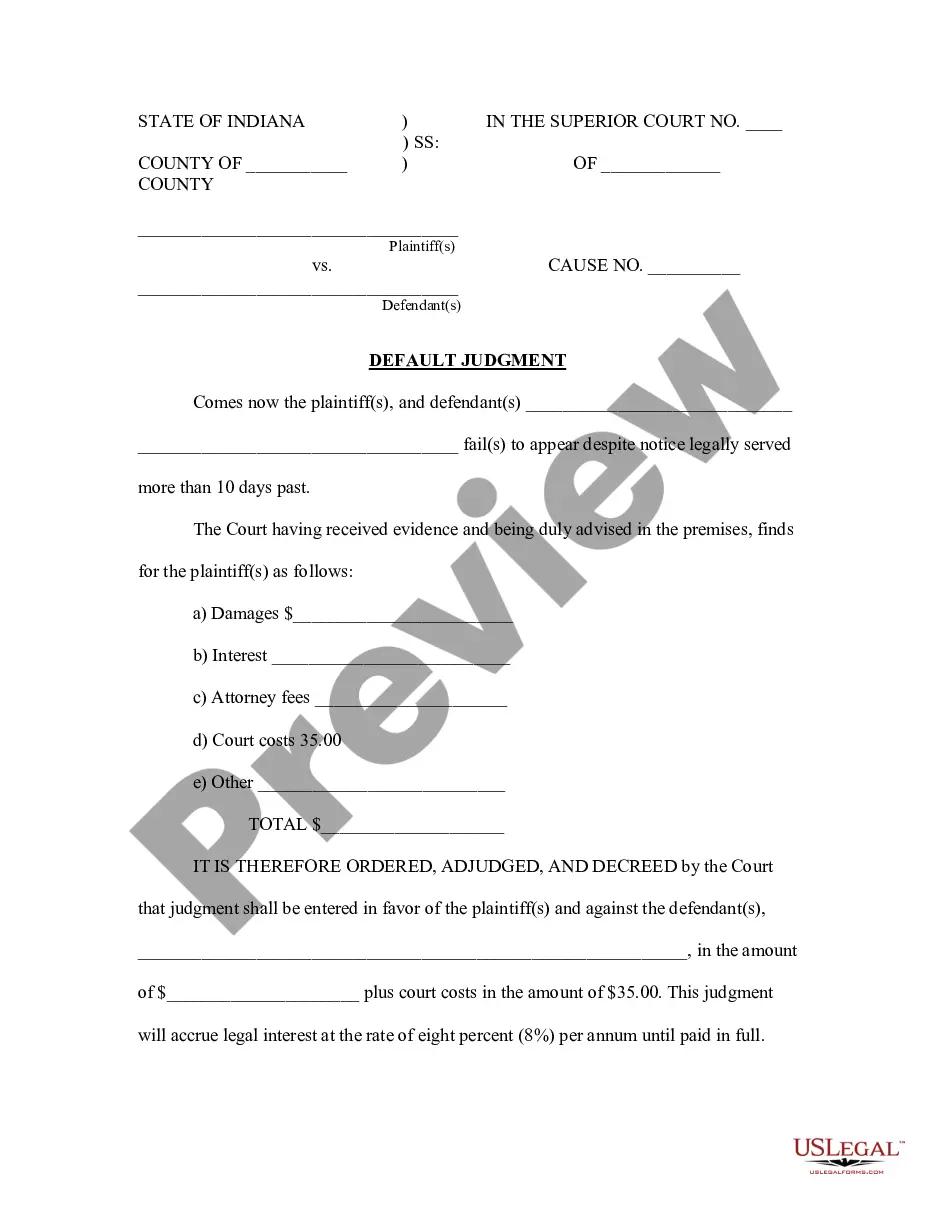
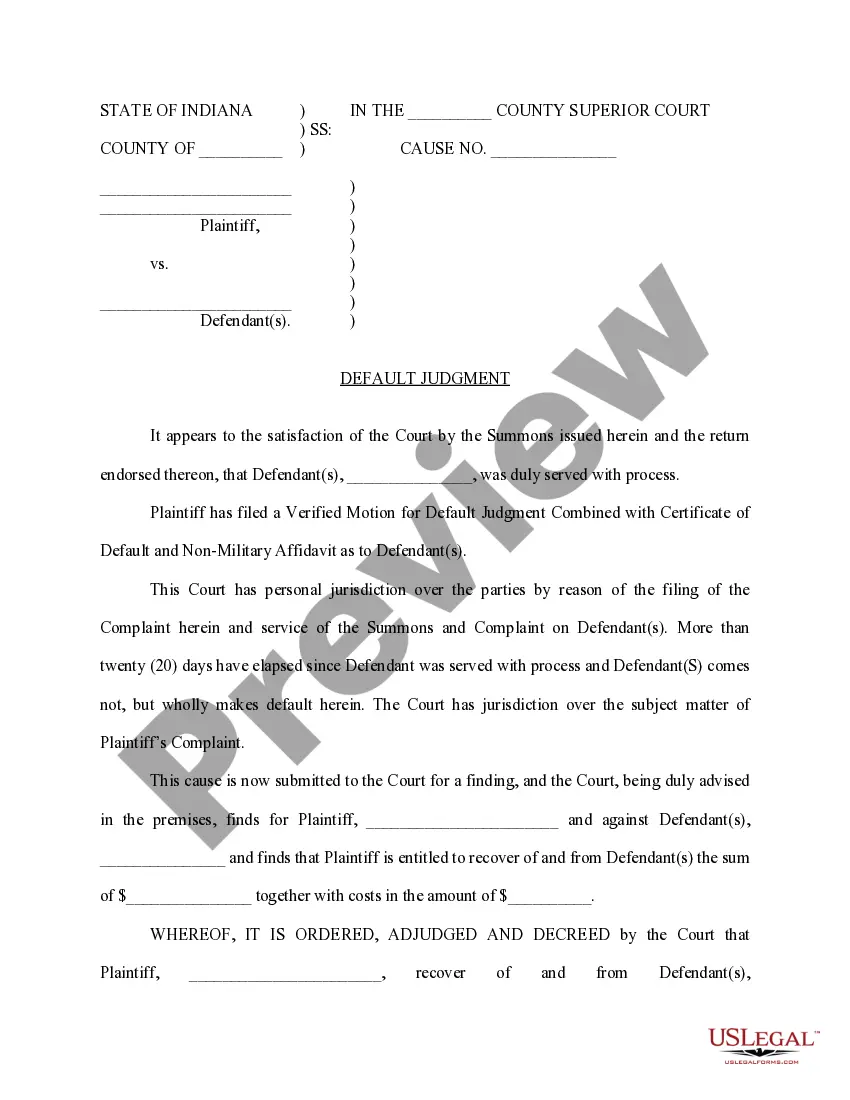
The Default Judgment form is a legal document used in Small Claims Court in the State of Indiana. This form is designed to declare a judgment in favor of the plaintiff when the defendant fails to respond to the court's notice within the specified time frame. It is essential for plaintiffs seeking a legally binding resolution when the defendant does not appear in court.
Main sections of this form
- Case details including cause number and parties involved.
- Sections for outlining damages, interest, attorney fees, and court costs.
- Judgment amount to be awarded to the plaintiff.
- Signature and date line for the judge's approval.
- Legal interest rate specified for accrued amounts.

Common use cases
This form should be used when a plaintiff has taken legal action against a defendant in Small Claims Court, but the defendant has failed to respond or appear in court after receiving legal notice. It is applicable when the plaintiff seeks a formal judgment to recover damages or costs without the defendant's participation.
Who can use this document
This form is intended for:
- Plaintiffs who have filed a claim in Small Claims Court in Indiana.
- Individuals or businesses seeking compensation due to a defendant's non-response.
- Those who want a legally binding judgment for cases where the defendant has not appeared or responded.
How to prepare this document
- Identify the parties involved in the case by entering the plaintiff's and defendant's names.
- Fill in the cause number assigned by the court.
- Document the damages being claimed, including interest and attorney fees.
- Sign and date the form for submission to the court.
- Ensure the completed form is submitted within the appropriate timeframe as per local court rules.
Is notarization required?
This form does not typically require notarization to be legally valid. However, some jurisdictions or document types may still require it. US Legal Forms provides secure online notarization powered by Notarize, available 24/7 for added convenience.
Get your form ready online
Our built-in tools help you complete, sign, share, and store your documents in one place.
Make edits, fill in missing information, and update formatting in US Legal Forms—just like you would in MS Word.
Download a copy, print it, send it by email, or mail it via USPS—whatever works best for your next step.
Sign and collect signatures with our SignNow integration. Send to multiple recipients, set reminders, and more. Go Premium to unlock E-Sign.
If this form requires notarization, complete it online through a secure video call—no need to meet a notary in person or wait for an appointment.
We protect your documents and personal data by following strict security and privacy standards.

Make edits, fill in missing information, and update formatting in US Legal Forms—just like you would in MS Word.

Download a copy, print it, send it by email, or mail it via USPS—whatever works best for your next step.

Sign and collect signatures with our SignNow integration. Send to multiple recipients, set reminders, and more. Go Premium to unlock E-Sign.

If this form requires notarization, complete it online through a secure video call—no need to meet a notary in person or wait for an appointment.

We protect your documents and personal data by following strict security and privacy standards.
Common mistakes
- Failing to provide complete party information.
- Incorrectly calculating damages or costs.
- Not signing or dating the form before submission.
- Submitting the form past the deadline for filing a judgment.
Why use this form online
- Easy access to a customizable legal template created by licensed attorneys.
- Eliminates the need for in-person consultations, saving time and effort.
- Allows for quick edits, ensuring accuracy and compliance with legal standards.
Looking for another form?

Form popularity
FAQ
A default judgment in Indiana occurs when a defendant fails to respond to a complaint filed in court. This means the court has made a decision in favor of the plaintiff without hearing from the defendant. The consequences of an Indiana Default Judgment can be significant, including financial penalties or garnishment of wages. It’s essential to respond to any legal complaints promptly to avoid such judgments.
Setting aside a default judgment in Indiana requires meeting specific criteria. Generally, the defendant must demonstrate a valid reason for missing the initial court date, such as not receiving proper notice. Additionally, they need to prove a meritorious defense against the claim. If you face challenges with a default judgment, consider seeking support through US Legal Forms to navigate the necessary filings and procedures.
Collecting on a judgment in Indiana involves several steps. First, you can use garnishment, which allows you to seize wages or bank accounts. Alternatively, you might seek to place a lien on the debtor's property. Utilizing the US Legal Forms platform can simplify this process by providing templates and forms tailored for Indiana Default Judgment enforcement.
A default judgment occurs when the defendant in a legal case fails to respond to a court summons or does not appear in court. If this occurs, a court may rule in favor of the plaintiff by default.
A very important fact you should keep in mind is that California courts do impose a timeline for seeking entry of a default judgment. Specifically, a request for entry of default must be filed within 10 days following a defendant's failure to timely file and serve a responsive pleading.
First, you can ask the court to set aside the default judgment and give you an opportunity to contest it. Next, you can settle the debt with the debt buyer for an amount less than what the default judgment is for. And finally you can eliminate the default judgment completely by filing for bankruptcy.
After you notify the defendant of the judgment, you can begin to enforce the judgment. Your judgment might be for money, repossession, eviction, foreclosure, or any number of things. In any case, your rights at this point would be the same as if you had gone to trial and won.
The danger of allowing a default judgment against you is once this occurs the debt buyer can garnish your wages and your bank accounts.If you don't submit a written answer to the lawsuit the court can enter a default judgment giving the debt buyer everything they are asking for.
Default judgments happen when you don't respond to a lawsuit often from a debt collector and a judge resolves the case without hearing your side. In effect, you're found guilty because you never entered a defense. Default judgments are sometimes called automatic judgments because of how fast they can happen.
Generally, if a defendant fails to respond to a complaint you can get a default judgment after 45 days. However, the court system is very slow these days and it can take several months to get the court to issue the default judgment.