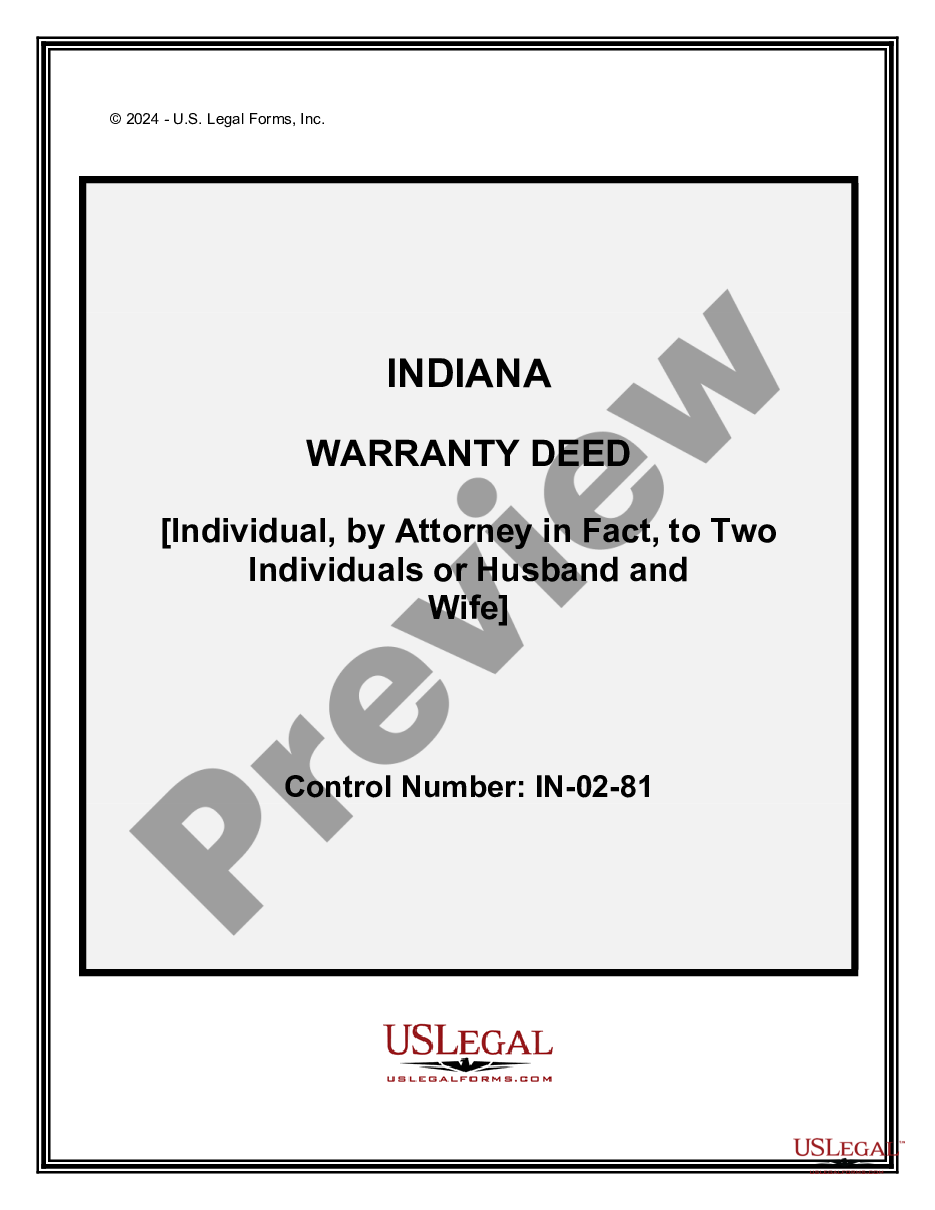
Indiana Warranty Deed - Individual Grantor, acting through an attorney-in-fact to Husband and Wife or Two Individuals as Grantees.
Overview of this form
The Warranty Deed for Individual Grantor, acting through an attorney-in-fact, allows an individual to transfer property ownership to a husband and wife or two individuals. This legal document ensures that the grantor provides a warranty of title, meaning they guarantee they own the property and can legally transfer it. Unlike other deeds, this form specifically accommodates transactions involving an attorney-in-fact and two grantees, making it ideal for couples or joint purchasers.
Key components of this form
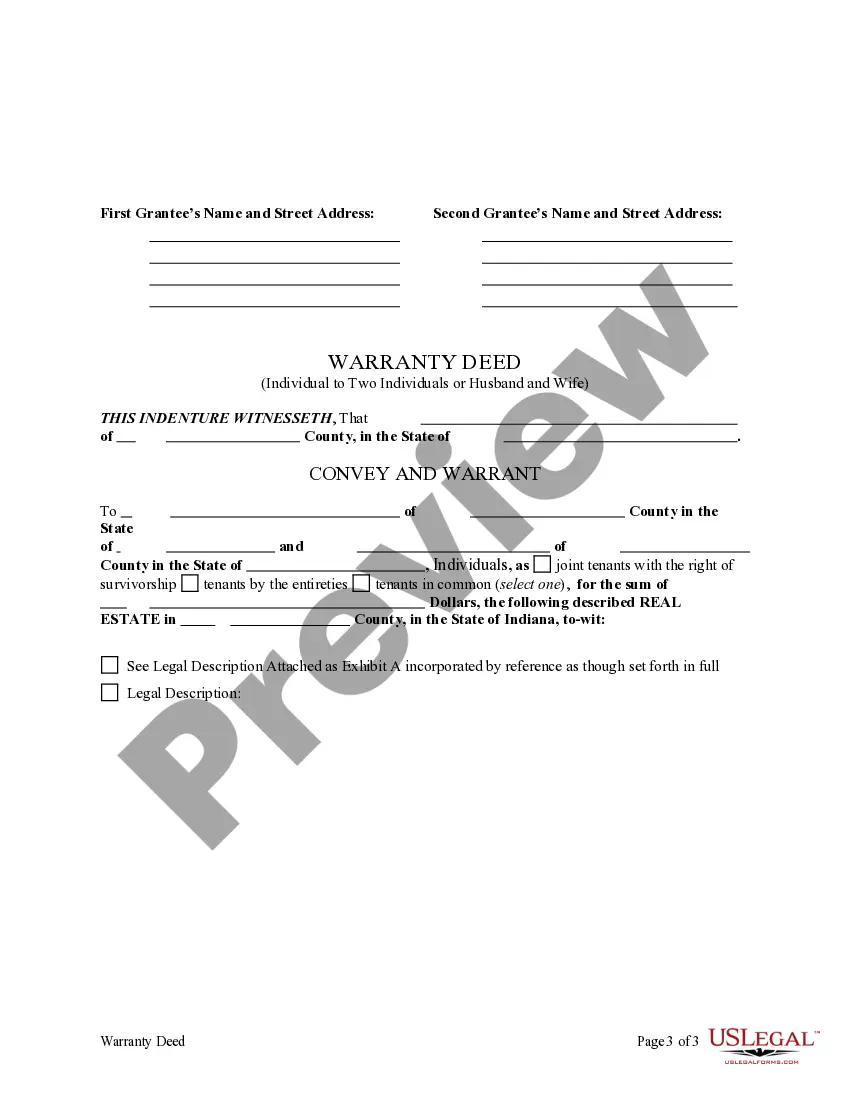
- Identification of the grantor, including the individual acting through an attorney-in-fact.
- Details of the grantees, which can include two individuals or a husband and wife.
- Legal description of the property being conveyed.
- Warranty clause affirming the grantor's ownership and legal right to transfer the property.
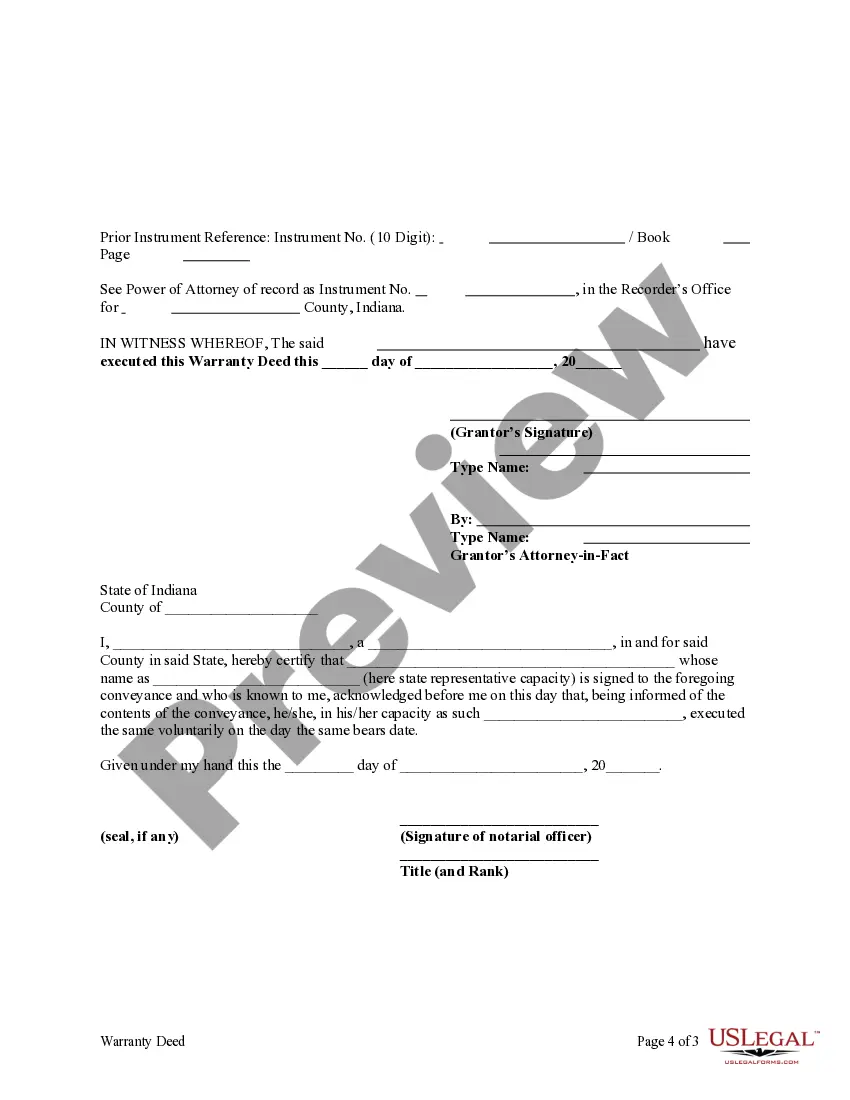
- Recordation information related to the power of attorney.


When this form is needed
This Warranty Deed should be used when an individual grants property ownership to two people, particularly when one party cannot be present to sign due to the use of an attorney-in-fact. Common scenarios include property gifts among family members or when purchasing property jointly while one party handles the transaction through a legal representative.
Who can use this document
- Individuals wishing to transfer real estate to another couple or two individuals.
- Those who are granting property through an attorney-in-fact.
- People who require a legally binding document that guarantees property rights.
- Homeowners looking to formalize joint ownership of their property.
Completing this form step by step
- Identify the parties involved, including the grantor and grantees.
- Provide the legal description of the property to be transferred.
- Ensure the grantor's authority by documenting the power of attorney's details.
- Include required warranties and covenants regarding the property's title.
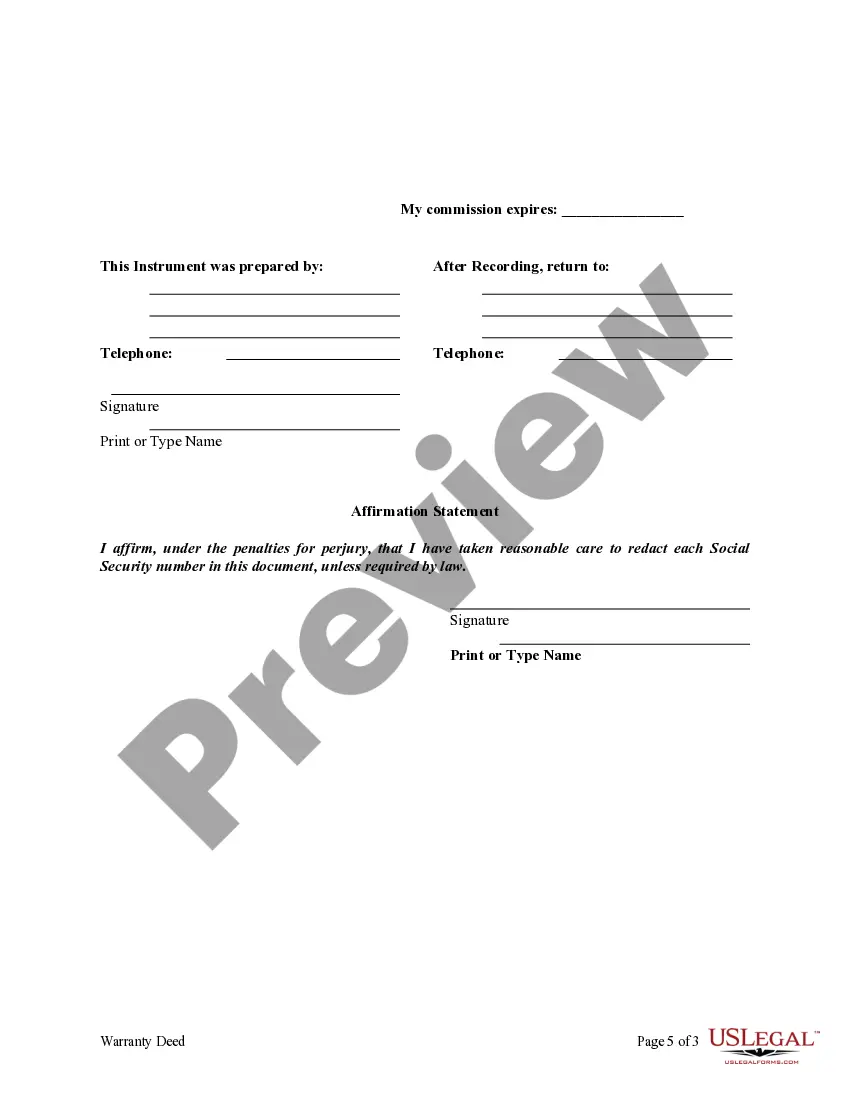
- Collect signatures from the grantor and the attorney-in-fact where needed.
Does this document require notarization?
This form needs to be notarized to ensure legal validity. US Legal Forms provides secure online notarization powered by Notarize, allowing you to complete the process through a verified video call, available anytime.
Get your form ready online
Our built-in tools help you complete, sign, share, and store your documents in one place.
Make edits, fill in missing information, and update formatting in US Legal Forms—just like you would in MS Word.
Download a copy, print it, send it by email, or mail it via USPS—whatever works best for your next step.
Sign and collect signatures with our SignNow integration. Send to multiple recipients, set reminders, and more. Go Premium to unlock E-Sign.
If this form requires notarization, complete it online through a secure video call—no need to meet a notary in person or wait for an appointment.
We protect your documents and personal data by following strict security and privacy standards.

Make edits, fill in missing information, and update formatting in US Legal Forms—just like you would in MS Word.

Download a copy, print it, send it by email, or mail it via USPS—whatever works best for your next step.

Sign and collect signatures with our SignNow integration. Send to multiple recipients, set reminders, and more. Go Premium to unlock E-Sign.

If this form requires notarization, complete it online through a secure video call—no need to meet a notary in person or wait for an appointment.

We protect your documents and personal data by following strict security and privacy standards.
Avoid these common issues
- Failing to properly document the power of attorney or not recording it.
- Omitting the legal description of the property.
- Not including all required signatures, especially from the attorney-in-fact.
- Leaving out the warranty language, which is critical to the deed's validity.
Advantages of online completion
- Convenient access to legal forms that can be downloaded anytime.
- Edit and customize the form to fit your specific needs quickly.
- Reliability of forms drafted by licensed attorneys, ensuring legal compliance.
- Clear instructions on completing the forms to navigate the legal process easily.
Summary of main points
- This Warranty Deed is crucial for formalizing property transfer when a Grantor cannot act themselves.
- Due diligence is required to ensure all components and signatures are accurately completed.
- Utilizing online resources simplifies the process and guarantees legal form integrity.
Looking for another form?
Form popularity
FAQ
An attorney can sign in their own name if either:the power of attorney is governed by the law of a jurisdiction which has a statutory provision allowing the attorney to sign in their own name (currently NSW, NT (unless a contrary intention appears in the power of attorney), Qld, Tas, Vic and WA).
The Supreme Court has ruled that sale transactions carried through general power of attorney will have no legal sanctity. "A transfer of immovable property by way of sale can only be by a deed of conveyance (sale deed).
A power of attorney enables an agent (also called the attorney-in-fact) to conduct transactions on another person's behalf.If so, a spouse, relative or friend with POA can sign a deed or other real estate documents.
There are circumstances in which individuals will be executing a deed not in connection with their own affairs but in some official capacity, which entitles them to act on behalf of someone else.
Sign your name below the principal's name. Simply add the word by in front of your name to indicate you're signing as POA on the principal's behalf. A power of attorney isn't the only document you should have in your estate plan. Consider writing a will to allocate your possessions to loved ones.
Grantor's signature: The grantor must sign the deed for it to be valid. Usually, if more than one person owns a property, all the owners must sign. In some states a husband or wife who own property by themselves may have to have the spouse also sign the deed even though the spouse does not have title to the property.
The Grantee in a Quitclaim Deed is the person who is being given interest in a property from the Grantor. It is possible for someone to be both a Grantor and a Grantee in a Quitclaim Deed.Most real estate deeds are notarized by attorneys.
An agent cannot:Make decisions on behalf of the principal after their death.However, unless the principal named a co-agent or alternate agent in the same POA document or is still competent to appoint someone else to act on their behalf, an agent cannot choose who takes over their duties.