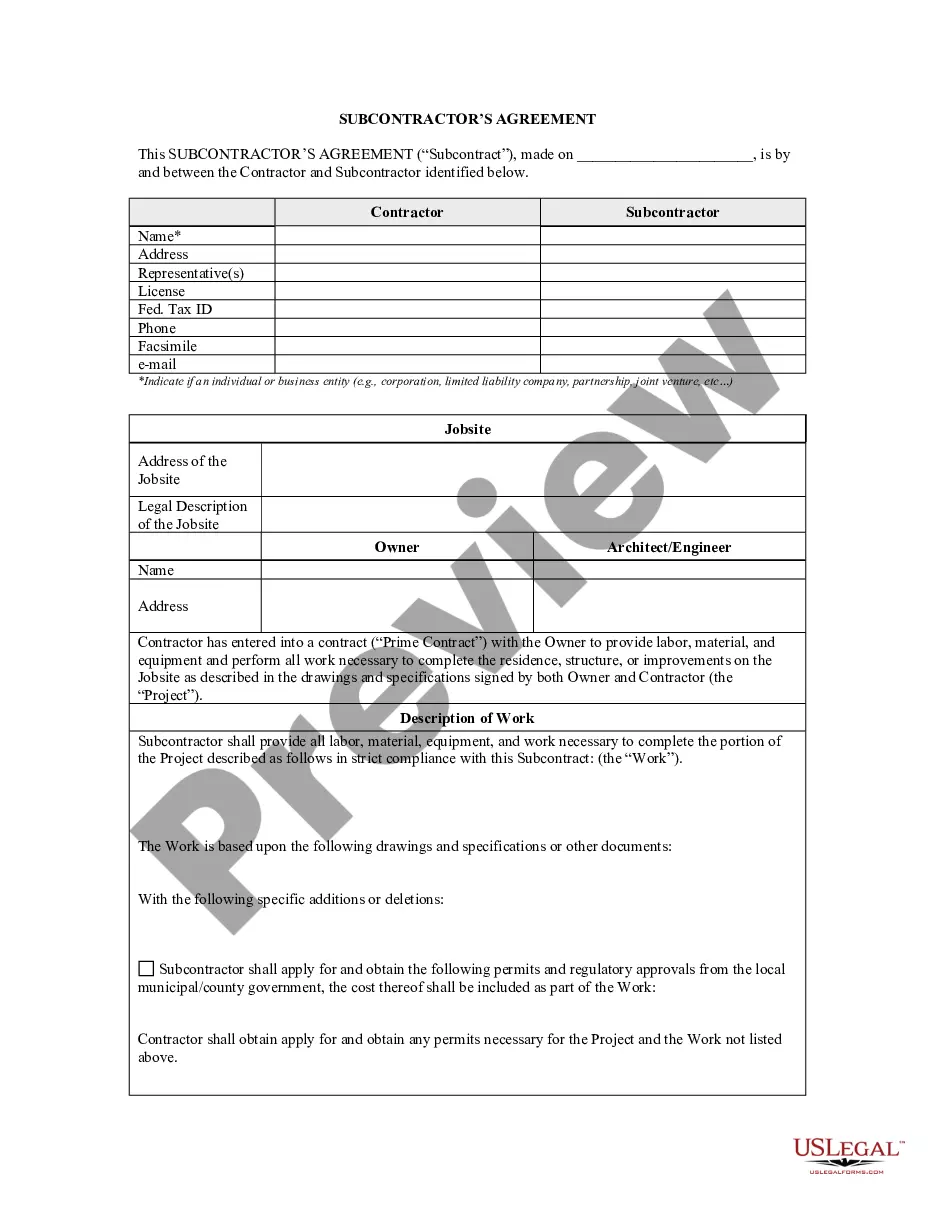
Washington Framing Contractor Package
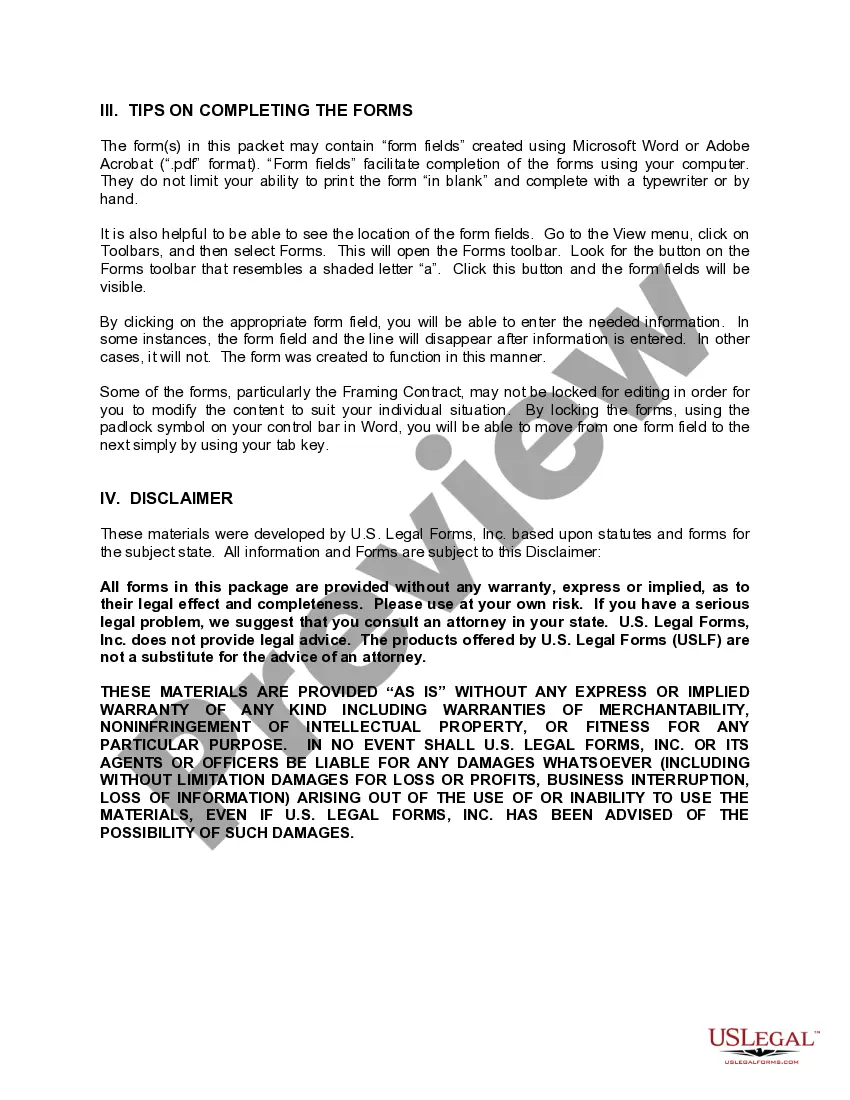
Understanding this form package
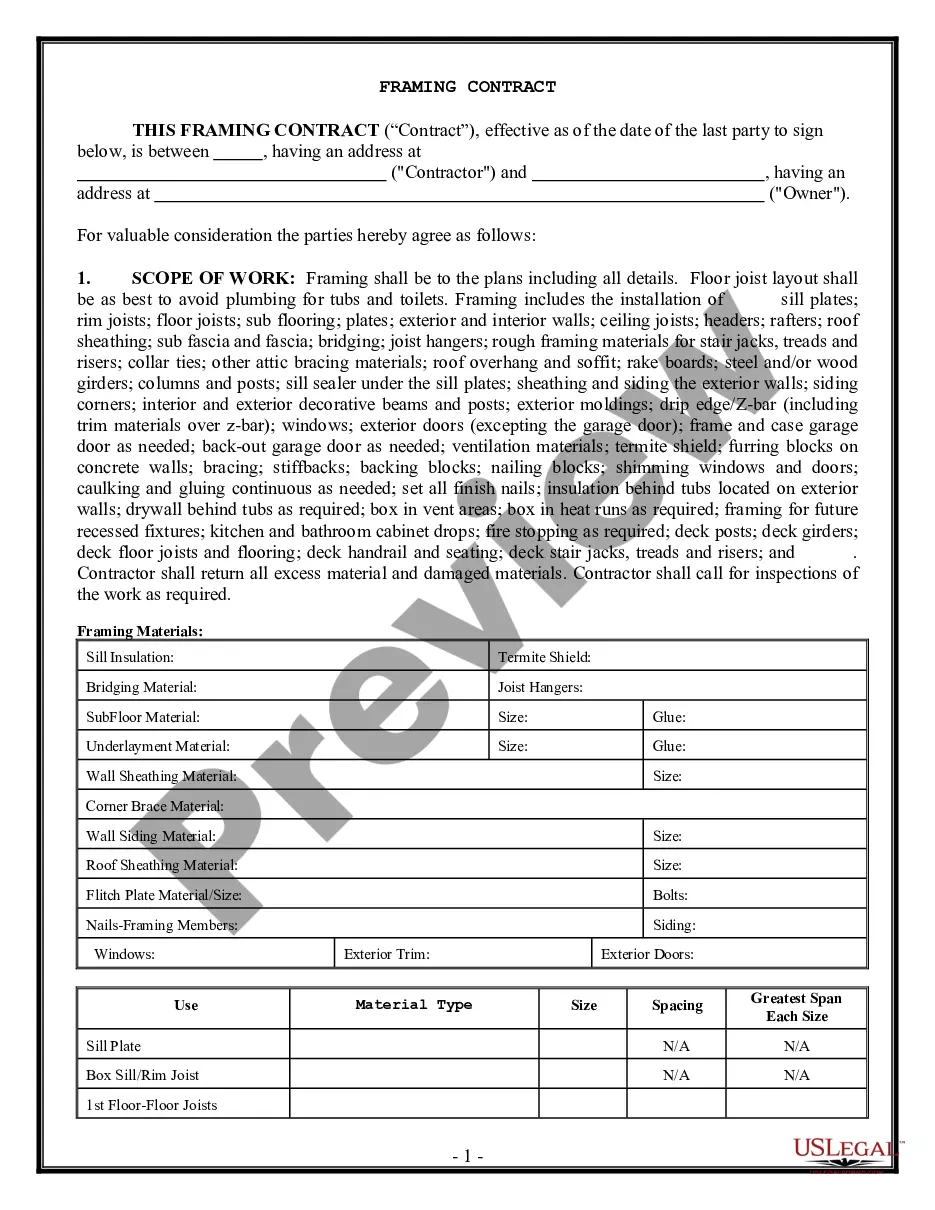
The Washington Framing Contractor Package provides essential legal documents specifically designed for framing contractors, owners, and subcontractors. Unlike other general construction packages, this one focuses on the unique needs and legalities associated with framing work, ensuring compliance with Washington state law. It includes a detailed framing contract alongside other critical forms necessary to protect your legal rights and manage project-related issues effectively.
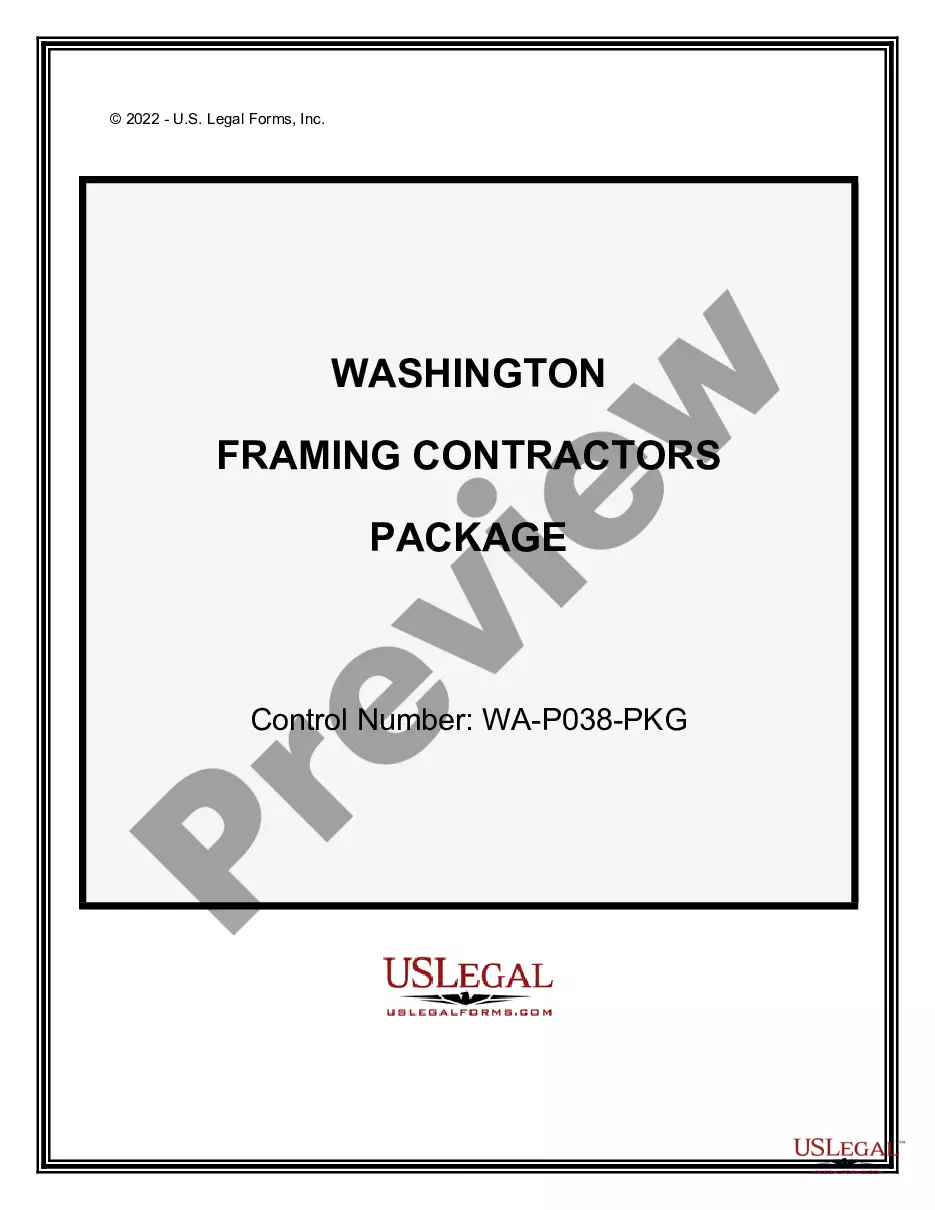
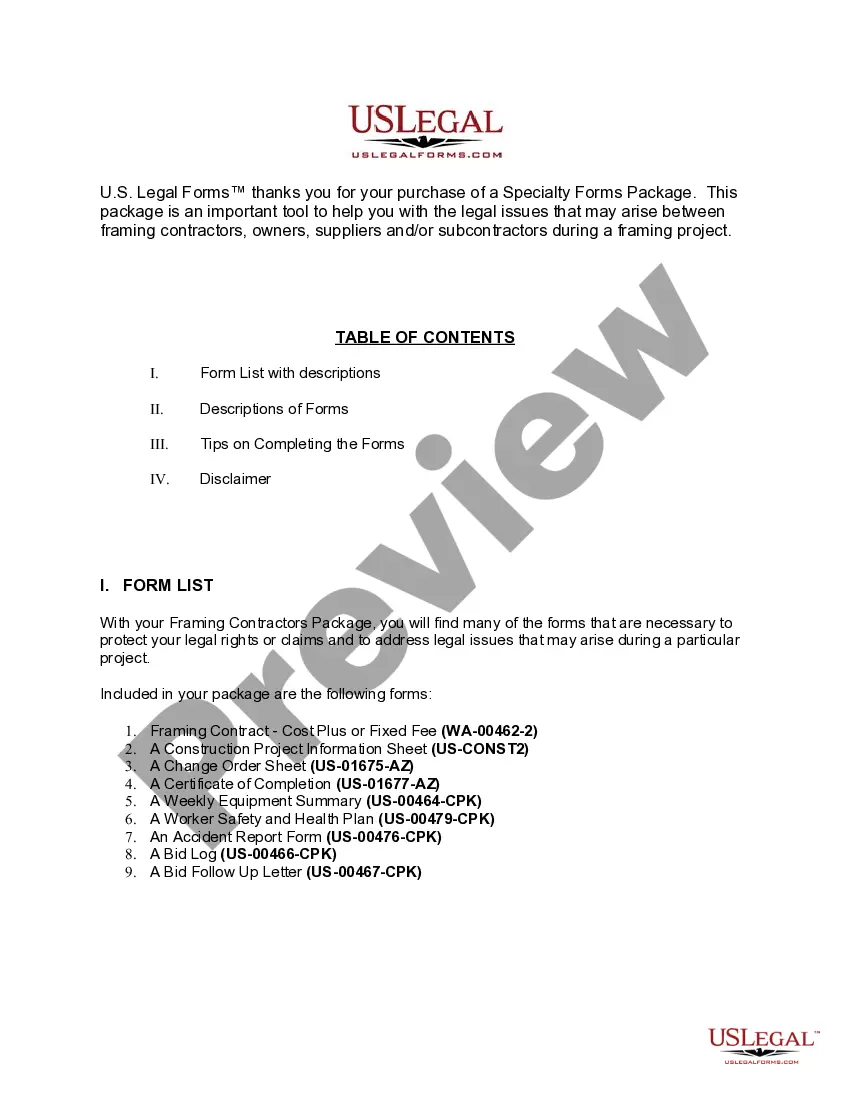
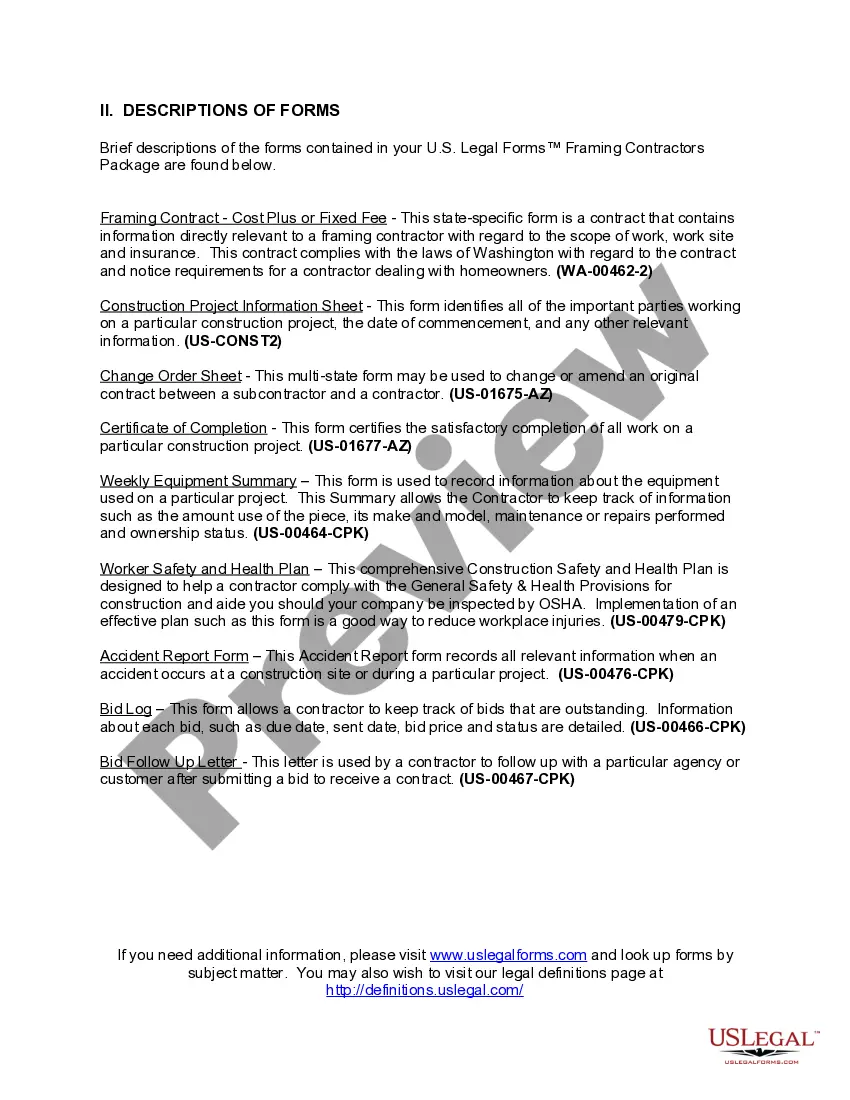
Forms included in this package
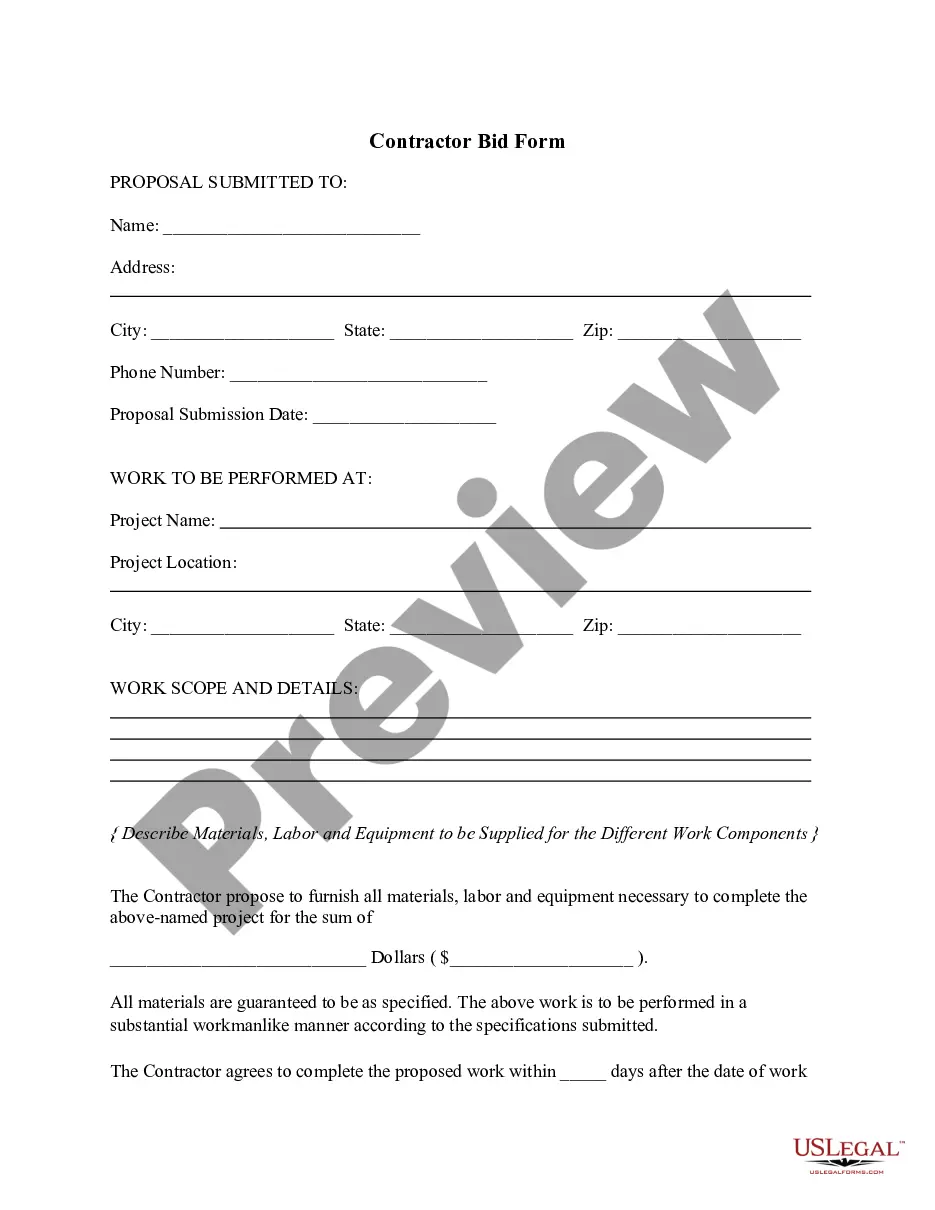
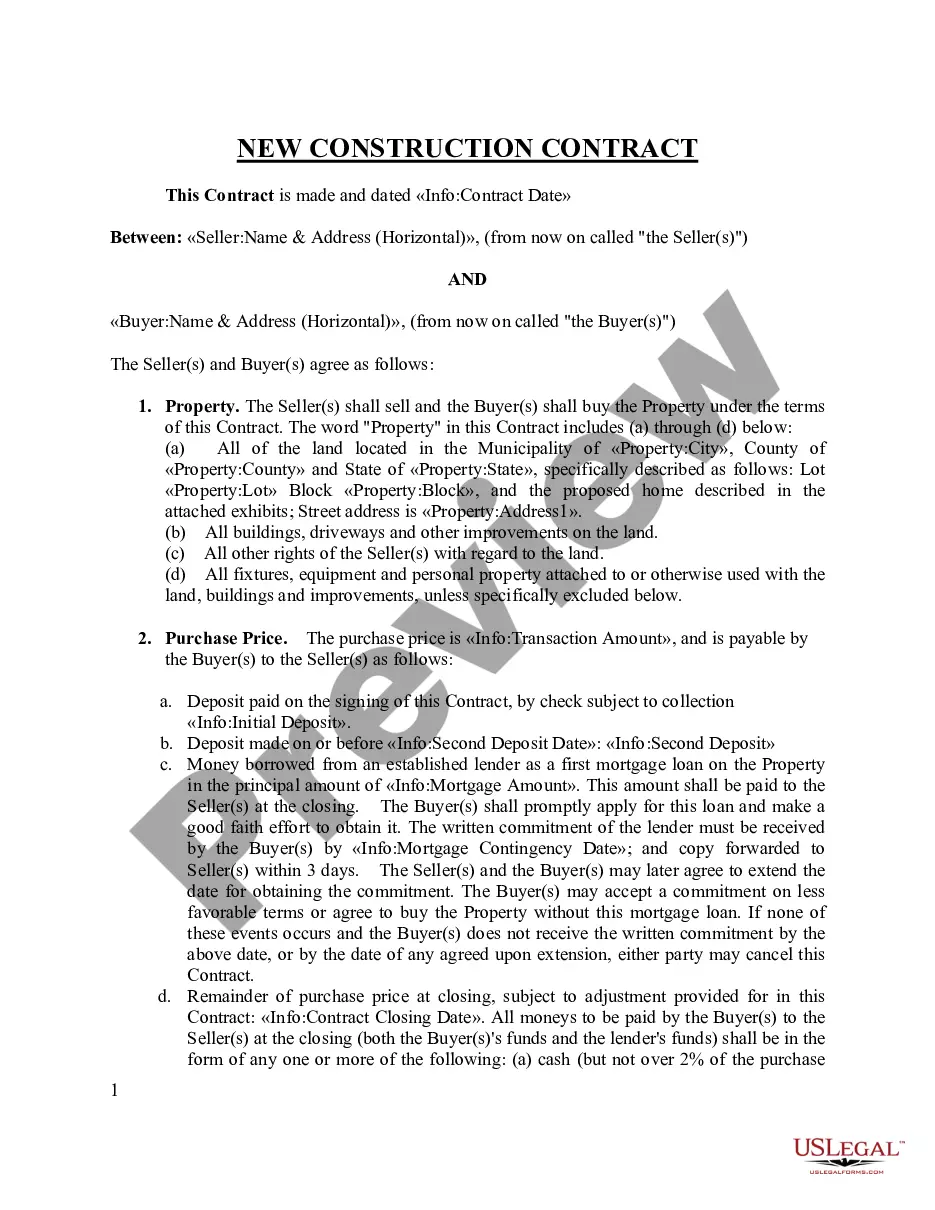
- Framing Contract for Contractor
- Contractor's Weekly Equipment Summary
- Contractor's Bid Log
- Contractor's Bid Follow Up Letter
- Construction Accident Report
- Construction Safety and Health Plan
- Change Order for Construction or Repairs by Contractor
- Certification of Completion by Contractor
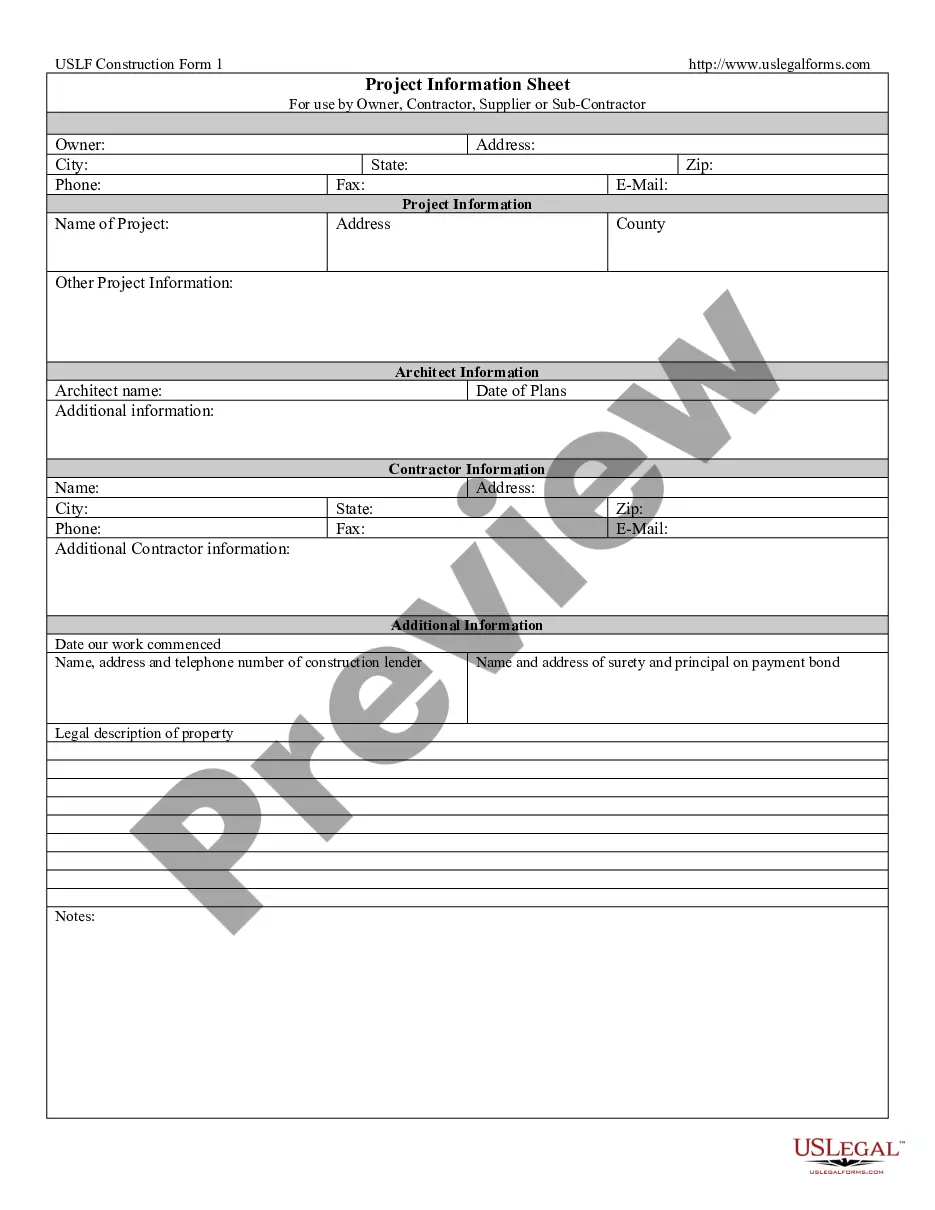
- Construction Project Information Sheet
Common use cases
This package is particularly useful in various scenarios, including:
- When entering into a contract for framing work with clients.
- To document important project details, including changes to contracts.
- When tracking equipment use throughout a construction project.
- To ensure compliance with safety regulations and health plans.
- After completing work, to certify the project's conclusion and manage any final documentation.
Who can use this document
- Framing contractors operating in Washington.
- Owners hiring framing contractors for specific projects.
- Framing subcontractors working under a primary contractor.
- Construction project managers overseeing framing operations.
Steps to complete these forms
- Review the included forms to understand their purposes.
- Identify all parties involved in the framing project.
- Enter relevant project details, including timelines and costs.
- Complete safety and health plans as required by law.
- Sign and date the necessary forms to execute agreements.
- Keep copies of all completed forms for your records.
Notarization details for included forms
Notarization is not commonly needed for forms in this package. However, if your state’s laws require it, our notarization service, powered by Notarize, allows you to finalize documents online 24/7 without in-person visits.
Get your form ready online
Our built-in tools help you complete, sign, share, and store your documents in one place.
Make edits, fill in missing information, and update formatting in US Legal Forms—just like you would in MS Word.
Download a copy, print it, send it by email, or mail it via USPS—whatever works best for your next step.
Sign and collect signatures with our SignNow integration. Send to multiple recipients, set reminders, and more. Go Premium to unlock E-Sign.
If this form requires notarization, complete it online through a secure video call—no need to meet a notary in person or wait for an appointment.
We protect your documents and personal data by following strict security and privacy standards.

Make edits, fill in missing information, and update formatting in US Legal Forms—just like you would in MS Word.

Download a copy, print it, send it by email, or mail it via USPS—whatever works best for your next step.

Sign and collect signatures with our SignNow integration. Send to multiple recipients, set reminders, and more. Go Premium to unlock E-Sign.

If this form requires notarization, complete it online through a secure video call—no need to meet a notary in person or wait for an appointment.

We protect your documents and personal data by following strict security and privacy standards.
Avoid these common issues
- Failing to complete all relevant fields in the forms.
- Neglecting to keep copies of signed contracts and documentation.
- Ignoring local safety regulations when filling out health plans.
- Using outdated forms that do not comply with current state laws.
Benefits of completing this package online
- Convenience of accessing and downloading forms anytime, anywhere.
- Editability of documents allows for customization to fit specific project needs.
- Reliable forms drafted by licensed attorneys, ensuring legal compliance.
- Time-saving features such as pre-structured fields for ease of completion.
Legal use & context
- The framed contract and accompanying documents provide the legal foundation for your engagement with clients and subcontractors.
- While these documents are designed to be enforceable, proper completion is crucial for legal validity.
- Consultation with a legal professional is recommended if you have specific questions about enforceability or compliance.
Summary of main points
- The Washington Framing Contractor Package is tailored for legal compliance in construction projects.
- It includes critical documentation for effective project management and safety.
- Users should carefully complete and retain copies of all forms for legal protection.
Looking for another form?
Form popularity
FAQ
Multiply the total wall length (in feet) by 0.75 (for 16-inch on-center stud spacing). Add three studs for each 90-degree corner. Add four studs for each 45-degree corner. Add two studs for each wall intersection (where another wall abuts the wall you are estimating).
In building construction a framer is a carpenter who assembles the major structural elements of a wood-framed building called the framing. Framers build walls out of studs, sills, and headers; build floors from joists and beams; and frame roofs using ridge poles and rafters.
It consists of fitting together pieces of materials, such as wood, brick, concrete, and steel. Wood is the material most often used to frame houses. Rough framing is used for new home construction, as well as for building room additions.
Framers tend to make between $12 to $30 per hour with and average hourly rate of $20.
Rough carpenters frame and roof a house.Finish carpenters do millwork to build out the ceilings, moldings, and trim of a house interior, as well as level the flooring and ensure the integrity of interior structures such as doors, window frames, and staircases.
Framers in the United States make an average salary of $33,075 per year or $15.9 per hour. In terms of salary range, an entry level framer salary is roughly $24,000 a year, while the top 10% makes $44,000. If you like following the crowd, construction and retail companies tend to attract the most workers in this field.
Framing Carpenters construct or repair the framework of commercial, residential, and industrial buildings. They determine the dimensions of the framework to be constructed, measure, and cut the required building materials accordingly, and assemble the materials to form the framework. Try Betterteam for FREE.
Framing carpenters cut, shape, and install building materials to build frames for buildings and structures. Framing carpenters repair existing structures and flooring. Framing carpenters sometimes perform finishing construction work, such as hanging drywall and paneling over completed framework.
This can include framing houses, creating frames for concrete, residential remodeling, and more.Whereas carpentry is focused on building homes and structures with wood, woodworking is focused on building specific wood pieces such as tables, cabinets, etc.