Ohio Notice of Default in Payment of Rent as Warning Prior to Demand to Pay or Terminate for Residential Property
Overview of this form
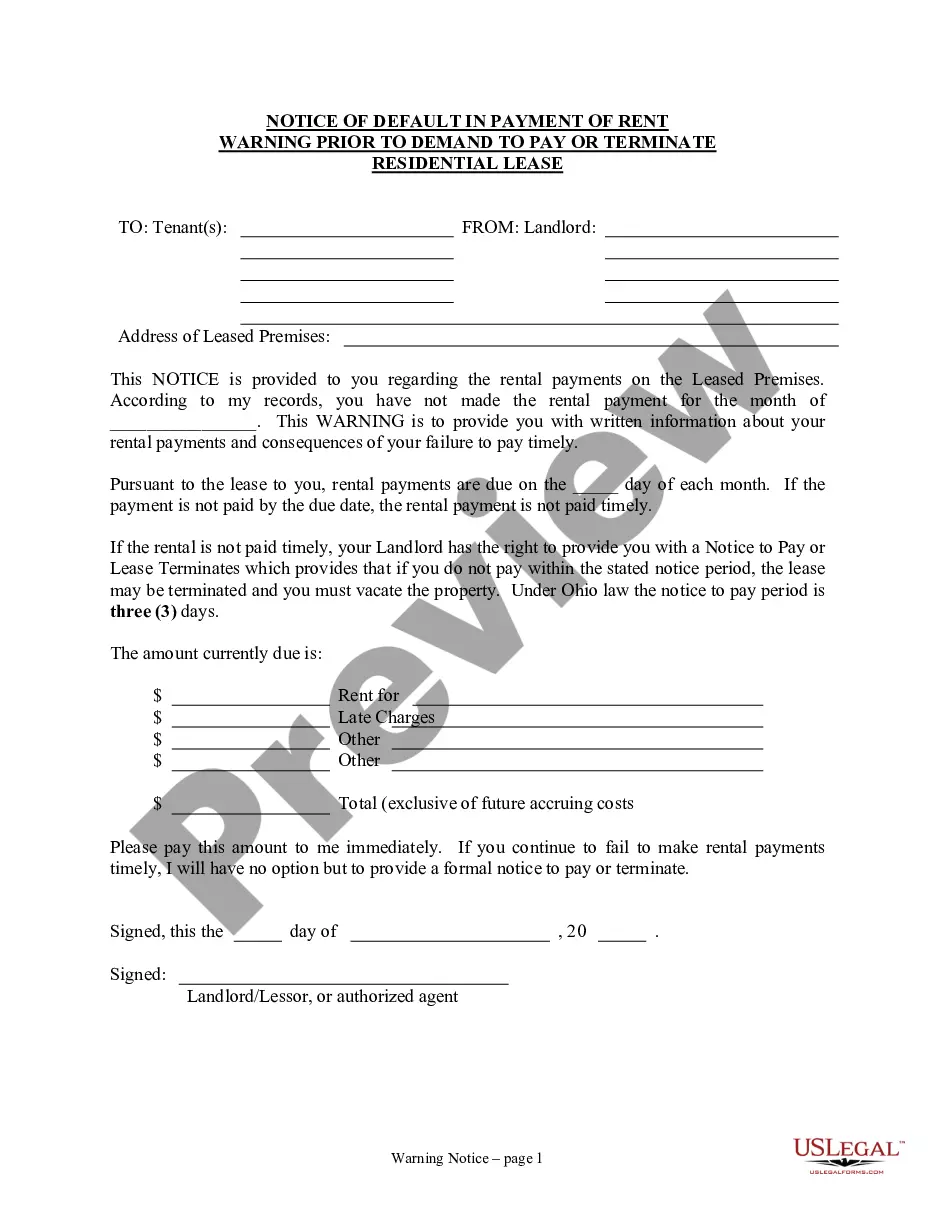
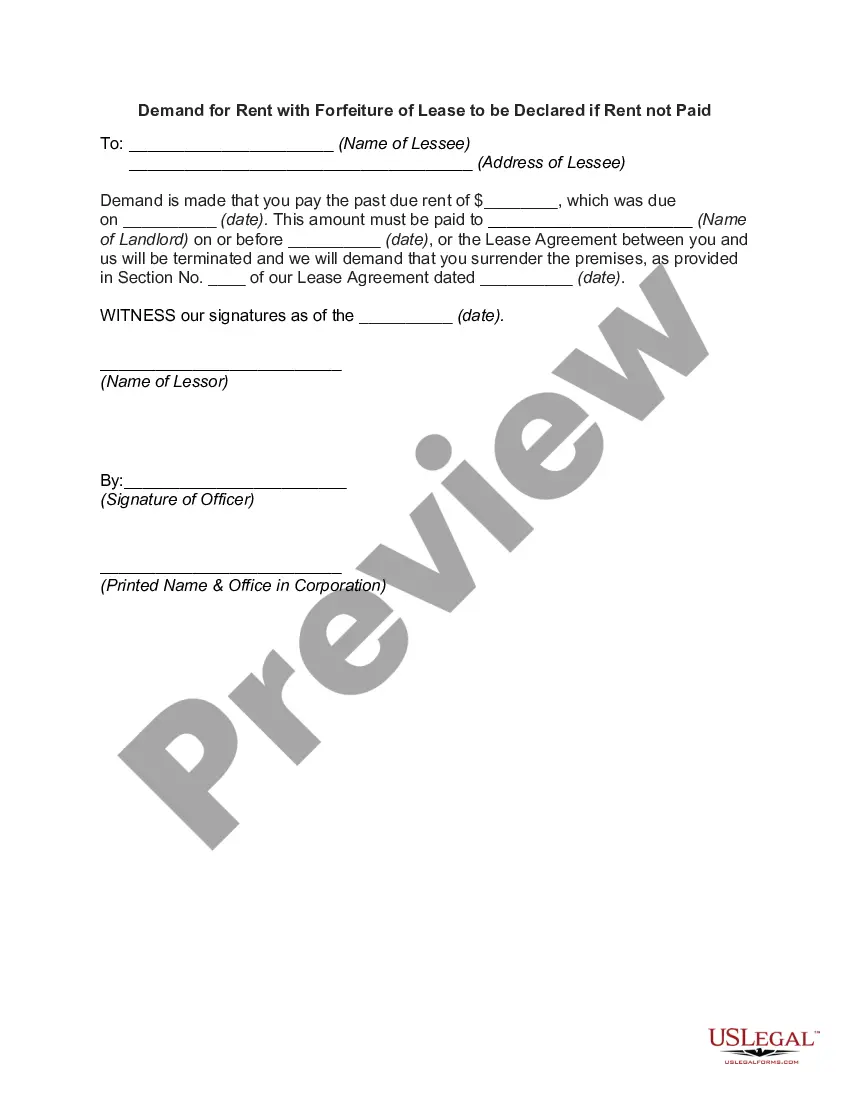
The Notice of Default in Payment of Rent as Warning Prior to Demand to Pay or Terminate for Residential Property is a legal notice used by landlords to inform tenants about missed rent payments. This form serves as an initial warning before a more formal notice to pay or vacate is issued. It specifies rental due dates, the unpaid amount, and the consequences of late payment, helping to establish clear communication and ensure compliance with rental agreements.
What’s included in this form
- The tenant's name and address.
- The date the notice is issued.
- The specific month for which rent is unpaid.
- Details on rental terms, including due dates and late payment consequences.
- The total amount due, including any late charges.
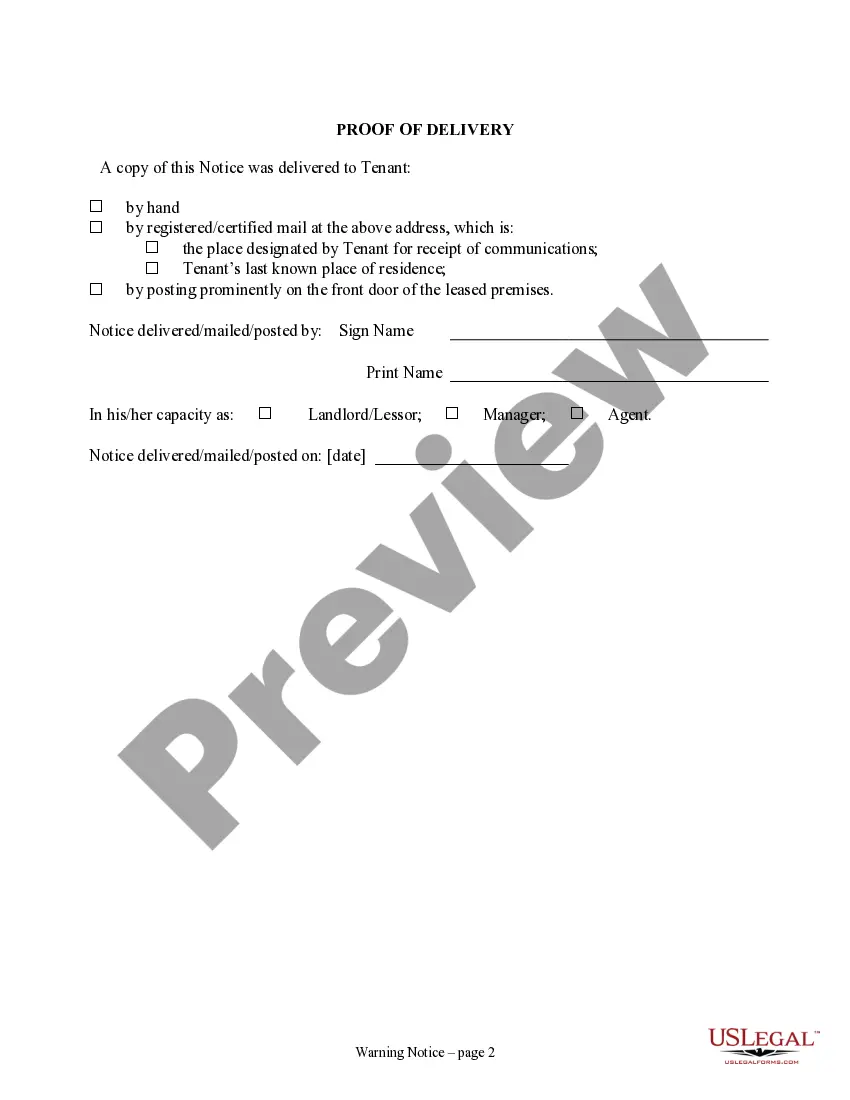
- Landlord's signature and delivery confirmation.



When to use this form
Intended users of this form
- Residential landlords managing rental properties.
- Property managers acting on behalf of landlords.
- Tenants needing to understand their rights concerning late payment notices.
Instructions for completing this form
- Insert the tenant's full name and their address on the notice.
- Write the date the notice is being issued.
- Specify the month for which the rent has not been paid.
- Clearly state the total amount due, including any late fees.
- Sign the notice as the landlord or authorized agent.
- Choose the method of delivery and complete the proof of delivery section.
Does this document require notarization?
This form does not typically require notarization to be legally valid. However, some jurisdictions or document types may still require it. US Legal Forms provides secure online notarization powered by Notarize, available 24/7 for added convenience.
Get your form ready online
Our built-in tools help you complete, sign, share, and store your documents in one place.
Make edits, fill in missing information, and update formatting in US Legal Forms—just like you would in MS Word.
Download a copy, print it, send it by email, or mail it via USPS—whatever works best for your next step.
Sign and collect signatures with our SignNow integration. Send to multiple recipients, set reminders, and more. Go Premium to unlock E-Sign.
If this form requires notarization, complete it online through a secure video call—no need to meet a notary in person or wait for an appointment.
We protect your documents and personal data by following strict security and privacy standards.

Make edits, fill in missing information, and update formatting in US Legal Forms—just like you would in MS Word.

Download a copy, print it, send it by email, or mail it via USPS—whatever works best for your next step.

Sign and collect signatures with our SignNow integration. Send to multiple recipients, set reminders, and more. Go Premium to unlock E-Sign.

If this form requires notarization, complete it online through a secure video call—no need to meet a notary in person or wait for an appointment.

We protect your documents and personal data by following strict security and privacy standards.
Typical mistakes to avoid
- Not including the exact amount due, including late charges.
- Failing to provide the correct address for the tenant.
- Not signing the notice, which can render it invalid.
- Overlooking the required delivery methods, which may affect notice compliance.
Advantages of online completion
- Convenient access to legally sound forms from licensed attorneys.
- Ability to edit and customize the form to fit specific circumstances.
- Downloadable format for easy sharing and record-keeping.
- Ensured compliance with the latest state laws and regulations.
Key takeaways
- The notice serves as a preliminary warning to tenants about overdue rent.
- Proper completion of the form is essential for legal validity and enforceability.
- This form helps landlords document communication before pursuing further legal action.
Looking for another form?




Form popularity
FAQ
The typical Ohio eviction process takes about five weeks. The eviction process starts with the posting of a three day notice. In certain cases, a longer notice is necessary but generally a three day notice covers most of the eviction issues that a landlord can encounter.
Notice Requirements for Ohio Landlords A landlord can simply give you a written notice to move, allowing you 30 days as required by Ohio law and specifying the date on which your tenancy will end.
The notice must inform the tenant that the tenant has three days to move out of the rental unit or an eviction action will be brought against the tenant. If the tenant does not move out by the end of three days, then the landlord can go to court and file an eviction lawsuit (see Ohio Rev. Code Ann.
The Ohio Three (3) Day Notice to Quit (Non-Payment of Rent) is used when a party, typically a landlord or owner, notifies the opposite party, the tenant, to leave the premises due to their failure to pay rent on the due date.
Ohio's Three-Day Notice After a tenant fails to pay rent, the first step in the Ohio eviction process is for a landlord to give the tenant a three-day notice, informing the tenant that he or she has three days to move out of the rental unit.
The law in Ohio forbids a landlord from evicting a tenant in any way except through the court system. The landlord must successfully win an eviction lawsuit before a tenant can be evicted.
Without a written lease, the landlord or the tenant may end a week-to-week tenancy by giving the other party at least seven days' notice before the termination date.Ohio law prohibits a landlord from shifting certain responsibilities or liabilities to a tenant.
The typical Ohio eviction process takes about five weeks. The eviction process starts with the posting of a three day notice. In certain cases, a longer notice is necessary but generally a three day notice covers most of the eviction issues that a landlord can encounter.