Alaska Release of Promissory Note
What this document covers
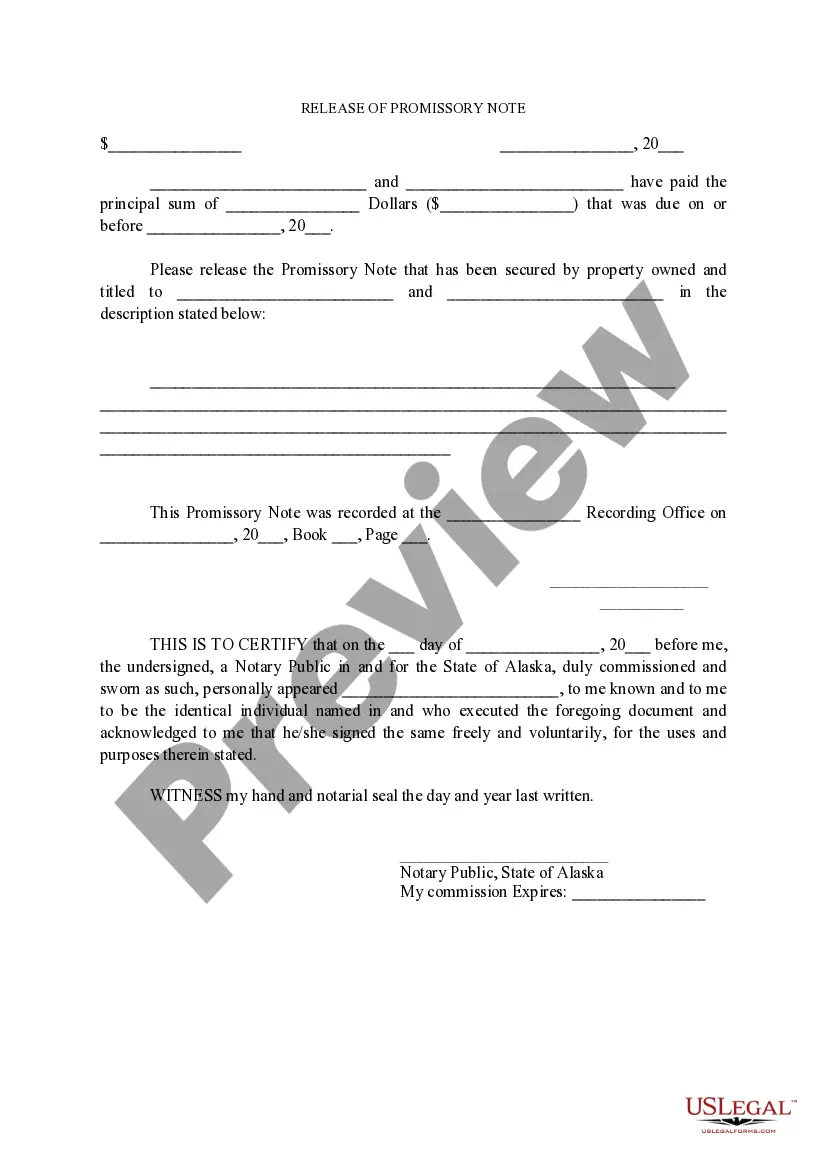
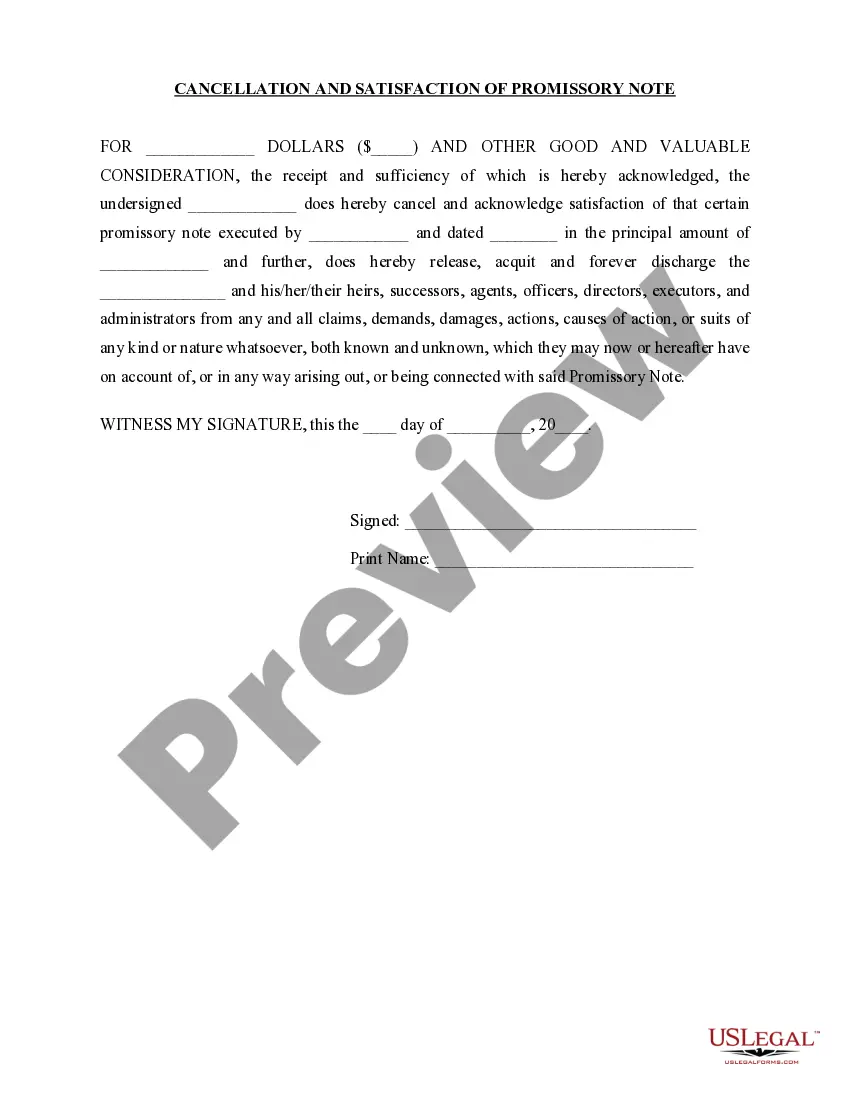
The Release of Promissory Note is a legal document that confirms the repayment of a debt secured by a promissory note. Once the borrower has paid the full amount due, the holder of the note executes this form to release the borrower's obligation. This document serves as proof of payment and distinguishes itself from similar forms by specifically addressing the release of liability regarding the promissory note in question.
Main sections of this form
- Principal sum being released
- Date by which the debt was satisfied
- Identification of the property secured by the note
- Recording details of the original promissory note
- Notary acknowledgment confirming authenticity
Situations where this form applies
This form should be used once the borrower has fulfilled their repayment obligations under the promissory note. It is applicable in situations such as a loan being paid off in full, a settlement of debts, or when transferring ownership of property that was previously secured by the note.
Who needs this form
This form is relevant for:
- Borrowers who have fully repaid their promissory note
- Lenders or holders of the promissory note wishing to formally release the debtor from obligations
- Real estate professionals managing properties secured by a promissory note
Completing this form step by step
- Identify the parties involved, including the lender and borrower.
- Specify the total amount paid and the date of payment.
- Describe the property that was secured under the original promissory note.
- Include the recording details of the original note, if applicable.
- Ensure the document is signed in the presence of a notary public to validate the release.
Is notarization required?
Yes, this form must be notarized to be legally valid. By notarizing the document, you ensure that the signatures are authenticated and that the document is recognized in legal proceedings. US Legal Forms offers integrated online notarization, allowing you to complete this process quickly and securely from anywhere, ensuring legal compliance.
Get your form ready online
Our built-in tools help you complete, sign, share, and store your documents in one place.
Make edits, fill in missing information, and update formatting in US Legal Forms—just like you would in MS Word.
Download a copy, print it, send it by email, or mail it via USPS—whatever works best for your next step.
Sign and collect signatures with our SignNow integration. Send to multiple recipients, set reminders, and more. Go Premium to unlock E-Sign.
If this form requires notarization, complete it online through a secure video call—no need to meet a notary in person or wait for an appointment.
We protect your documents and personal data by following strict security and privacy standards.

Make edits, fill in missing information, and update formatting in US Legal Forms—just like you would in MS Word.

Download a copy, print it, send it by email, or mail it via USPS—whatever works best for your next step.

Sign and collect signatures with our SignNow integration. Send to multiple recipients, set reminders, and more. Go Premium to unlock E-Sign.

If this form requires notarization, complete it online through a secure video call—no need to meet a notary in person or wait for an appointment.

We protect your documents and personal data by following strict security and privacy standards.
Typical mistakes to avoid
- Failing to enter the correct principal sum paid.
- Omitting details about the secured property.
- Not having the form notarized when required.
- Leaving out the accurate recording details of the original promissory note.
Advantages of online completion
- Immediate access allows for quick completion and filing.
- Editable format lets users personalize the document easily.
- Reliability from a source that provides attorney-drafted templates.
Looking for another form?
Form popularity
FAQ
A promissory note is a written agreement to pay someone essentially an IOU. But it's not something to be taken lightly. "It is a legally binding written document effectuating a promise to repay money," says Andrea Wheeler, a business attorney and owner of Wheeler Legal PLLC of Florida.
The debt owed on a promissory note either can be paid off, or the noteholder can forgive the debt even if it has not been fully paid.The value of the amount of debt forgiven may be deemed either taxable income, or a gift subject to the federal estate and gift tax.
Banks hold the majority of mortgage notes but it is possible for individuals and companies to also buy and hold notes.Individual people do buy promissory notes but it is wise to go with an established company who has the experience, knowledge and funds to buy notes.
Promissory notes are a valuable legal tool that any individual can use to legally bind another individual to an agreement for purchasing goods or borrowing money. A well-executed promissory note has the full effect of law behind it and is legally binding on both parties.
The owner of the promissory note can file a civil lawsuit against the signer of the note if the signer refuses to pay. The purpose of the lawsuit is to obtain a judgment against the note's signer, which will give the owner of the note the ability to pursue the signer's assets.
To collect on a demand promissory note, you will need to send a demand for payment letter to the lender. This lets the lender know that you want the loan paid back now and that the repayment period is ending. This demand letter should include the following: The date of the letter.
The lender can then take the promissory note to a financial institution (usually a bank, albeit this could also be a private person, or another company), that will exchange the promissory note for cash; usually, the promissory note is cashed in for the amount established in the promissory note, less a small discount.
What Happens When a Promissory Note Is Not Paid? Promissory notes are legally binding documents. Someone who fails to repay a loan detailed in a promissory note can lose an asset that secures the loan, such as a home, or face other actions.
The lender holds the promissory note while the loan is being repaid, then the note is marked as paid and returned to the borrower when the loan is satisfied. Promissory notes aren't the same as mortgages, but the two often go hand in hand when someone is buying a home.