Alaska Release Loan Agreement
What is this form?
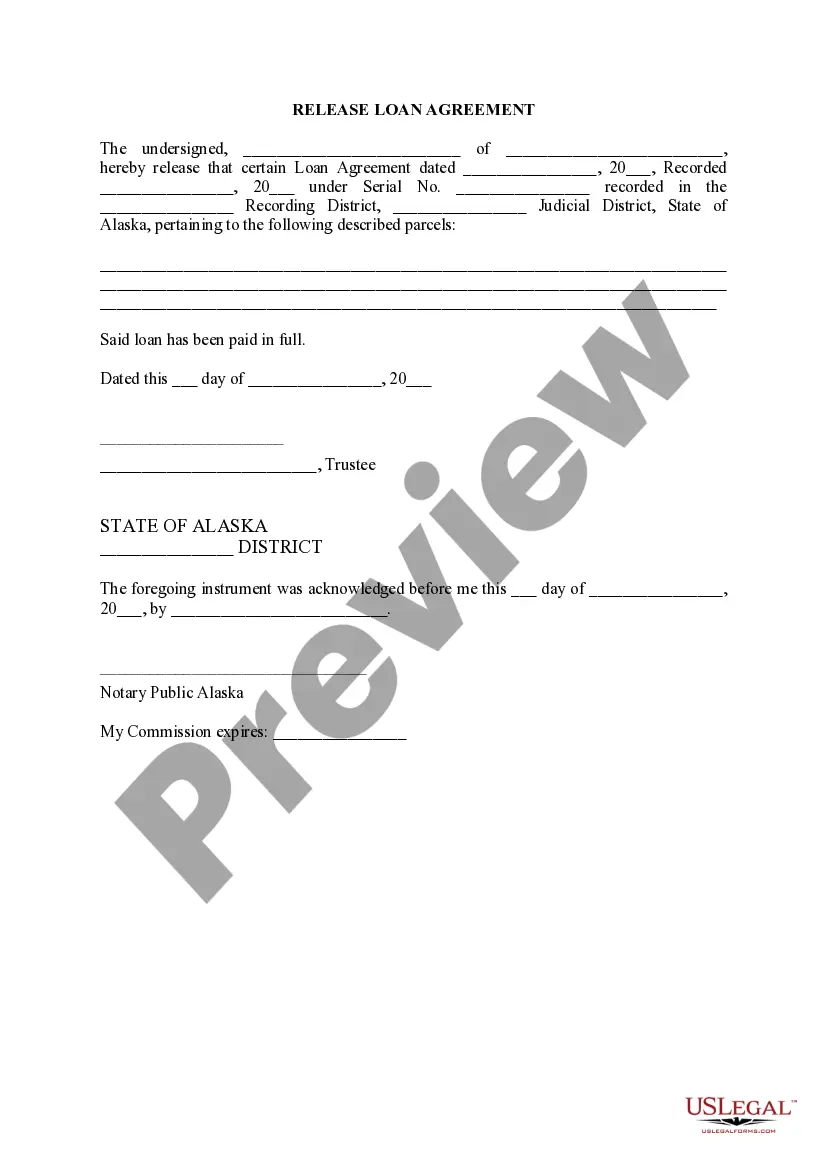
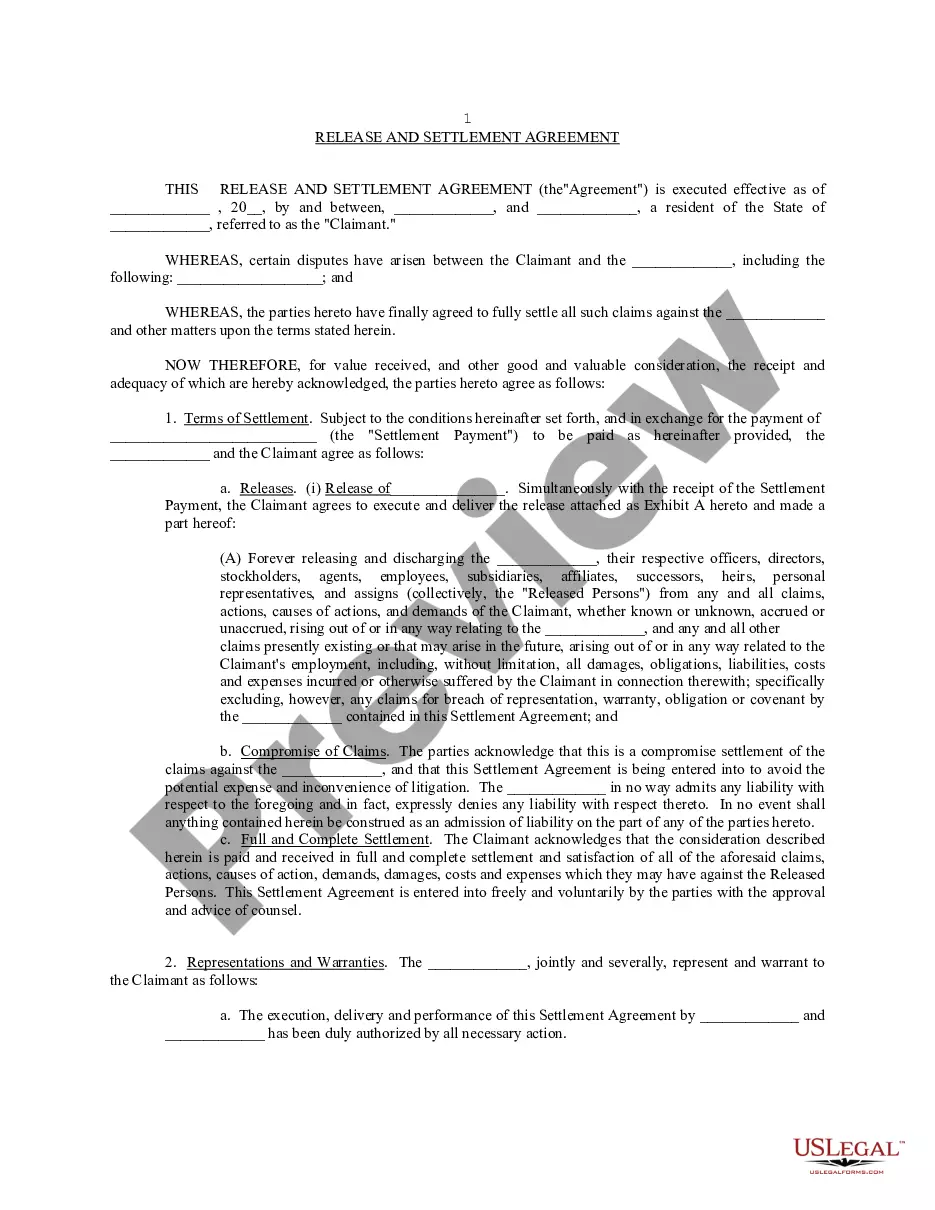
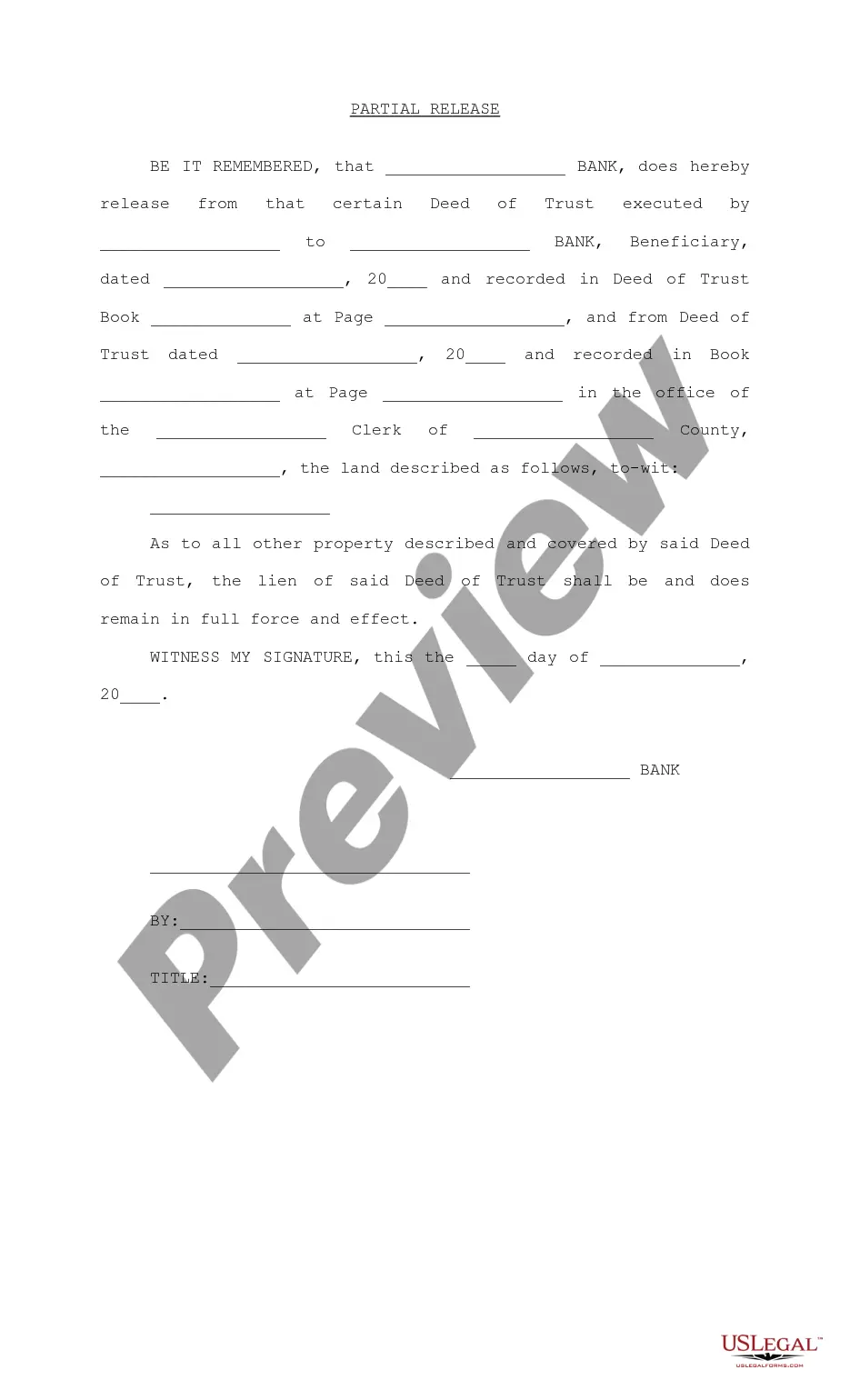
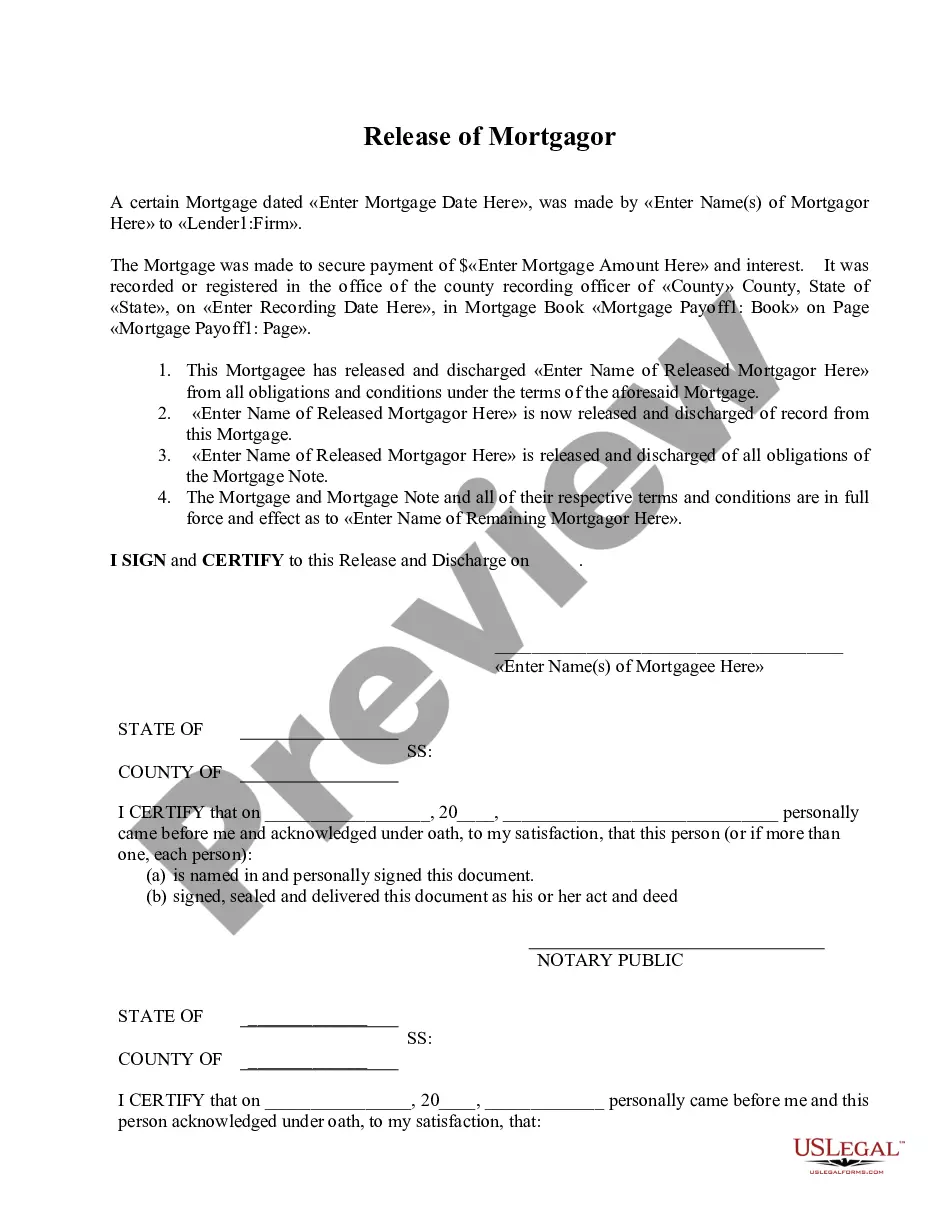
The Release Loan Agreement is a legal document confirming that a borrower has fully paid off their loan. This agreement officially removes the lender's lien from the property, ensuring clear ownership for the borrower. Unlike other loan documents that remain active until the loan is settled, this form signifies the conclusion of the loan obligation.
Key parts of this document
- Parties involved: Identifies the borrower and the lender.
- Date of loan agreement: States the original date of the loan agreement being released.
- Loan details: Includes specifics like the serial number and recording details related to the loan.
- Property description: Specifies the property affected by the loan.
- Trustee signature: Requires signature from the trustee or authorized representative.
- Notarization section: Provides space for notary public acknowledgment.
When this form is needed
This form is essential when borrowers have completely paid off a loan and need to ensure that the lender's claim to the property is officially released. It is often used in real estate transactions where a mortgage or other liens have been paid in full, preventing future ownership disputes.
Who this form is for
- Borrowers who have fully paid off their loans.
- Lenders who need to acknowledge the completion of loan payments.
- Property owners wishing to clear their title after loan repayment.
Steps to complete this form
- Identify the parties: Fill in the names of the borrower and the lender.
- Enter the date of the original loan agreement and the recording details.
- Describe the property: Provide a detailed description of the property related to the loan.
- Complete the date of execution: Write the date on which the release is being signed.
- Obtain signatures: Have the trustee or authorized representative sign the agreement.
- Secure notary acknowledgment: Ensure a notary public acknowledges the signatures for legal validity.
Is notarization required?
Yes, this form must be notarized to be legally valid. US Legal Forms offers integrated online notarization through secure video calls, available 24/7, ensuring convenience without the need for in-person visits.
Get your form ready online
Our built-in tools help you complete, sign, share, and store your documents in one place.
Make edits, fill in missing information, and update formatting in US Legal Forms—just like you would in MS Word.
Download a copy, print it, send it by email, or mail it via USPS—whatever works best for your next step.
Sign and collect signatures with our SignNow integration. Send to multiple recipients, set reminders, and more. Go Premium to unlock E-Sign.
If this form requires notarization, complete it online through a secure video call—no need to meet a notary in person or wait for an appointment.
We protect your documents and personal data by following strict security and privacy standards.

Make edits, fill in missing information, and update formatting in US Legal Forms—just like you would in MS Word.

Download a copy, print it, send it by email, or mail it via USPS—whatever works best for your next step.

Sign and collect signatures with our SignNow integration. Send to multiple recipients, set reminders, and more. Go Premium to unlock E-Sign.

If this form requires notarization, complete it online through a secure video call—no need to meet a notary in person or wait for an appointment.

We protect your documents and personal data by following strict security and privacy standards.
Common mistakes
- Failing to provide complete property descriptions.
- Not obtaining the necessary signatures from all parties.
- Leaving out the notarization step.
- Incorrectly entering dates or other important information.
Advantages of online completion
- Convenience: Download and complete the form at your own pace.
- Editability: Easily fill in information directly from your computer or device.
- Reliability: Form templates are reviewed and drafted by licensed attorneys.
Looking for another form?
Form popularity
FAQ
A personal loan agreement is a legally binding document regardless of whether the lender is a financial institution or another person.As a borrower, you could be sued by the lender or lose the asset or assets used to secure the loan.
Starting the Document. Write the date at the top of the page. Write the Terms of the Loan. State the purpose of the personal payment agreement and the terms for returning the money. Date the Document. Statement of Agreement. Sign the Document. Record the Document.
What is the difference between a Promissory Note and a Loan Agreement? Both contracts evidence a debt owed from the Borrower to the Lender, but the Loan Agreement contains more extensive clauses than the Promissory Note. Further, only the Borrower signs the promissory note while both parties sign a loan agreement.
A loan agreement does not require a notary signature. The purpose of a notary seal is to provide evidence that the signature is genuinely the signature of the person signing.
For loans by a commercial lender, the lender will provide the agreement. But for loans between friends or relatives, you will need to create your own loan agreement.
A loan agreement is a contract between you, the borrower and the lender.If there are valid reasons such as fraud or a breech of contract, you should be able to get out of the loan. If you are unable to cancel the contract, you may be forced to take other measures to get out of the loan.
Starting the Document. Write the date at the top of the page. Write the Terms of the Loan. State the purpose of the personal payment agreement and the terms for returning the money. Date the Document. Statement of Agreement. Sign the Document. Record the Document.
The purpose of a loan agreement is to detail what is being loaned and when the borrower has to pay it back as well as how.Once it has been executed, it is essentially a promise to pay from the lender to the borrower.
A loan agreement is a contract between a borrower and a lender which regulates the mutual promises made by each party.Loan agreements are usually in written form, but there is no legal reason why a loan agreement cannot be a purely oral contract (although oral agreements are more difficult to enforce).