North Carolina Divorce by Summary Judgment with Adult Children
What this document covers
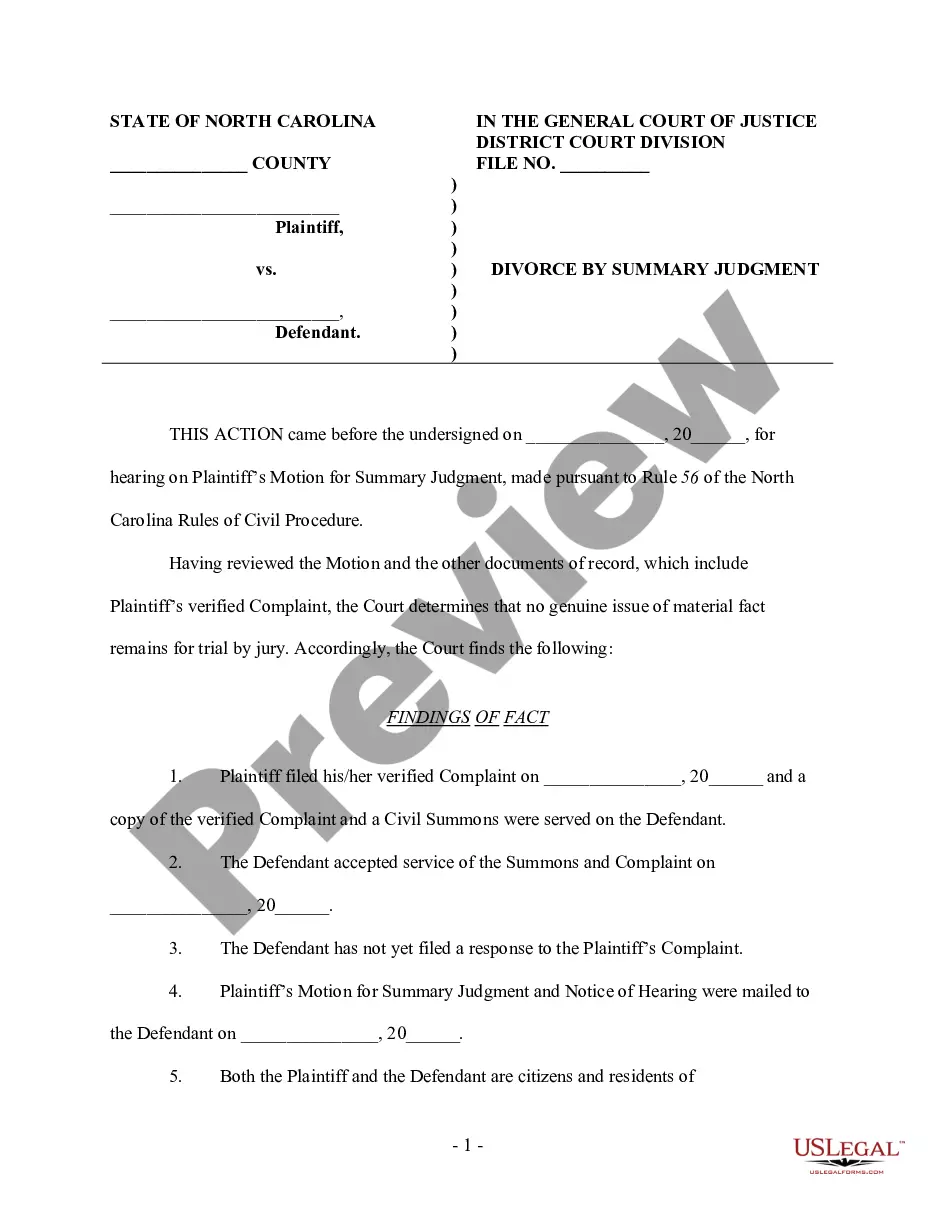
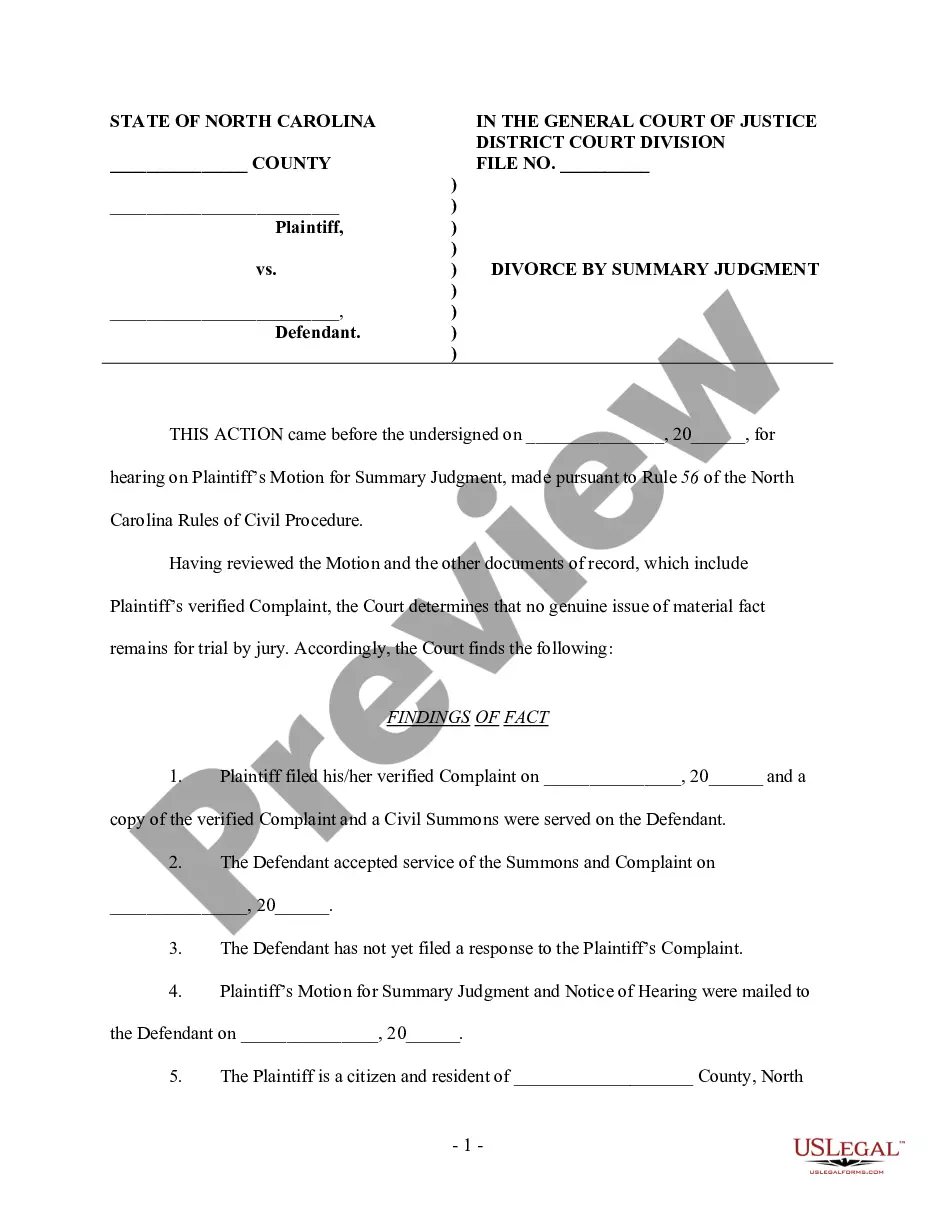
The Divorce by Summary Judgment with Adult Children form is a legal document used to grant an absolute divorce without the need for a trial. This form is specifically designed for couples who have adult children and have been living separately for at least one year. By utilizing this process, parties can obtain a divorce efficiently when there are no contested issues and no minor children involved, making it distinct from other divorce forms that may require court hearings or mediation.
Key components of this form
- Date of hearing for the Motion for Summary Judgment
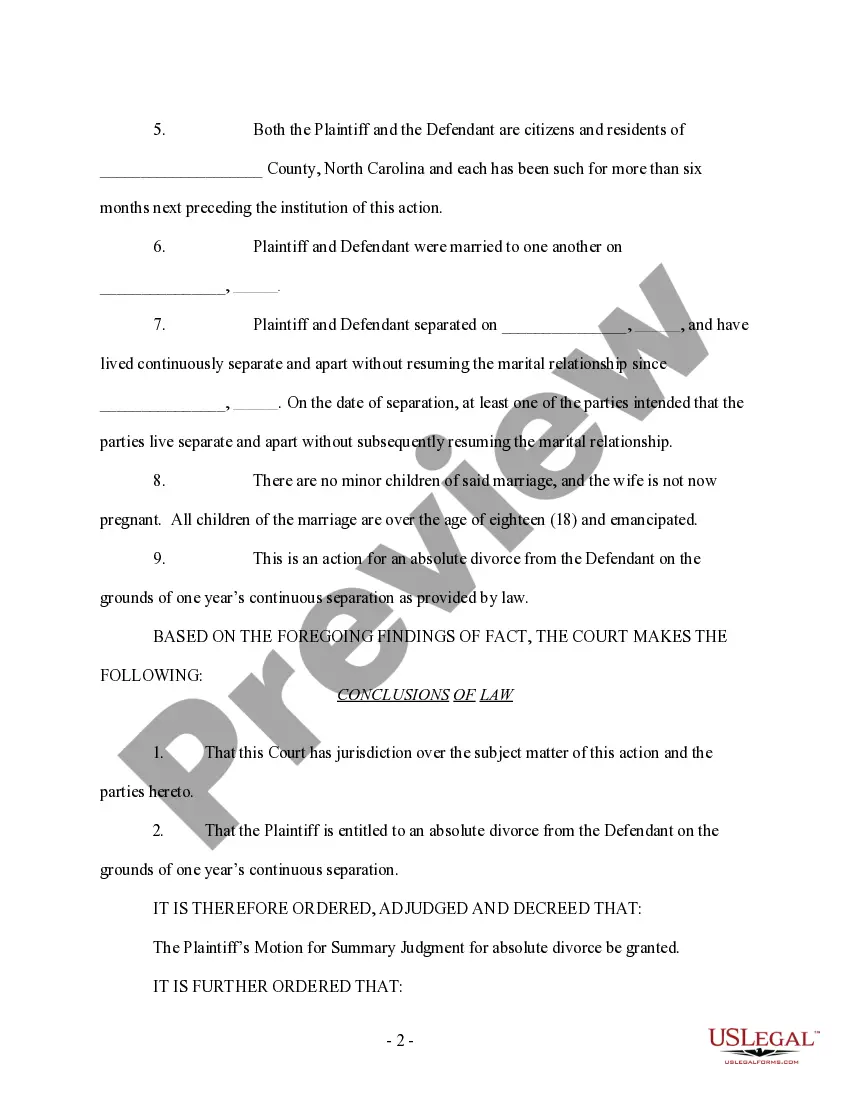
- Findings of fact regarding the marriage and separation
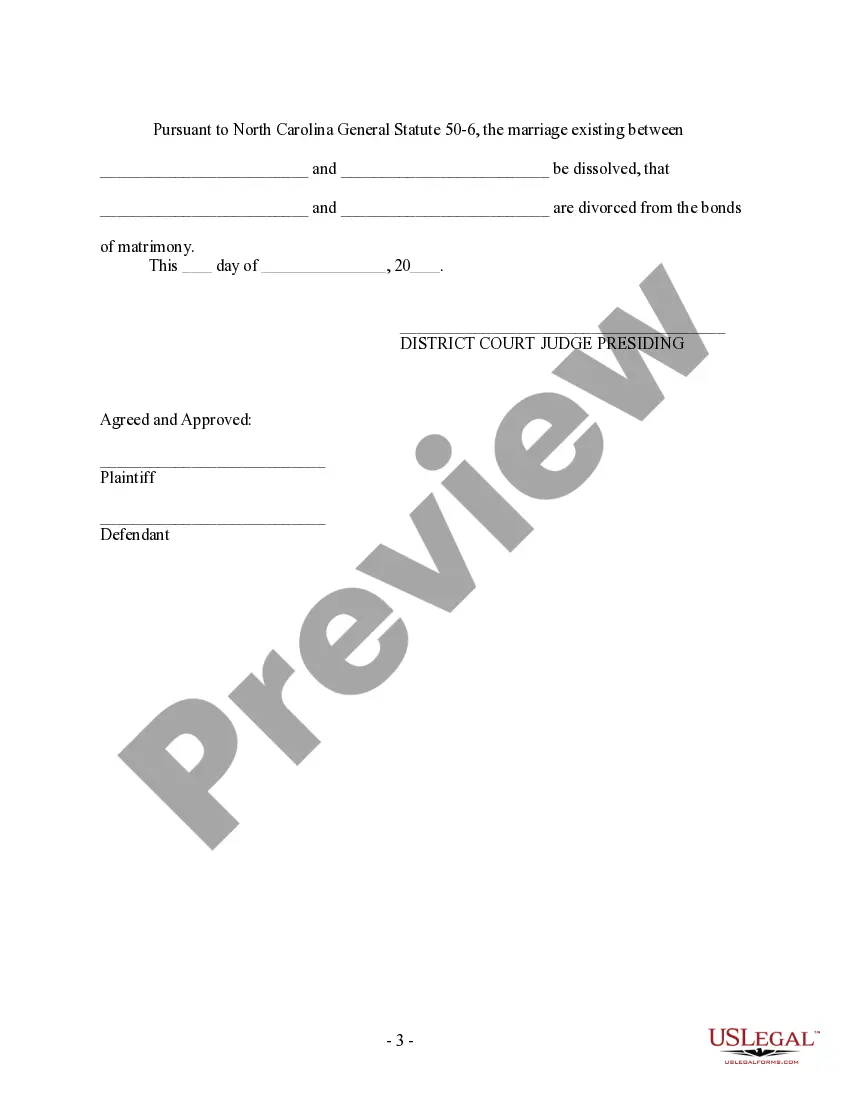
- Conclusion of law stating the entitlement to an absolute divorce
- Order dissolving the marriage
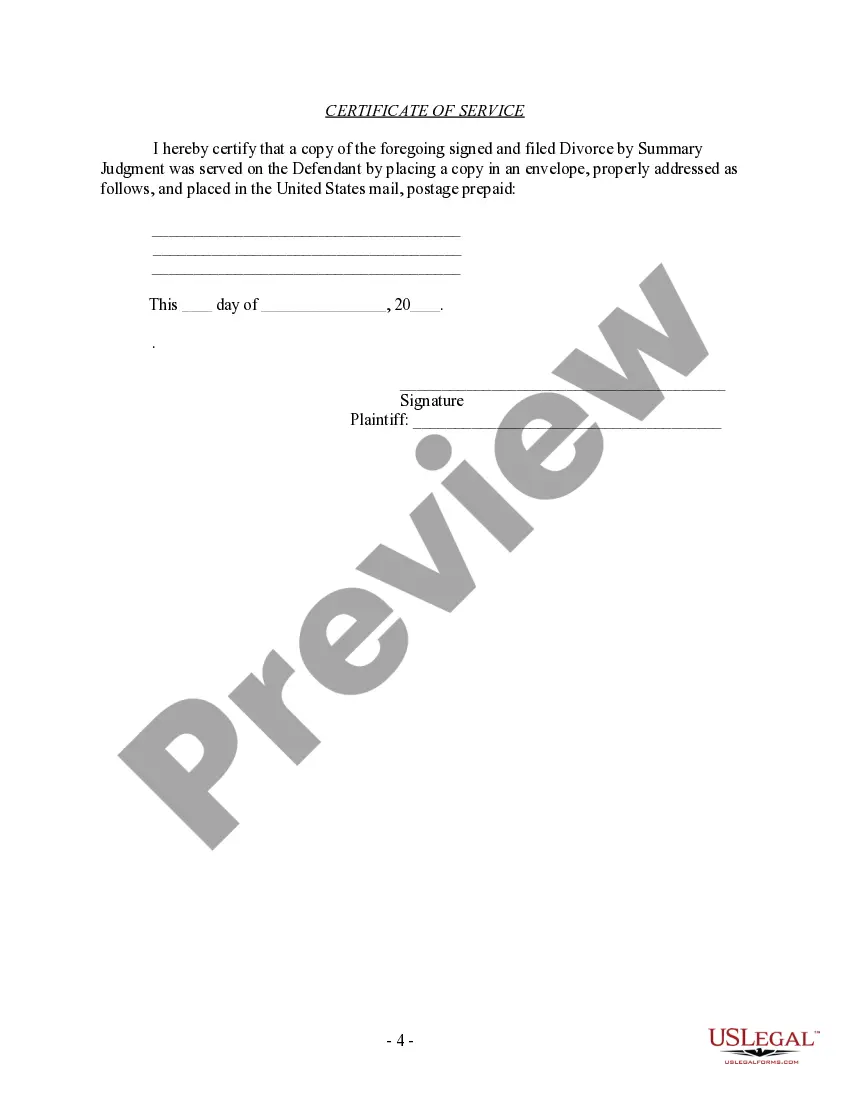
- Certification of service to the Defendant


Common use cases
This form is appropriate for individuals seeking to finalize their divorce when they have been separated for at least one year, there are no disputes regarding the divorce, and all children from the marriage are adults. It is especially beneficial when both parties agree on the terms and conditions of the divorce and wish to avoid lengthy court proceedings.
Who this form is for
- Individuals residing in North Carolina seeking a divorce
- Married couples without minor children
- Couples who have been separated for one year or more
- Those who have mutual agreement on the terms of the divorce
Completing this form step by step
- Enter the date of the hearing for the Motion for Summary Judgment.
- Fill in the names of the Plaintiff and Defendant and the date of marriage and separation.
- Provide the county of residence for both parties.
- Indicate that both parties consent to the divorce and that all children are adults.
- Sign and date the form in the presence of the presiding judge or notarization if required.
Does this document require notarization?
This form does not typically require notarization to be legally valid. However, some jurisdictions or document types may still require it. US Legal Forms provides secure online notarization powered by Notarize, available 24/7 for added convenience.
Get your form ready online
Our built-in tools help you complete, sign, share, and store your documents in one place.
Make edits, fill in missing information, and update formatting in US Legal Forms—just like you would in MS Word.
Download a copy, print it, send it by email, or mail it via USPS—whatever works best for your next step.
Sign and collect signatures with our SignNow integration. Send to multiple recipients, set reminders, and more. Go Premium to unlock E-Sign.
If this form requires notarization, complete it online through a secure video call—no need to meet a notary in person or wait for an appointment.
We protect your documents and personal data by following strict security and privacy standards.

Make edits, fill in missing information, and update formatting in US Legal Forms—just like you would in MS Word.

Download a copy, print it, send it by email, or mail it via USPS—whatever works best for your next step.

Sign and collect signatures with our SignNow integration. Send to multiple recipients, set reminders, and more. Go Premium to unlock E-Sign.

If this form requires notarization, complete it online through a secure video call—no need to meet a notary in person or wait for an appointment.

We protect your documents and personal data by following strict security and privacy standards.
Mistakes to watch out for
- Failing to provide accurate dates of separation or marriage.
- Not specifying that all children are over eighteen.
- Omitting signatures or not having the form signed by an authorized individual.
Advantages of online completion
- Easy and convenient access to the form at any time.
- Editability ensures that you can customize it to your specific situation.
- Reliable format in both Word and fillable PDF options.
What to keep in mind
- The form is designed for couples seeking a mutual, uncontested divorce.
- It should be used when there are no minor children involved.
- Completing it accurately is crucial for obtaining a swift divorce.
Looking for another form?







Form popularity
FAQ
Under North Carolina law, the amount and duration of an alimony award is based upon a number of factors including the length of the marriage, the reasonable needs of the spouses, the ability of one spouse to pay alimony, the dependent spouse's standard of living, the dependent spouse's educational background, and any
A spouse is typically entitled to some amount of alimony or spousal support, depending on the decision of the NC divorce courts. A spouse may also be entitled to a 50/50 split of marital property if so decided by the courts.
A separation agreement is not valid in North Carolina unless both parties have signed and their signatures are notarized.Coercion, fraud, undue influence or lack of knowledge will void the terms of a separation agreement.
While adultery by husband, wife, or both may destroy a marriage, but you can't use it as a ground for your divorce in North Carolina. North Carolina is one of only a few states that permit a spouse to file a civil lawsuit against the spouse's lover or anyone who interfered with the marriage.
In North Carolina, the courts will divide property in a way that is equitable, or fair.This is true unless the court determines that dividing the assets equally is not fair. Marital property is defined as all property acquired by either party, or both, after the date of marriage but before the date of separation.
North Carolina law presumes that an equal (50/50) division of marital property is equitable, or fair. However, the law provides for many factors that allow for an unequal distribution of property, in situations where an equal division would not be fair.
Marital property is all property acquired or earned during the marriage up until the date of separation. Pensions, retirement benefits, and other deferred compensation rights earned during the marriage are also marital property.
Unless the terms of the agreement are unconscionable, or the agreement itself is a result of fraud, coercion or duress, the courts tend to accept the terms as written. Attempting to have a separation agreement overturned is difficult, but not impossible.