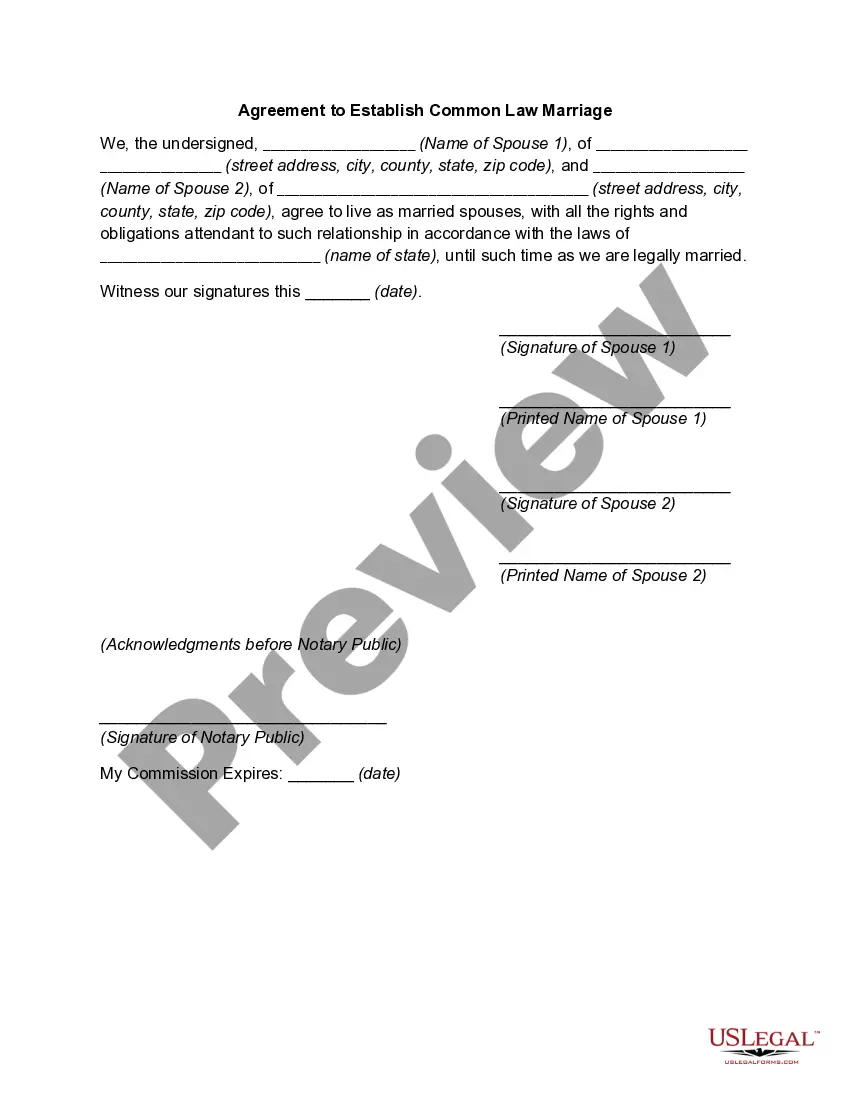
Agreement to Establish Common Law Marriage
What this document covers
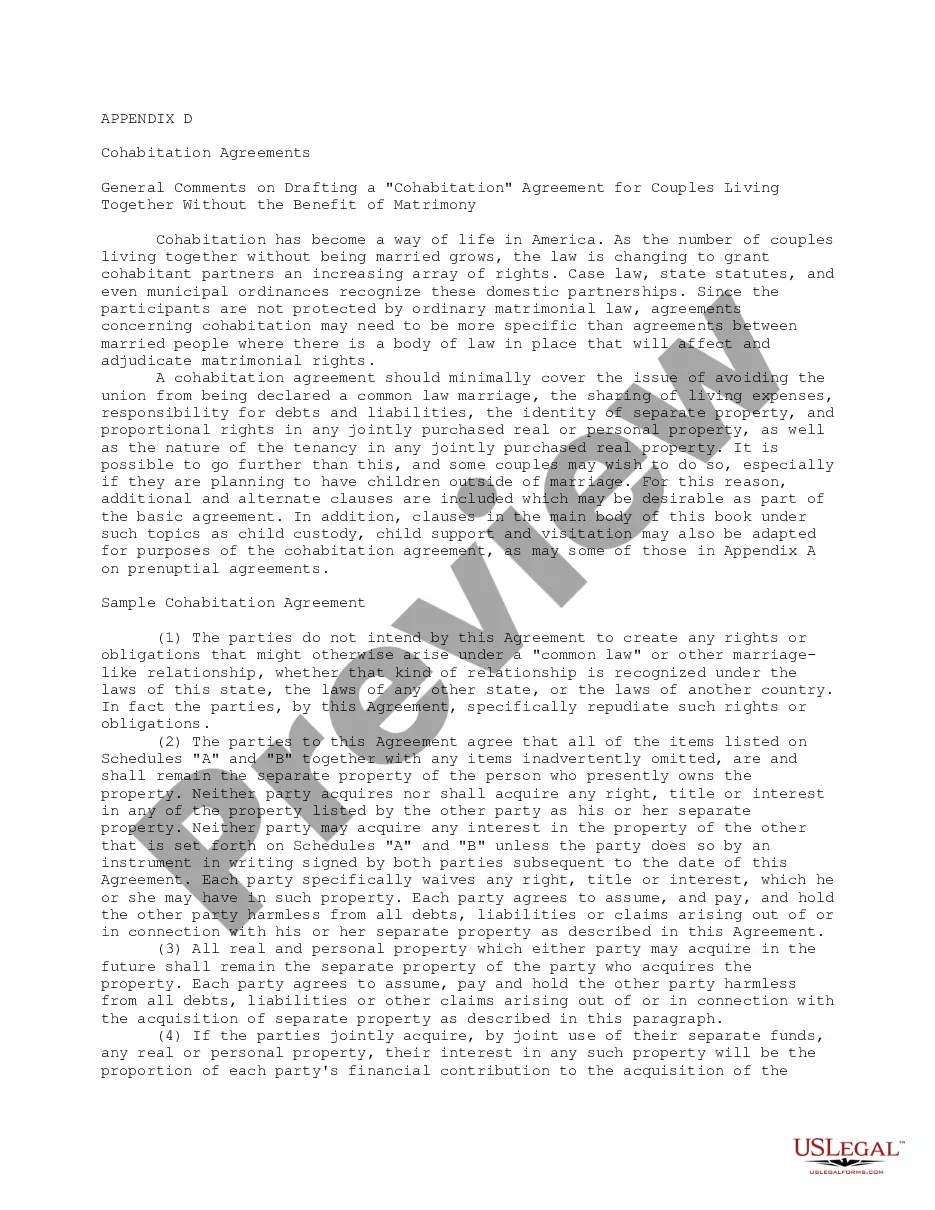
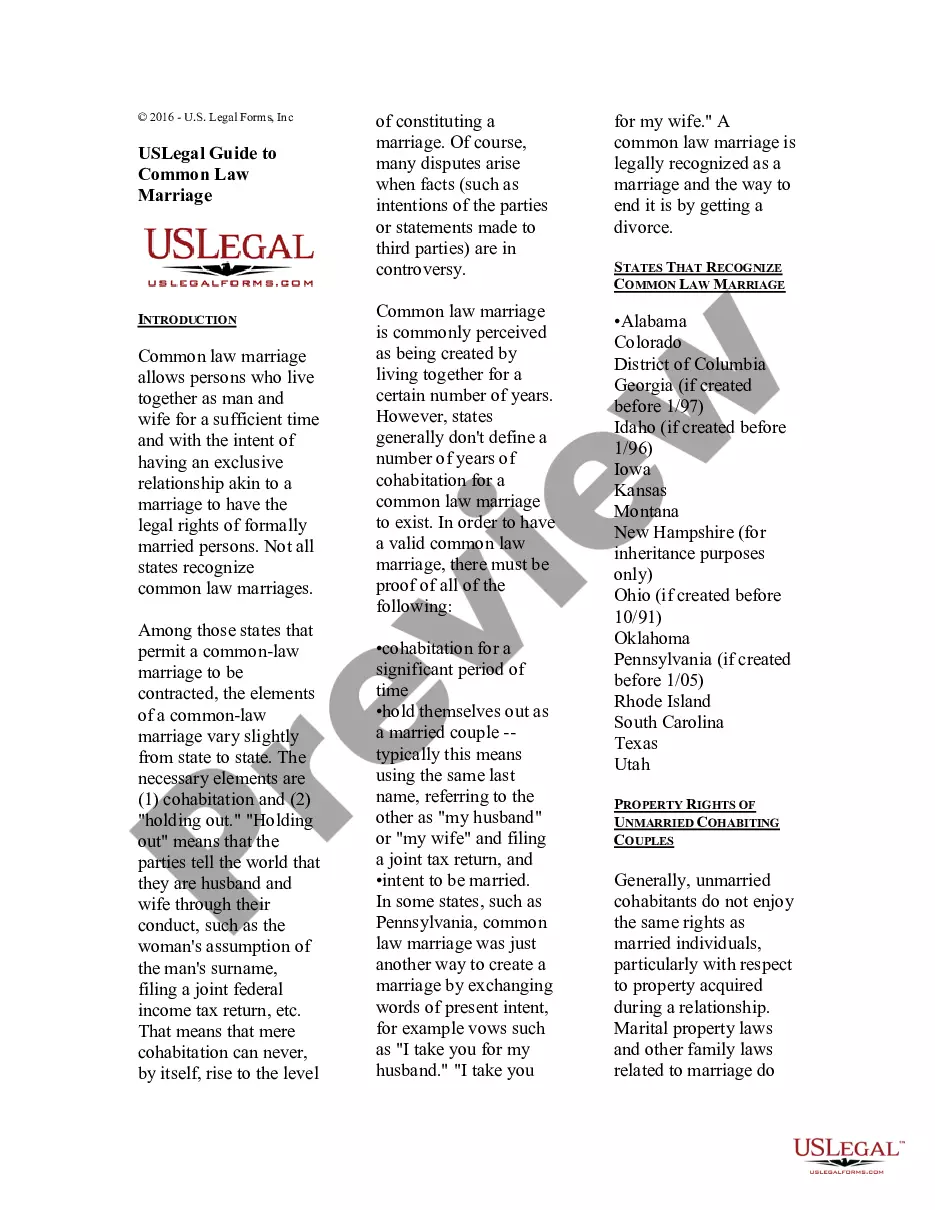
The Agreement to Establish Common Law Marriage is a legal document that outlines the mutual intention of two individuals to live together as spouses without formally marrying. This form provides both parties with the rights and obligations similar to those of a legally recognized marriage. Unlike traditional marriage licenses, common law marriage is based on cohabitation and mutual agreement, which can be recognized differently across various states.
Main sections of this form
- Names and addresses of both parties.
- Clear declaration of intent to live as married spouses.
- Legal jurisdiction specifying the state under which the agreement is made.
- Signatures of both parties along with their printed names.
- Notary public acknowledgment to validate the form.
Common use cases
This form should be used when a couple has chosen to live together as spouses and wishes to establish a common law marriage. It is especially useful in jurisdictions that recognize such relationships, providing legal clarity regarding rights and responsibilities. Scenarios include cohabiting partners who wish to formalize their relationship without a conventional marriage license, or couples who want to clarify their legal standing in states that recognize common law marriage.
Who can use this document
This form is intended for couples who meet the following criteria:
- Couples living together in a committed, marital-like relationship.
- Individuals seeking to establish legal recognition of their partnership without marriage.
- Those aware of their stateâs laws regarding common law marriage.
- Partners looking for a flexible alternative to traditional marriage.
Completing this form step by step
- Identify the parties by providing the names and addresses of both individuals.
- State your mutual intention to live as married spouses.
- Specify the state jurisdiction for the agreement.
- Both parties should sign the document where indicated.
- Have the signatures notarized to formalize the document's legality.
Notarization requirements for this form
Yes, this form must be notarized to be legally valid. The notary public serves to verify the identities of the signers and ensure that the document is executed voluntarily. US Legal Forms offers integrated online notarization services, enabling you to complete this process securely via a video call, available 24/7, without the need to travel.
Get your form ready online
Our built-in tools help you complete, sign, share, and store your documents in one place.
Make edits, fill in missing information, and update formatting in US Legal Forms—just like you would in MS Word.
Download a copy, print it, send it by email, or mail it via USPS—whatever works best for your next step.
Sign and collect signatures with our SignNow integration. Send to multiple recipients, set reminders, and more. Go Premium to unlock E-Sign.
If this form requires notarization, complete it online through a secure video call—no need to meet a notary in person or wait for an appointment.
We protect your documents and personal data by following strict security and privacy standards.

Make edits, fill in missing information, and update formatting in US Legal Forms—just like you would in MS Word.

Download a copy, print it, send it by email, or mail it via USPS—whatever works best for your next step.

Sign and collect signatures with our SignNow integration. Send to multiple recipients, set reminders, and more. Go Premium to unlock E-Sign.

If this form requires notarization, complete it online through a secure video call—no need to meet a notary in person or wait for an appointment.

We protect your documents and personal data by following strict security and privacy standards.
Common mistakes
- Failing to include both parties' full names and accurate addresses.
- Not specifying the jurisdiction in which the common law marriage is intended to be recognized.
- Omitting signatures or forgetting to have the document notarized.
- Using a generic form without adapting it to meet specific state requirements.
Why use this form online
- Convenience of downloading and completing the form at your own pace.
- Editability allows customization to fit your specific needs and state requirements.
- Access to forms drafted by licensed attorneys, ensuring legal validity.
- Immediate availability for use without the need for in-person appointments.
What to keep in mind
- The Agreement to Establish Common Law Marriage provides a legal framework for couples choosing to live together without formal marriage.
- Ensure compliance with your state's laws regarding common law marriage.
- Notarization is required to validate the agreement.
- Using this form online is convenient and offers flexibility in completing legal documentation.
Looking for another form?
Form popularity
FAQ
Rights to protecting a family residence and dividing family assets are only granted to legally married couples. A common law spouse who is the sole owner of a shared residence may sell or mortgage property without consent and without splitting proceeds.
In both types of agreements, the disclosure requirements are onerous but necessary. Full disclosure includes things such as income tax returns, pay stubs, banks account and credit card statements, RRSP/investment statements and a statutory declaration of all income, assets and debts, among others.
A common law (or informal) marriage is a legal marriage without a ceremony or other formalities. It is created only if certain specific legal requirements are met. Proving a common law marriage does NOT depend on how long you have been living together or whether you have children together.
Example of Cohabitation Two single people meet at a university and live together to save on expenses and have a sexual relationship.
Shared ownership of residential property. joint leases or rental agreements. bills for shared utility accounts, such as: gas. electricity. important documents for both of you showing the same address, such as: driver's licenses. identification documents.
The parties must have entered into a present contract to become husband and wife; the contract must have been consummated; the parties must have had contractual capacity; there must have been mutual assent and mutuality to the contract;
Cohabitation is an arrangement where two people are not married but live together. They are often involved in a romantic or sexually intimate relationship on a long-term or permanent basis.More broadly, the term cohabitation can mean any number of people living together.
The Social Security Administration mandates that you must provide evidence of your marriage. Evidence to prove a common-law marriage in the States that recognize such marriages must include: A statement from each spouse and a statement from a blood relative of each, if both spouses are living, OR.
Deeds showing title to property held jointly by both parties to the common law marriage. Bank statements and checks showing joint ownership of the accounts. Insurance policies naming the other party as beneficiary. Birth certificates naming you and your common law spouse as parents of your child.