Massachusetts Brick Mason Contractor Package
What this form package covers
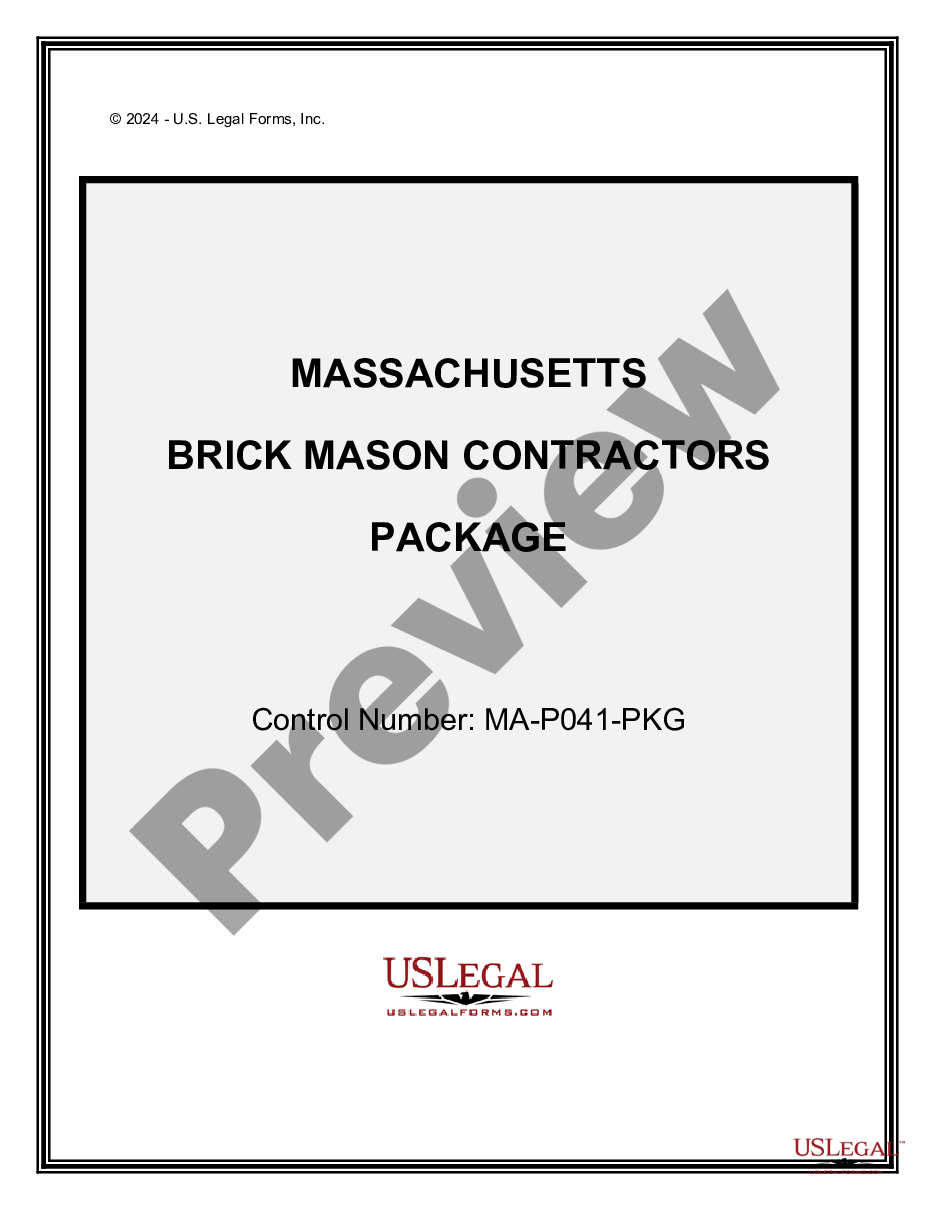
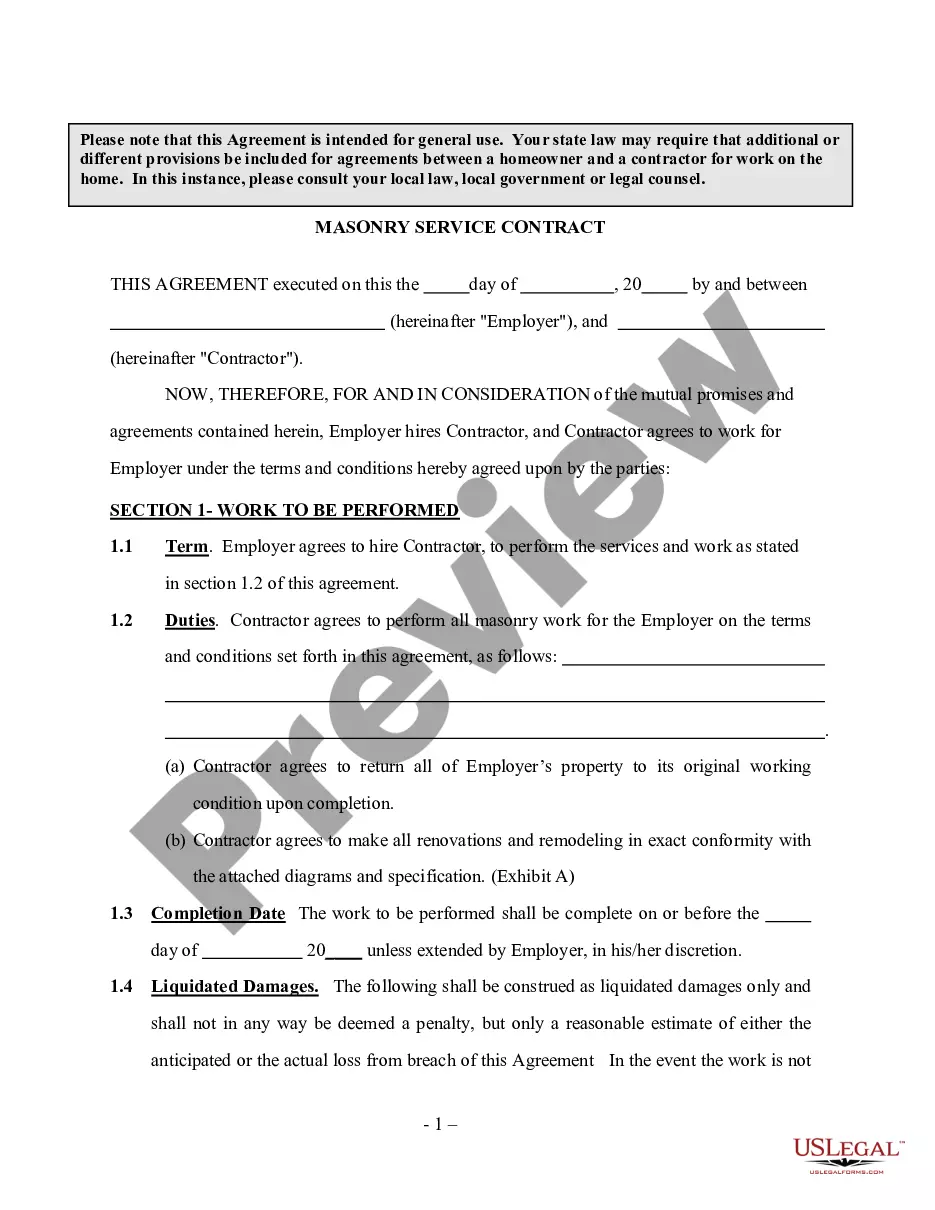
The Massachusetts Brick Mason Contractor Package includes essential legal forms specifically designed for contractors who construct brick or stone structures, walls, driveways, or chimneys. This comprehensive package is intended to help contractors assert their legal rights and manage various legal issues arising from specific projects. Central to this package is a Brick Mason Contract that complies with Massachusetts state law, setting it apart from similar offerings in the market.
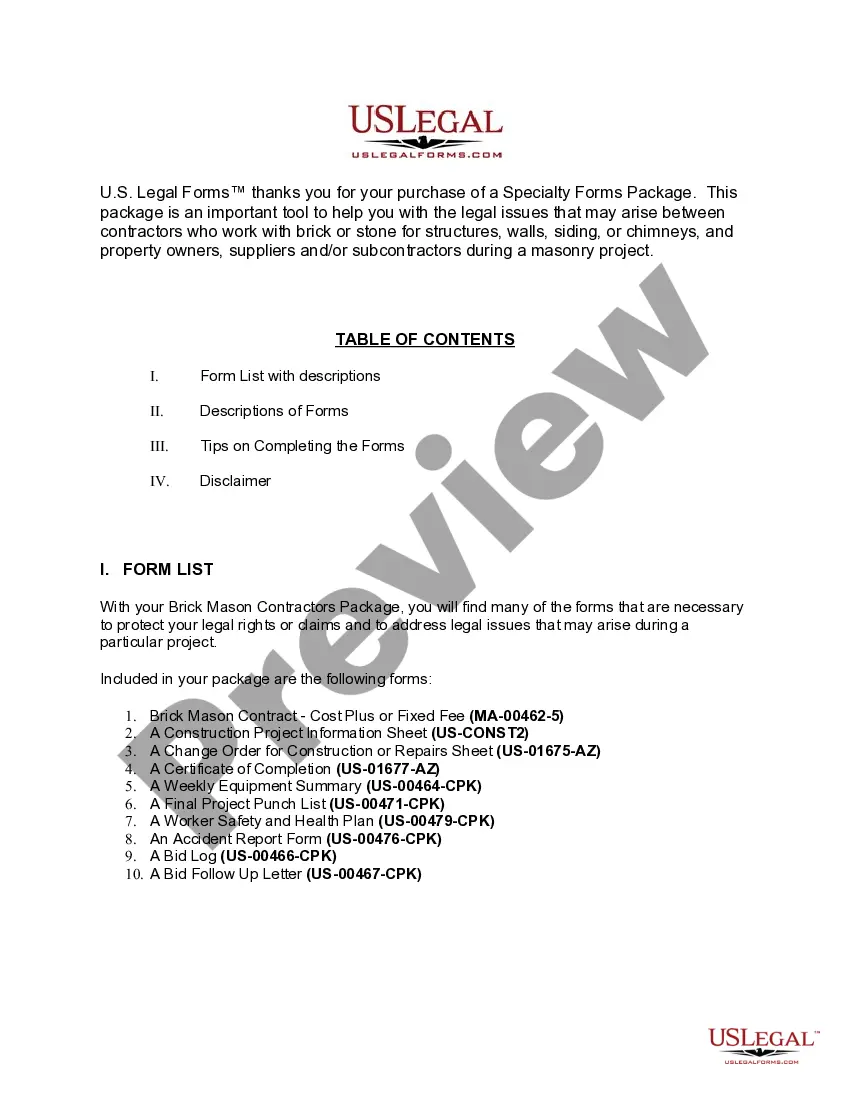
Forms provided in this package
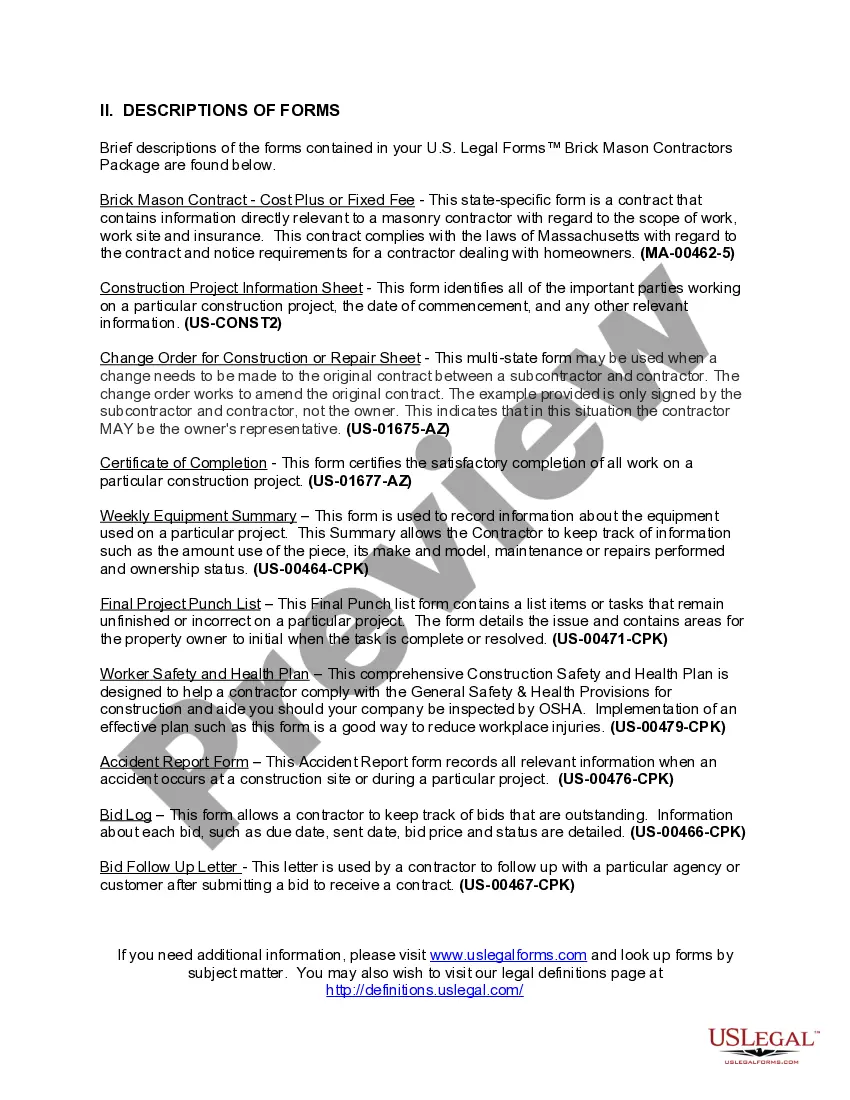
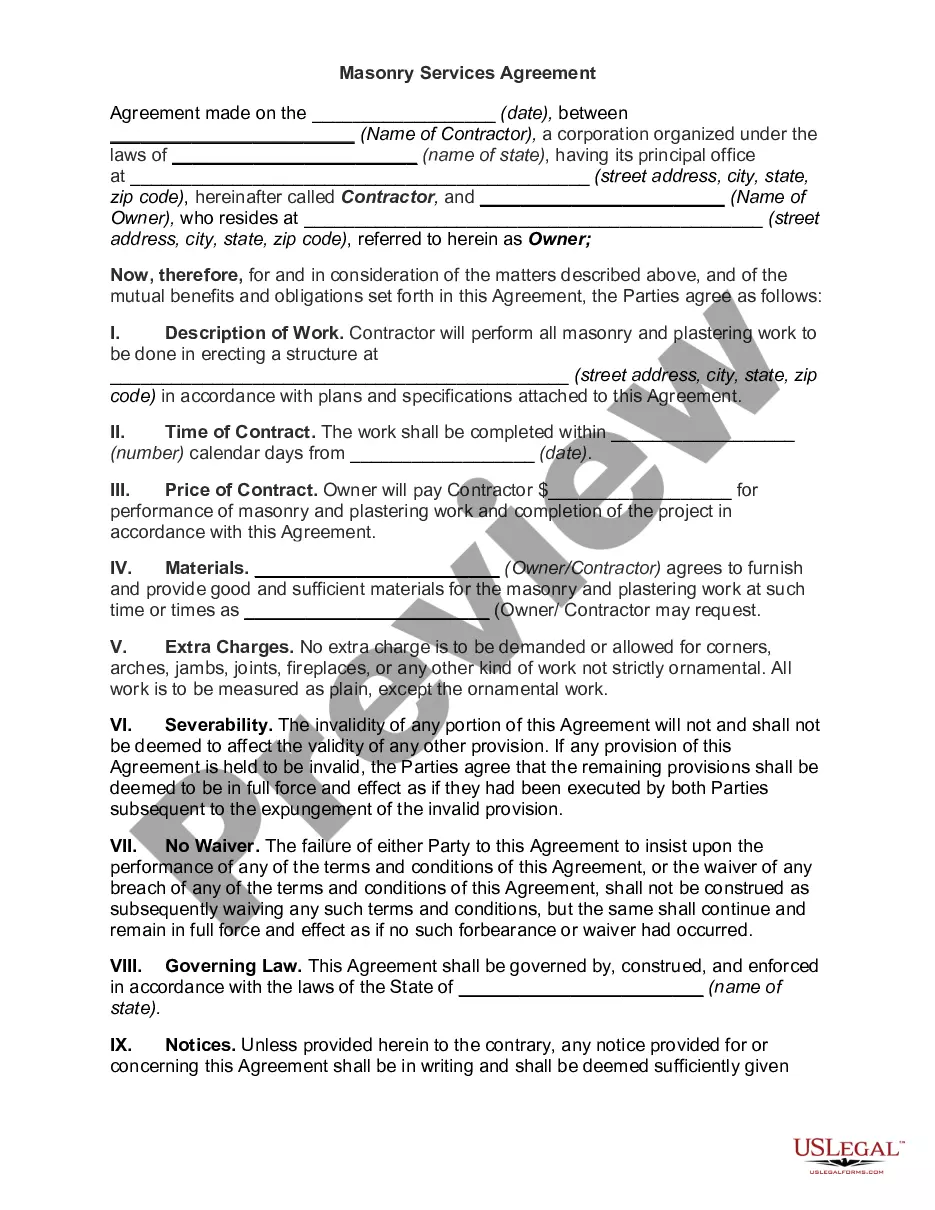
- Brick Mason Contract for Contractor
- Contractor's Weekly Equipment Summary
- Contractor's Bid Log
- Contractor's Bid Follow Up Letter
- Contractor's Final Punch List
- Construction Accident Report
- Construction Safety and Health Plan
- Change Order for Construction or Repairs by Contractor
- Certification of Completion by Contractor
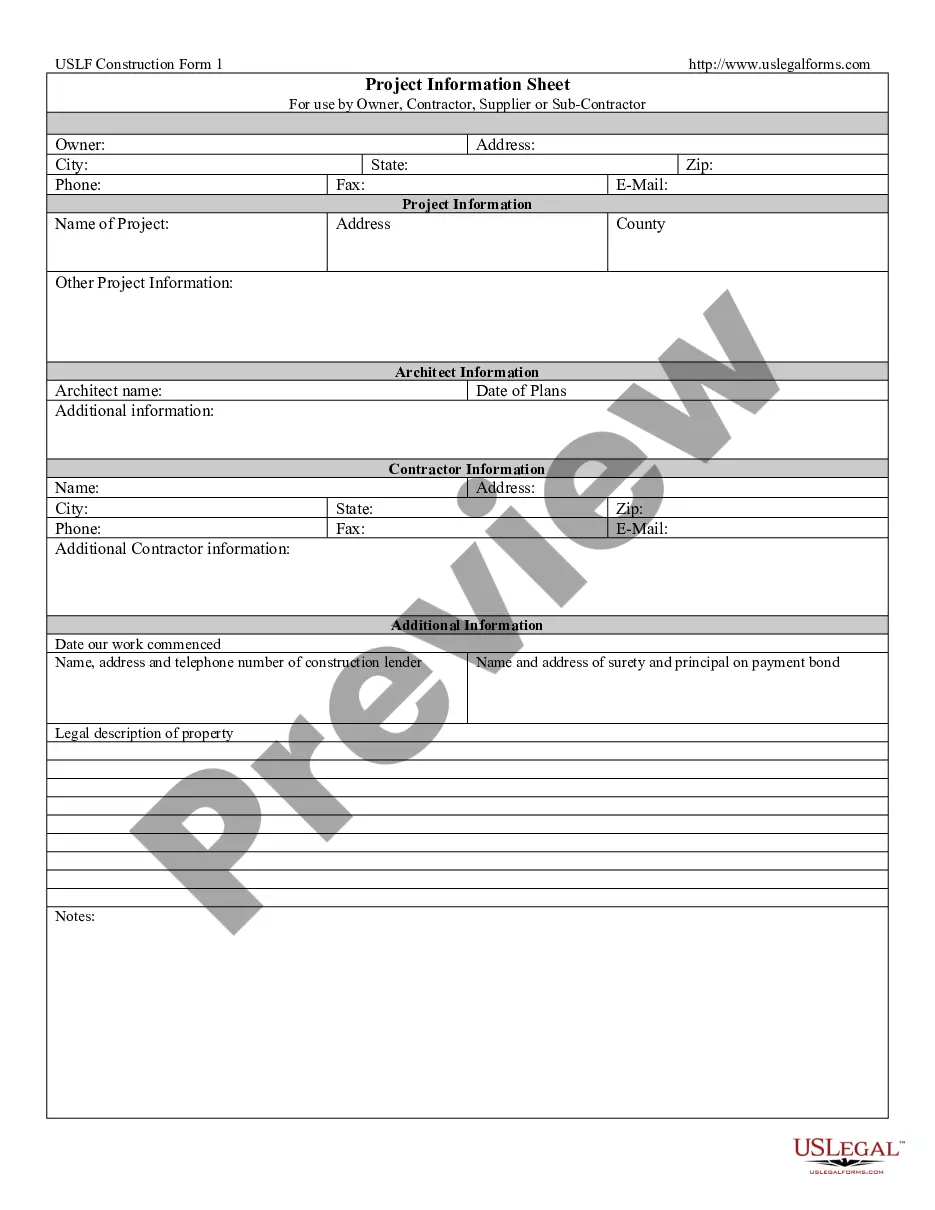
- Construction Project Information Sheet

When to use this document
This form package is beneficial when:
- Starting a new brick or stone construction project.
- Modifying an existing contract with a change order.
- Finalizing project details by certifying completion.
- Tracking equipment and labor for project management.
- Ensuring worker safety and compliance with health regulations.
Who can use this document
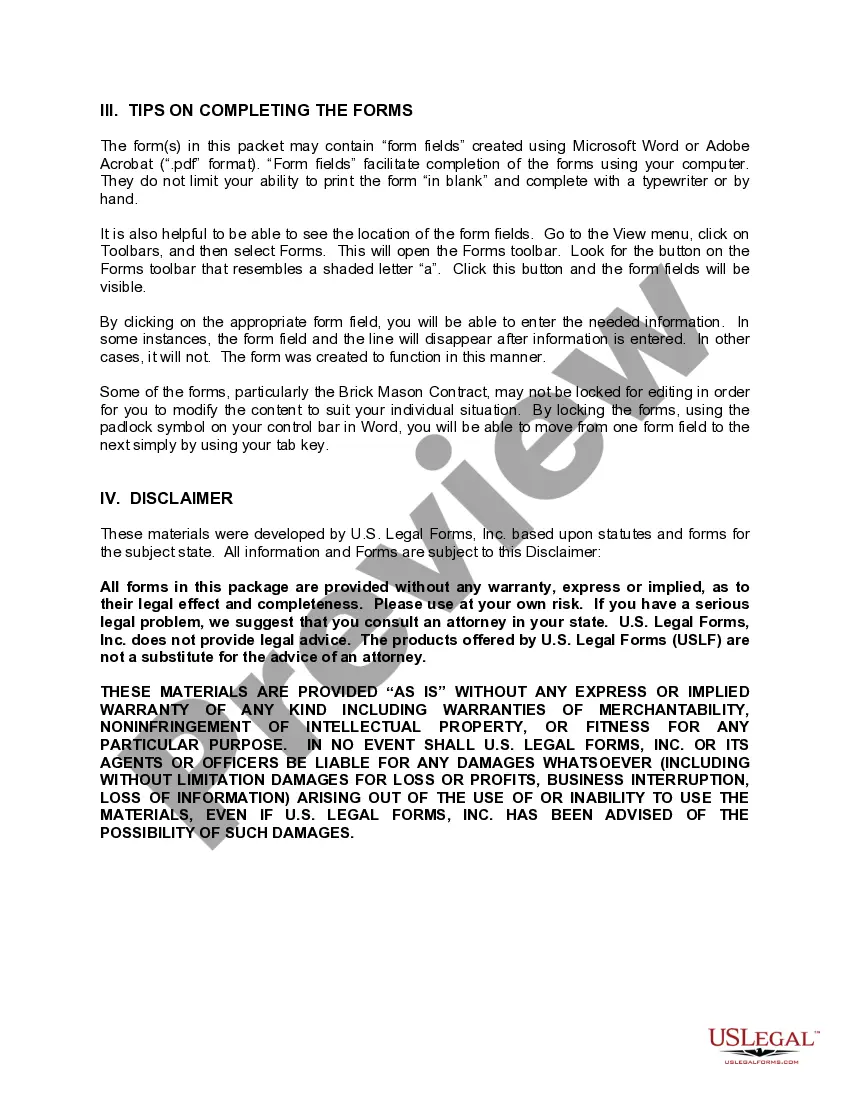
- Brick masons seeking to formalize contracts for their services.
- General contractors managing brick or stone construction projects.
- Subcontractors working under larger projects involving masonry work.
- Any individual or business involved in brick construction in Massachusetts.
Completing these forms step by step
- Review all included forms and their descriptions to understand their purpose.
- Identify the parties involved in the construction project.
- Enter the necessary project details such as dates, locations, and scope of work.
- Complete the Brick Mason Contract according to the specifics of the job.
- Ensure all parties sign where required and keep copies for your records.
Do documents in this package require notarization?
Notarization is generally not required for forms in this package. However, specific circumstances or local laws may require it. You can complete notarization remotely through US Legal Forms, powered by Notarize, with 24/7 availability.
Get your form ready online
Our built-in tools help you complete, sign, share, and store your documents in one place.
Make edits, fill in missing information, and update formatting in US Legal Forms—just like you would in MS Word.
Download a copy, print it, send it by email, or mail it via USPS—whatever works best for your next step.
Sign and collect signatures with our SignNow integration. Send to multiple recipients, set reminders, and more. Go Premium to unlock E-Sign.
If this form requires notarization, complete it online through a secure video call—no need to meet a notary in person or wait for an appointment.
We protect your documents and personal data by following strict security and privacy standards.

Make edits, fill in missing information, and update formatting in US Legal Forms—just like you would in MS Word.

Download a copy, print it, send it by email, or mail it via USPS—whatever works best for your next step.

Sign and collect signatures with our SignNow integration. Send to multiple recipients, set reminders, and more. Go Premium to unlock E-Sign.

If this form requires notarization, complete it online through a secure video call—no need to meet a notary in person or wait for an appointment.

We protect your documents and personal data by following strict security and privacy standards.
Common mistakes to avoid
- Not including all relevant parties in the contract.
- Failing to specify clear payment terms in the Brick Mason Contract.
- Neglecting to complete the Final Punch List before project closure.
- Overlooking safety requirements in the Worker Safety and Health Plan.
- Not tracking equipment use, leading to disputes over costs.
Benefits of completing this package online
- Convenience of downloading and printing forms from anywhere.
- Edit and customize forms easily to fit your specific project needs.
- Access to professionally drafted legal documents, ensuring compliance with state laws.
- Cost-effective solution, saving more than 40% compared to purchasing forms individually.
Looking for another form?
Form popularity
FAQ
The primary difference between being a bricklayer and a mason is that bricklaying is a less skilled form of masonry.However, masons work with a far greater variety of materials, such as stone, and know more complex cutting techniques.
The average hourly wage for all bricklayers, both union and non-union, at all levels of experience from across the U.S. was $22.50. Annual salaries range from more than $80,570 to less than $28,950.
Expect to pay $65 to $105 per hour for hiring a bricklayer. Labour costs may vary depending on your location, the nature of bricklaying work and the experience level of the hired bricklayer. Here's a list of indicative subcontractor rate for bricklayers.
Like many trade jobs, masonry is in high demand and pays well in most areas. The US Bureau of Labor Statistics expects it to grow 29 percent or more between 2012 and 2020 (depending on the specialty). This is a much higher growth rate than many other careers, meaning there will be plenty of opportunities for growth.
Masons work with a range of materials like stone, brick and concrete to install chimneys, retaining walls, patios and entire homes.
Bricklayers are responsible for building or repairing walls in accordance with construction plans. These dynamic construction workers also build or refurbish chimneys, arches and other structures.A substantial majority of bricklayers are self-employed, offering their services to an established client base.
'In London, a bricklayer is commanding wages of up to £90,000 a year. Pursuing a career in construction is therefore becoming an increasingly savvy move.
Peters says SAM's purpose is to leverage human jobs, not entirely replace thema human mason can lay about 300 to 500 bricks a day, while SAM can lay about 800 to 1,200 bricks a day. One human plus one SAM equals the productivity of having four or more masons on the job.
Bricklayers are typically focused on construction using clay or concrete bricks, and blocks. Masons focus on construction involving stone, marble, granite and other similar natural materials.Masons from the Greek and Roman empires are credited with intricate construction using materials such as limestone and marble.