Connecticut Warranty Deed from Husband and Wife to LLC
What this document covers
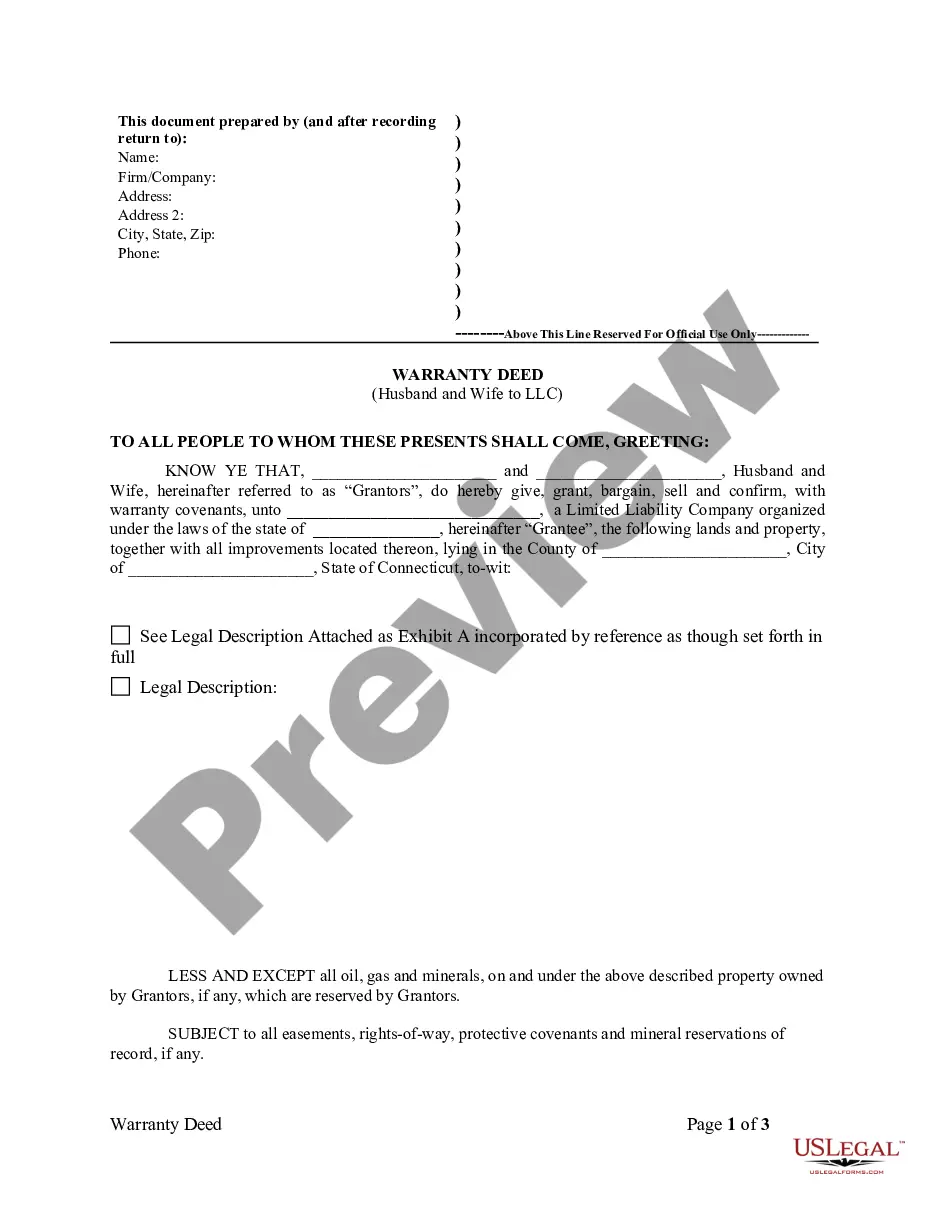
The Warranty Deed from Husband and Wife to LLC is a legal document that transfers property ownership from a husband and wife to a limited liability company (LLC). Unlike a standard deed, this form specifically addresses the unique circumstances of married couples conveying property while reserving certain rights, such as oil, gas, and mineral rights.
Main sections of this form
- Identification of the grantors (husband and wife) and grantee (LLC).
- Description of the property being transferred, including any reservations for rights.
- Covenants ensuring the property is free of encumbrances unless otherwise noted.
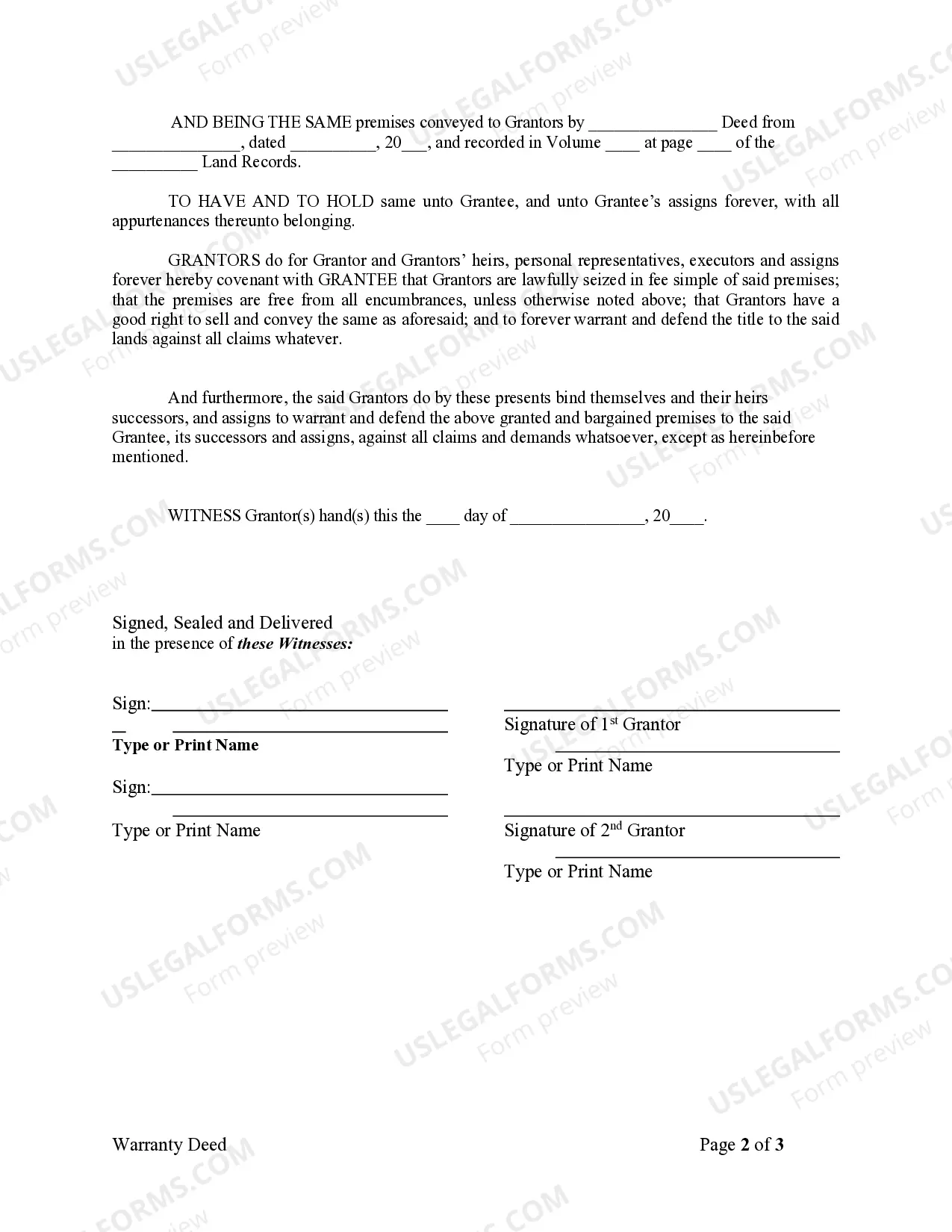
- Provisions for binding the grantors and their heirs.
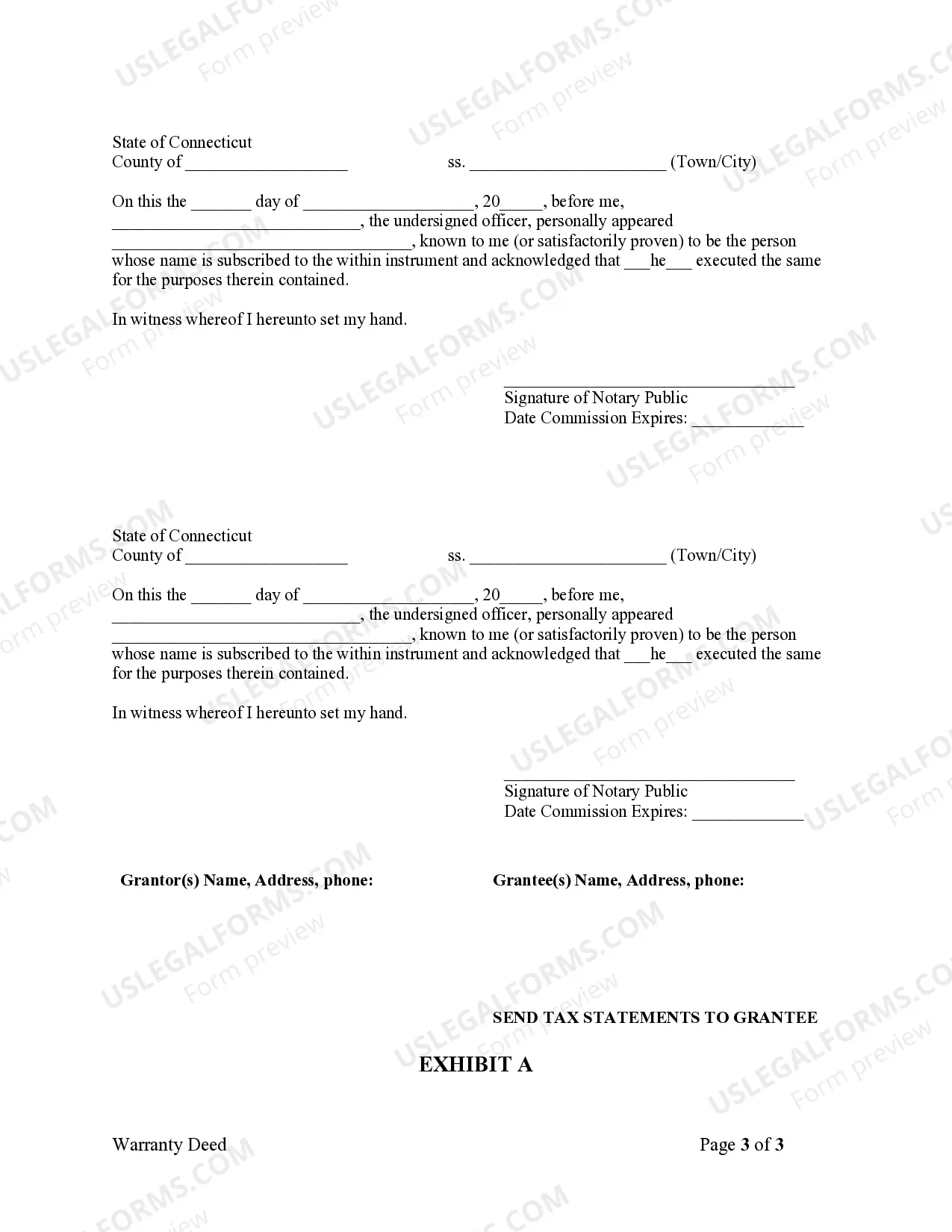
- Signature lines for both parties and a notary public section.





Common use cases
This form is typically used when a married couple wants to transfer property ownership to their LLC, either for business purposes or to protect assets. It is useful for those looking to consolidate their real property within a business structure while maintaining specific mineral rights.
Who this form is for
- Married couples wishing to convey property to their LLC.
- Business owners seeking to protect real estate assets through an LLC structure.
- Individuals managing properties with reserved rights, such as mineral rights.
Instructions for completing this form
- Identify the parties involved: clearly state the names of the husband and wife as grantors and the LLC as the grantee.
- Specify the property being transferred by providing a complete legal description.
- Fill in the date of the previous deed and the volume and page number from the land records.
- Include any reservations, specifically noting rights retained for oil, gas, and minerals.
- Both grantors must sign the document in the presence of a notary public.
Is notarization required?
Yes, this form must be notarized to be legally valid. US Legal Forms offers integrated online notarization services, available 24/7 through secure video calls, ensuring the process is straightforward and legally acceptable without requiring travel.
Get your form ready online
Our built-in tools help you complete, sign, share, and store your documents in one place.
Make edits, fill in missing information, and update formatting in US Legal Forms—just like you would in MS Word.
Download a copy, print it, send it by email, or mail it via USPS—whatever works best for your next step.
Sign and collect signatures with our SignNow integration. Send to multiple recipients, set reminders, and more. Go Premium to unlock E-Sign.
If this form requires notarization, complete it online through a secure video call—no need to meet a notary in person or wait for an appointment.
We protect your documents and personal data by following strict security and privacy standards.

Make edits, fill in missing information, and update formatting in US Legal Forms—just like you would in MS Word.

Download a copy, print it, send it by email, or mail it via USPS—whatever works best for your next step.

Sign and collect signatures with our SignNow integration. Send to multiple recipients, set reminders, and more. Go Premium to unlock E-Sign.

If this form requires notarization, complete it online through a secure video call—no need to meet a notary in person or wait for an appointment.

We protect your documents and personal data by following strict security and privacy standards.
Mistakes to watch out for
- Failing to accurately describe the property being transferred.
- Omitting required reservations for mineral rights.
- Not properly identifying all grantors and the grantee entity.
- Neglecting to have the document notarized if required by local law.
Why use this form online
- Convenience: Easily accessible for download, allowing for quick preparation.
- Editability: Fill in the form electronically before printing it for signatures.
- Reliability: Forms are drafted by licensed attorneys, ensuring legal accuracy.
Summary of main points
- The Warranty Deed from Husband and Wife to LLC facilitates the transfer of property ownership to an LLC.
- It is important to include specific property descriptions and any reservations for rights retained.
- Notarization is required; consider using online options for convenience.
Looking for another form?
Form popularity
FAQ
People often put their houses under an LLC to gain asset protection and to manage risks more effectively. By doing so, individuals can shield their personal assets from liabilities related to the property. Additionally, an LLC can facilitate smoother transfers of ownership through a Connecticut Warranty Deed from Husband and Wife to LLC, which streamlines estate planning. Ultimately, this strategy can provide peace of mind and financial security.
One major disadvantage of an LLC is the potential for higher costs and administrative burdens. Operating an LLC often involves state fees, annual reports, and adherence to specific regulations. This complexity can be daunting for some owners. Hence, when contemplating a Connecticut Warranty Deed from Husband and Wife to LLC, consider whether the benefits outweigh these possible challenges.
Putting a property in an LLC using a Connecticut Warranty Deed from Husband and Wife to LLC has its pros and cons. On the positive side, it provides liability protection and simplifies estate planning. However, on the downside, transferring a property into an LLC may incur additional costs and administrative tasks, such as filing fees and annual reports. It’s essential to weigh these factors carefully before deciding on this route.
When an LLC owns property, it can benefit from various tax advantages. One significant benefit is that rental income generated by the property typically passes through to the owners, allowing them to report it on their personal tax returns. Furthermore, LLCs can deduct expenses related to property management, which can lower taxable income. Consequently, this structure can make owning property through a Connecticut Warranty Deed from Husband and Wife to LLC tax-efficient.
To fill out a warranty deed form for a Connecticut Warranty Deed from Husband and Wife to LLC, start by identifying the grantors and grantee. Clearly state the property's legal description, including its location and boundaries. Additionally, ensure you include the date of the transfer and any required notarization. Using platforms like USLegalForms can simplify this process by providing templates that guide you through each step.
Two names can go on a deed, allowing shared ownership of the property involved. This can also provide legal protections and clarify responsibilities between the parties. When completing a Connecticut Warranty Deed from Husband and Wife to LLC, ensuring that both names are accurately represented simplifies any future dealings and strengthens ownership claims.
Yes, two people can indeed be on a warranty deed, and this is often used in property transactions among couples, business partners, or family members. Including both names provides protection and clarity regarding ownership rights. When creating a Connecticut Warranty Deed from Husband and Wife to LLC, this ensures that both parties are recognized as tenants and can share responsibilities related to the property.
When two people are on a deed, it generally means that both individuals share ownership of the property. If one person wants to sell or transfer their interest, they typically need the consent of the other. This arrangement can become critical when dealing with a Connecticut Warranty Deed from Husband and Wife to LLC, ensuring that both parties agree on future actions related to the property.
To transfer ownership from husband to wife, you can create a warranty deed that outlines the new ownership structure. This process may involve legally drafting the deed with the appropriate information, signing it in front of a notary, and then filing it with the local government. This is particularly relevant when you are considering a Connecticut Warranty Deed from Husband and Wife to LLC, as it provides a clear legal record of the transfer.
Joint tenants on a warranty deed refers to a form of property ownership where two or more individuals hold title to a property together. This means that if one joint tenant passes away, their share automatically transfers to the surviving tenant(s). It’s a common arrangement in marital situations and can be an essential aspect when creating a Connecticut Warranty Deed from Husband and Wife to LLC.