Second Motion Examination With Graph
Description

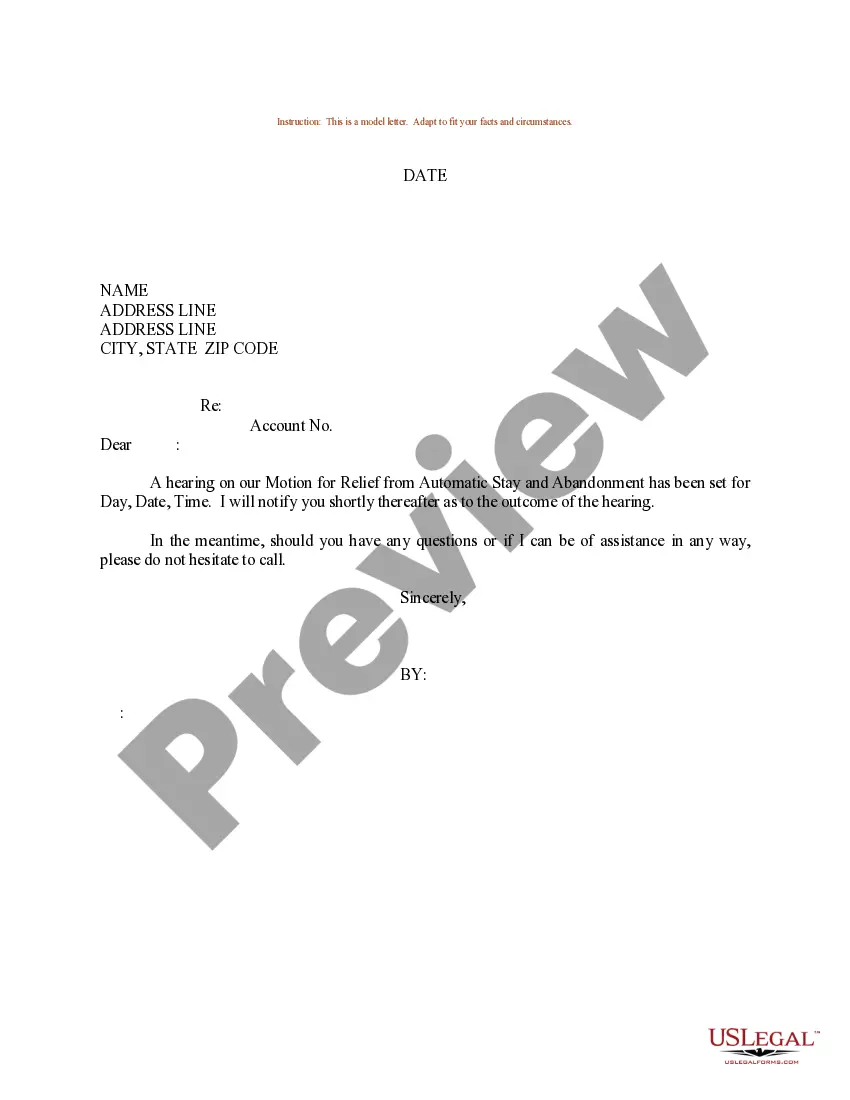

How to fill out Sample Letter For Second Motion For Examination Of Judgment - Debtor?
Whether for commercial reasons or personal affairs, everyone must address legal issues at some point in their lives.
Filling out legal documents requires meticulous attention, beginning with selecting the appropriate form template.
With an extensive US Legal Forms library available, you won’t need to waste time searching for the right template online. Make use of the library’s easy navigation to find the correct template for any circumstance.
- Identify the template you need by utilizing the search bar or browsing the catalogue.
- Review the form’s description to ensure it aligns with your situation, state, and locality.
- Click on the form’s preview to view it.
- If it is not the correct form, return to the search feature to find the Second Motion Examination With Graph template you need.
- Download the document when it meets your requirements.
- If you have a US Legal Forms profile, click Log in to access previously saved documents in My documents.
- If you do not have an account yet, you can purchase the form by clicking Buy now.
- Select the relevant pricing option.
- Complete the profile registration form.
- Choose your payment method: you can utilize a debit or credit card or a PayPal account.
- Select the file format you want and download the Second Motion Examination With Graph.
- Once downloaded, you can fill out the form using editing software or print it and complete it by hand.
Form popularity
FAQ
Graphs are powerful tools for understanding the motion of objects. They allow you to visualize data, identify trends, and make comparisons easily. During a second motion examination with graph, you can analyze acceleration, velocity, and other motion characteristics more effectively. Utilizing platforms like US Legal Forms can enhance your understanding by providing resources and templates that simplify the graphing process.
A flat line in a PT graph shows no slope, meaning no motion, and therefore at rest (v = 0). A positive slope in a PT graph is constant positive velocity (+v). A negative slope in a PT graph is constant backward motion (-v). A curved line represents an acceleration or deceleration (See the examples below)
To Derive 2nd equation of motion [Graphically] There's uniform acceleration a from A to B,and after time t the final Velocity is v which is equal to BC. The time t is represented by OC. Through construction we drew perpendicular CB from point C,and AD parallel to OC. BE is perpendicular to the point B to OE.
Summary. Motion can be represented by a position-time graph, which plots position relative to the starting point on the y-axis and time on the x-axis. The slope of a position-time graph represents velocity. The steeper the slope is, the faster the motion is changing.
There are three main types of graphs used to define the motion of an object in a straight line: displacement-time graphs, velocity-time graphs, and acceleration-time graphs.
Summary: A speed - time graph shows us how the speed of a moving object changes with time. The steeper the graph, the greater the acceleration. A horizontal line means the object is moving at a constant speed. A downward sloping line means the object is slowing down.