Sample Letter for Reference Letter for a School or College Scholarship Applicant - From Employer
Understanding this form
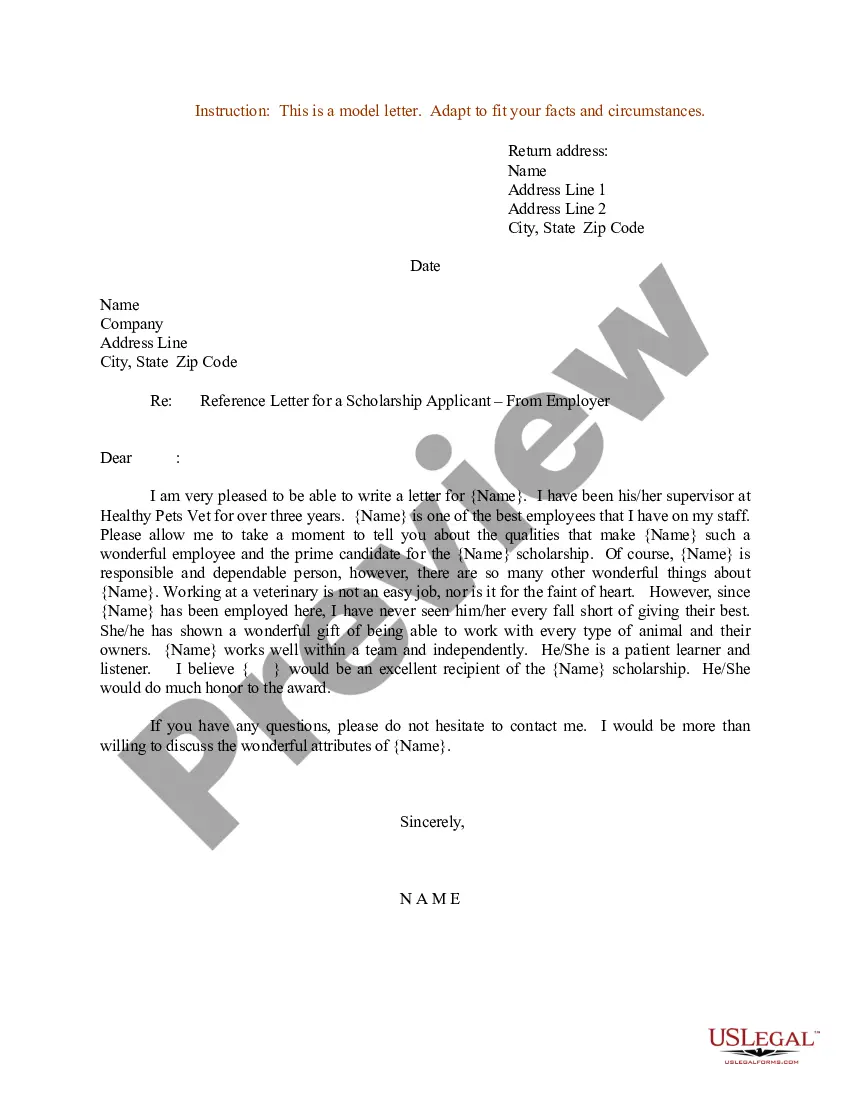
This form is a Sample Letter for Reference Letter for a School or College Scholarship Applicant - From Employer. It serves the purpose of providing a recommendation for an applicant seeking a scholarship, highlighting their qualifications and character from the perspective of their employer. This type of letter is critical in supporting the applicant's candidacy by offering insights into their work ethic and achievements, distinguishing it from general reference letters.
What’s included in this form
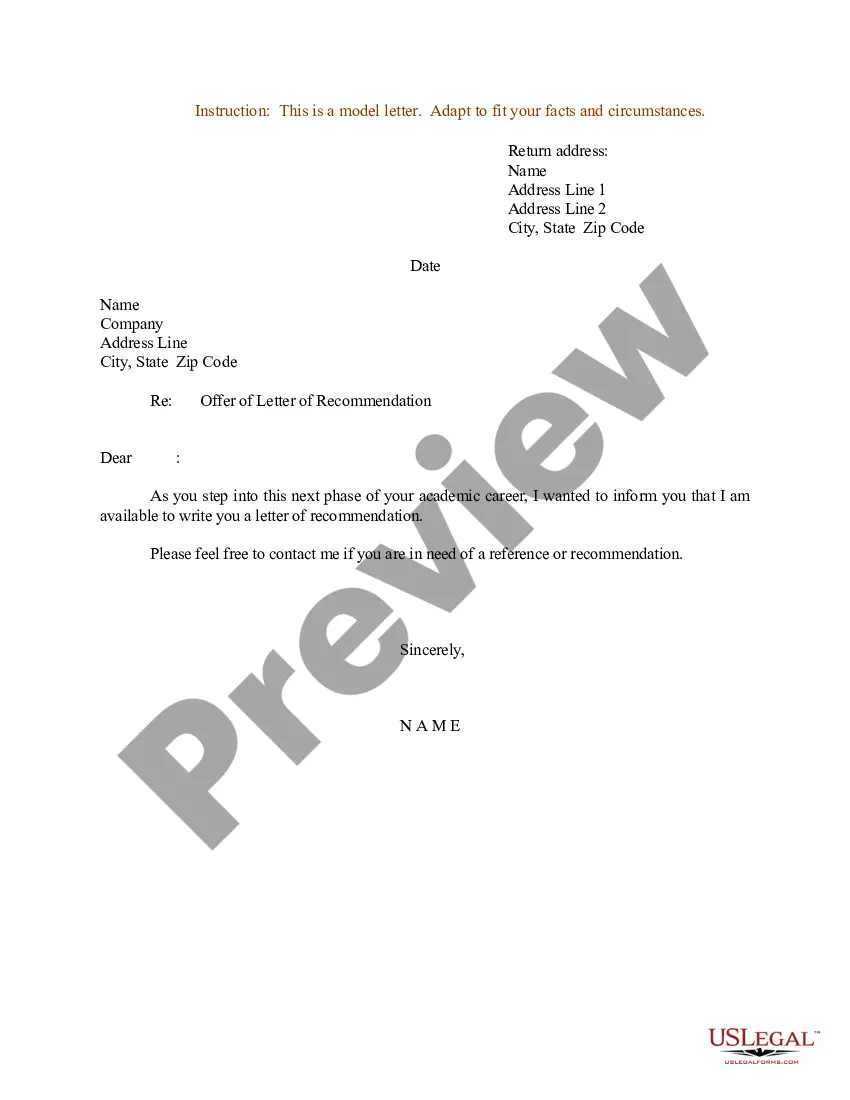
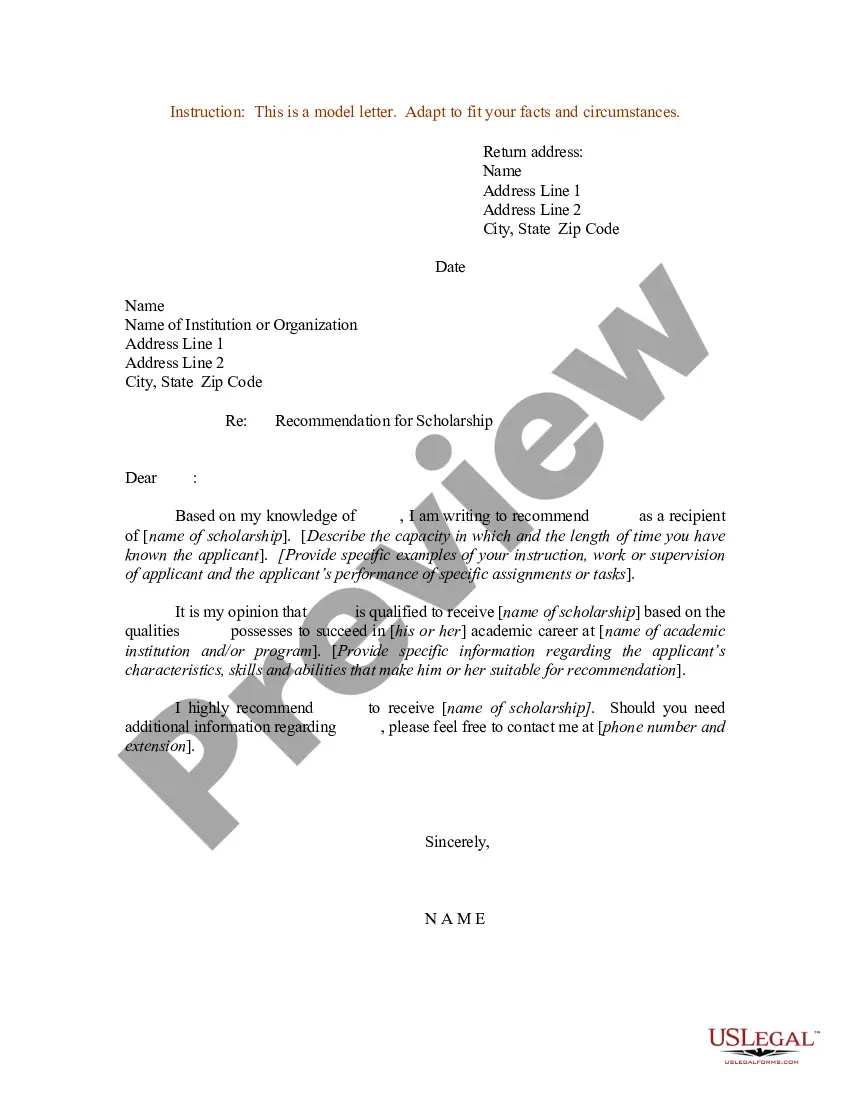
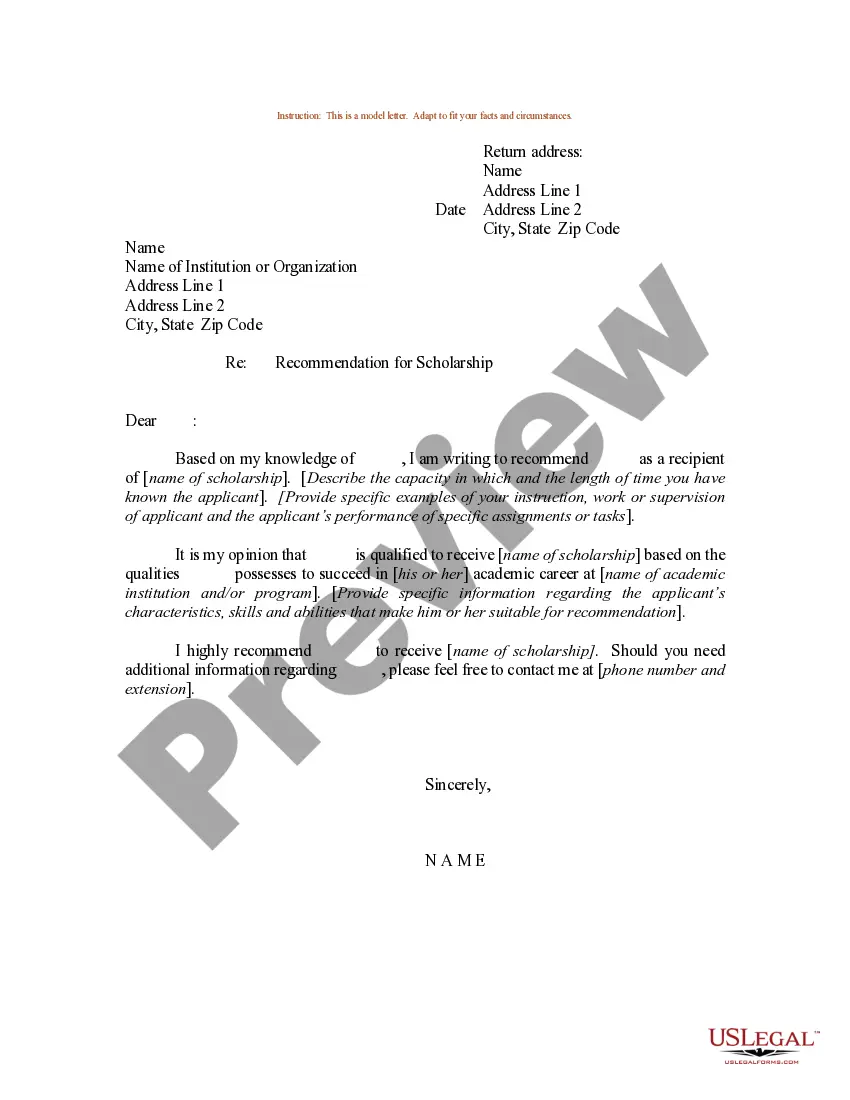
- Return address: Your name and address to ensure proper delivery.
- Date: The date on which the letter is written.
- Recipient's address: Details of the individual or organization receiving the letter.
- Subject line: Clearly states the reason for the letter.
- Body content: Provides details about the applicantâs skills, experience, and character, tailored to scholarship applications.
- Signature: Your name and title, reinforcing your authority to recommend the applicant.
When to use this document
This form should be utilized when an employer is asked to provide a reference for an employee or intern applying for a school or college scholarship. It is appropriate in cases where the applicant is seeking financial assistance to further their education and requires a strong endorsement to enhance their application.
Who should use this form
- Employers or supervisors of scholarship applicants.
- Managers or team leaders wanting to support an employeeâs educational aspirations.
- Individuals responsible for mentoring or supervising interns applying for scholarships.
Steps to complete this form
- Identify the return address, including your name and address.
- Insert the current date at the top of the letter.
- Fill in the recipient's address with all necessary details.
- Write a clear subject line indicating it is a reference letter for a scholarship applicant.
- Compose the body of the letter, detailing the applicant's qualifications and recommending them for the scholarship.
- Sign the letter with your name and title to validate your recommendation.
Does this document require notarization?
This form does not typically require notarization unless specified by local law. It is generally accepted as a formal recommendation without the need for a notary's acknowledgment.
Get your form ready online
Our built-in tools help you complete, sign, share, and store your documents in one place.
Make edits, fill in missing information, and update formatting in US Legal Forms—just like you would in MS Word.
Download a copy, print it, send it by email, or mail it via USPS—whatever works best for your next step.
Sign and collect signatures with our SignNow integration. Send to multiple recipients, set reminders, and more. Go Premium to unlock E-Sign.
If this form requires notarization, complete it online through a secure video call—no need to meet a notary in person or wait for an appointment.
We protect your documents and personal data by following strict security and privacy standards.

Make edits, fill in missing information, and update formatting in US Legal Forms—just like you would in MS Word.

Download a copy, print it, send it by email, or mail it via USPS—whatever works best for your next step.

Sign and collect signatures with our SignNow integration. Send to multiple recipients, set reminders, and more. Go Premium to unlock E-Sign.

If this form requires notarization, complete it online through a secure video call—no need to meet a notary in person or wait for an appointment.

We protect your documents and personal data by following strict security and privacy standards.
Common mistakes
- Failing to customize the content for the specific scholarship and applicant.
- Neglecting to proofread for spelling and grammatical errors.
- Using overly vague language that does not convey the applicant's strengths.
- Not including all necessary contact information for follow-up inquiries.
Benefits of using this form online
- Convenience: Accessible anytime for quick and easy completion.
- Editability: Easily editable to suit individual applicant's needs and details.
- Reliability: Drafted by legal professionals to meet the necessary requirements.
What to keep in mind
- This letter is essential for employers supporting scholarship applicants.
- A well-structured letter can significantly impact the applicant's chances of receiving a scholarship.
- Using this form ensures compliance with standard expectations for reference letters.
Looking for another form?
Form popularity
FAQ
A Letter of Recommendation for Scholarship is a letter created by someone who is in a position of authority that can give attestation to the capacity of an applicant to be granted a scholarship. Scholarship applications can be difficult. Only a few people are accepted or shortlisted from a long list of applicants.
Think carefully about saying yes. Focus on the particular school. Collect information. Mention how you know the student. Include specific examples. Remain positive. Avoid cliches. Share your contact information.
An introduction that identifies who you are, your relationship to the student, and how long you've known them. Your general observations and thoughts about the student's academic strengths, personal qualities, and readiness for college.
Think carefully about saying yes. Focus on the particular school. Collect information. Mention how you know the student. Include specific examples. Remain positive. Avoid cliches. Share your contact information.
To Whom It May Concern: {Name} would be an excellent choice for the scholarship you are offering. I have known {Name} for {length of time} in my capacity as {teacher, friend, etc.}, and I have come to know {him/her} quite well in that time.
Introduction. Body of the Letter: Why the Student Deserves the Scholarship. Your Contact Information. Lukewarm Praise. Non-Descriptive Reasons Why the Student Deserves the Scholarship. Generic Writing.
A scholarship letter of recommendation should fill an entire page (approximately 300 500 words) and contain a letterhead, an introduction, 2 body paragraphs, and a conclusion.
Teachers and professors. Former or current employers. Clergy members (preachers, pastors, rabbis, imams, etc.) Coaches. School counselors and advisers. Leaders of an organization you are associated with.