Utah Subcontractors Package
Understanding this form package
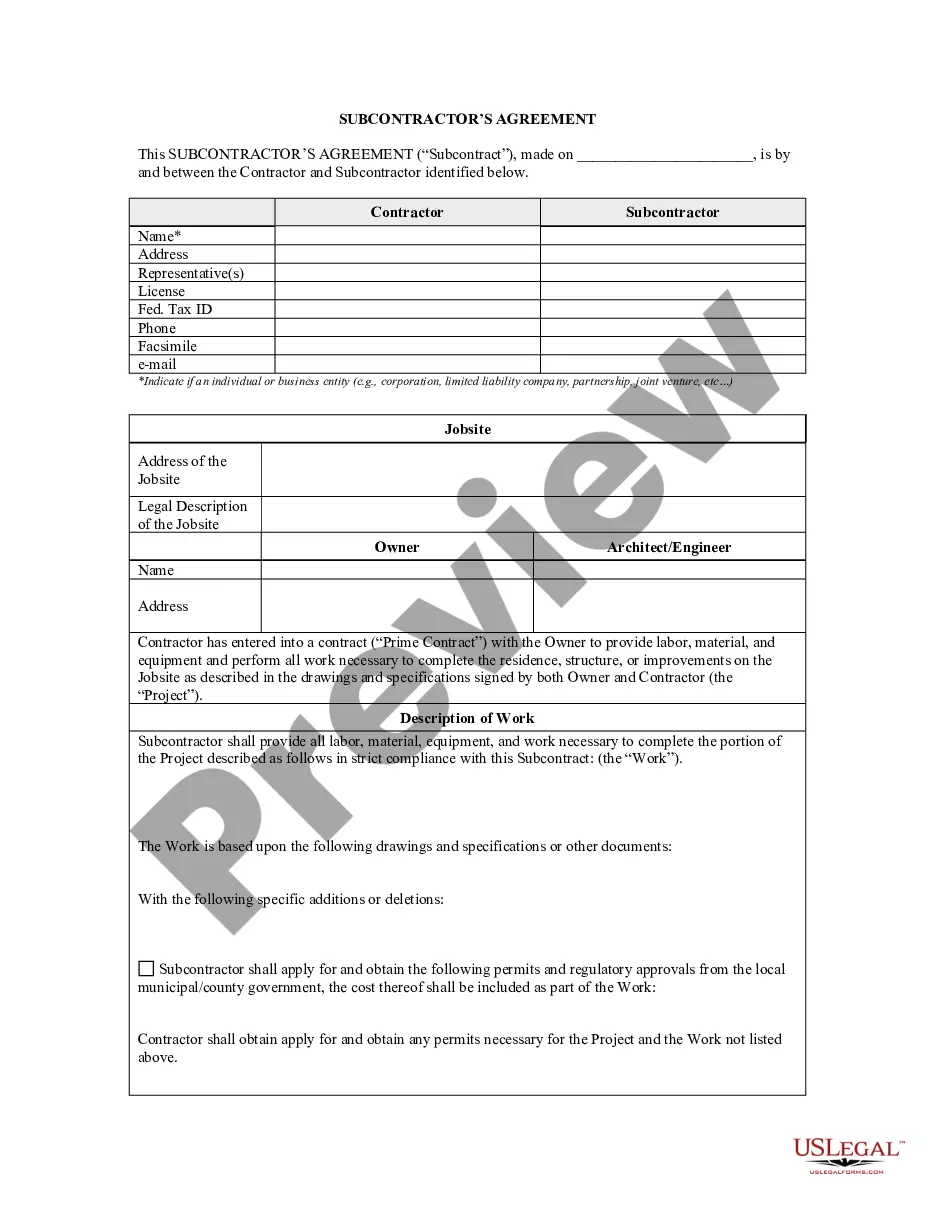
The Utah Subcontractors Package is a comprehensive set of legal documents designed specifically for subcontractors in the construction industry. This package includes essential forms that help manage construction projects while ensuring legal protections are in place. Unlike other generic packages, the Utah Subcontractors Package is tailored to comply with Utah state laws, making it a reliable choice for subcontractors working in this region.
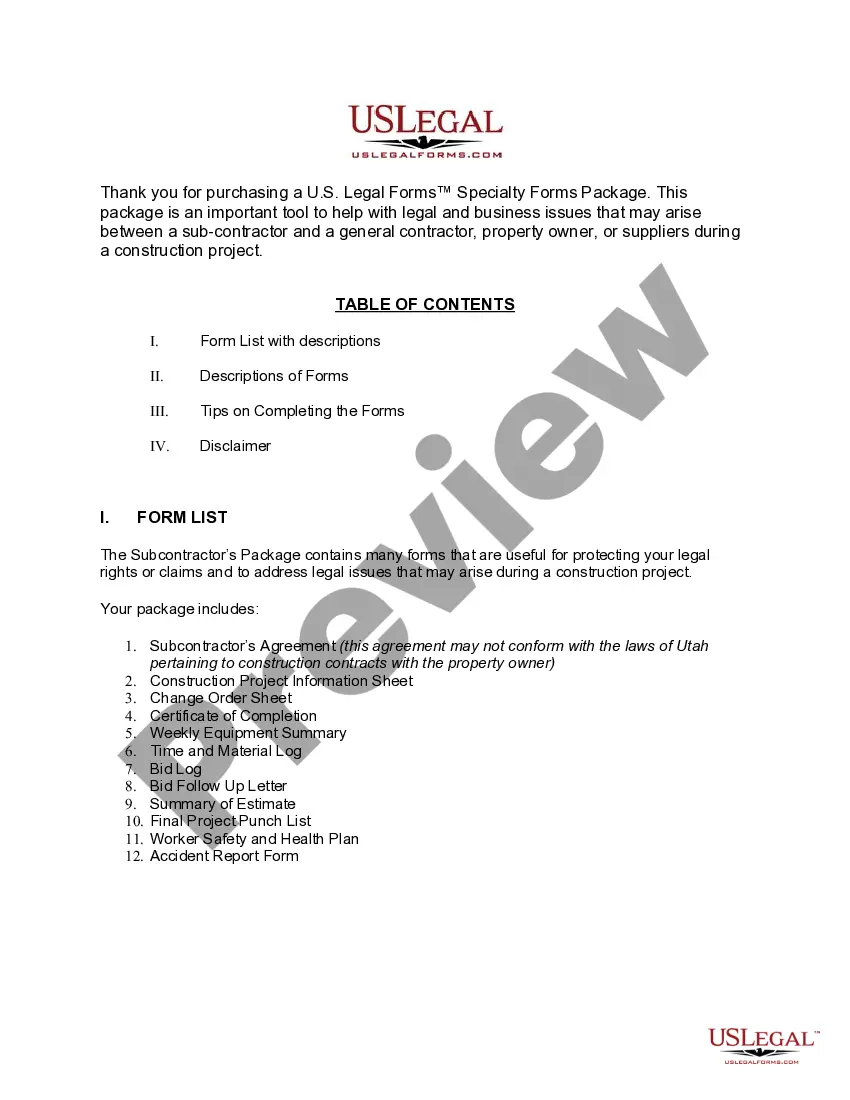
Forms included in this package
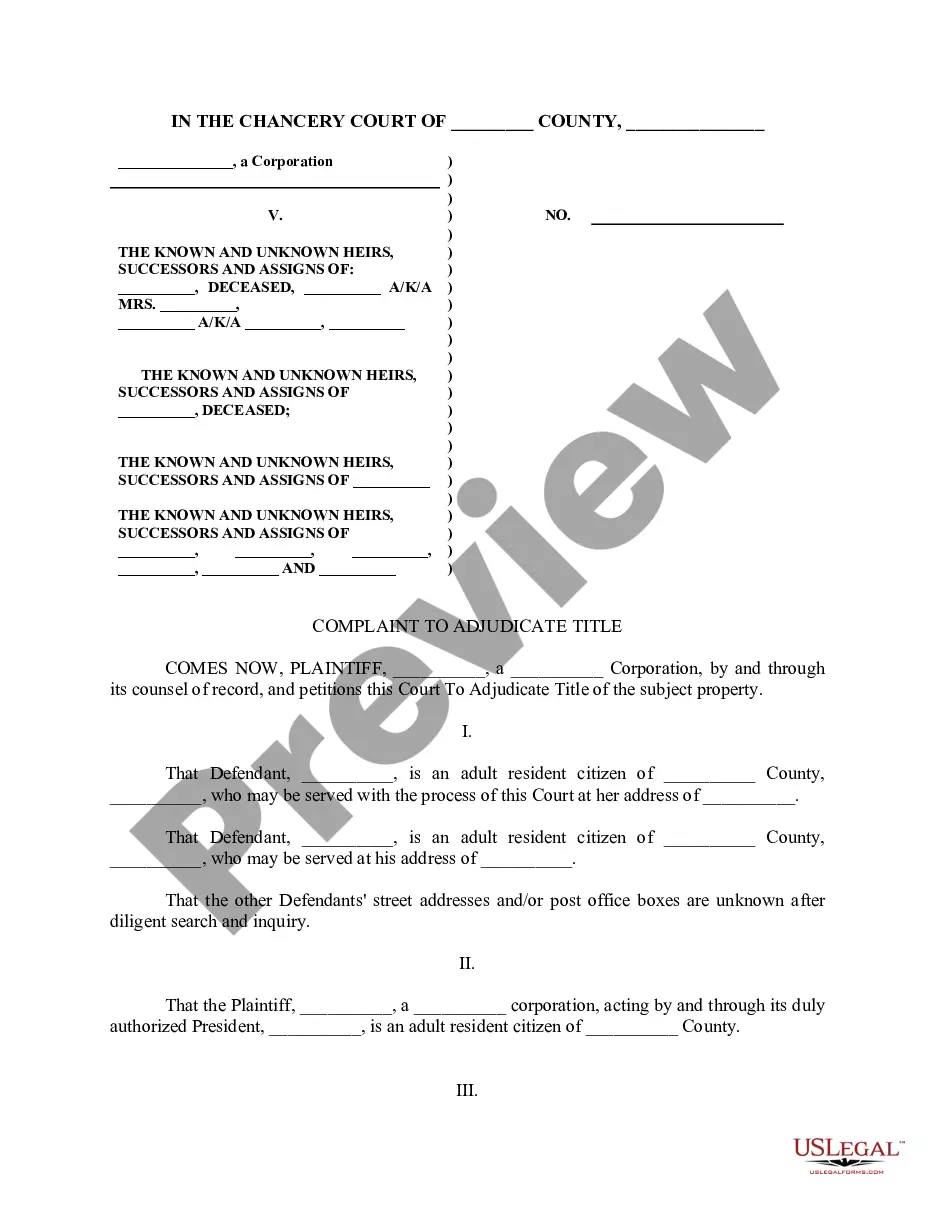
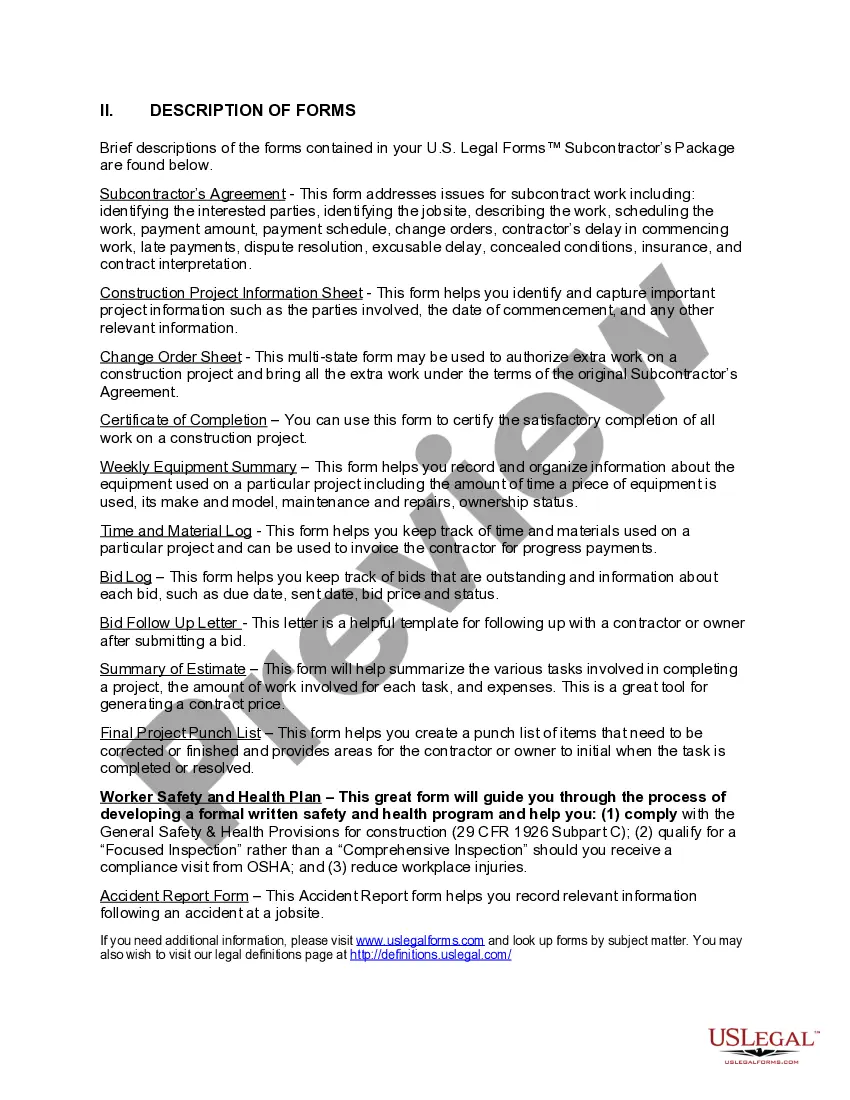
- Subcontractor's Agreement
- Contractor's Weekly Equipment Summary
- Contractor's Time and Materials Log
- Contractor's Bid Log
- Contractor's Bid Follow Up Letter
- Contractor's Summary of an Estimate
- Contractor's Final Punch List
- Construction Accident Report
- Construction Safety and Health Plan
- Change Order for Construction or Repairs by Contractor
- Certification of Completion by Contractor
- Construction Project Information Sheet


When this form package is needed
This package is particularly useful in several scenarios, including:
- When entering into agreements with general contractors or property owners.
- For tracking project details and changes throughout the construction process.
- When needing to report or document project completion and safety measures.
- For managing equipment usage and documenting materials for invoicing.
- In situations where safety and accident reports need to be filed.
Who should use this form package
- Subcontractors looking for structured agreements and project management tools.
- Construction professionals aiming to protect their legal rights and fulfill state regulations.
- Individuals or businesses involved in construction projects who require comprehensive documentation.
Completing these forms step by step
- Review the included forms to familiarize yourself with their purposes and requirements.
- Identify the relevant parties involved in your project and enter their details accurately.
- Enter specific dates and relevant information on each form as needed.
- Obtain necessary signatures from all involved parties where indicated.
- Keep copies of all completed forms for your records and future reference.
Notarization guidance for this package
Forms in this package typically do not require notarization. However, certain states or document types may still need it. US Legal Forms provides online notarization powered by Notarize, available 24/7 for your convenience.
Get your form ready online
Our built-in tools help you complete, sign, share, and store your documents in one place.
Make edits, fill in missing information, and update formatting in US Legal Forms—just like you would in MS Word.
Download a copy, print it, send it by email, or mail it via USPS—whatever works best for your next step.
Sign and collect signatures with our SignNow integration. Send to multiple recipients, set reminders, and more. Go Premium to unlock E-Sign.
If this form requires notarization, complete it online through a secure video call—no need to meet a notary in person or wait for an appointment.
We protect your documents and personal data by following strict security and privacy standards.

Make edits, fill in missing information, and update formatting in US Legal Forms—just like you would in MS Word.

Download a copy, print it, send it by email, or mail it via USPS—whatever works best for your next step.

Sign and collect signatures with our SignNow integration. Send to multiple recipients, set reminders, and more. Go Premium to unlock E-Sign.

If this form requires notarization, complete it online through a secure video call—no need to meet a notary in person or wait for an appointment.

We protect your documents and personal data by following strict security and privacy standards.
Common mistakes
- Neglecting to obtain all necessary signatures before commencing work.
- Failing to complete the Change Order Sheet when additional work is needed.
- Not maintaining accurate records in the Weekly Equipment Summary and Time and Material Log.
- Overlooking safety requirements outlined in the Worker Safety and Health Plan.
- Using outdated forms that may not comply with current state laws.
Why use this package online
- Immediate access to legally vetted forms that save time and effort.
- Edit and customize forms as needed to fit specific project requirements.
- Reliable and up-to-date documentation that complies with state laws.
- The convenience of downloading forms instantly from any device.
Legal use & context
- The forms are designed to help subcontractors establish clear agreements and maintain compliance with Utah construction laws.
- Properly executed documents contribute to enforceability and can protect against potential disputes.
- Legal advice is recommended for complex situations or disputes that may arise during construction projects.
What to keep in mind
- The Utah Subcontractors Package contains crucial legal documents tailored for construction projects in Utah.
- It aids subcontractors in managing their work effectively while ensuring compliance with state law.
- Accurate completion of forms is essential for protecting rights and interests in contractual agreements.
Looking for another form?
Form popularity
FAQ
First-tier Subcontractor means any Subcontractor that has a contract with the General Contractor.First-tier Subcontractor means a subcontractor who contracts directly with the construction manager at risk.
Add your chosen salary and overhead costs together. Multiply this total by your profit margin. Divide the total by your annual billable hours to arrive at your hourly rate: $99,000 ÷ 1,920 = $51.56. Finally, multiply your hourly rate by 8 to reach your day rate.
The subcontracting costs are based on the gross input of the end items. The costs are calculated by multiplying the end item quantity displayed in the Ordered Quantity field of the Purchase Order Lines (tdpur4101m000) session by the subcontracting rate factor and the subcontracting rate.
A rule of thumb for independent contractors is that the vendor should be allowed to mark up your pay rate by about 15 percent when billing the client. This allows the vendor a respectable profit without making the bill rate outrageous.
You can expect to pay around $50 $100 per hour for a contractor and $40 $50 per hour for a subcontractor or a helper if you can find one who's willing to work at that particular rate. Be extra cautious about people who accept an hourly rate.
All subcontractors must file and pay taxes including state, local and federal income and self-employment taxes on their own. The general contractor must file IRS Form 1099-MISC if the subcontractor earns over $600.
Subcontractor Costs means all costs incurred by subcontractors for the project, including labor and non-labor costs.
The payment bond is backed by a surety company, and protects the owner and subcontractors. If a general contractor refuses to pay his subcontractors, they can make a claim against the payment bond. The surety company will pay out the subcontractors for at least part of their money and take the contractor to court.
The disadvantages contractors doing this work lie in costs: The hourly expenses are high, and the professionals are independent in that they don't report to supervisors inside the company. These factors make it challenging to control the costs of these subcontracts.