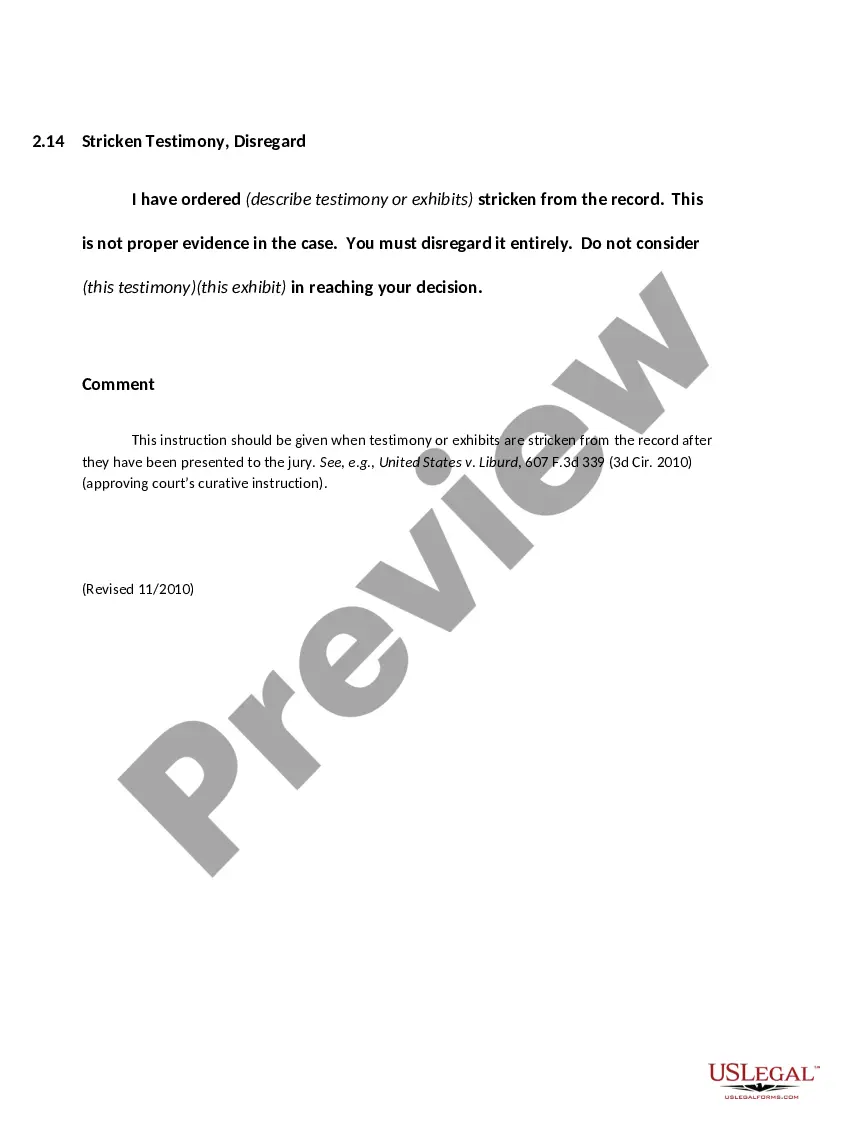
Stricken Testimony, Disregard
What this document covers
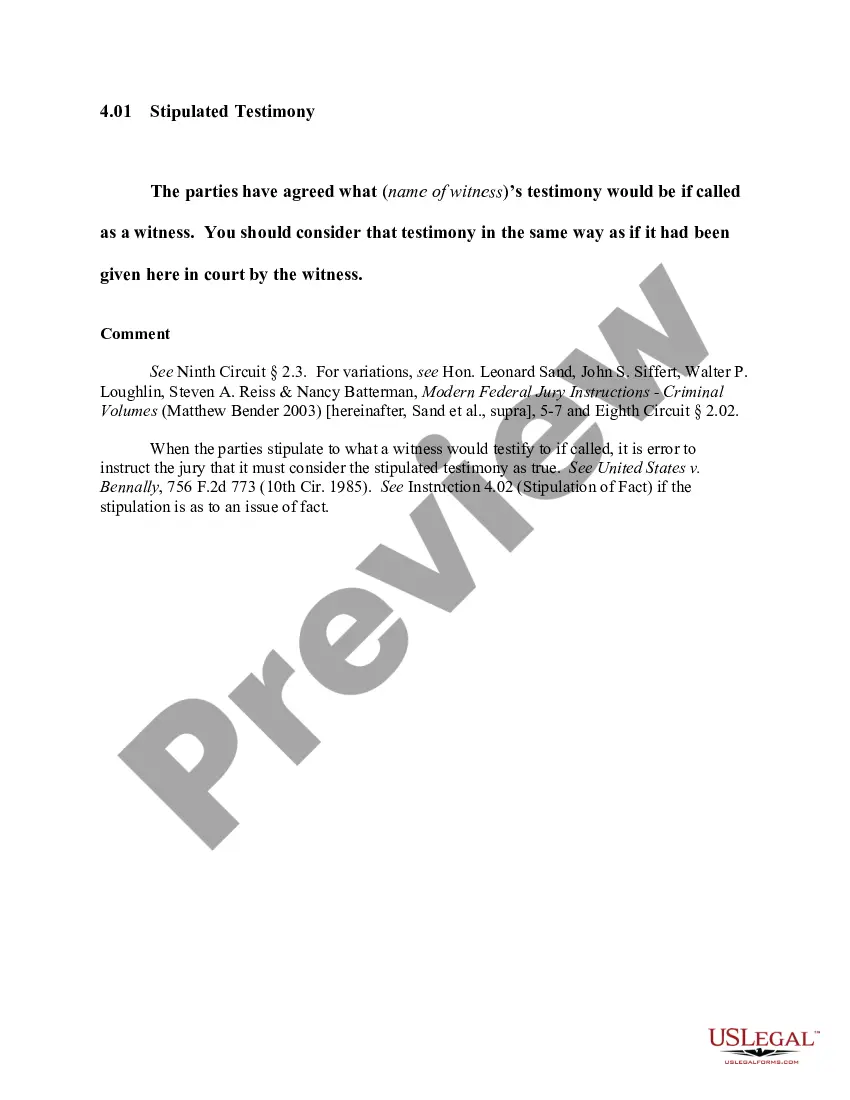
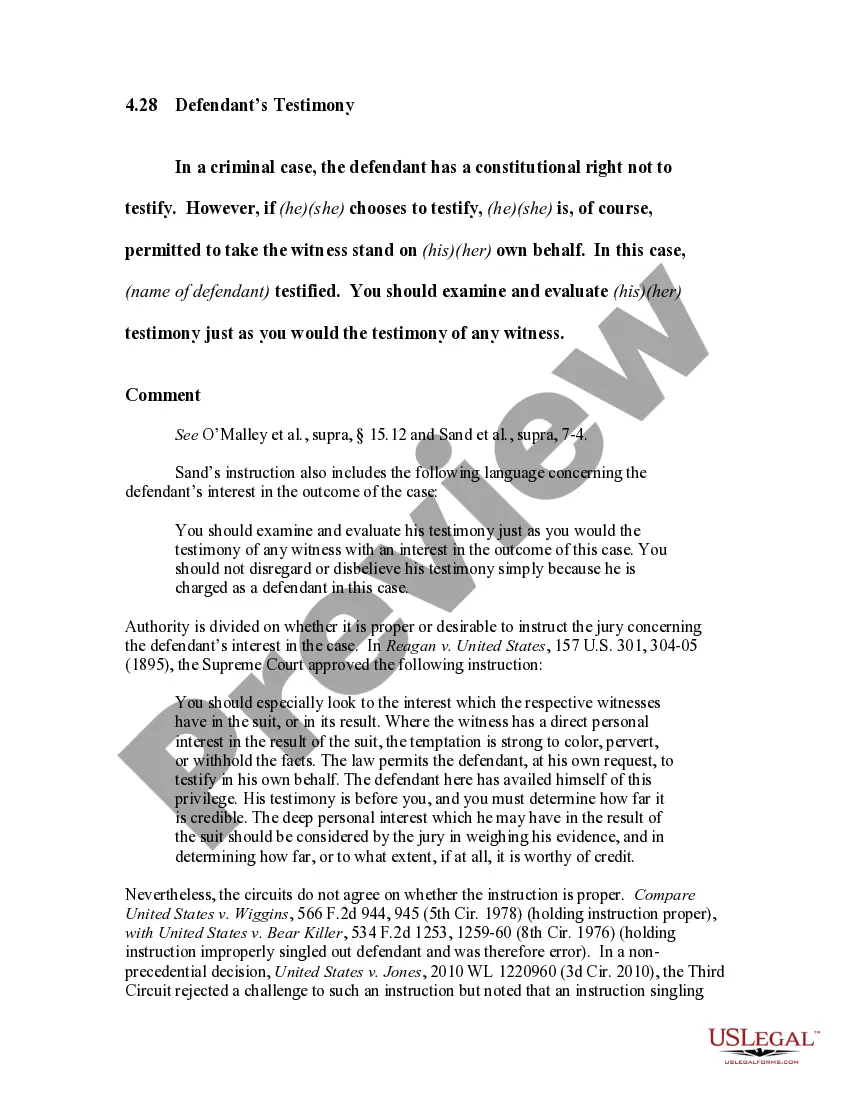
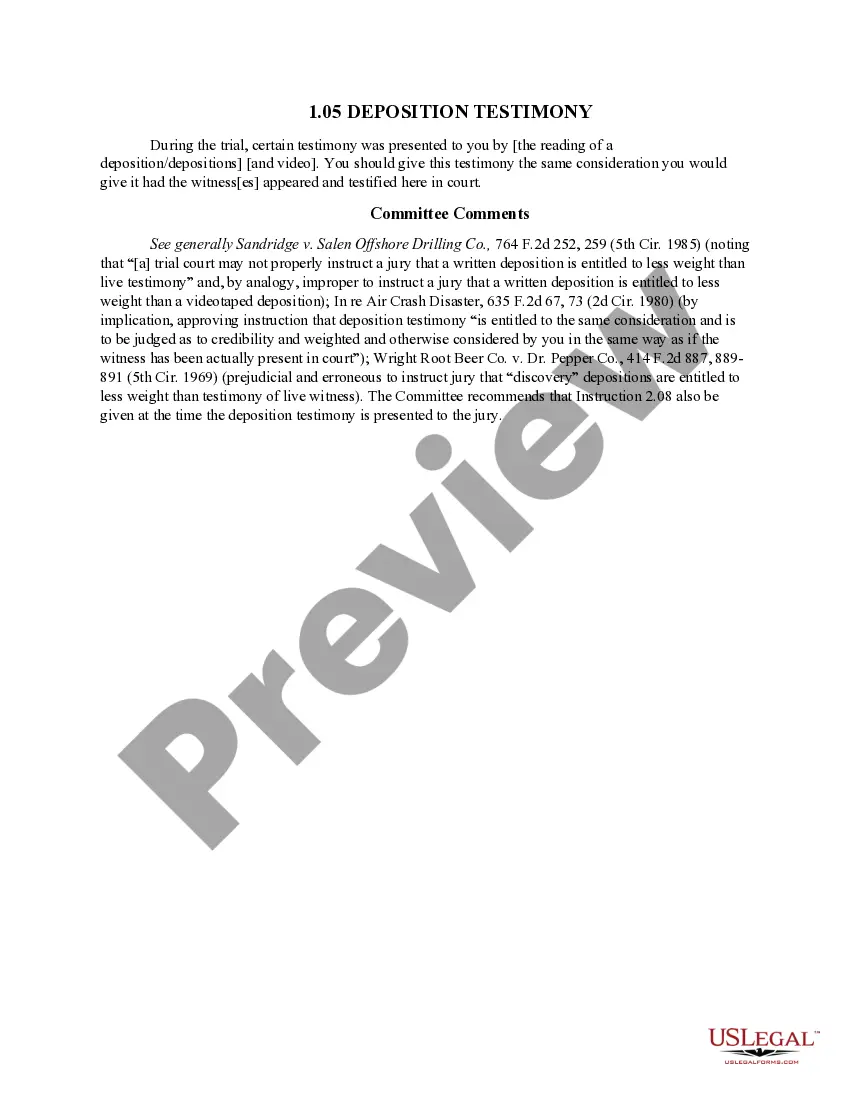
The Stricken Testimony, Disregard form is a legal instruction provided by a judge to a jury. Its purpose is to clarify that certain testimony or exhibits presented during the trial are not to be considered as evidence. This form is used when the court has ordered specific information to be disregarded to ensure a fair trial. Unlike other forms that may contain evidence or legal arguments, this form focuses solely on instructing the jury on how to handle stricken information.
What’s included in this form
- Description of the testimony or exhibit being stricken
- Instruction to the jury to disregard the specified information
- Clarification that the stricken testimony or exhibit should not influence their decision
- A reference to court precedents for using such instructions
Situations where this form applies
This form should be used in a courtroom setting when a judge decides that certain testimony or exhibits are inadmissible and must be removed from the record. It is commonly applied during trials to prevent jurors from being influenced by evidence that is not legally accepted, ensuring that their verdict is based solely on admissible information.
Who this form is for
- Judges issuing instructions to juries in criminal cases
- Attorneys representing clients in trial settings
- Court clerks preparing trial documentation
Instructions for completing this form
- Identify and describe the specific testimony or exhibit to be stricken.
- Clearly instruct the jury to disregard the stricken information.
- Use plain language to ensure the jury understands the instruction.
- Provide context or reasoning, if necessary, based on legal precedent.
- Review the instruction for clarity before delivering it to the jury.
Does this document require notarization?
This form does not typically require notarization to be legally valid. However, some jurisdictions or document types may still require it. US Legal Forms provides secure online notarization powered by Notarize, available 24/7 for added convenience.
Get your form ready online
Our built-in tools help you complete, sign, share, and store your documents in one place.
Make edits, fill in missing information, and update formatting in US Legal Forms—just like you would in MS Word.
Download a copy, print it, send it by email, or mail it via USPS—whatever works best for your next step.
Sign and collect signatures with our SignNow integration. Send to multiple recipients, set reminders, and more. Go Premium to unlock E-Sign.
If this form requires notarization, complete it online through a secure video call—no need to meet a notary in person or wait for an appointment.
We protect your documents and personal data by following strict security and privacy standards.

Make edits, fill in missing information, and update formatting in US Legal Forms—just like you would in MS Word.

Download a copy, print it, send it by email, or mail it via USPS—whatever works best for your next step.

Sign and collect signatures with our SignNow integration. Send to multiple recipients, set reminders, and more. Go Premium to unlock E-Sign.

If this form requires notarization, complete it online through a secure video call—no need to meet a notary in person or wait for an appointment.

We protect your documents and personal data by following strict security and privacy standards.
Typical mistakes to avoid
- Failing to explicitly identify the evidence being stricken.
- Using unclear language that confuses jurors.
- Neglecting to reference relevant legal precedents.
Benefits of completing this form online
- Convenience of accessing the template from any location.
- Editability allows for quick adjustments to fit specific cases.
- Reliability, as templates are drafted by licensed attorneys.
What to keep in mind
- The Stricken Testimony, Disregard form serves to instruct jurors on what evidence they cannot consider.
- It should be used when certain information has been deemed inadmissible in court.
- Clear and precise language is crucial for effective jury instructions.
Looking for another form?
Form popularity
FAQ
An attorney can show jurors a witness is not credible by showing: 1) inconsistent statements, 2) reputation for untruthfulness, 3) defects in perception, 4) prior convictions that show dishonesty or untruthfulness, and 5) bias.
Under certain circumstances, relevant evidence will be inadmissible if its probative value is substantially outweighed by the danger of unfair prejudice, confusing the issues, misleading the jury, undue delay, wasting time, or needlessly presenting cumulative.
It is often used in an attempt to have an entire cause of action removed ("stricken") from the court record. A motion to strike is also made orally during trial to ask the judge to order "stricken" answers by a witness in violation of rules of evidence (laws covering what is admissible in trial).
Impeachment is defined as an attempt to show that the witness may not be testifying truthfully. Either party may impeach a witness, including the party who originally called the witness to testify.
Generally speaking, jurors will ignore inadmissible evidence when told by the judge to disregard that evidence. increases the likelihood of a conviction on a subsequent charge.
The way that a witness comes off, their personality, the consistency of their statements, their background, if they have a criminal past, their connection to the case, and more can all go into what makes up a trustworthy witness or one who is suspect.
A witnesses may be impeached with evidence that shows a defect in his or her perception, memory, or truthfulness, such as evidence of bias, mistake, character for untruthfulness, or prior inconsistent statements.
The three most often used methods to impair witness credibility include prior inconsistent statements, character evidence and case-specific impeachment.