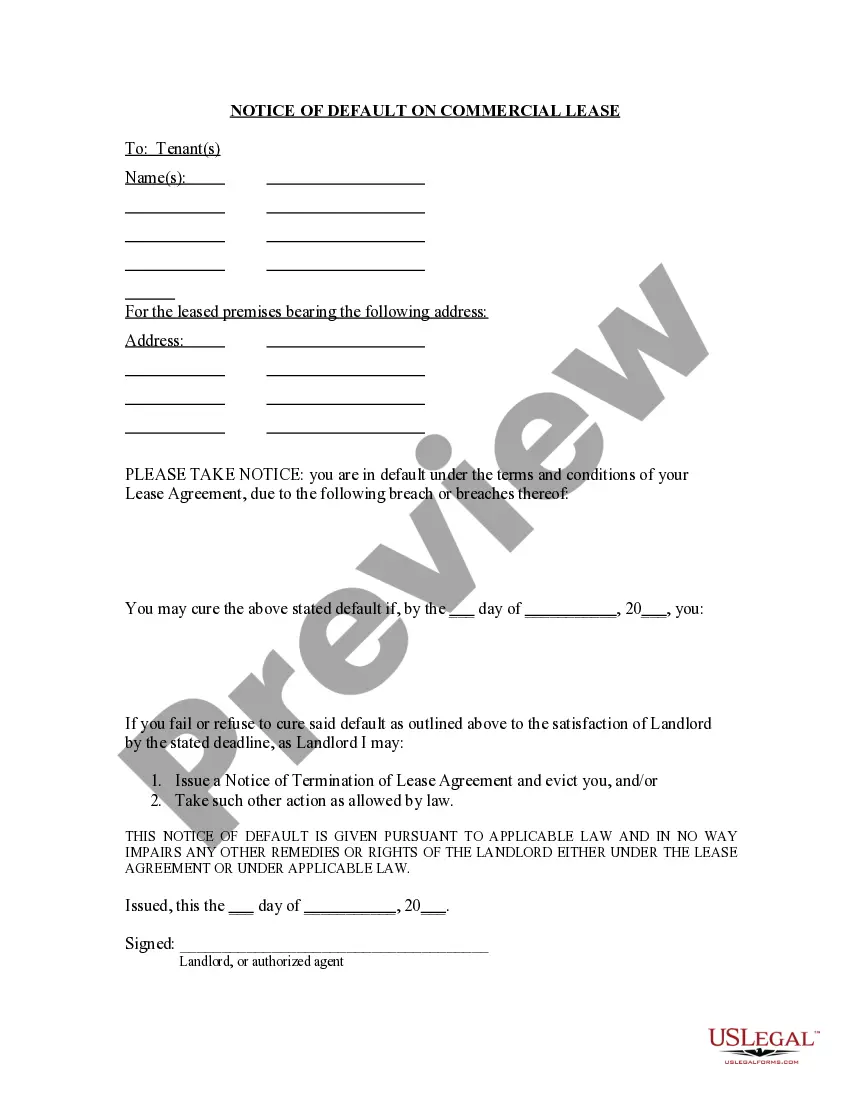
In landlord-tenant law, default refers to the failure of a tenant to timely pay rent due. In anticipation of such an occurence, landlords commonly require a new tenant to pay a security deposit, which may be used to remedy defaults in payment of rent and other monetary obligations under the rental agreement. In general, the landlord is required to give the tenant notice of the default before bringing eviction proceedings or applying security deposit proceeds to the payment in default. The fixing of a definite default date for payment of rent can be critical if it becomes necessary to evict a tenant for a default in the payment of rent. Landlords often require a background and/or reference check on prospective tenants in an attempt to minimize defaults in rent payments.
Commercial Lease Agreement Maryland
Description
How to fill out Maryland Letter From Landlord To Tenant As Notice Of Default On Commercial Lease?
Welcome to the largest legal documents library, US Legal Forms. Right here you can find any example such as Maryland Letter from Landlord to Tenant as Notice of Default on Commercial Lease templates and save them (as many of them as you wish/require). Make official papers with a several hours, instead of days or weeks, without spending an arm and a leg on an lawyer. Get the state-specific sample in clicks and be confident with the knowledge that it was drafted by our accredited attorneys.
If you’re already a subscribed consumer, just log in to your account and click Download next to the Maryland Letter from Landlord to Tenant as Notice of Default on Commercial Lease you want. Due to the fact US Legal Forms is online solution, you’ll always get access to your downloaded files, no matter the device you’re utilizing. Locate them in the My Forms tab.
If you don't come with an account yet, just what are you awaiting? Check our guidelines below to get started:
- If this is a state-specific document, check out its applicability in your state.
- View the description (if readily available) to understand if it’s the proper example.
- See a lot more content with the Preview option.
- If the example matches all of your needs, just click Buy Now.
- To make an account, choose a pricing plan.
- Use a card or PayPal account to sign up.
- Save the template in the format you want (Word or PDF).
- Print the file and complete it with your/your business’s information.
When you’ve filled out the Maryland Letter from Landlord to Tenant as Notice of Default on Commercial Lease, send out it to your lawyer for confirmation. It’s an extra step but a necessary one for making confident you’re totally covered. Join US Legal Forms now and get thousands of reusable examples.