Texas Executor's Deed of Distribution - Individual Executor to Individual Beneficiary
What is this form?
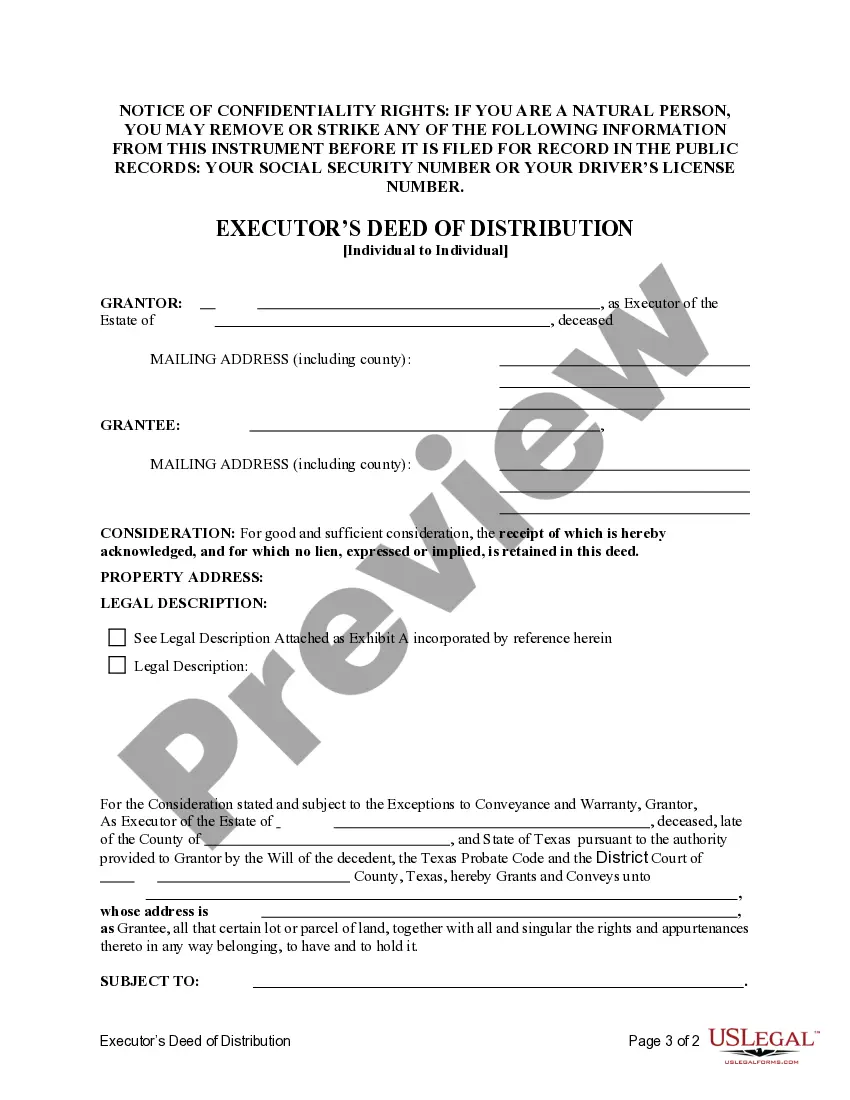
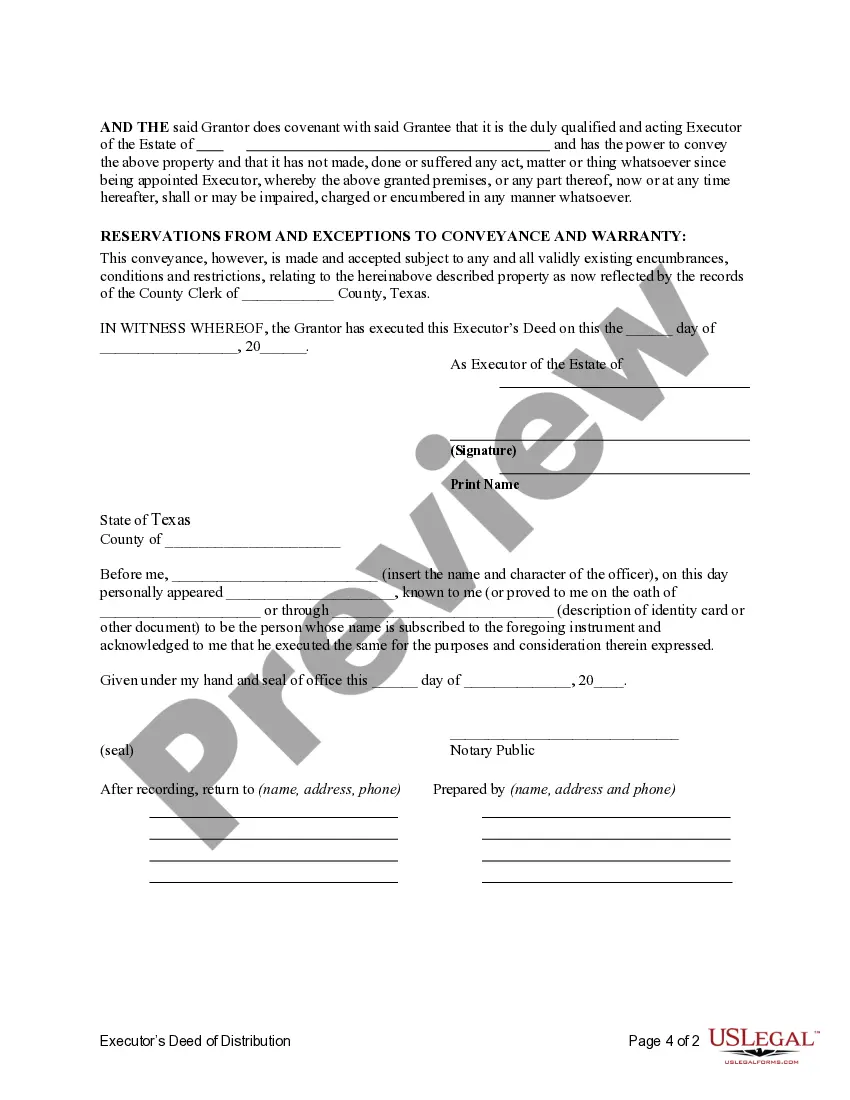
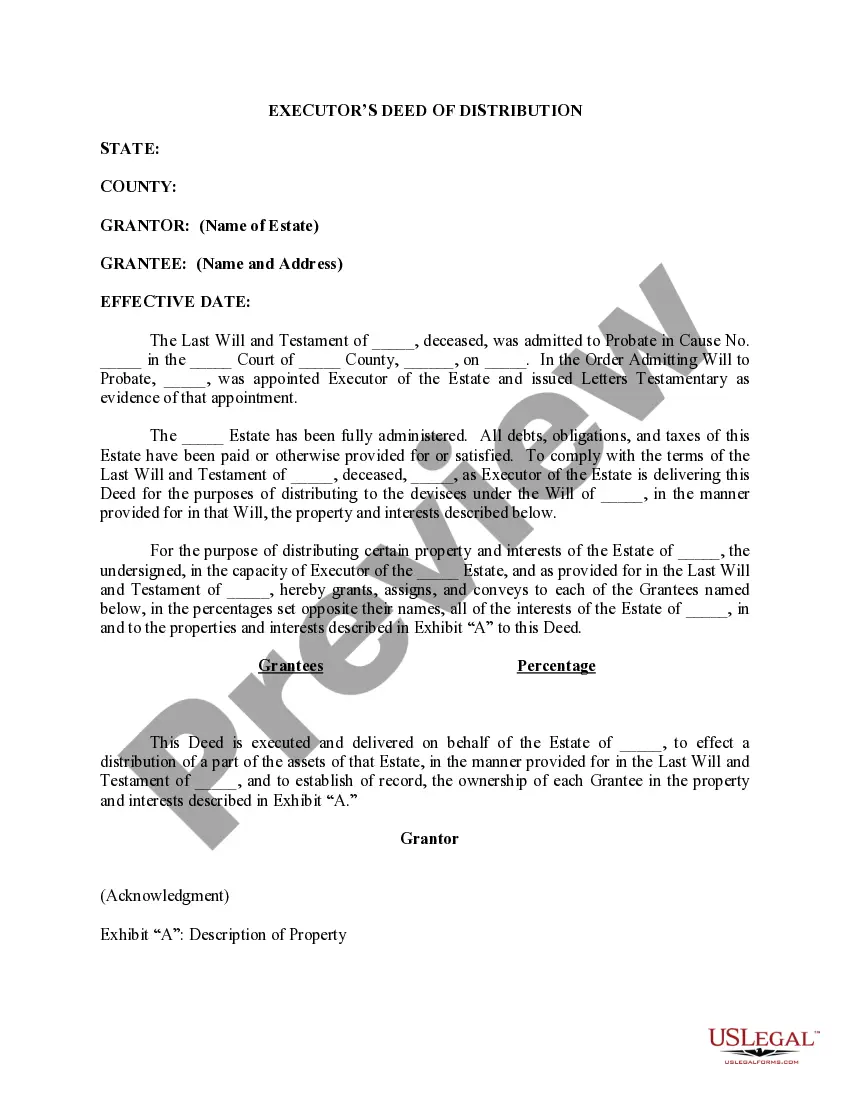
The Executor's Deed of Distribution is a legal document used to transfer property from an estate to its beneficiaries according to the instructions outlined in a will. This form is specifically designed for situations where an individual executor is distributing property to an individual beneficiary. Unlike other deeds, this document provides warranties of title only for the time the executor held the property, ensuring clarity in property ownership transfer.
Key parts of this document
- Identification of the Grantor (executor) and Grantee (beneficiary).
- Description of the property being conveyed.
- Warranties regarding the title of the property.
- Notary acknowledgement section for legal verification.

Situations where this form applies
This form is needed when an executor of an estate is ready to distribute property to beneficiaries as specified in a will. It is particularly useful in settling estates where the executor needs to formally transfer ownership of real property to an individual named in the will, thereby completing their duties as executor.
Who should use this form
- Executors of estates who are responsible for the distribution of property.
- Beneficiaries who are entitled to receive property under a will.
- Individuals seeking a legally recognized method to transfer property post-death of the owner.
How to complete this form
- Identify the Grantor by entering the executor's name.
- Specify the Grantee's name, which is the beneficiary receiving the property.
- Provide a detailed description of the property being conveyed.
- Complete the notary section to ensure legal validity.
- Sign and date the document in the presence of a notary public.
Does this document require notarization?
Yes, this form must be notarized to be legally valid. It requires the signature of a notary public, which can be conveniently achieved through US Legal Forms' integrated online notarization services, offering secure video calls and legal equivalence without the need to travel.
Get your form ready online
Our built-in tools help you complete, sign, share, and store your documents in one place.
Make edits, fill in missing information, and update formatting in US Legal Forms—just like you would in MS Word.
Download a copy, print it, send it by email, or mail it via USPS—whatever works best for your next step.
Sign and collect signatures with our SignNow integration. Send to multiple recipients, set reminders, and more. Go Premium to unlock E-Sign.
If this form requires notarization, complete it online through a secure video call—no need to meet a notary in person or wait for an appointment.
We protect your documents and personal data by following strict security and privacy standards.

Make edits, fill in missing information, and update formatting in US Legal Forms—just like you would in MS Word.

Download a copy, print it, send it by email, or mail it via USPS—whatever works best for your next step.

Sign and collect signatures with our SignNow integration. Send to multiple recipients, set reminders, and more. Go Premium to unlock E-Sign.

If this form requires notarization, complete it online through a secure video call—no need to meet a notary in person or wait for an appointment.

We protect your documents and personal data by following strict security and privacy standards.
Common mistakes to avoid
- Failing to accurately describe the property being transferred.
- Not including both the Grantor and Grantee's full legal names.
- Forgetting to have the form notarized.
Benefits of completing this form online
- Convenience of completing the form from home.
- Editable fields allow for easy adjustments to the document.
- Access to forms drafted by licensed attorneys ensures legal reliability.
Looking for another form?



Form popularity
FAQ
Naming someone as the executor of your estate does not preclude him or her from inheriting from you. In fact, the executor can and often is a beneficiary of the estate.Distributing the remaining assets to your beneficiaries.
If you resign as executor after having started probate court proceedings, you can submit your resignation to the probate court and provide a written record of what (if anything) you have done. The court will then appoint someone to take your place.
Once the COURT appoints you as executor, you will record an affidavit of death of joint tenant to get your mother's name of the property. Then, when you get an order for final distribution, you will record a certified copy to get the property into the names of the beneficiaries under the will.
Depending on the circumstances, the executor might transfer the title to heirs as directed in the decedent's will or sell the property outright.In any case, the executor must issue a deed for the transfer. Note that executor's deeds do NOT typically include a general warranty on the title.
If you are an executor and you do not wish to act You can appoint someone else to apply for probate on your behalf.
Before distributing assets to beneficiaries, the executor must pay valid debts and expenses, subject to any exclusions provided under state probate laws.The executor must maintain receipts and related documents and provide a detailed accounting to estate beneficiaries.
To change the executor of a will, you must be a person with interest in the estate typically a beneficiary or a creditor. After gathering evidence of the executor's wrongdoing, you need to file a petition with the probate court to have the executor removed so a new executor can be appointed.
This involves filing a petition with the court overseeing probate, asking a judge to remove the executor you named and to transfer the job to another individual.