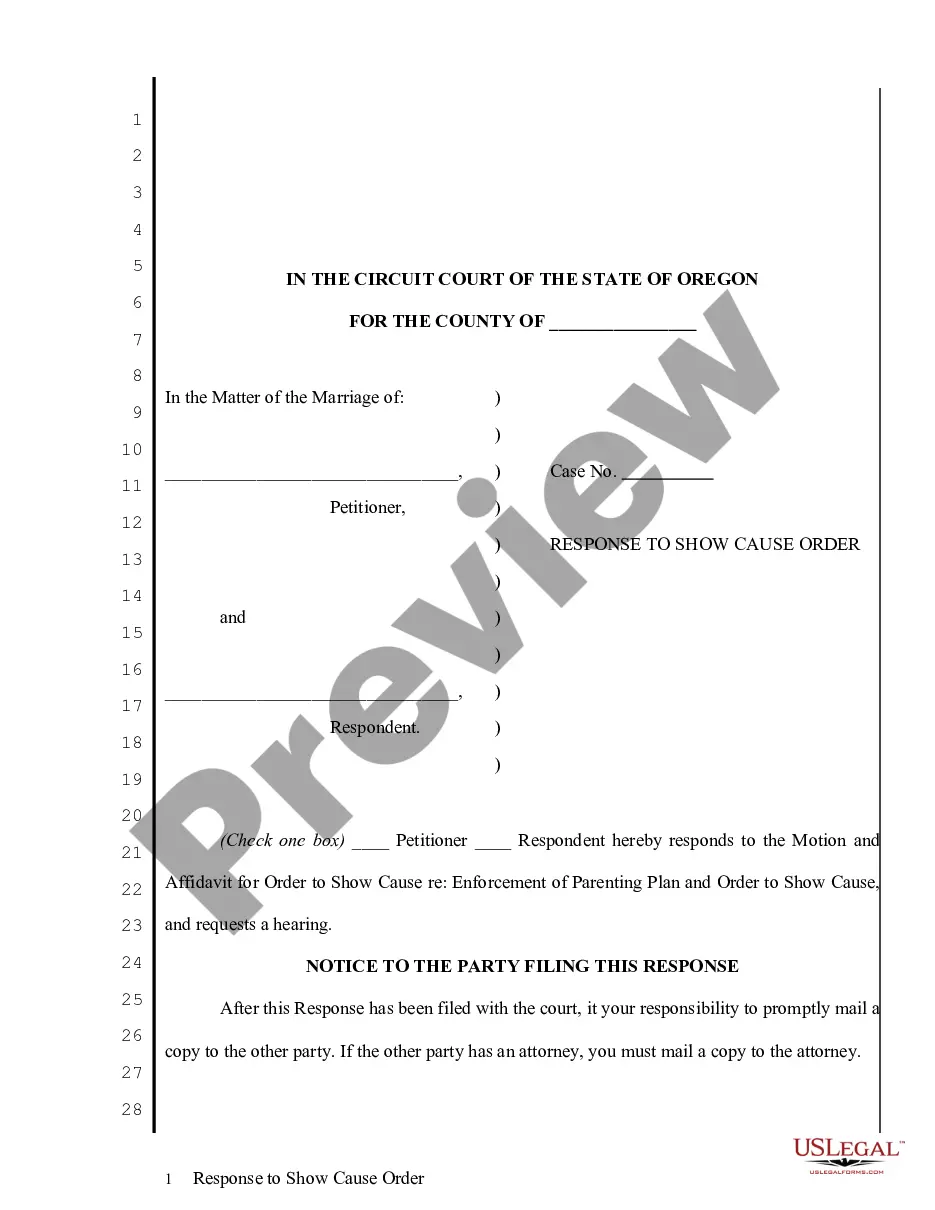
Oregon Response to Show Cause Order
What this document covers
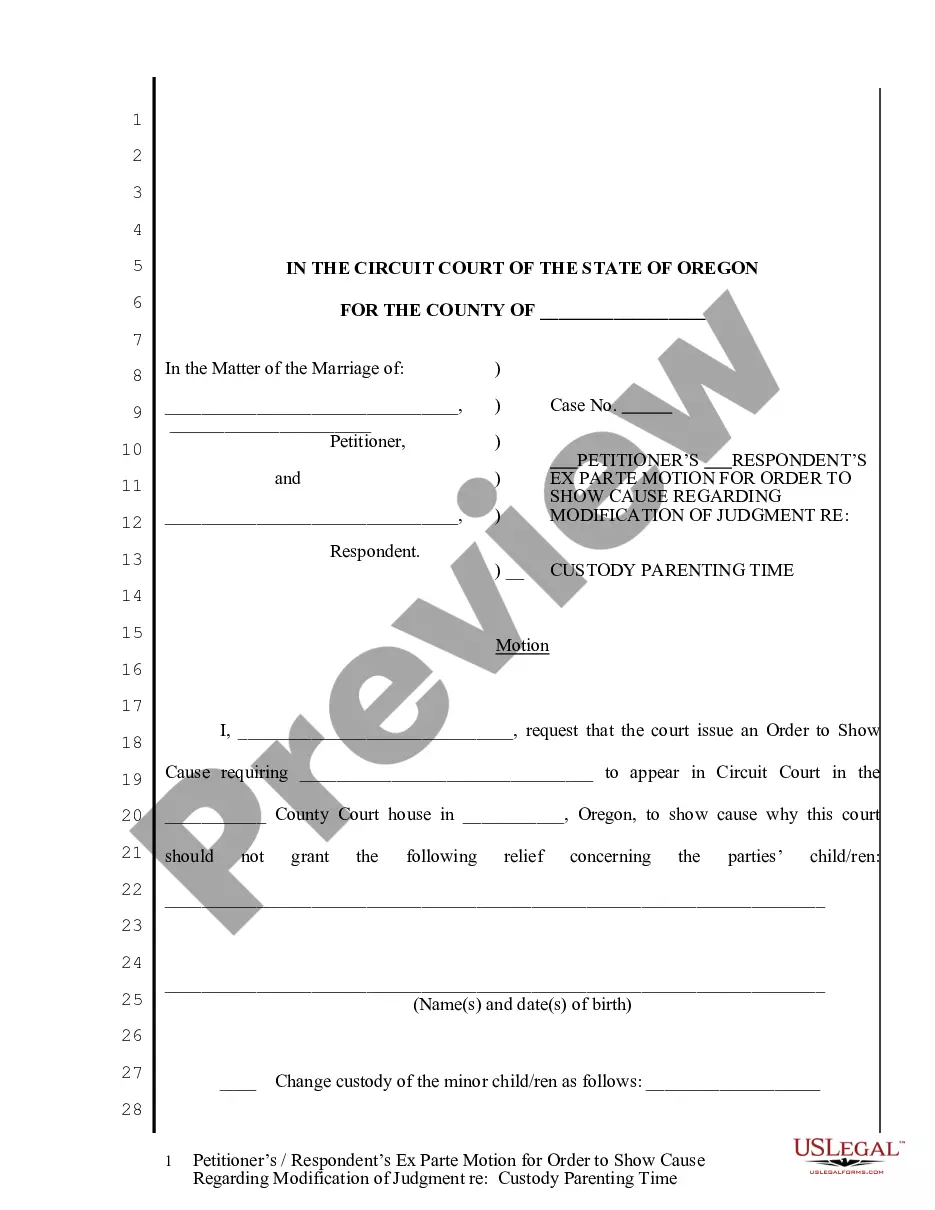
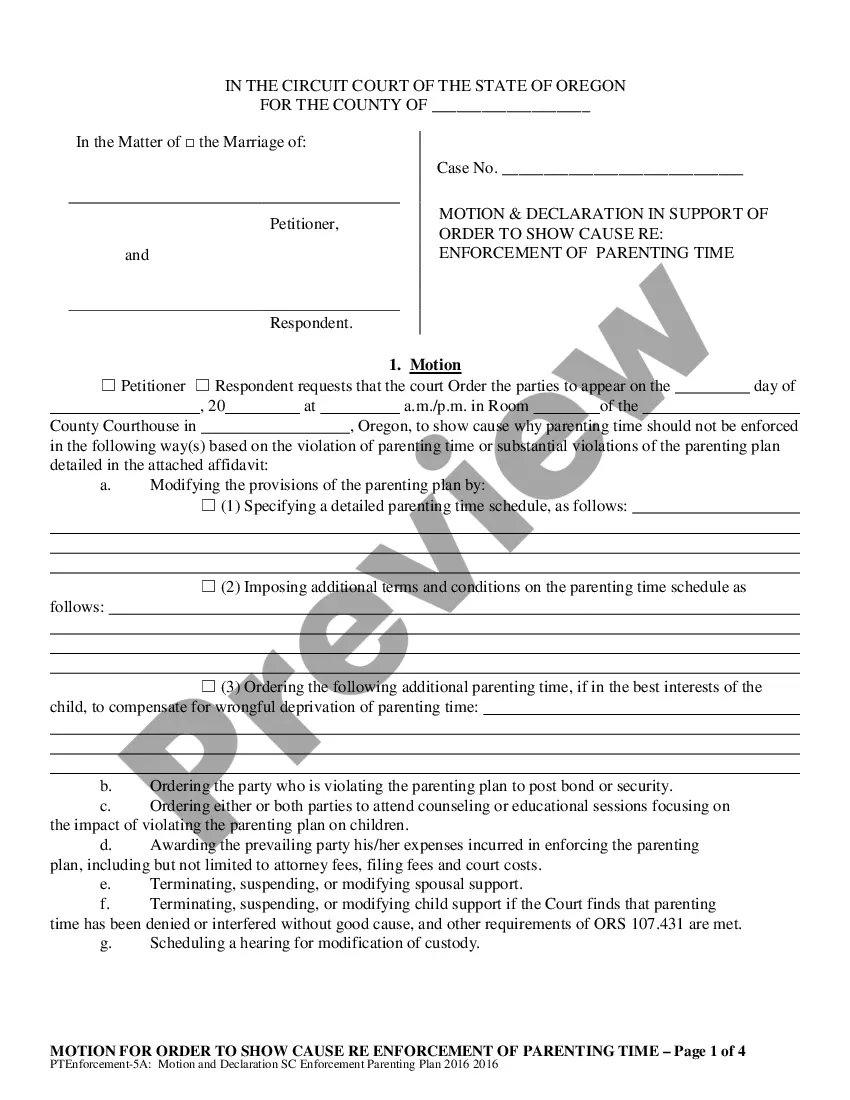
The Response to Show Cause Order is a legal document used in domestic litigation to formally respond to a show cause order regarding the enforcement of a parenting plan. This form allows either party, the petitioner or the respondent, to request a hearing. It is specifically designed for situations related to family law in Oregon, distinguishing it from other response forms that may not pertain to parenting issues.
Form components explained
- Identification of the petitioner and respondent, with space to check who is responding.
- Request for a hearing regarding the motion and affidavit for enforcement of the parenting plan.
- Notification to the filing party about the requirement to mail a copy to the other party or their attorney.
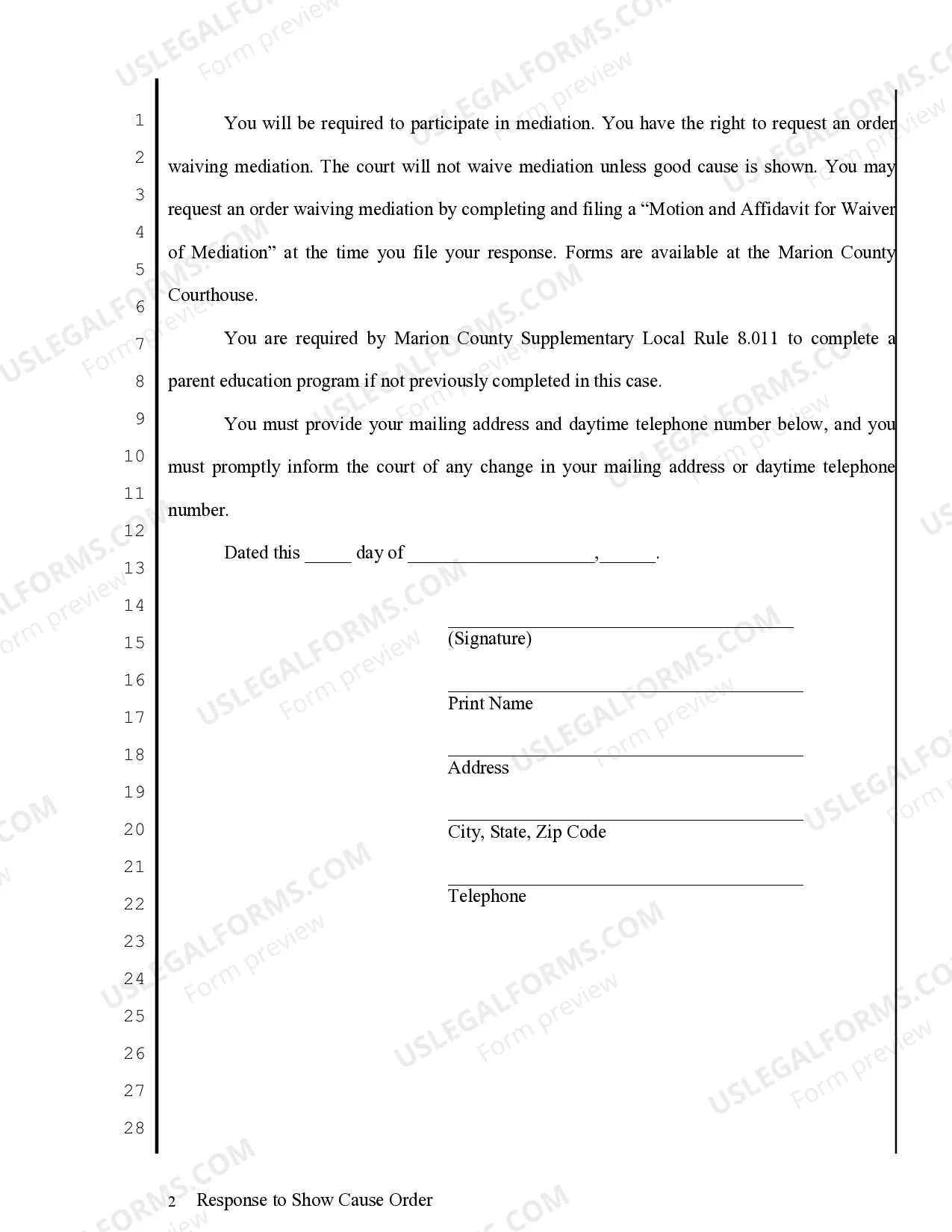
- Requirement to participate in mediation, with the option to request a waiver.
- Space for providing contact information, including mailing address and phone number.
Common use cases
This form should be used when a party in a domestic litigation case receives a show cause order from the court, specifically concerning issues related to the enforcement of a parenting plan. Situations may include disputes over child custody, visitation rights, and other parenting responsibilities where one party needs to explain their position and request a court hearing.
Who needs this form
- Individuals involved in domestic litigation in Oregon related to parenting plans.
- Either the petitioner or respondent who has received a show cause order regarding child support, custody, or visitation issues.
- Anyone seeking to formally respond to a motion for enforcement of a parenting plan.
Steps to complete this form
- Check whether you are the petitioner or the respondent.
- Fill in the case number and names of the parties involved in the matter.
- Sign and date the response at the indicated location.
- Provide your current mailing address and daytime phone number.
- Ensure a copy is mailed to the other party or their attorney after filing.
Does this document require notarization?
This form usually doesn’t need to be notarized. However, local laws or specific transactions may require it. Our online notarization service, powered by Notarize, lets you complete it remotely through a secure video session, available 24/7.
Get your form ready online
Our built-in tools help you complete, sign, share, and store your documents in one place.
Make edits, fill in missing information, and update formatting in US Legal Forms—just like you would in MS Word.
Download a copy, print it, send it by email, or mail it via USPS—whatever works best for your next step.
Sign and collect signatures with our SignNow integration. Send to multiple recipients, set reminders, and more. Go Premium to unlock E-Sign.
If this form requires notarization, complete it online through a secure video call—no need to meet a notary in person or wait for an appointment.
We protect your documents and personal data by following strict security and privacy standards.
Make edits, fill in missing information, and update formatting in US Legal Forms—just like you would in MS Word.
Download a copy, print it, send it by email, or mail it via USPS—whatever works best for your next step.
Sign and collect signatures with our SignNow integration. Send to multiple recipients, set reminders, and more. Go Premium to unlock E-Sign.

If this form requires notarization, complete it online through a secure video call—no need to meet a notary in person or wait for an appointment.
We protect your documents and personal data by following strict security and privacy standards.
Avoid these common issues
- Failing to check the appropriate box for petitioner or respondent.
- Not providing a complete mailing address and phone number.
- Neglecting to mail a copy of the response to the other party.
- Omitting the date or signature before filing the form.
Why complete this form online
- Convenience of accessing the form any time from home.
- Easy to download and modify to fit individual case needs.
- Reliability of having a state-approved form prepared by licensed attorneys.
- Immediate availability reduces delays in filing with the court.
Looking for another form?

Form popularity
FAQ
An order to show cause is a type of court order that requires one or more of the parties to a case to justify, explain, or prove something to the court. Courts commonly use orders to show cause when the judge needs more information before deciding whether or not to issue an order requested by one of the parties.
A response to an order to show cause typically requires you to show up in-person to the hearing. You can provide an answer to the order and state why you object to the order being issued.
A motion is the standard way to seek certain forms of relief from a court. An Order to Show Cause is often a quicker way to seek the same relief. It usually has some provision which directs you to do something or to refrain from doing something...
1 attorney answer As a general rule, the court will, on a contested motion, wait 10-12 days after the motion is docketed to see if an objection is filed. Once that time has passed, the clerk will give the motion and any...
Fill out your court forms. Have your forms reviewed. Make at least 2 copies of all your forms. File your forms with the court clerk. Serve your papers on the other parent. File your Proof of Service. Go to your court hearing.
The court will schedule a show cause hearing and order the custodial parent to appear and explain the failure to follow the visitation schedule. At the hearing, both parents will have the opportunity to tell their version of the events. The judge will determine what the facts are.
It's basically an order directing a party to appear in court and explain why that party took (or failed to take) some action, or why the court should or should not grant the requested relief.The main objective of the show cause hearing is to get the party who is not following the court's order to do so.
You may reschedule an order to show cause by submitting a request or motion for continuance with the court.