Nebraska Notice of Assessment Lien
What this document covers
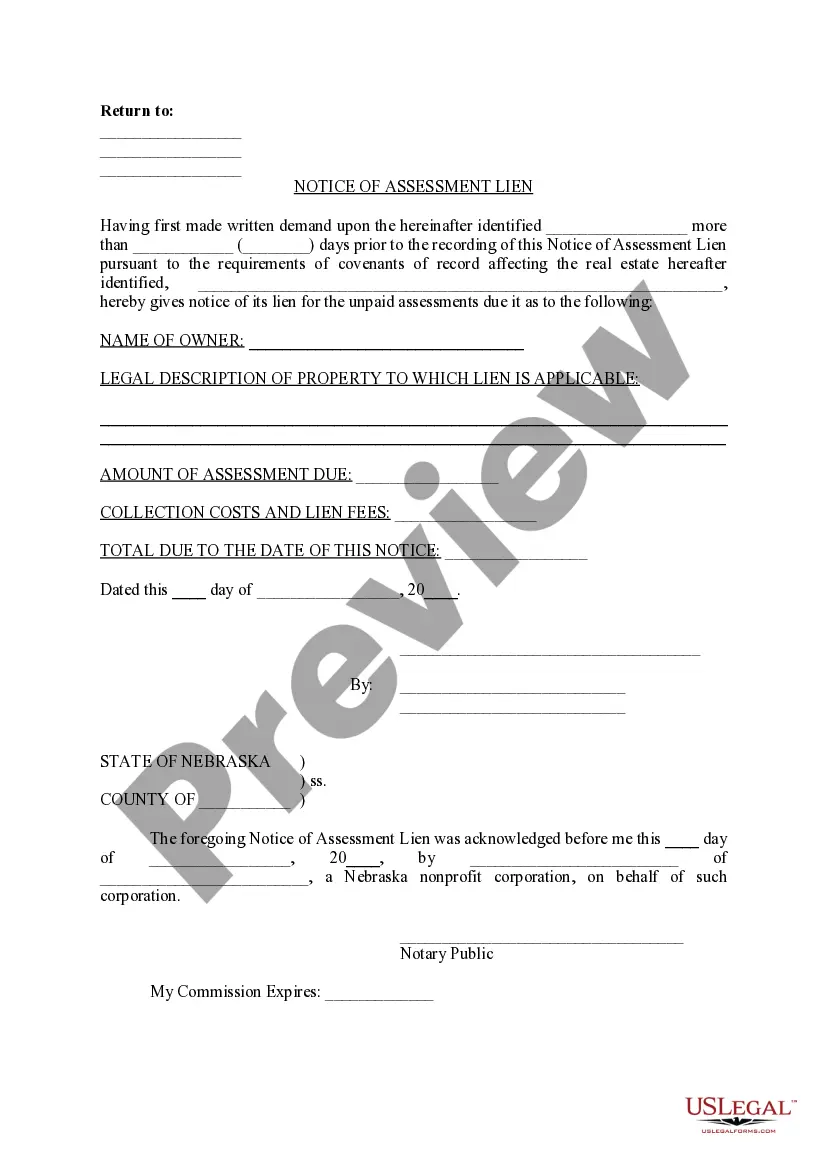
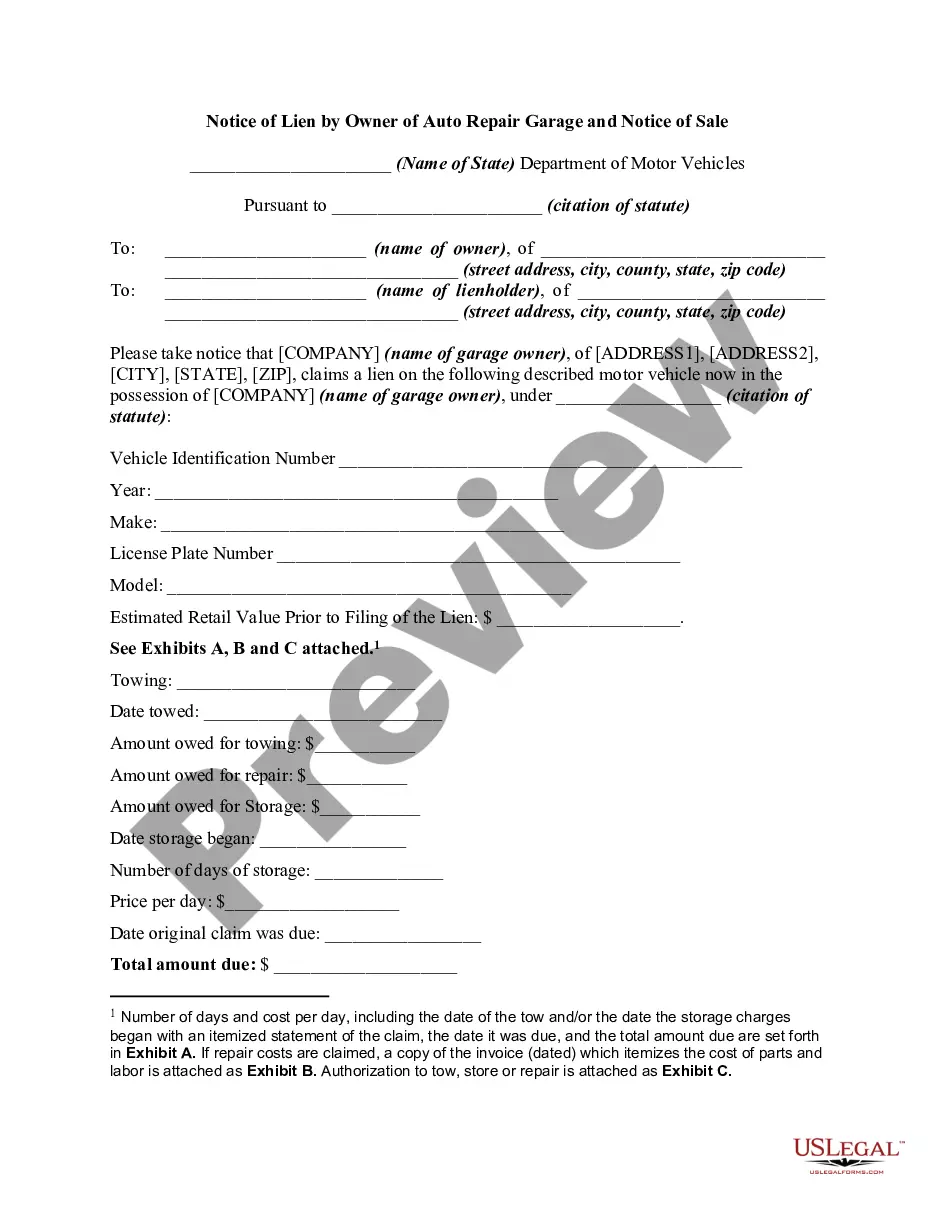
The Notice of Assessment Lien is a legal document that serves as a public declaration of a lien on real property due to unpaid assessments. This form is essential for property owners and associations who need to enforce payment for dues related to property covenants. It differs from other lien notices by specifically addressing assessments, which can include maintenance fees or other costs associated with property upkeep.
Main sections of this form
- Identification of the party issuing the lien
- Name of the property owner
- Legal description of the property
- Amount of assessment due and associated costs
- Date of the notice
- Notary acknowledgment section
When this form is needed
This form should be used when a property owner has failed to pay required assessments or fees related to property covenants. It is typically utilized by homeowner associations or other entities responsible for collecting these fees to formally notify the property owner and establish a legal claim against the property.
Who this form is for
- Homeowner associations
- Property management companies
- Nonprofit organizations managing real estate
- Property owners facing assessment delinquencies
Completing this form step by step
- Identify the party issuing the lien at the top of the notice.
- Enter the name of the property owner and the legal description of the property.
- Specify the amount of assessment due and any associated costs.
- Fill in the date and ensure the form is signed by an authorized representative.
- Have the form notarized to ensure its legal validity.
Does this document require notarization?
Yes, this form must be notarized to be legally valid. Incorporating US Legal Formsâ integrated online notarization makes the process simple and secure, available 24/7 through a video call, ensuring your legal documents are properly executed.
Get your form ready online
Our built-in tools help you complete, sign, share, and store your documents in one place.
Make edits, fill in missing information, and update formatting in US Legal Forms—just like you would in MS Word.
Download a copy, print it, send it by email, or mail it via USPS—whatever works best for your next step.
Sign and collect signatures with our SignNow integration. Send to multiple recipients, set reminders, and more. Go Premium to unlock E-Sign.
If this form requires notarization, complete it online through a secure video call—no need to meet a notary in person or wait for an appointment.
We protect your documents and personal data by following strict security and privacy standards.

Make edits, fill in missing information, and update formatting in US Legal Forms—just like you would in MS Word.

Download a copy, print it, send it by email, or mail it via USPS—whatever works best for your next step.

Sign and collect signatures with our SignNow integration. Send to multiple recipients, set reminders, and more. Go Premium to unlock E-Sign.

If this form requires notarization, complete it online through a secure video call—no need to meet a notary in person or wait for an appointment.

We protect your documents and personal data by following strict security and privacy standards.
Typical mistakes to avoid
- Failing to provide a complete legal description of the property.
- Not specifying the correct amount of assessment owed.
- Neglecting to obtain notarization if required.
- Ignoring the necessary waiting period before filing the notice.
Why use this form online
- Convenient access to downloadable templates wherever you are.
- Edit and customize the form easily to fit your specific needs.
- Reliability of using forms drafted by licensed attorneys.
- Quick turnaround, allowing for timely filing and enforcement of claims.
Looking for another form?
Form popularity
FAQ
A general rule in property law says that whichever lien is recorded first in the land records has higher priority over later-recorded liens. This rule is known as the "first in time, first in right" rule.
An assessment lien is a legal claim or "hold" on an owner's unit or lot making the property collateral against delinquent assessments, whether regular or special assessments, owed to the association.
Liens Wiped Out, Not Debt The HOA first sends you a notice of the delinquent fees and ways to resolve the debt.Foreclosure by a mortgage lender wipes out the HOA lien, but doesn't resolve the debt itself.
Removal of Association's LienTo remove a lien on a property, homeowners must first satisfy the debt owed to the homeowners association. To pay off an HOA lien, the homeowner must make payment to the association in the amount of the delinquent assessments, plus interest and any applicable fees.
HOA Super Liens, Though, Are Senior to First Mortgages If an HOA forecloses a super lien, it can potentially eliminate the first mortgage and any other junior mortgages on the property. Keep in mind, though, that even if a mortgage lien is eliminated, you're not off the hook for the debt.
Removal of Association's Lien To remove a lien on a property, homeowners must first satisfy the debt owed to the homeowners association. To pay off an HOA lien, the homeowner must make payment to the association in the amount of the delinquent assessments, plus interest and any applicable fees.
A lien gives an individual or entity a claim to a property until a debt is paid off.If the debt goes unpaid, they have the right to take it back.
It is up to the board of directors to set annual HOA fees. They look at the overall operating expenses of the community things like utilities, vendor services, overhead costs, maintenance, insurance, etc. as well as contributions to the reserve fund.
Majority of Members Must Consent to Dissolution of HOA Because an HOA technically consists of two parts, the legal entity plus its membership, one part usually needs the consent and approval of the other in order to take an extreme action like dissolution.