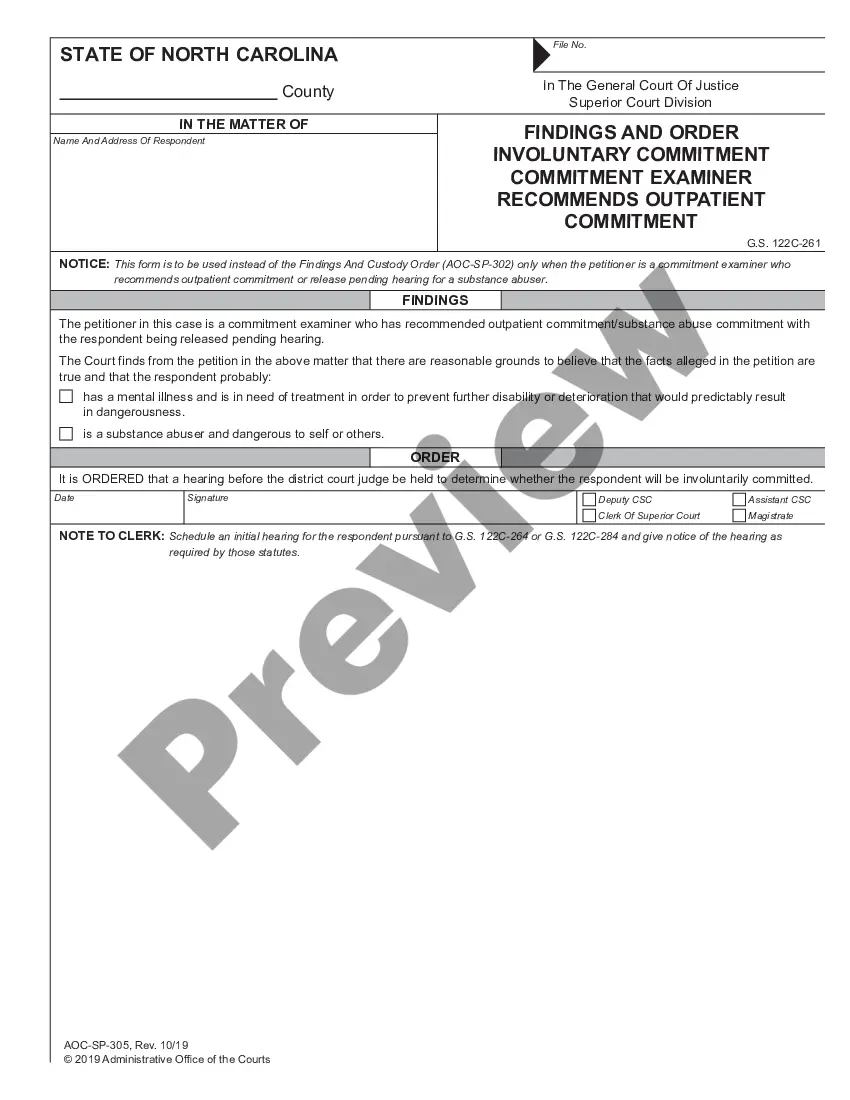
Findings and Order Involuntary Commitment Physican - Petitioner Recommends Outpatient Commitment: This is an official form from the North Carolina Administration of the Courts (AOC), which complies with all applicable laws and statutes. USLF amends and updates the forms as is required by North Carolina statutes and law.
North Carolina Findings and Order Involuntary Commitment Physician - Petitioner Recommends Outpatient Commitment
State:
North Carolina
Category:
Control #:
NC-SP-305
Format:
PDF
Instant download
This website is not affiliated with any governmental entity
Public form
Description
Get your form ready online
Our built-in tools help you complete, sign, share, and store your documents in one place.
Built-in online Word editor
Make edits, fill in missing information, and update formatting in US Legal Forms—just like you would in MS Word.
Export easily
Download a copy, print it, send it by email, or mail it via USPS—whatever works best for your next step.
E-sign your document
Sign and collect signatures with our SignNow integration. Send to multiple recipients, set reminders, and more. Go Premium to unlock E-Sign.
Notarize online 24/7
If this form requires notarization, complete it online through a secure video call—no need to meet a notary in person or wait for an appointment.
Store your document securely
We protect your documents and personal data by following strict security and privacy standards.

Make edits, fill in missing information, and update formatting in US Legal Forms—just like you would in MS Word.

Download a copy, print it, send it by email, or mail it via USPS—whatever works best for your next step.

Sign and collect signatures with our SignNow integration. Send to multiple recipients, set reminders, and more. Go Premium to unlock E-Sign.

If this form requires notarization, complete it online through a secure video call—no need to meet a notary in person or wait for an appointment.

We protect your documents and personal data by following strict security and privacy standards.
Looking for another form?
How to fill out North Carolina Findings And Order Involuntary Commitment Physician - Petitioner Recommends Outpatient Commitment?
Steer clear of costly attorneys and discover the North Carolina Findings and Order Involuntary Commitment Physician - Petitioner Suggests Outpatient Commitment you require at a reasonable cost on the US Legal Forms site.
Utilize our straightforward categories feature to search for and download legal and tax documents. Review their descriptions and preview them before downloading.
After downloading, you may fill out the North Carolina Findings and Order Involuntary Commitment Physician - Petitioner Suggests Outpatient Commitment manually or using editing software. Print it out and reuse the form multiple times. Achieve more for less with US Legal Forms!
- Moreover, US Legal Forms provides users with step-by-step guidance on how to download and complete each template.
- US Legal Forms clients simply need to Log In and access the specific form they require in their My documents section.
- Those who have yet to subscribe should adhere to the steps outlined below.
- Ensure that the North Carolina Findings and Order Involuntary Commitment Physician - Petitioner Suggests Outpatient Commitment is valid for use in your state.
- If accessible, examine the description and utilize the Preview feature prior to downloading the document.
- If you are assured that the template aligns with your requirements, select Buy Now.
- If the template is incorrect, employ the search tool to locate the appropriate one.
- Subsequently, create your account and select a subscription plan.
- Make a payment via credit card or PayPal.
- Select to receive the document in PDF or DOCX format.
- Click Download and locate your template in the My documents section.
- Feel free to save the template to your device or print it out.
Form popularity
FAQ
You will be allowed to leave within 3 days (72 hours) unless your doctor feels you need further treatment. If this is the case, the process for involuntary commitment may be started.
The criteria for involuntary hospitalization are as follows: patients must exhibit dangerous behavior toward themselves or others, they must be helpless and unable to provide for their basic daily needs, and there is a danger of essential harm to their mental health if they do not receive mental care.
Involuntary Patients You have the right to refuse medical treatment or treatment with medications (except in an emergency) unless a capacity hearing is held and a hearing officer or a judge finds that you do not have the capacity to consent to or refuse treatment.
Involuntary commitment should be limited to persons who pose a serious risk of physical harm to themselves or others in the near future. Under no circumstances should involuntary commitment be imposed upon someone based upon a risk of harm to property or a risk of non-physical harm.
Depending on whether the person seeks treatment for a mental condition he or she experiences, a therapist or a counselor can have a person committed against his or her will.The therapist will have the power to contact the appropriate authorities and have the person sent to a mental health clinic.
Illegal commitments can be challenged and the records expunged through the filing of a petition with the Court of Common Pleas. If the petition to expunge is granted, the involuntary commitment record is expunged and the petitioner's rights, including the right to bear arms are restored.
Petition. People may be involuntarily committed when symptoms of a mental illness or substance use disorder escalate to the point of endangering themselves or others. In North Carolina, anyone who has first-hand knowledge of the individual's behavior or state of mind can complete a petition in front of a magistrate.
What happens during an involuntary hold? When a person is detained for up to 72 hours, the emergency facility or hospital is required to do an evaluation of that person, taking into account his/her medical, psychological, educational, social, financial and legal situation.