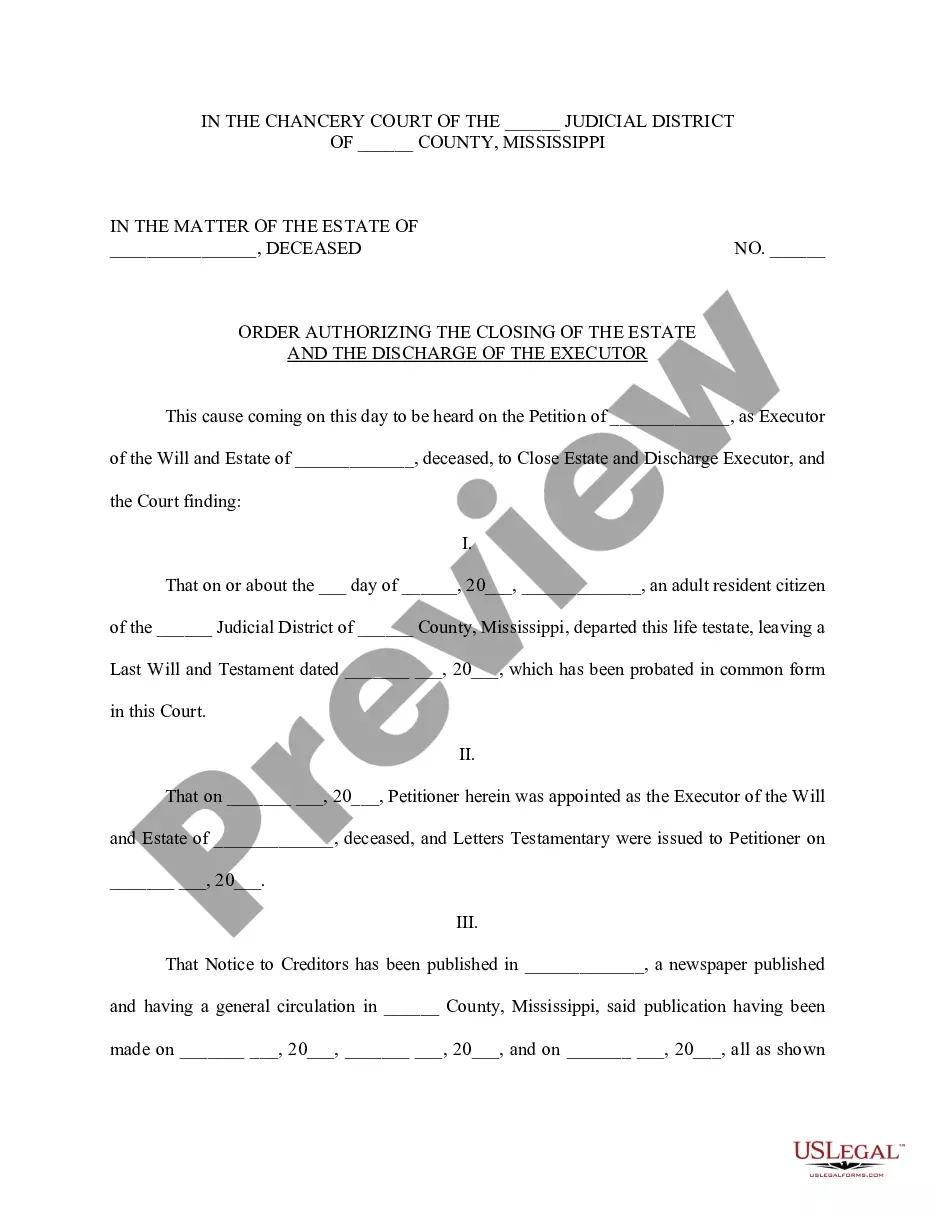
Mississippi Order authorizing the closing of the estate and the discharge of the executor
What is this form?
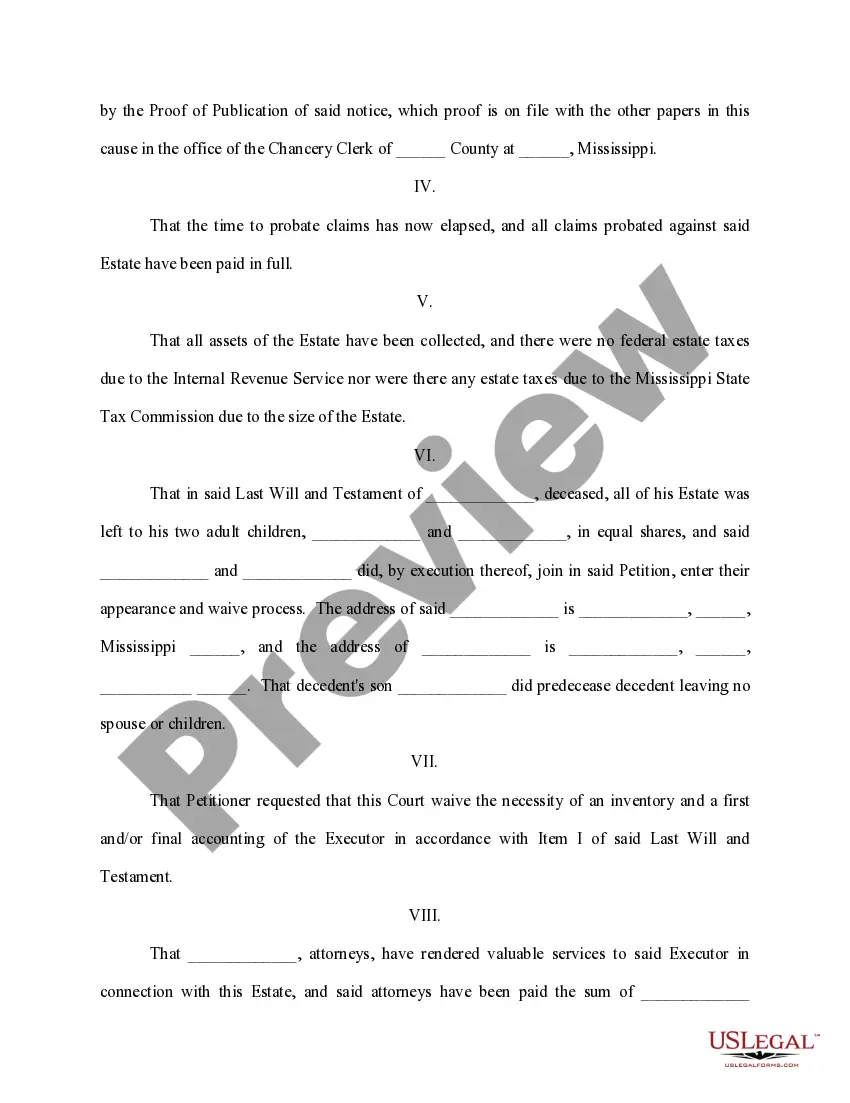
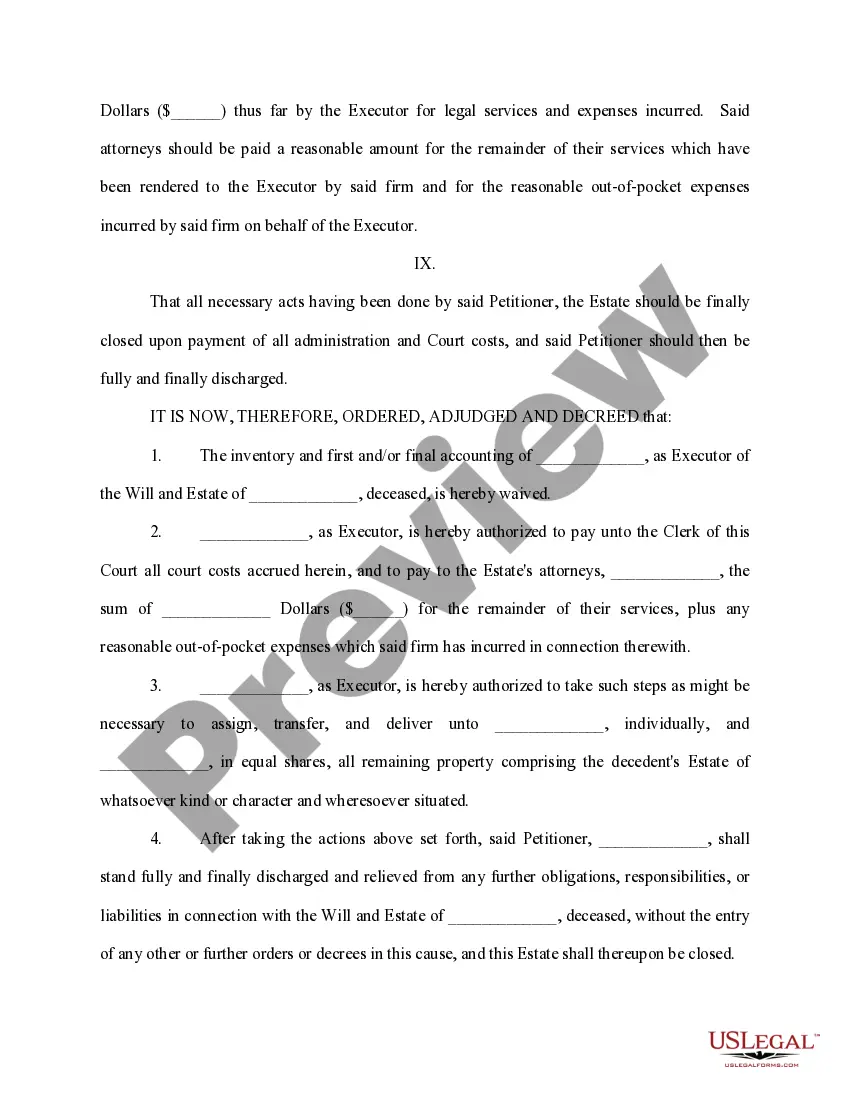
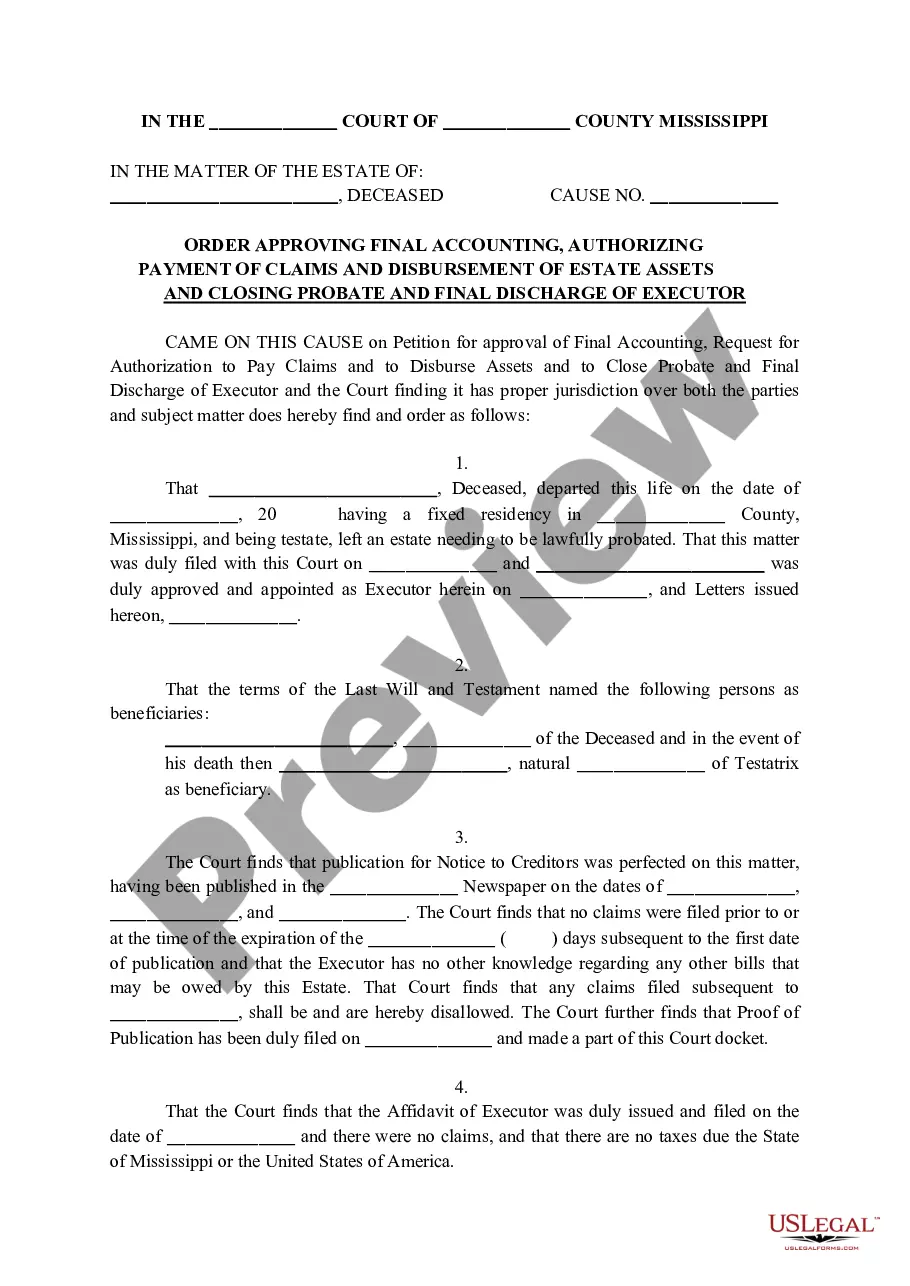
This Order authorizing the closing of the estate and the discharge of the executor is a legal document used in Mississippi. It finalizes the estate settlement process, allowing the executor to close the estate after fulfilling their obligations. This form is essential for verifying that all debts and taxes are paid and that the remaining assets are distributed according to the deceased's will. It differs from other estate forms by specifically addressing the completion of duties by the executor and the finalization of the estate process.
Main sections of this form
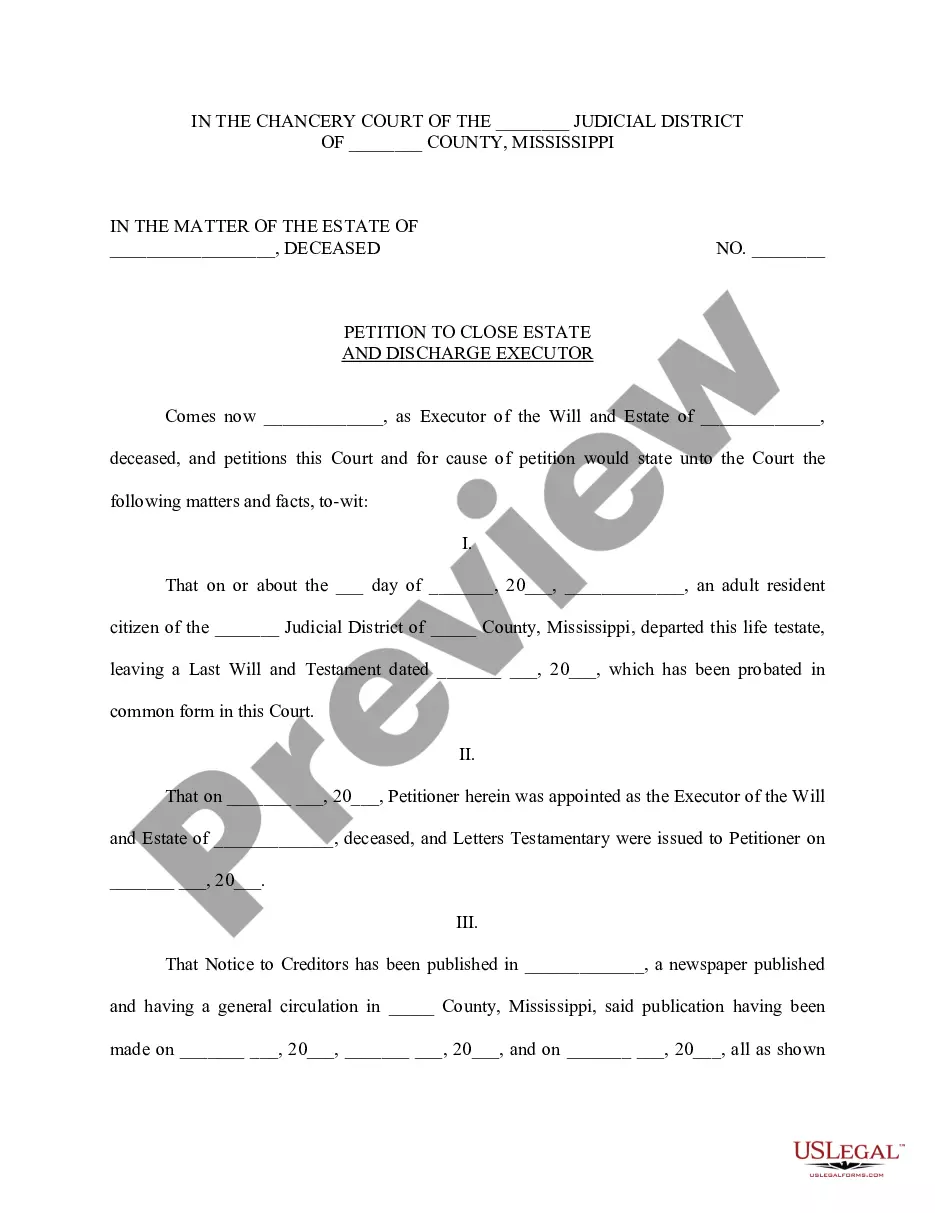
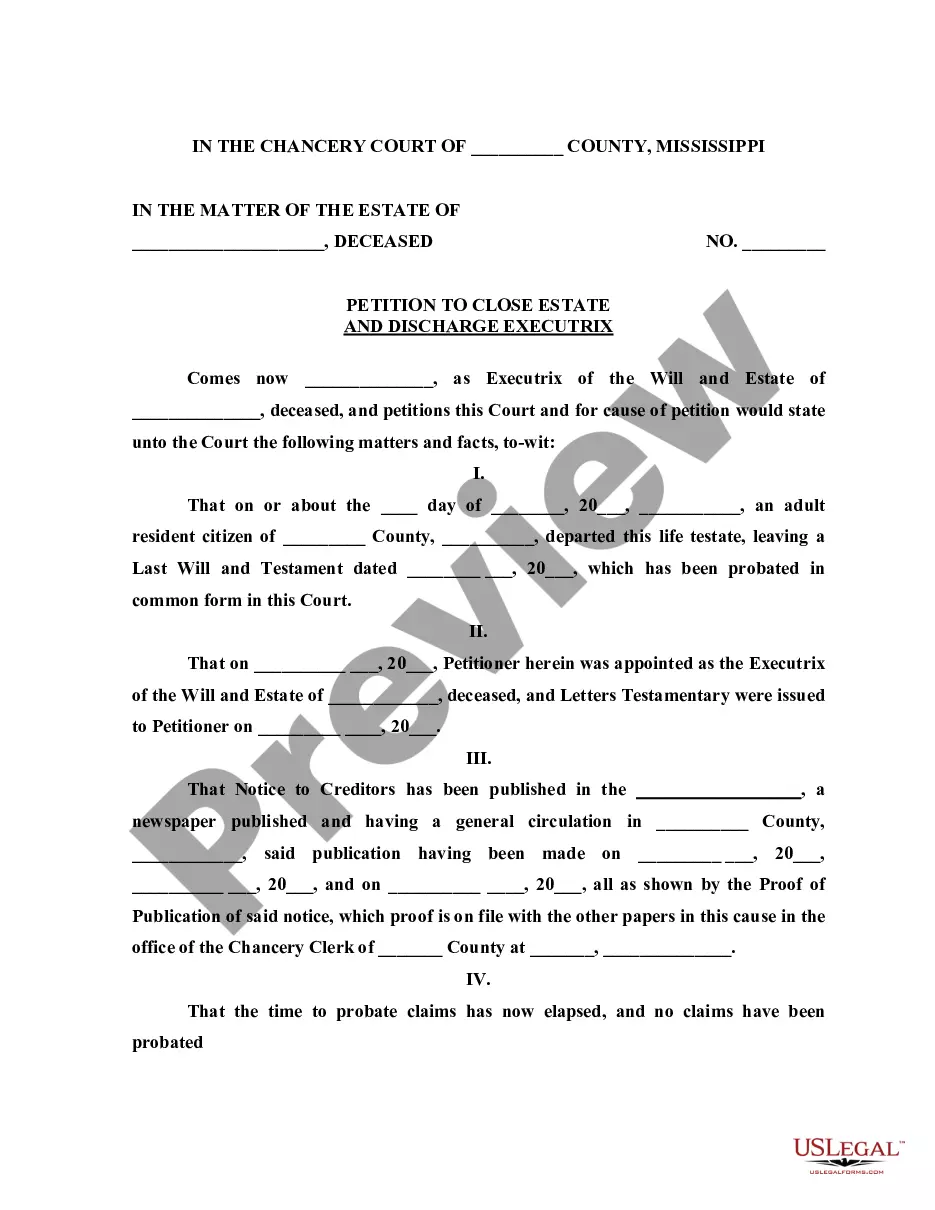
- Identification of the deceased and the executor.
- Confirmation of the probate of the will.
- Details on the notice to creditors and payment of claims.
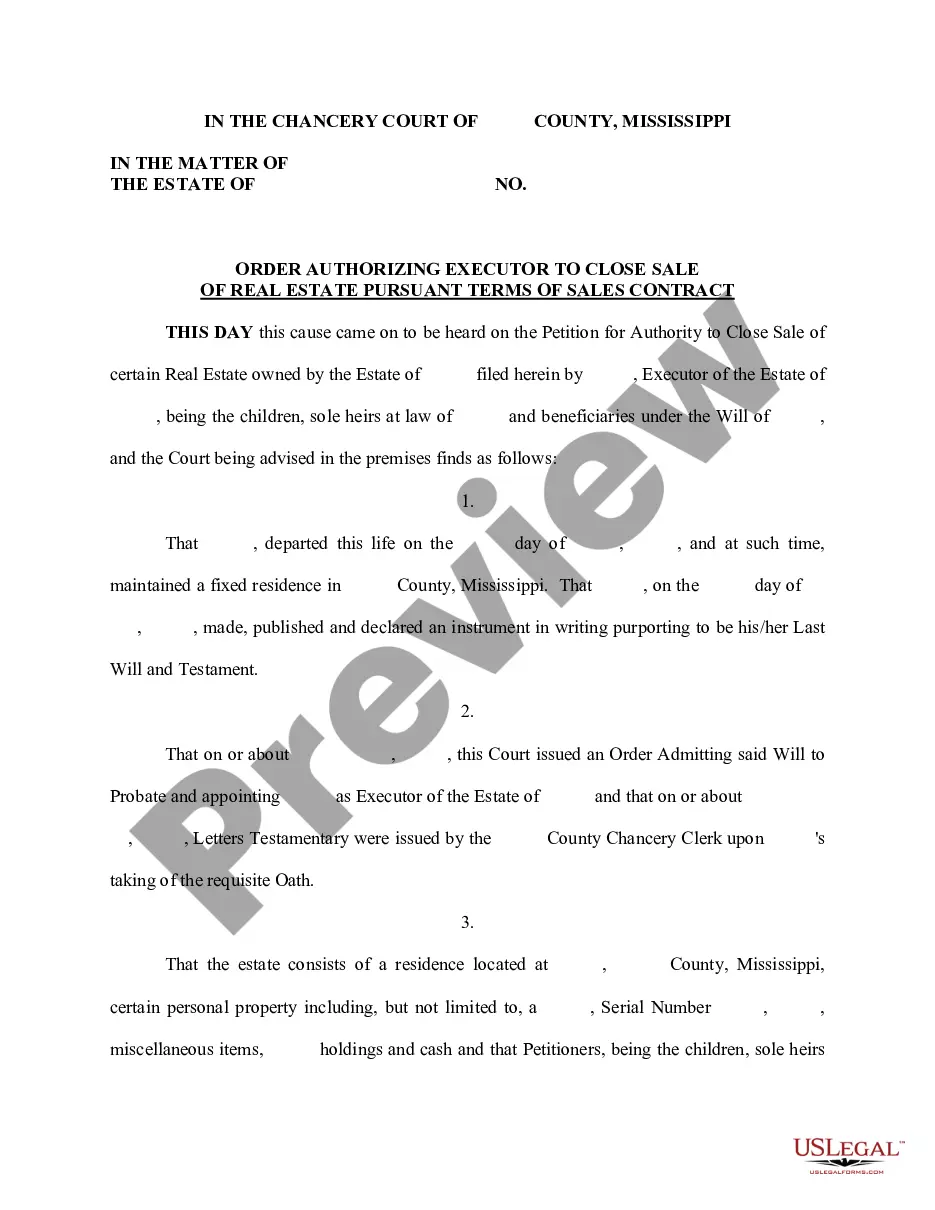
- Authorization to distribute remaining estate assets.
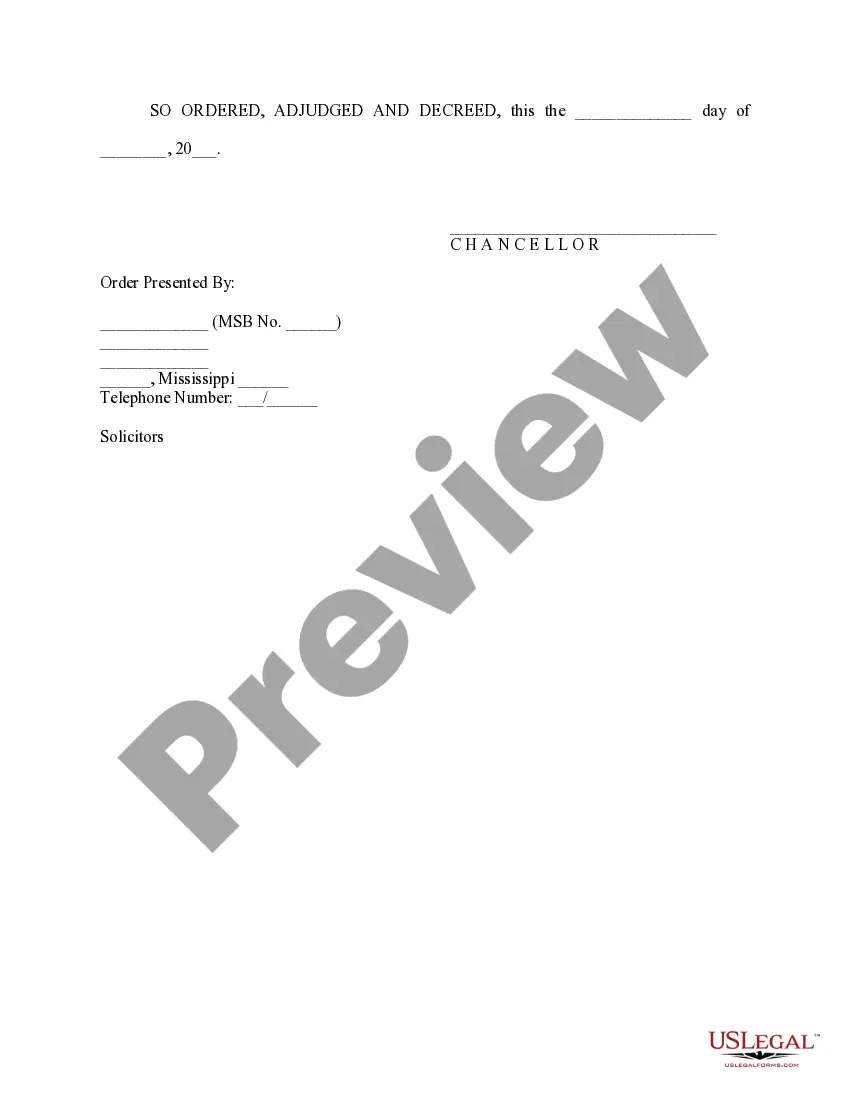
- Discharge of the executor from further responsibilities.
When to use this form
This form should be used when an estate has been fully administered and all claims and taxes have been settled. If you are an executor and you have completed your responsibilities related to the deceased's estate, you will need this form to formally close the estate and ensure you are discharged from any further liabilities.
Intended users of this form
- Executors appointed to manage a deceased person's estate.
- Beneficiaries seeking confirmation that the estate has been settled.
- Estate attorneys who are overseeing the final distribution of assets.
Steps to complete this form
- Fill in the name of the deceased and your role as the executor.
- Provide details of the probate proceedings and dates of significant events.
- Include proof of publication for notice to creditors.
- List the final asset distribution details and addresses of beneficiaries.
- Sign the document where indicated and submit it to the court.
Does this form need to be notarized?
This form does not typically require notarization unless specified by local law. However, ensuring proper execution of this document is important for its acceptance by the court.
Get your form ready online
Our built-in tools help you complete, sign, share, and store your documents in one place.
Make edits, fill in missing information, and update formatting in US Legal Forms—just like you would in MS Word.
Download a copy, print it, send it by email, or mail it via USPS—whatever works best for your next step.
Sign and collect signatures with our SignNow integration. Send to multiple recipients, set reminders, and more. Go Premium to unlock E-Sign.
If this form requires notarization, complete it online through a secure video call—no need to meet a notary in person or wait for an appointment.
We protect your documents and personal data by following strict security and privacy standards.
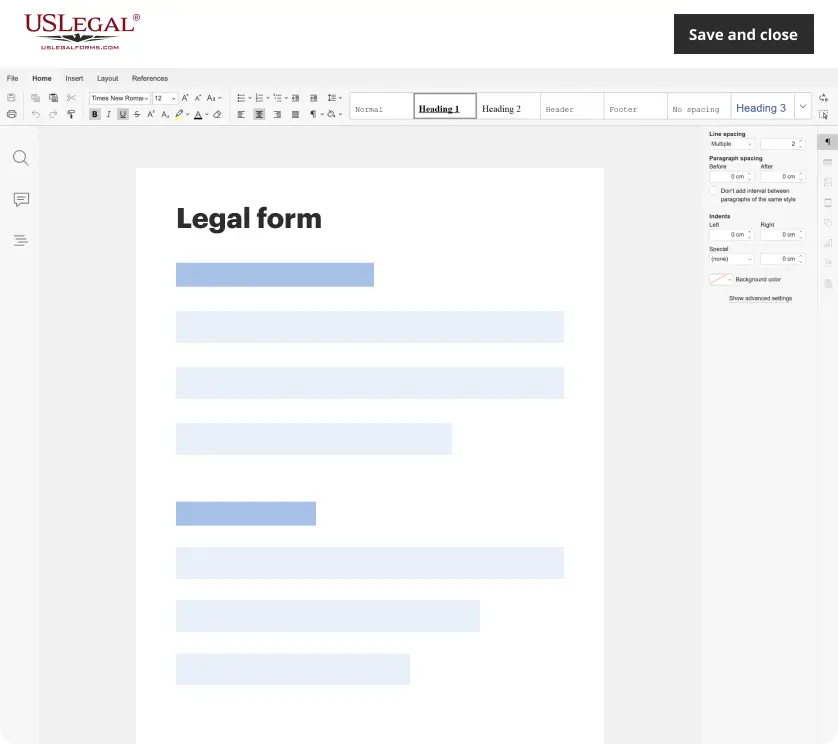
Make edits, fill in missing information, and update formatting in US Legal Forms—just like you would in MS Word.
Download a copy, print it, send it by email, or mail it via USPS—whatever works best for your next step.
Sign and collect signatures with our SignNow integration. Send to multiple recipients, set reminders, and more. Go Premium to unlock E-Sign.

If this form requires notarization, complete it online through a secure video call—no need to meet a notary in person or wait for an appointment.

We protect your documents and personal data by following strict security and privacy standards.
Avoid these common issues
- Failing to publish notice to creditors before applying for closure.
- Not including all necessary signatures from beneficiaries.
- Incorrectly stating the distribution of assets.
- Omitting the proof of payment of all claims against the estate.
Why complete this form online
- Easy access to a professionally drafted form specific to your needs.
- Convenience of completing the form at your own pace, anytime.
- Instant download capabilities allow for immediate use.
- Secure and reliable methods for document preparation.
Legal use & context
- The form is legally binding once it is approved by the court, finalizing the estate closure.
- It serves as a protective measure for the executor against future claims related to the estate.
- Filing this order with the court is essential for formal acknowledgment of the estateâs closure.
Main things to remember
- This form finalizes the estate process for Mississippi executors.
- Use this form to ensure legal protection and closure of executor responsibilities.
- Complete all sections accurately to avoid common mistakes.
Looking for another form?
Form popularity
FAQ
The executor will need to wait until the 2 month time limit is up, before distributing the estate. Six month limit to bring a claim in other cases, it can be sensible for the executors not to pay any beneficiaries until at least 6 months after receiving the grant of probate.
The length of time an executor has to distribute assets from a will varies by state, but generally falls between one and three years.
The Executor's Final Act, Closing an Estate The personal representative, now without any estate funds to pay his lawyer, must respond. Even if the charges are baseless, the executor is stuck paying the legal bill. Instead, before making any distribution, the administrator should insist on receiving a release.
A simple estate with just a few, easy-to-find assets may be all wrapped up in six to eight months. A more complicated affair may take three years or more to fully settle.
Keep the letter brief and straightforward as it is a legal document. Confirm the situation whereby probate has been granted. Was it written in the will? Clearly outline the obligations of the recipient so they know what is required of them. Sign the letter to make it legally binding.
By Stephanie Kurose, J.D. Closing a person's estate after they die can often be a long, detailed process. This includes paying off debts, filing final tax returns, and, finally, distributing the estate's assets according to the wishes of the deceased.
Under the Administration and Probate Act there is a period of 6 months once Probate (or Letters of Administration, if there was no Will) is granted in which claims can be made on an Estate.
In the best of circumstances, the Mississippi probate process usually takes 4 to 6 months. This would only be possible if the estate was fairly simple, all interested parties are agreeable, and documents are signed and returned to the probate attorney in a timely manner.