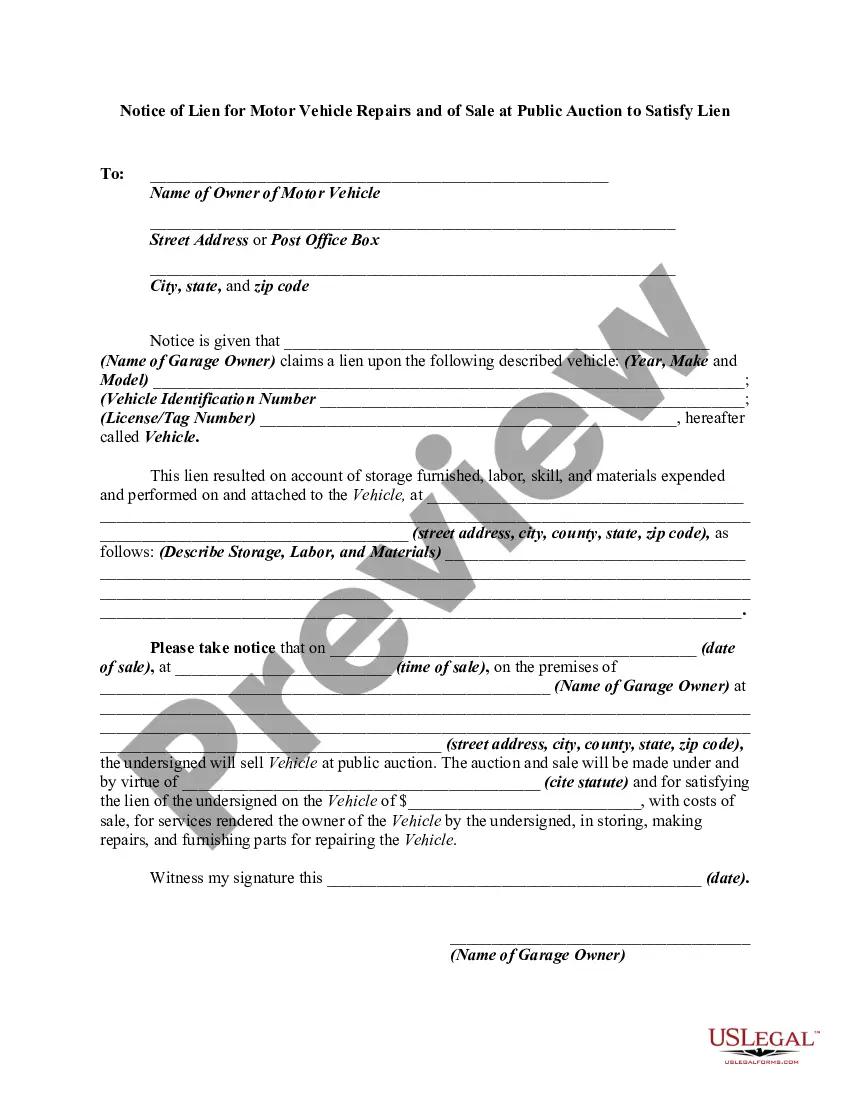
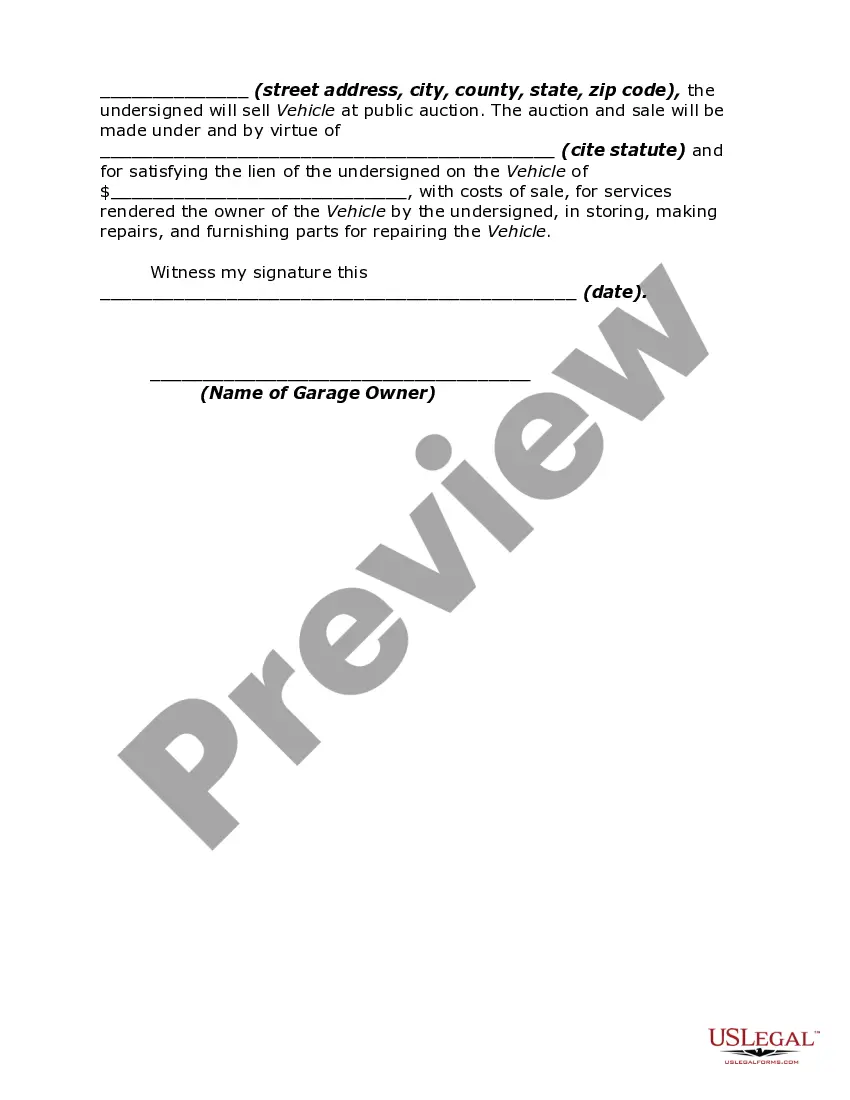
A Notice of Lien for Motor Vehicle Repairs and of Sale at Public Auction to Satisfy Lien is a notice issued by a lien holder when a motor vehicle is being sold to satisfy a lien that has been placed on the vehicle. This type of lien is typically placed when a motor vehicle owner fails to pay for repairs to their vehicle. The Notice of Lien will be posted in a public place, such as a government bulletin board or a newspaper, and will state the date, location, and other pertinent details of the upcoming public auction. The Notice will also provide the vehicle owner with an opportunity to redeem the vehicle prior to the auction by paying the outstanding debt. There are two types of Notice of Lien for Motor Vehicle Repairs and of Sale at Public Auction to Satisfy Lien: Statutory Liens and Contractual Liens. Statutory Liens are placed on a vehicle when a mechanic performs a repair on the vehicle and is not paid for the work. Contractual Liens are placed when a vehicle owner has a contract with a mechanic or repair shop and fails to pay the bill according to the terms of the contract.
Notice of Lien for Motor Vehicle Repairs and of Sale at Public Auction to Satisfy Lien
Description
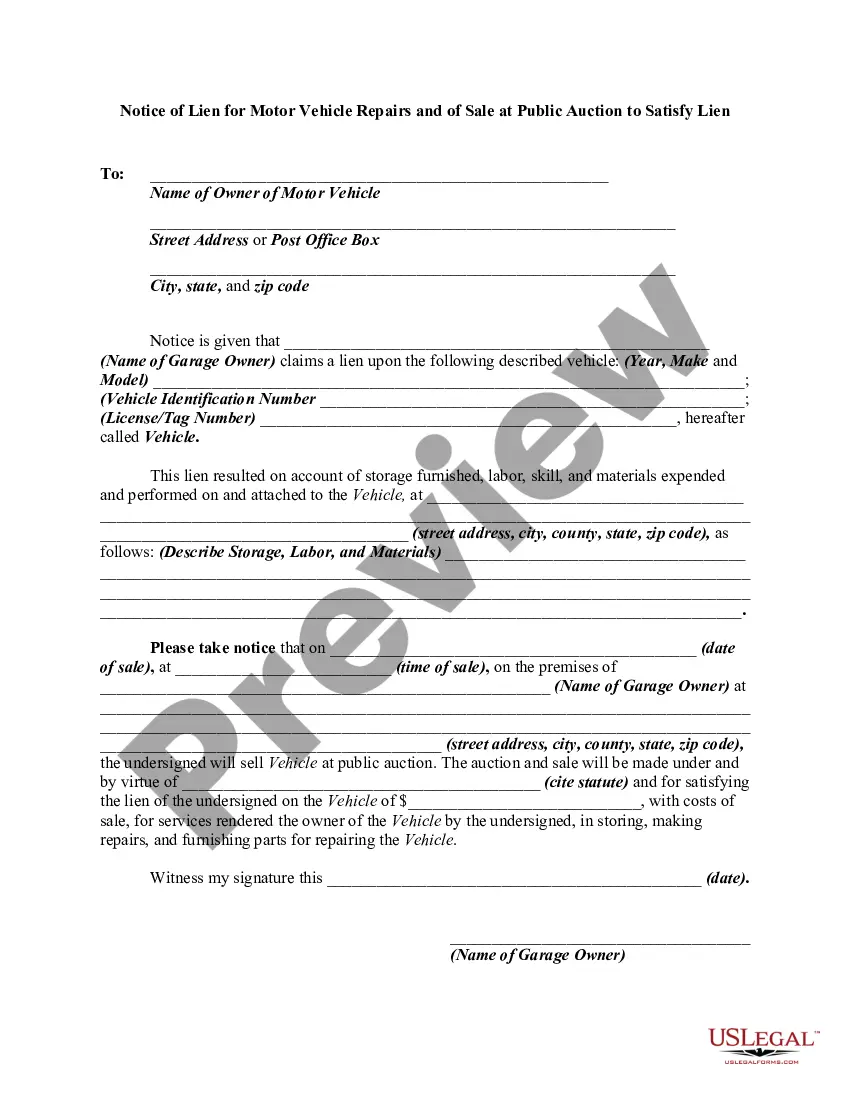
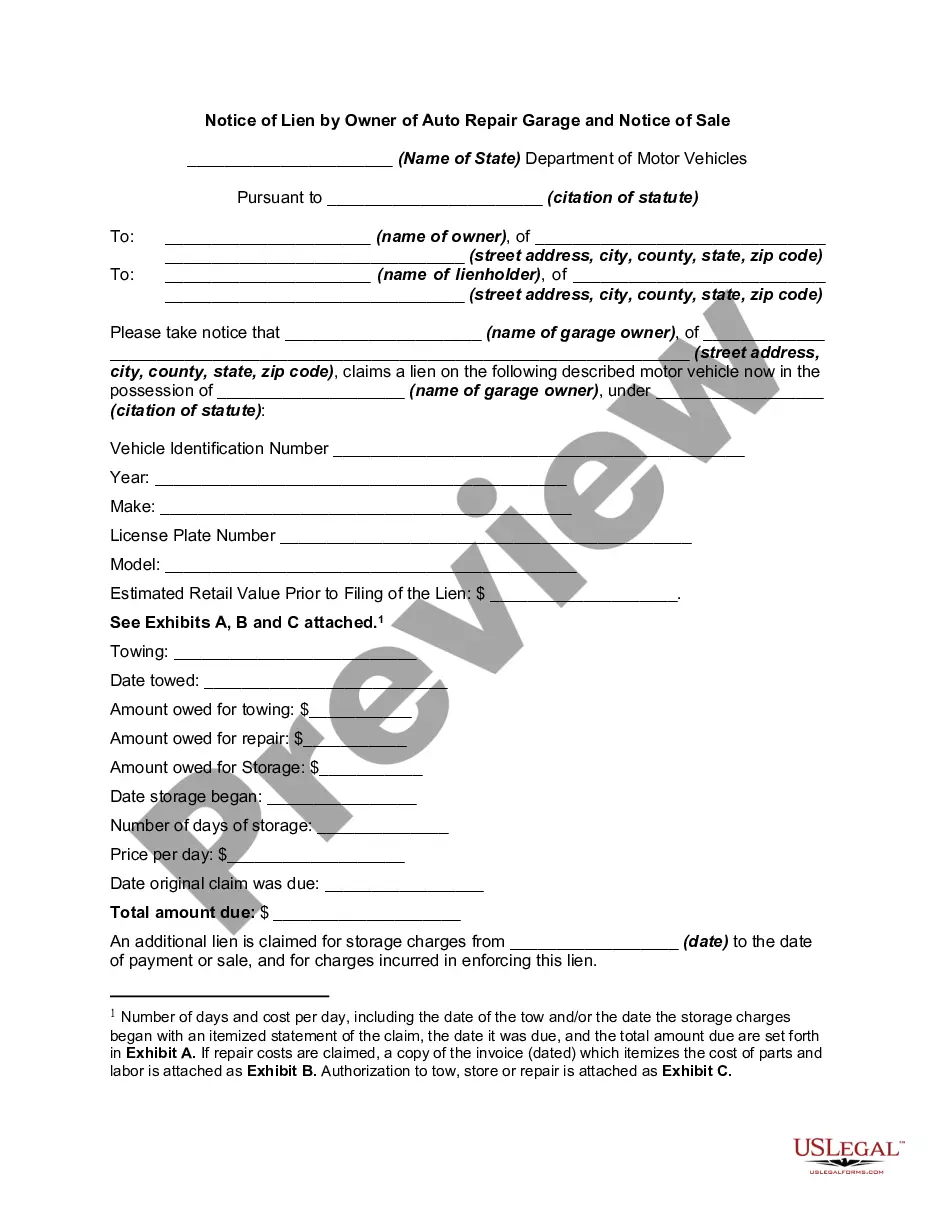
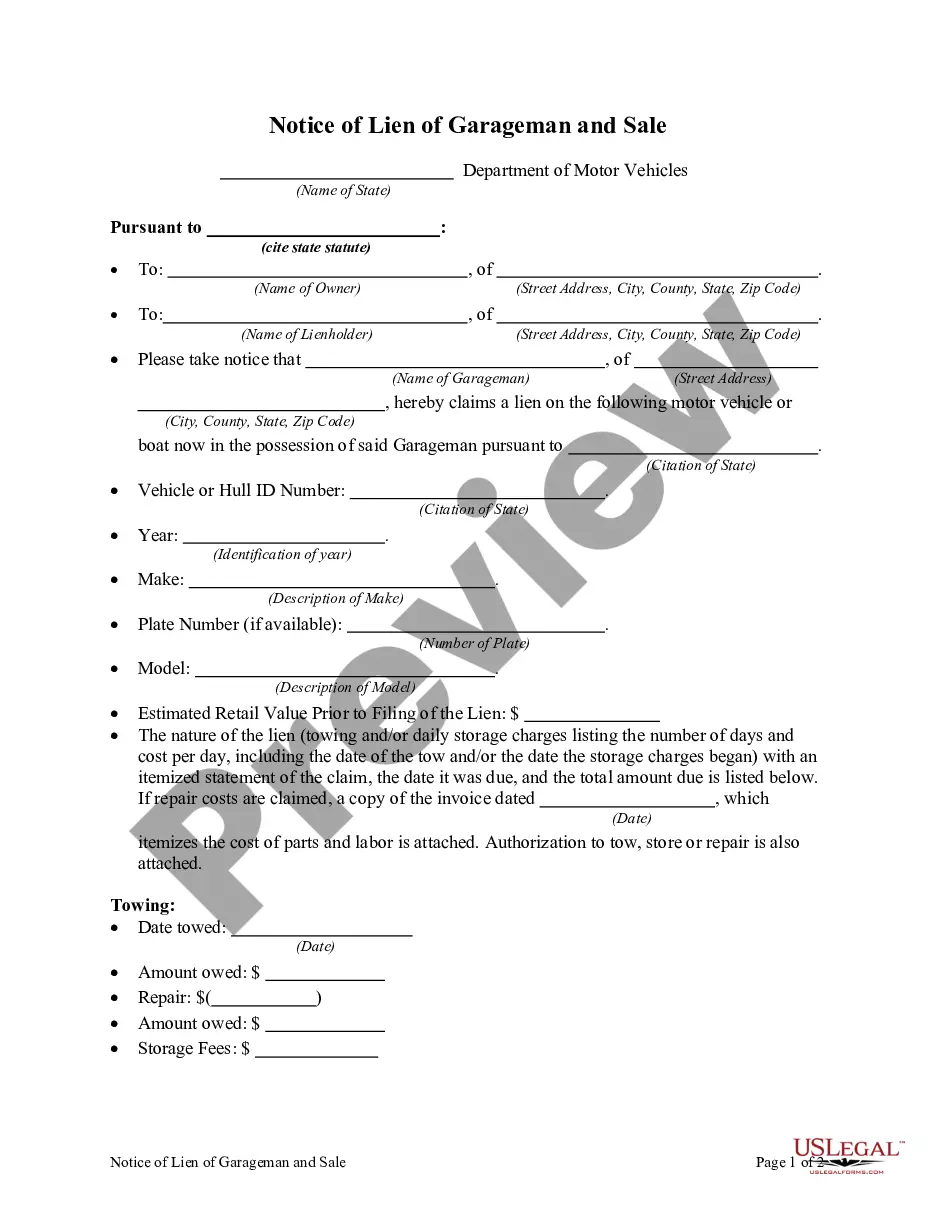
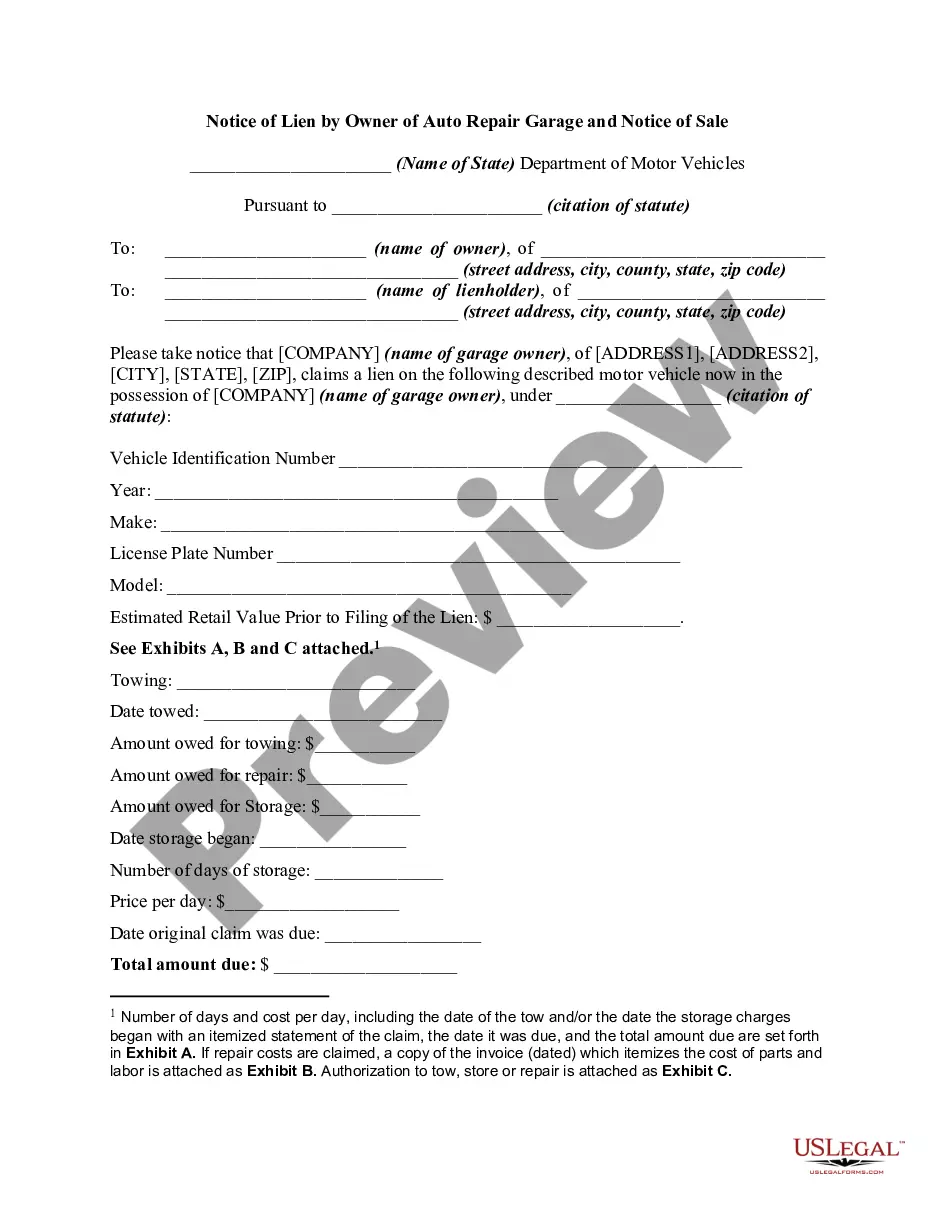
How to fill out Notice Of Lien For Motor Vehicle Repairs And Of Sale At Public Auction To Satisfy Lien?
How much time and resources do you typically spend on drafting official paperwork? There’s a greater opportunity to get such forms than hiring legal experts or spending hours searching the web for a proper template. US Legal Forms is the premier online library that provides professionally drafted and verified state-specific legal documents for any purpose, including the Notice of Lien for Motor Vehicle Repairs and of Sale at Public Auction to Satisfy Lien.
To get and complete an appropriate Notice of Lien for Motor Vehicle Repairs and of Sale at Public Auction to Satisfy Lien template, follow these easy steps:
- Examine the form content to ensure it complies with your state regulations. To do so, read the form description or use the Preview option.
- If your legal template doesn’t meet your needs, find another one using the search tab at the top of the page.
- If you are already registered with our service, log in and download the Notice of Lien for Motor Vehicle Repairs and of Sale at Public Auction to Satisfy Lien. Otherwise, proceed to the next steps.
- Click Buy now once you find the right document. Choose the subscription plan that suits you best to access our library’s full service.
- Sign up for an account and pay for your subscription. You can make a transaction with your credit card or via PayPal - our service is absolutely secure for that.
- Download your Notice of Lien for Motor Vehicle Repairs and of Sale at Public Auction to Satisfy Lien on your device and complete it on a printed-out hard copy or electronically.
Another benefit of our service is that you can access previously purchased documents that you securely store in your profile in the My Forms tab. Pick them up anytime and re-complete your paperwork as often as you need.
Save time and effort preparing official paperwork with US Legal Forms, one of the most trusted web services. Join us now!
Form popularity
FAQ
1. Mortgage Liens. A mortgage lien is voluntary when you purchase a home. A mortgage is a legal form of security collateral to guarantee payment of a debt.
The most common type of lien is a first mortgage, which gives the lending bank the first lien to the property. The property is used as security for the repayment of the loan down the road, and the lien remains on record until the loan is paid off.
Liens generally follow the "first in time, first in right" rule, which says that whichever lien is recorded first in the land records has higher priority than later recorded liens. For example, a mortgage has priority over a judgment lien if the lender records it before the judgment creditor records its lien.
How long does a judgment lien last in Connecticut? A judgment lien in Connecticut will remain attached to the debtor's property (even if the property changes hands) for 20 years (for liens on real estate) or five years (liens on personal property).
A mechanics lien in Connecticut is valid for 1 year from the recording date. If unpaid, claimants must take action to enforce their lien before this deadline expires. The timeframe to enforce a Connecticut lien cannot be extended.
How long does a judgment lien last in Connecticut? A judgment lien in Connecticut will remain attached to the debtor's property (even if the property changes hands) for 20 years (for liens on real estate) or five years (liens on personal property).
How to sell your vehicle without a title: Request and complete a Supplemental Assignment of Ownership Form (Form Q1). This form is also available at your local DMV office. Without this form, we are unable to transfer ownership.
Of the three types of liens (consensual, statutory, and judgment), the judgment lien is the most dangerous form, but one which the informed business owner may be able to eliminate. A judicial lien is created when a court grants a creditor an interest in the debtor's property, after a court judgment.