Wisconsin Notice of Lease for Recording
Understanding this form
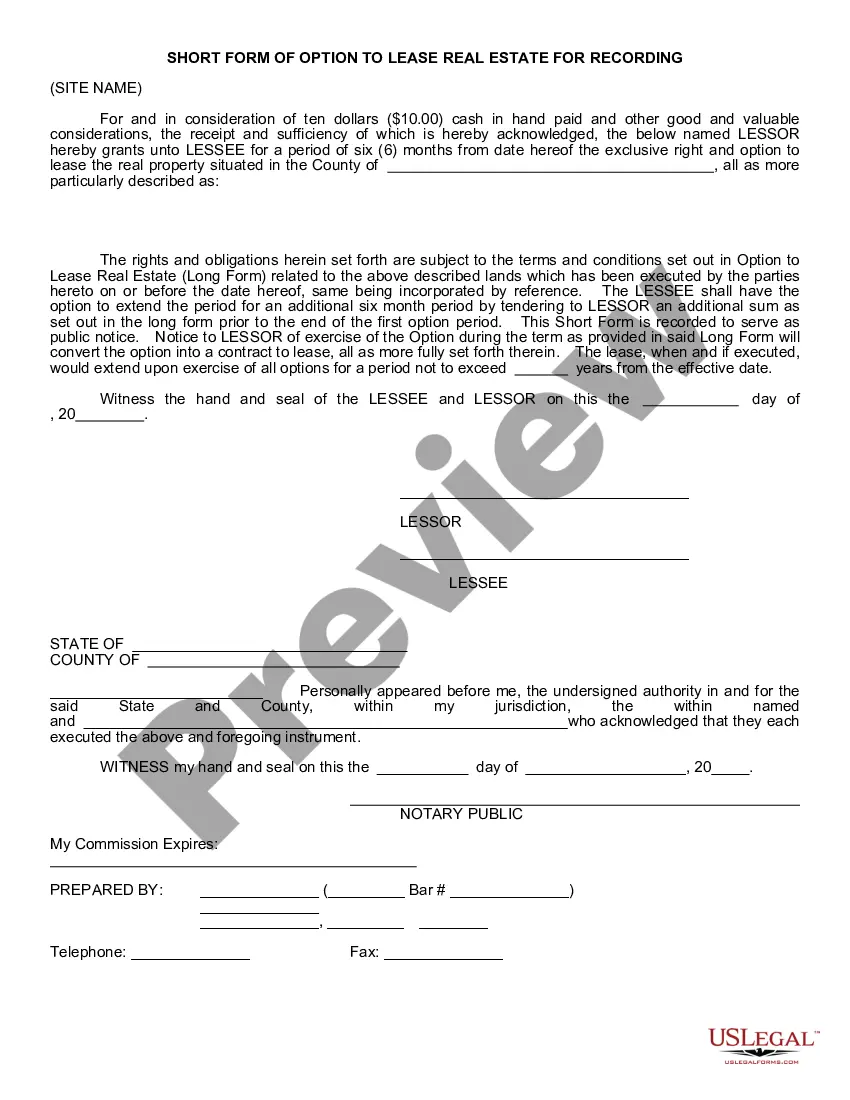
The Notice of Lease for Recording is a legal document used to formally notify that a lease exists on a specific parcel of real estate. This memorandum serves as a summary of the lease agreement without recording the entire document. It is a crucial tool for protecting property rights and ensuring that all parties involved are aware of the existing lease terms.
Main sections of this form
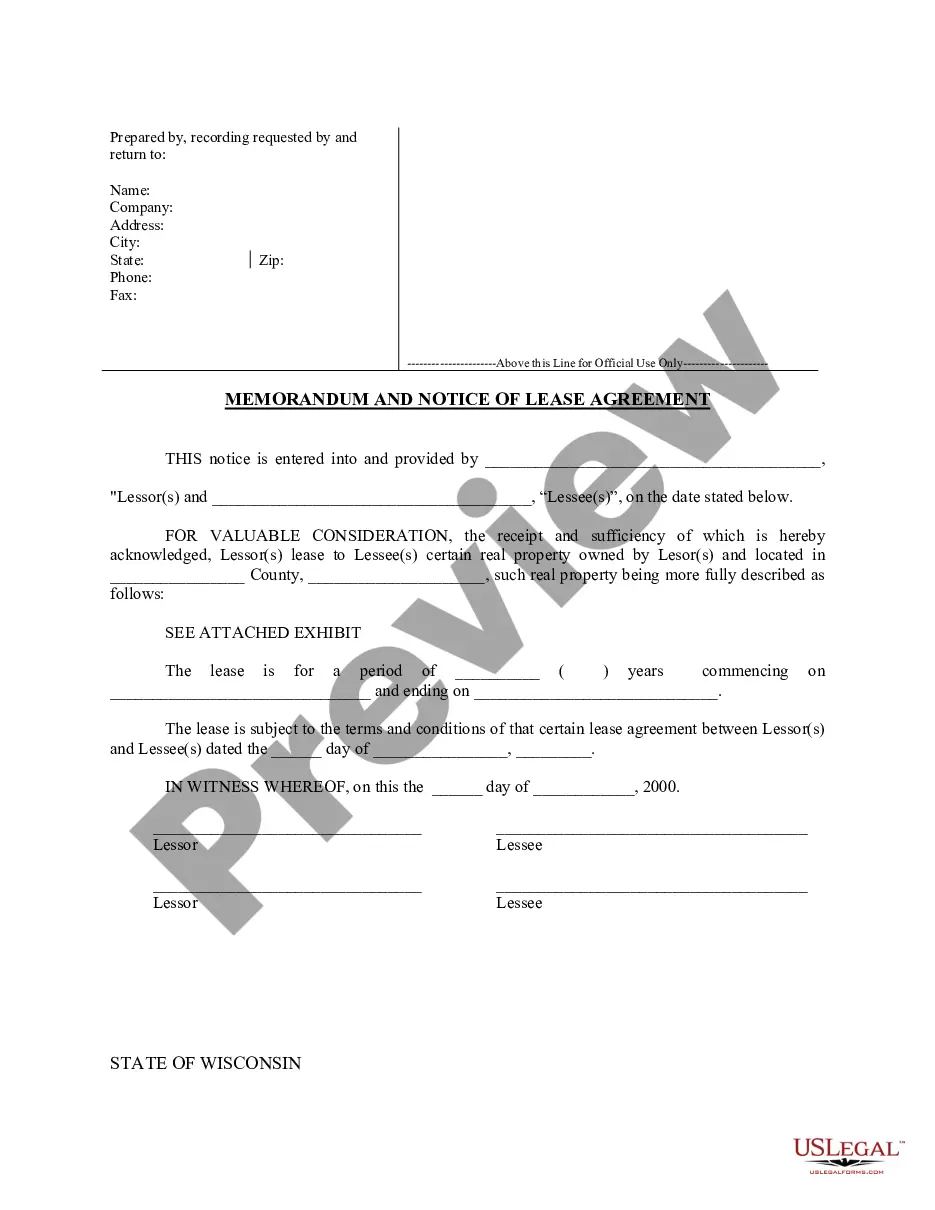
- Prepared by section: Space to indicate the name and contact details of the party completing the form.
- Memorandum section: Identifies the lessor and lessee, outlining the essential details of the lease.
- Description of the property: Specifies the real estate involved, with directions to an attached exhibit for details.
- Lease duration: Indicates the lease term and the start and end dates of the agreement.
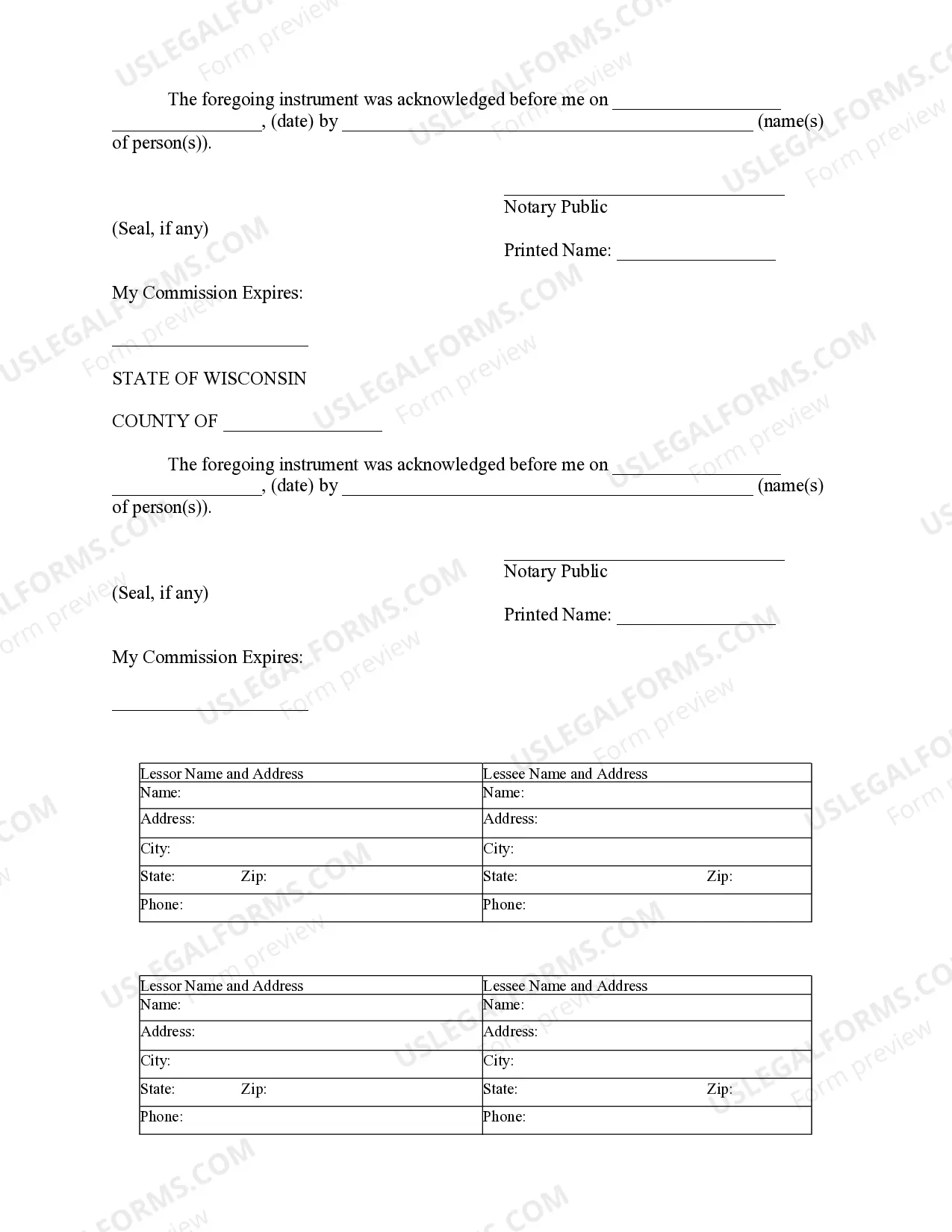
- Signatures and acknowledgments: Includes signatures from both lessor and lessee, along with notary recognition.


Situations where this form applies
This form is necessary when a property owner (lessor) and tenant (lessee) want to formally notify that a lease exists on a property without having to file the entire lease agreement. It is particularly useful in situations where either party wants to ensure the lease terms are recognized by other parties or potential creditors.
Who this form is for
- Property owners who are leasing their property.
- Tenants who have entered into a lease agreement.
- Real estate professionals assisting clients in residential or commercial leases.
- Attorneys advising clients on lease matters.
Instructions for completing this form
- Identify the parties: Enter the names of the lessor and lessee in the designated sections.
- Specify the property: Provide a clear description of the property being leased, referencing any attached exhibit as necessary.
- Enter lease details: Fill in the lease term duration, start date, and end date.
- Obtain signatures: Have both parties sign the document to validate the agreement.
- Prepare for notarization: Ensure a notary public witnesses the signing for legal recognition.
Does this document require notarization?
Yes, this form must be notarized to be legally valid. Notarization ensures that the identities of the parties are verified and that the document can be enforced in court. US Legal Forms offers integrated online notarization services, allowing you to complete this step securely and conveniently from anywhere.
Get your form ready online
Our built-in tools help you complete, sign, share, and store your documents in one place.
Make edits, fill in missing information, and update formatting in US Legal Forms—just like you would in MS Word.
Download a copy, print it, send it by email, or mail it via USPS—whatever works best for your next step.
Sign and collect signatures with our SignNow integration. Send to multiple recipients, set reminders, and more. Go Premium to unlock E-Sign.
If this form requires notarization, complete it online through a secure video call—no need to meet a notary in person or wait for an appointment.
We protect your documents and personal data by following strict security and privacy standards.

Make edits, fill in missing information, and update formatting in US Legal Forms—just like you would in MS Word.

Download a copy, print it, send it by email, or mail it via USPS—whatever works best for your next step.

Sign and collect signatures with our SignNow integration. Send to multiple recipients, set reminders, and more. Go Premium to unlock E-Sign.

If this form requires notarization, complete it online through a secure video call—no need to meet a notary in person or wait for an appointment.

We protect your documents and personal data by following strict security and privacy standards.
Mistakes to watch out for
- Failing to include the complete property description.
- Not specifying the lease duration accurately.
- Leaving out signatures from one or both parties.
- Neglecting the notary acknowledgment, if required.
Benefits of completing this form online
- Convenience: Download and complete the form at your convenience.
- Editability: Easily customize fields based on your situation.
- Reliability: Forms drafted by licensed attorneys ensure compliance with legal standards.
Legal use & context
- This form serves to officially document the existence of a lease in public records.
- It is crucial in establishing priority interests in cases of disputes or claims related to the property.
- Failure to record the lease may weaken the lessee's rights against third parties.
Key takeaways
- The Notice of Lease for Recording protects property rights by officially documenting the existence of a lease.
- Accuracy in completing the form is crucial to avoid disputes or misunderstandings.
- Notarization is often required for legal enforceability.
- This form can be used across multiple states, but local regulations should always be checked.
Looking for another form?
Form popularity
FAQ
Your landlord can end the let at any time by serving a written 'notice to quit'. The notice period will depend on the tenancy or agreement, but is often at least 4 weeks.
The landlord can give the tenant a five-day notice to pay or vacate. This notice informs the tenant that the tenant has five days to either pay rent or move out of the rental unit, or the landlord will file an eviction lawsuit against the tenant.
The landlord can enter at reasonable times to inspect the premises, make repairs, or show the premises to prospective tenants. The landlord usually must give 12 hours notice before entry, unless immediate entry is necessary to preserve or protect the premises, such as in case of a fire or a burst water pipe.
If the case hasn't gone to court yet, then you can go to the court hearing and fight the eviction. If you are successful in fighting the eviction, then in that same hearing, you can ask the judge or court commissioner to make it part of the court record that this case is sealed or expunged from CCAP.
If you are renting by the month, the landlord may terminate the rental agreement by giving you a written termination notice at least 28 days before the next rent due date. You must use the same procedure in notifying the landlord of your intent to terminate the rental agreement, Wis.
Petition the court: In the county where the case was filed, you can petition the court to have the eviction expunged from your record. Win your case: If the landlord served you an eviction notice without a legal or valid basis, prove that.
Landlords are prohibited from harassing or retaliating against tenants who exercise their legal rights. In Wisconsin, the landlord must not terminate, refuse to renew a lease, or fine a tenant for complaining to the landlord regarding the deposit, complaining to a government agency, or exercising a legal right.
In Wisconsin, a landlord can evict a tenant for a variety of reasons, such as tenant nonpayment of rent or violation of rental or lease agreement term. Depending on the circumstances, a tenant facing an eviction may have the legal grounds, or a defense, to challenge the eviction.