Vermont Warranty Deed for Separate or Joint Property to Joint Tenancy
What this document covers
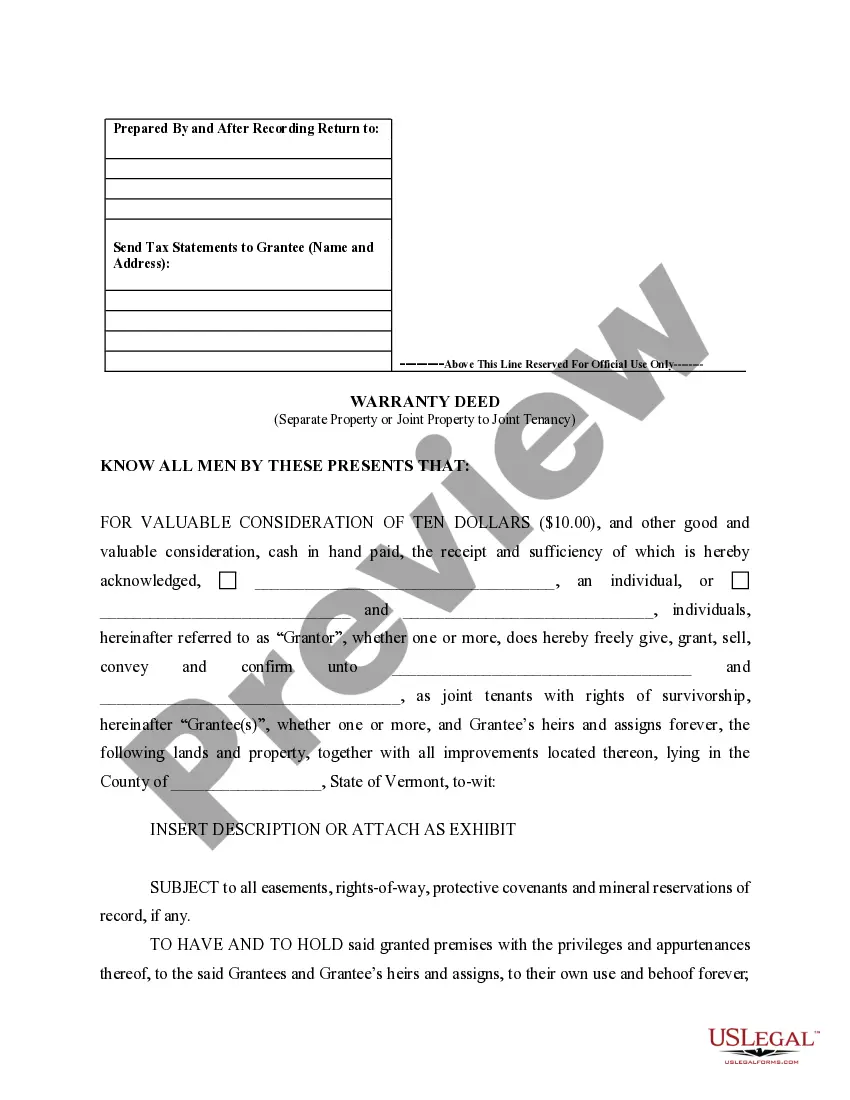
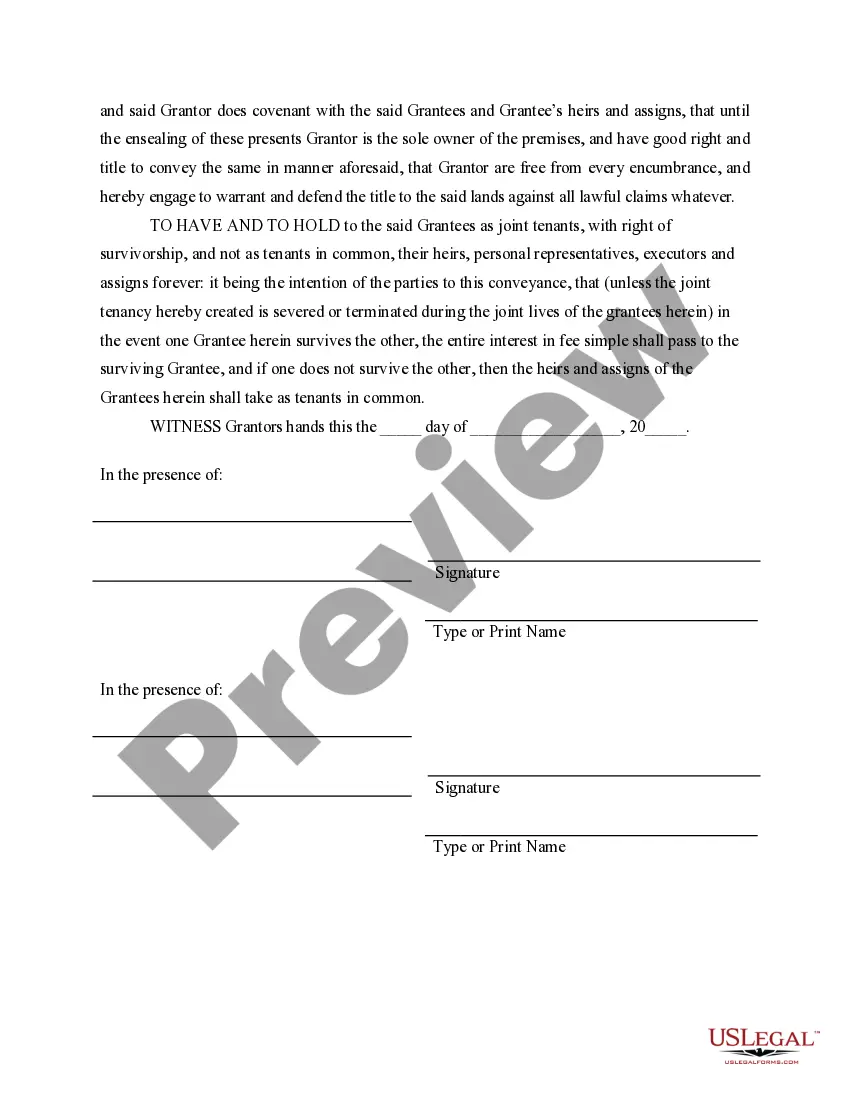
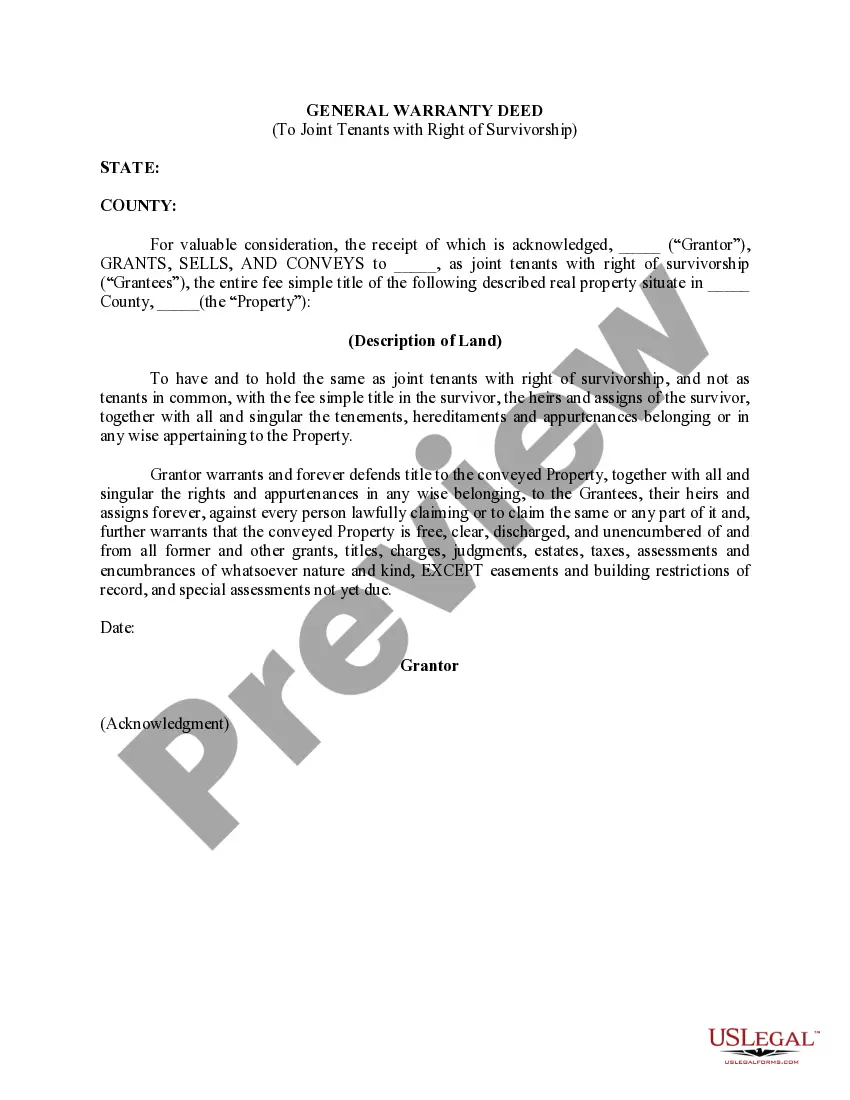
The Warranty Deed for Separate or Joint Property to Joint Tenancy is a legal document that transfers ownership of property from one or more individuals (the grantor) to another individual or individuals (the grantee) as joint tenants with rights of survivorship. This means that if one owner passes away, their share of the property automatically transfers to the surviving owner(s). This form is distinct from a standard warranty deed, as it specifically establishes a joint tenancy, which includes rights of survivorship, ensuring that property ownership remains intact between co-owners even after death.
Form components explained
- Identification of the grantor(s) and grantee(s)
- Description of the property being conveyed
- Statement of consideration (payment) for the property
- Covenant of title assurance, guaranteeing ownership and legal authority to transfer the property
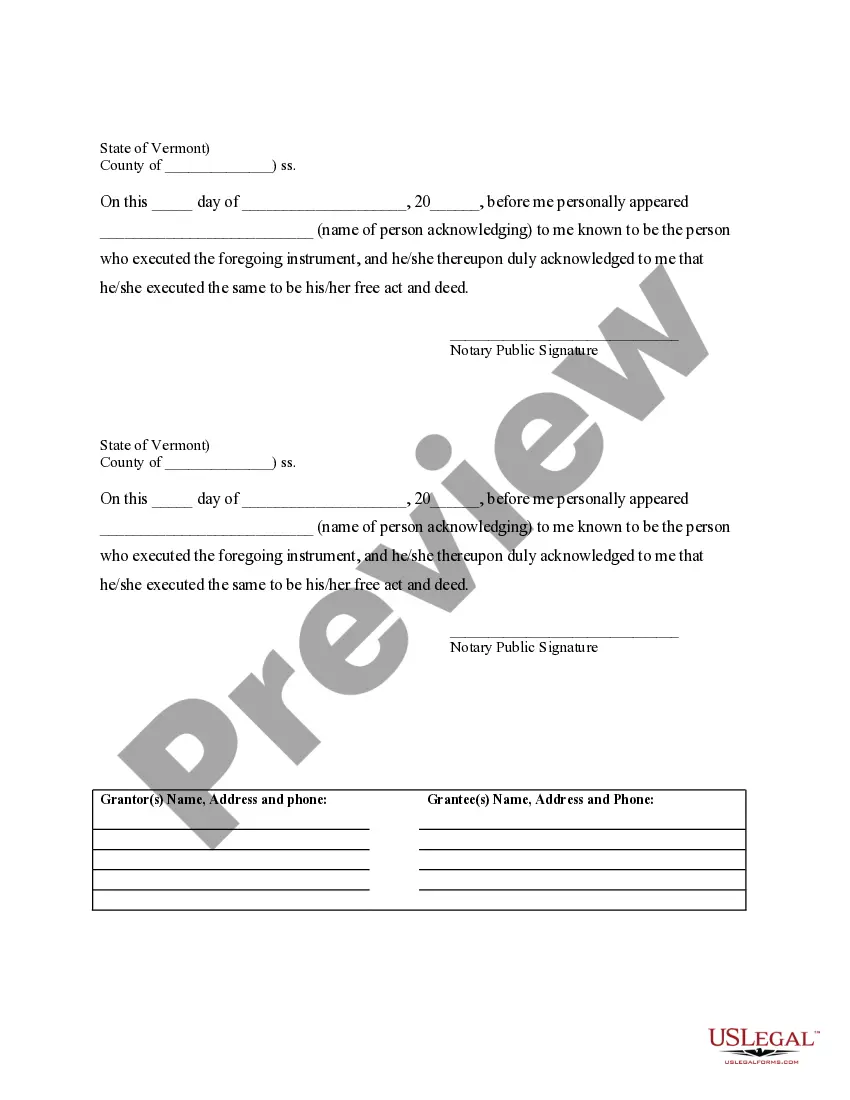
- Notarization section for confirming the identity of signers

Common use cases
This form is used when individuals wish to convert the ownership of separate or jointly owned property into a joint tenancy arrangement. It is particularly useful for couples, family members, or business partners who want to ensure that property automatically passes to the surviving co-owner without going through probate. This form may also be needed during estate planning or property transfers between related individuals who desire joint ownership.
Who needs this form
- Couples who want to establish joint ownership of property.
- Individuals wishing to transfer ownership to family members or friends as joint tenants.
- Business partners who intend to hold real estate as joint tenants.
- Anyone looking to simplify property transfer upon death to avoid probate.
Completing this form step by step
- Identify the grantor(s), including their full names and addresses.
- Identify the grantee(s) with their full names and addresses, ensuring that all parties are included.
- Insert a detailed description of the property being conveyed.
- Specify the consideration amount (the payment for the property, typically a nominal amount).
- Sign and date the form in the presence of a notary public.
Is notarization required?
Notarization is required for this form to take effect. Our online notarization service, powered by Notarize, lets you verify and sign documents remotely through an encrypted video session, available 24/7.
Get your form ready online
Our built-in tools help you complete, sign, share, and store your documents in one place.
Make edits, fill in missing information, and update formatting in US Legal Forms—just like you would in MS Word.
Download a copy, print it, send it by email, or mail it via USPS—whatever works best for your next step.
Sign and collect signatures with our SignNow integration. Send to multiple recipients, set reminders, and more. Go Premium to unlock E-Sign.
If this form requires notarization, complete it online through a secure video call—no need to meet a notary in person or wait for an appointment.
We protect your documents and personal data by following strict security and privacy standards.

Make edits, fill in missing information, and update formatting in US Legal Forms—just like you would in MS Word.

Download a copy, print it, send it by email, or mail it via USPS—whatever works best for your next step.

Sign and collect signatures with our SignNow integration. Send to multiple recipients, set reminders, and more. Go Premium to unlock E-Sign.

If this form requires notarization, complete it online through a secure video call—no need to meet a notary in person or wait for an appointment.

We protect your documents and personal data by following strict security and privacy standards.
Typical mistakes to avoid
- Failing to properly describe the property in detail.
- Omitting the notarization, which is necessary for legal validity.
- Incorrectly listing the names of grantors or grantees, which can lead to legal disputes.
- Not understanding the implications of joint tenancy versus other forms of property ownership.
Why use this form online
- Convenience of downloading and completing forms from the comfort of your home.
- Editable fields allow for easy customization to fit your specific needs.
- Access to attorney-drafted templates ensures legal accuracy.
- Immediate access to forms eliminates the need to wait for physical delivery.
Looking for another form?




Form popularity
FAQ
With a Survivorship Deed in place, when one of the parties in a joint tenancy dies, the other party (or parties) takes over the deceased party's interest in the property instead of it passing to the deceased's heirs or beneficiaries.
Four conditions that are required in order for there to be a formation of a joint tenancy. The four unities are: time, title, interest and possession.
Adding someone to your house deed requires the filing of a legal form known as a quitclaim deed. When executed and notarized, the quitclaim deed legally overrides the current deed to your home. By filing the quitclaim deed, you can add someone to the title of your home, in effect transferring a share of ownership.
The term joint tenancy refers to a legal arrangement in which two or more people own a property together, each with equal rights and obligations. Joint tenancies can be created by married and non-married couples, friends, relatives, and business associates.
Here are some of the options: Joint Ownership. If mom, daughter, and (perhaps) son-in-law own the house as joint tenants with right of survivorship, when mom passes away the house will go to the other owners without going through probate.
Look on the deed itself. If after the owner's names it reads as "Tenants in Common" then that's what it is; if there is no notation the law will presume that it is as tenants in common.
Property held in joint tenancy, tenancy by the entirety, or community property with right of survivorship automatically passes to the survivor when one of the original owners dies. Real estate, bank accounts, vehicles, and investments can all pass this way. No probate is necessary to transfer ownership of the property.
To create a joint tenancy, all you need to do is put the right words on the title document, such as a deed to real estate, a car's title slip, or the signature card establishing a bank account.
The dangers of joint tenancy include the following: Danger #1: Only delays probate. When either joint tenant dies, the survivor usually a spouse or child immediately becomes the owner of the entire property. But when the survivor dies, the property still must go through probate.