Vermont Warranty Deed from Individual to a Trust

What this document covers
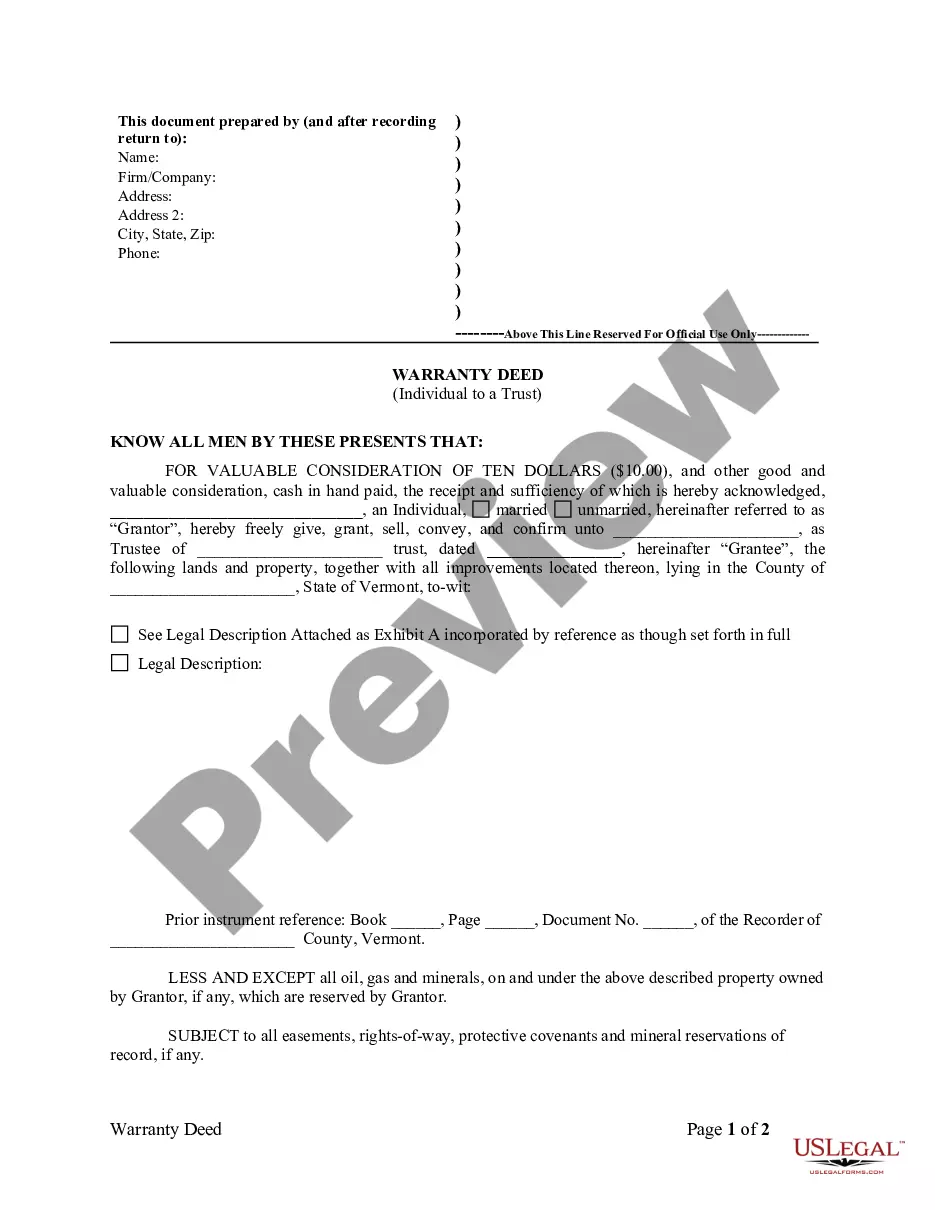
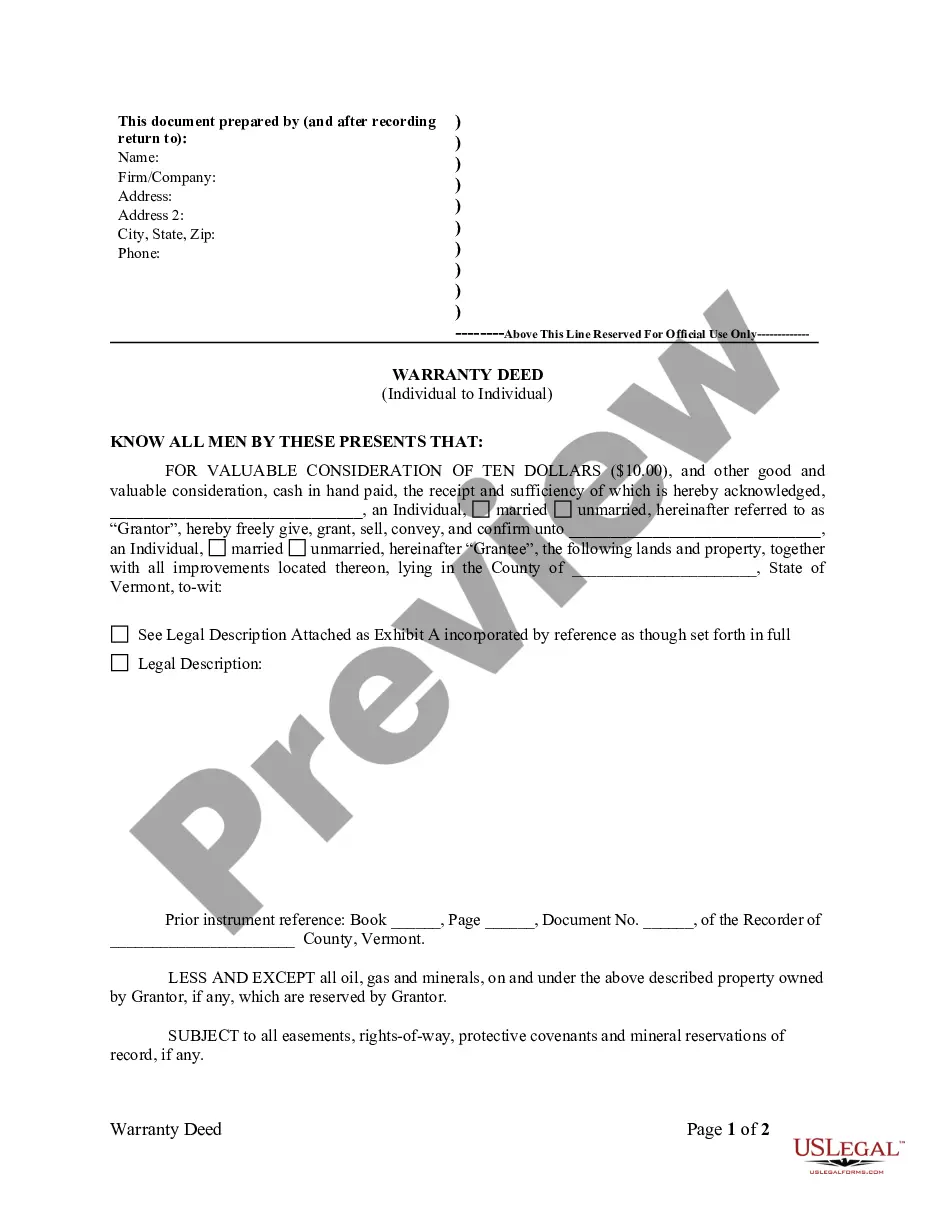
The Warranty Deed from Individual to a Trust is a legal document that transfers property ownership from an individual (the grantor) to a trust (the grantee). This deed ensures that the title of the property is conveyed with a warranty, meaning the grantor guarantees good title without any encumbrances except those noted. This form is unique because it specifically involves a trust as the recipient of the property, distinguishing it from standard warranty deeds used for individual property transfers.
Main sections of this form
- Grantor Information: Details about the individual transferring the property.
- Grantee Information: Identifies the trust that will receive the property.
- Legal Description: Clearly describes the property being transferred.
- Reservation of Rights: Specifies any reservations such as oil, gas, and mineral rights retained by the grantor.
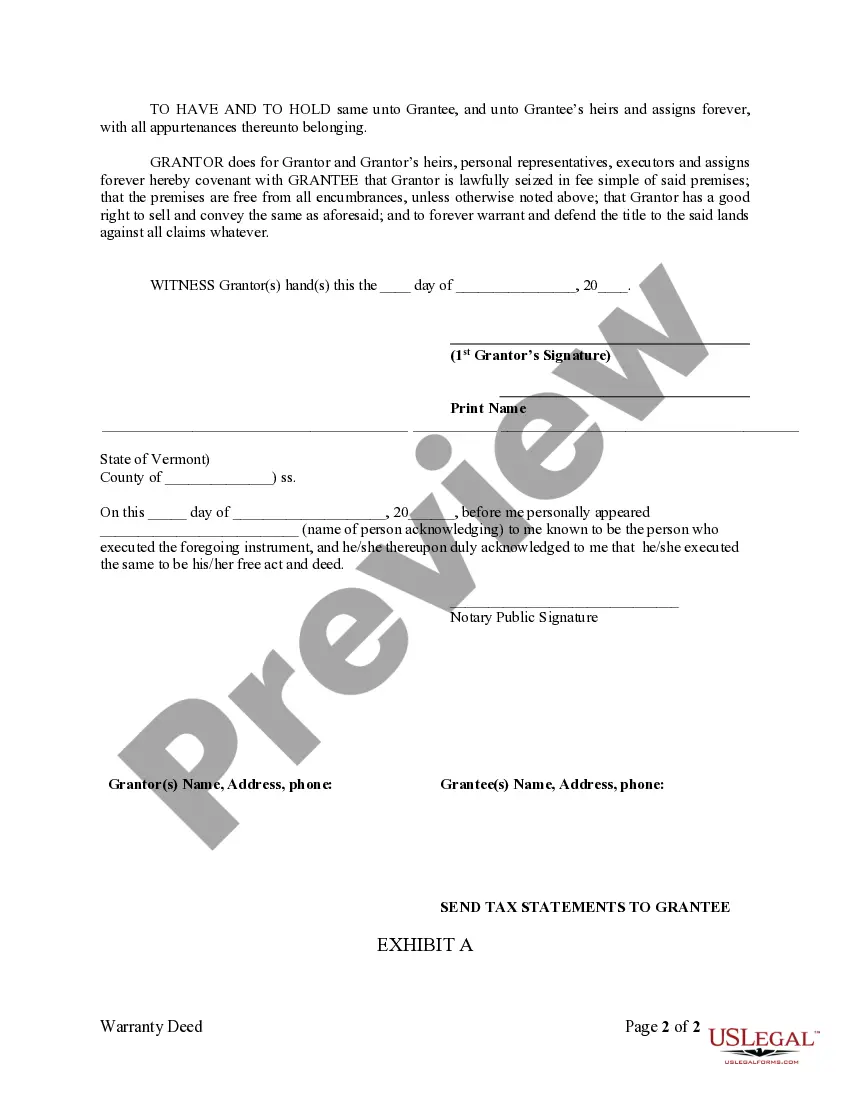
- Covenants: Legal assurances made by the grantor regarding the property title.
- Signatures and Notarization: Includes spaces for signatures and notary acknowledgment to validate the deed.





Common use cases
This form is used when an individual wishes to transfer ownership of real property to a trust, often for purposes such as estate planning or asset protection. It is applicable in situations where the grantor wants to ensure the trust becomes the legal owner of the property while retaining certain rights, such as mineral rights. If you're setting up a trust and want to include property as part of that trust, this deed is essential.
Who needs this form
- Individuals creating a trust to manage their assets.
- Grantors who want to transfer ownership of property to a trust.
- Trustees preparing to receive property as part of their fiduciary duties.
- Estate planners looking to structure property ownership effectively.
Steps to complete this form
- Identify the parties involved: the grantor (individual) and the grantee (trust).
- Provide the legal description of the property being transferred.
- Specify any rights being reserved by the grantor, such as mineral rights.
- Complete the signatures section, ensuring that both the grantor and a notary public sign the document.
- File the completed warranty deed with the appropriate local government office to finalize the transfer.
Notarization guidance
This form must be notarized to be legally valid. US Legal Forms provides secure online notarization powered by Notarize, allowing you to complete the process through a verified video call.
Get your form ready online
Our built-in tools help you complete, sign, share, and store your documents in one place.
Make edits, fill in missing information, and update formatting in US Legal Forms—just like you would in MS Word.
Download a copy, print it, send it by email, or mail it via USPS—whatever works best for your next step.
Sign and collect signatures with our SignNow integration. Send to multiple recipients, set reminders, and more. Go Premium to unlock E-Sign.
If this form requires notarization, complete it online through a secure video call—no need to meet a notary in person or wait for an appointment.
We protect your documents and personal data by following strict security and privacy standards.

Make edits, fill in missing information, and update formatting in US Legal Forms—just like you would in MS Word.

Download a copy, print it, send it by email, or mail it via USPS—whatever works best for your next step.

Sign and collect signatures with our SignNow integration. Send to multiple recipients, set reminders, and more. Go Premium to unlock E-Sign.

If this form requires notarization, complete it online through a secure video call—no need to meet a notary in person or wait for an appointment.

We protect your documents and personal data by following strict security and privacy standards.
Common mistakes to avoid
- Failing to include a complete legal description of the property.
- Not reserving specific rights, which can lead to future disputes.
- Omitting notary signatures, which is critical for validity.
- Not recording the deed with local authorities, making the transfer ineffective.
Benefits of using this form online
- Easy access to downloadable and customizable templates.
- Time-saving compared to drafting a deed from scratch.
- Legal reassurance as forms are created by licensed attorneys.
- Ability to fill out and edit forms conveniently from home.
Summary of main points
- The Warranty Deed from Individual to a Trust facilitates the transfer of property from an individual to a trust.
- Proper completion and notarization are essential for legal validity.
- It is useful in planning estates and protecting specific property rights.
- Accessible online forms ensure you have the correct documentation quickly and easily.
Looking for another form?
Form popularity
FAQ
To use a Quitclaim Deed to add someone to a property deed or title, you would need to create a Quitclaim Deed and list all of the current owners in the grantor section. In the grantee section, you would list all of the current owners as well as the person you would like to add.
Typically, the lender will provide you with a copy of the deed of trust after the closing. The original warranty deeds are often mailed to the grantee after they are recorded. These are your original copies and should be kept in a safe place, such as a fireproof lockbox or a safe deposit box at a financial institution.
Before a quit claim deed can be filed with the County Clerk's Office, Form PT-172 must be filled out and filed with the Department of Taxes in order to prove that the property tax has been paid. Signing - Vermont Law dictates that the grantor must have the quit claim deed notarized (27 V.S.A § 301).
A warranty deed protects property owners from future claims that someone else actually owns a portion (or all) of their property, while trustee deeds protect lenders when borrowers default on their mortgage loans.
With a warranty deed, the seller is providing to the buyer a guarantee that the seller owns the property and that there are no other rights to any part of the property, other than what is disclosed, and that the seller has the legal authority to sell the property to the buyer.
A trustee deed offers no such warranties about the title.
The mortgage company usually prepares this deed as part of the loan package and delivers it to the title company for you to sign at closing. The title company is commonly the trustee to the deed and holds legal title to the property until the loan gets fully repaid.
Trustee's deeds convey real estate out of a trust.This type of conveyance is named for the person using the form the trustee who stands in for the beneficiary of the trust and holds title to the property.
But you might be wondering if an owner can transfer a deed to another person without a real estate lawyer. The answer is yes. Parties to a transaction are always free to prepare their own deeds.A quitclaim deed, for example, is far simpler than a warranty deed.