Non Employee Director Stock Option Agreement
What this document covers
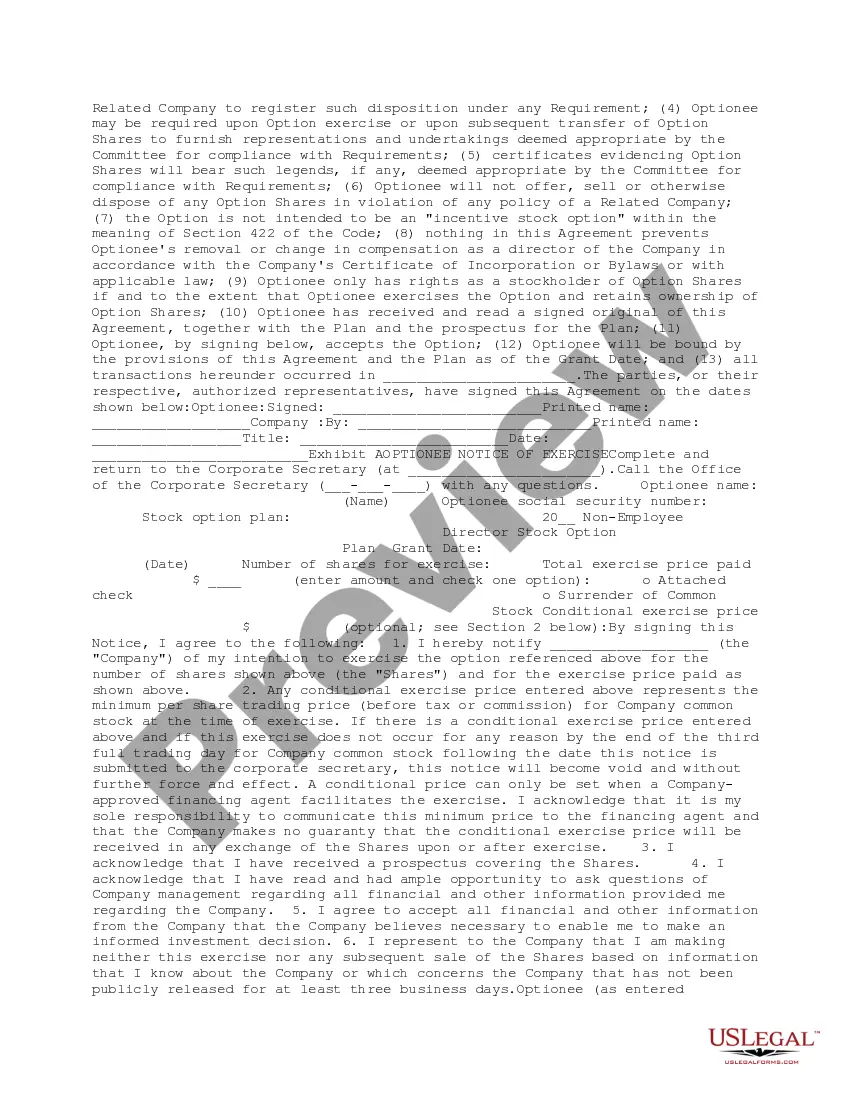
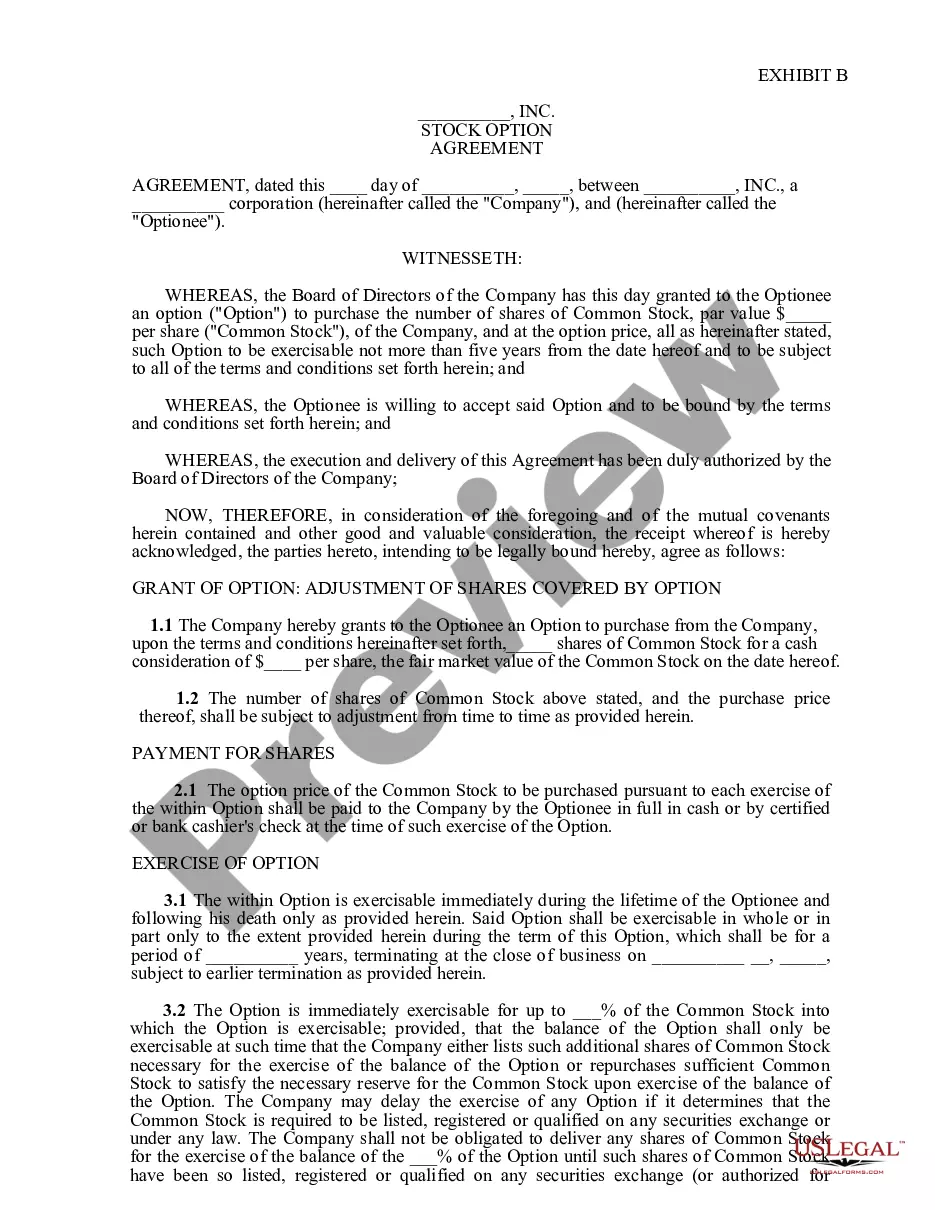
The Non Employee Director Stock Option Agreement is a legal document that grants non-employee directors the right to purchase shares of a company's stock at a predetermined price. This agreement is specifically designed for directors who do not receive a salary but may be compensated with stock options, allowing them to have a stake in the company's success. This form is distinct from other stock option agreements primarily because it addresses the specific needs and regulatory considerations for non-employee directors.
Form components explained
- Grant date: The date on which the option is granted to the optionee.
- Exercise price: The price at which the optionee can purchase the company's stock.
- Option shares: The number of shares granted to the optionee under the agreement.
- Vesting schedule: Defines when the option shares can be exercised.
- Termination conditions: Outlines what happens to the options upon the director's termination of service.
- Tax withholding: Specifies requirements for any taxes owed upon exercising the option.






When to use this form
This form is used when a company wishes to provide stock options to its non-employee directors as part of their compensation package. It is applicable during the establishment of a non-employee directorâs stock option plan, especially in situations where the company is incentivizing directors to align their interests with those of shareholders.
Who can use this document
- Companies looking to compensate non-employee directors through stock options.
- Corporate boards of directors managing the equity compensation of their members.
- Legal teams needing a compliant template for issuing stock options to directors.
Completing this form step by step
- Identify the parties involved: Enter the name of the optionee and the company.
- Specify the grant date and the exercise price in the appropriate fields.
- Fill in the number of option shares being granted.
- Review the vesting and expiration conditions detailed in the agreement.
- Ensure proper signatures are obtained from both the optionee and a company representative.
Does this document require notarization?
This form does not typically require notarization unless specified by local law.
Get your form ready online
Our built-in tools help you complete, sign, share, and store your documents in one place.
Make edits, fill in missing information, and update formatting in US Legal Forms—just like you would in MS Word.
Download a copy, print it, send it by email, or mail it via USPS—whatever works best for your next step.
Sign and collect signatures with our SignNow integration. Send to multiple recipients, set reminders, and more. Go Premium to unlock E-Sign.
If this form requires notarization, complete it online through a secure video call—no need to meet a notary in person or wait for an appointment.
We protect your documents and personal data by following strict security and privacy standards.

Make edits, fill in missing information, and update formatting in US Legal Forms—just like you would in MS Word.

Download a copy, print it, send it by email, or mail it via USPS—whatever works best for your next step.

Sign and collect signatures with our SignNow integration. Send to multiple recipients, set reminders, and more. Go Premium to unlock E-Sign.

If this form requires notarization, complete it online through a secure video call—no need to meet a notary in person or wait for an appointment.

We protect your documents and personal data by following strict security and privacy standards.
Typical mistakes to avoid
- Failing to specify the correct exercise price can lead to confusion.
- Omitting signatures from relevant parties invalidates the agreement.
- Not understanding the vesting schedule may result in missed opportunities to exercise options.
Benefits of using this form online
- Quick access to a legally vetted template that saves time and resources.
- The ability to customize fields easily makes it adaptable for different scenarios.
- Reliable document storage and retrieval without the need for physical copies.
Key takeaways
- The Non-Employee Director Stock Option Agreement allows a director to purchase company shares, linking their success to the company's performance.
- Completion requires careful attention to detail in entering key terms, including pricing and vesting timelines.
- This form is particularly useful for corporate governance and aligning interests between directors and shareholders.
Looking for another form?
Form popularity
FAQ
Types of Employee Stock Options Companies can offer two types of stock optionsnonqualified stock options (NQSOS) and incentive stock options (ISOS).
In some situations companies choose to pay independent contractors with company stock in the form of stock options, restricted stock or outright stock grants.However, companies can offer stock to any independent contractor.
Stock Option Journal Entries Year 1 The stock option compensation is an expense of the business and is represented by the debit to the expense account in the income statement. The other side of the entry is to the additional paid in capital account (APIC) which is part of the total equity of the business.
In a simple option transfer to a family member, you transfer a vested option to a child, grandchild, or other heir. The transfer of the vested option is treated as a completed gift for gift-tax purposes. In 2021, you can generally give annual gifts of up to $15,000 (married couples $30,000) to each donee.
Stock options are of two main types. Incentive stock options, generally only offered to key employees and top management, receive preferential tax treatment in many cases, as the IRS treats gains on such options as long-term capital gains.
Qualified stock options, also known as incentive stock options, can only be granted to employees. Non-qualified stock options can be granted to employees, directors, contractors and others. This gives you greater flexibility to recognize the contributions of non-employees.
In a private company setting, after the founders have been issued fully vested or restricted stock under their stock purchase agreements, the employees, consultants, advisors and directors who are subsequently hired commonly receive equity compensation through stock options.
Once you exercise your non-qualified stock option, the difference between the stock price and the strike price is taxed as ordinary income. This income is usually reported on your paystub.If you hold the shares for less than one year, any gain is taxed at your ordinary income tax rates, which are usually higher.
The stock option compensation is an expense of the business and is represented by the debit to the expense account in the income statement. The other side of the entry is to the additional paid in capital account (APIC) which is part of the total equity of the business.