Parental Permission For Child To Use Internet At School
What this document covers
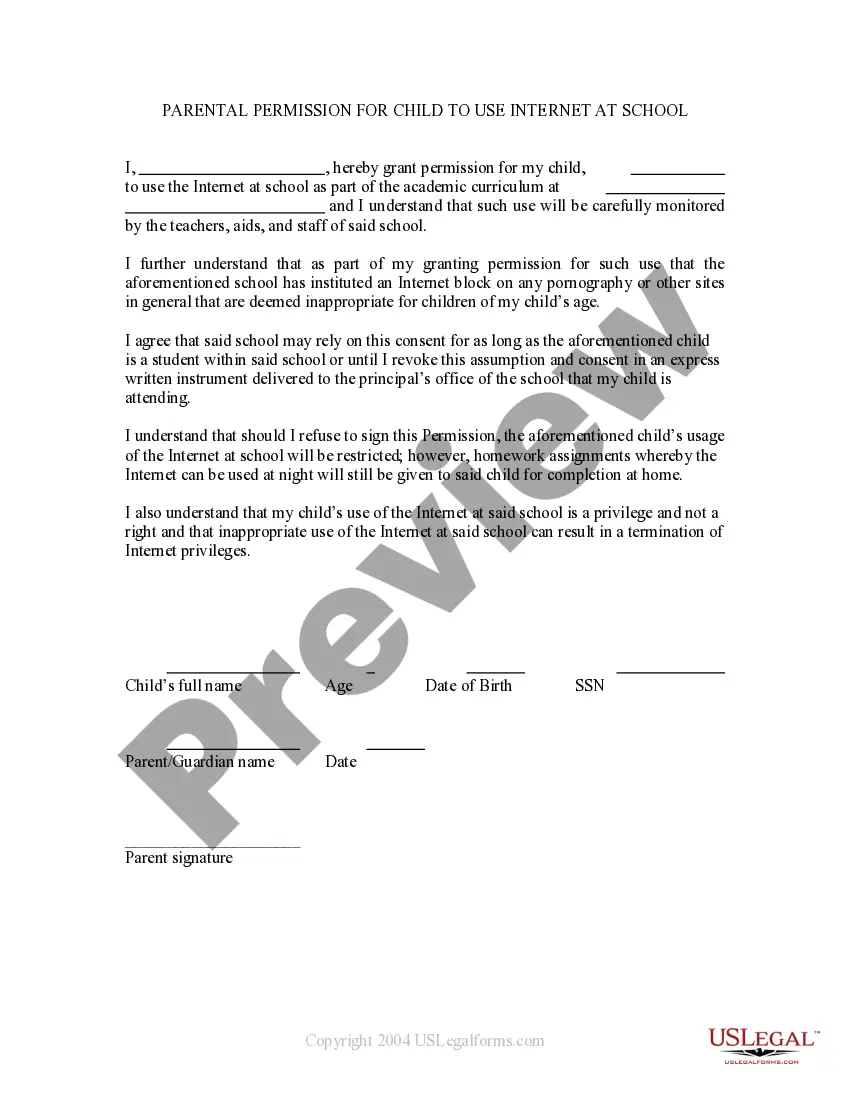
The Parental Permission For Child To Use Internet At School form is a legal document allowing parents to grant their children access to the internet during school hours as part of their academic activities. This form ensures that the child can use online resources under the supervision of school staff while maintaining a safe environment. Unlike general consent forms, it specifically addresses internet use in an educational context and the precautions taken by schools to block inappropriate content.
Form components explained
- Parent's name and signature, granting consent for internet use.
- Identification of the child who will use the internet.
- Statement regarding the school's internet filtering practices.
- Duration of consent, which lasts until revoked by the parent.
- Clarification that refusal to sign may lead to restricted internet access.
Common use cases
This form is necessary when a parent wishes to provide permission for their child to access the internet at school as part of learning activities. It should be used at the beginning of the school year or when a child starts a new school. Parents should also complete the form if there is a change in the school's internet policy or if the child shifts to a different academic program requiring online work.
Who needs this form
- Parents or legal guardians of students attending school.
- Schools that require parental permission for students to access the internet.
- Educational institutions that implement internet usage for academic purposes.
Instructions for completing this form
- Fill in the name of the child who will be using the internet.
- Provide your name as the parent or guardian granting consent.
- Sign and date the form to confirm your permission.
- Submit the completed form to the school office or designated authority.
Notarization guidance
This form does not typically require notarization unless specified by local law. Ensure that you check with your school for any specific requirements in your area.
Get your form ready online
Our built-in tools help you complete, sign, share, and store your documents in one place.
Make edits, fill in missing information, and update formatting in US Legal Forms—just like you would in MS Word.
Download a copy, print it, send it by email, or mail it via USPS—whatever works best for your next step.
Sign and collect signatures with our SignNow integration. Send to multiple recipients, set reminders, and more. Go Premium to unlock E-Sign.
If this form requires notarization, complete it online through a secure video call—no need to meet a notary in person or wait for an appointment.
We protect your documents and personal data by following strict security and privacy standards.

Make edits, fill in missing information, and update formatting in US Legal Forms—just like you would in MS Word.

Download a copy, print it, send it by email, or mail it via USPS—whatever works best for your next step.

Sign and collect signatures with our SignNow integration. Send to multiple recipients, set reminders, and more. Go Premium to unlock E-Sign.

If this form requires notarization, complete it online through a secure video call—no need to meet a notary in person or wait for an appointment.

We protect your documents and personal data by following strict security and privacy standards.
Mistakes to watch out for
- Not signing the form, which makes it invalid.
- Failing to provide the child's full name or grade.
- Misunderstanding the duration of the consent period.
Advantages of online completion
- Convenience: Easily download and fill out the form from home.
- Editability: Modify the form to fit your needs before printing.
- Access to professionally drafted content, ensuring compliance with legal standards.
Legal use & context
- The form grants the school the authority to allow Internet access under specified conditions, ensuring a safer environment for students.
- It protects both parents and schools by outlining the rights and responsibilities involved in Internet usage.
- Parents retain the ability to revoke consent at any time, giving them control over their childâs Internet access at school.
What to keep in mind
- This form grants parental permission for internet access in schools.
- It includes important components like consent duration and safety measures.
- Completing the form is essential for enabling internet use related to school assignments.
Looking for another form?





Form popularity
FAQ
Parental Permission For Child To Use Internet At School is a consent document that lets a parent authorize their child to access the internet at school for academic activities, under staff supervision. It records the child's identity, the parent's consent, and notes the school's filtering practices. The consent remains in effect until the parent revokes it, and signing may influence access at school.
Yes. The form states that the Parental Permission For Child To Use Internet At School remains in effect until the parent revokes it. The revocation ends the parent's authorization for the child to use the school internet, so the school will no longer have permission to provide internet access under this agreement.
The form should be signed by the parent or legal guardian who is granting permission. It requires the parent's name and signature to document consent for the child's internet use at school, aligning with the stated duration and the school's obligation to monitor access.
If a parent refuses to sign, the form notes that refusal may lead to restricted internet access for the child at school. The document ties access to parental consent, so unsigned permission typically results in limited or no internet access during school activities.
The form includes a statement about the school's internet filtering practices, acknowledging that the school uses content filters to block inappropriate websites and to supervise online activities during school hours. This helps parents understand the safeguards while their child uses the school network.
The Parental Permission For Child To Use Internet At School form is tailored for school use, linking consent specifically to educational activities and staff supervision. It explicitly references the school's internet filtering practices and notes that consent continues until the parent revokes it, making it distinct from generic, non-educational internet access consents.