Permission To Discipline
About this form
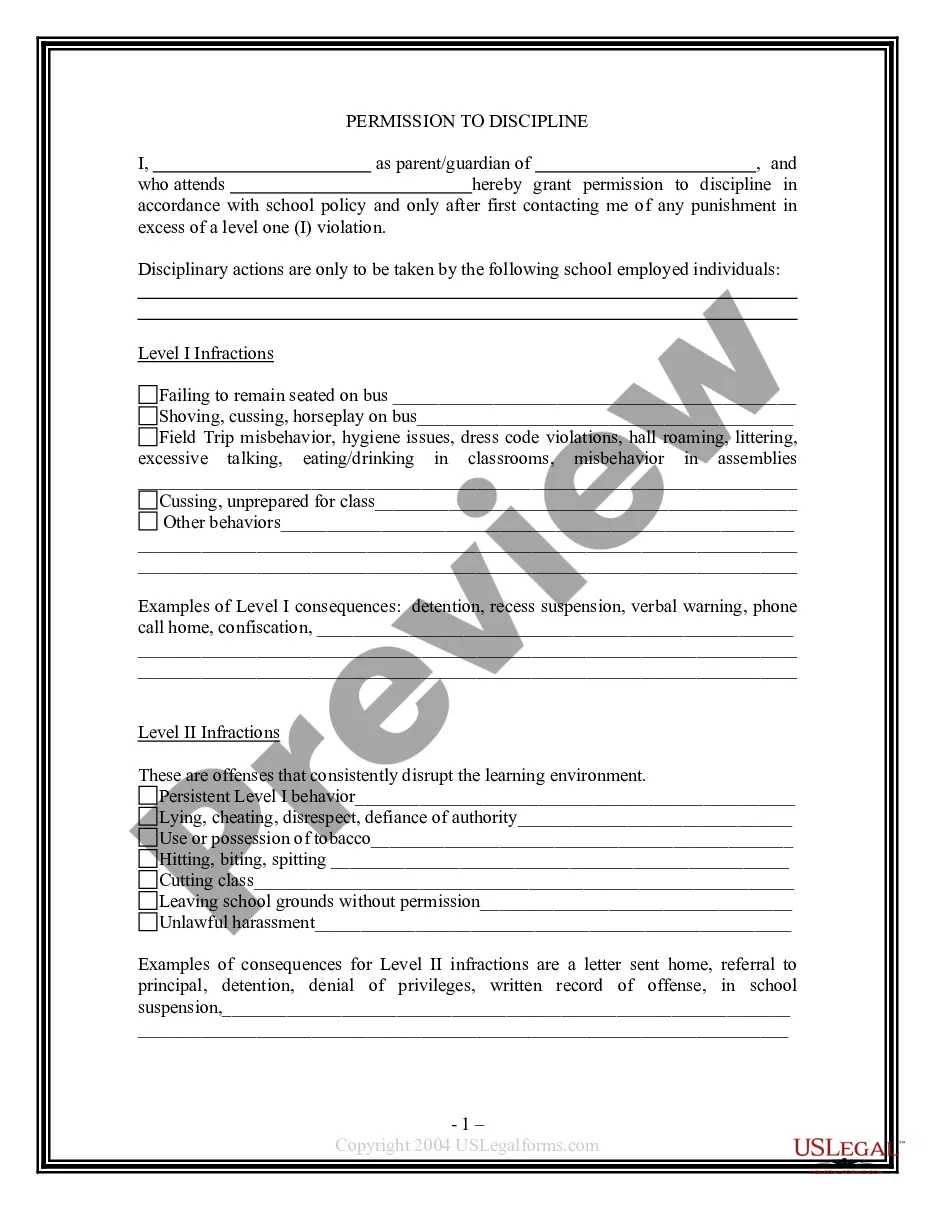
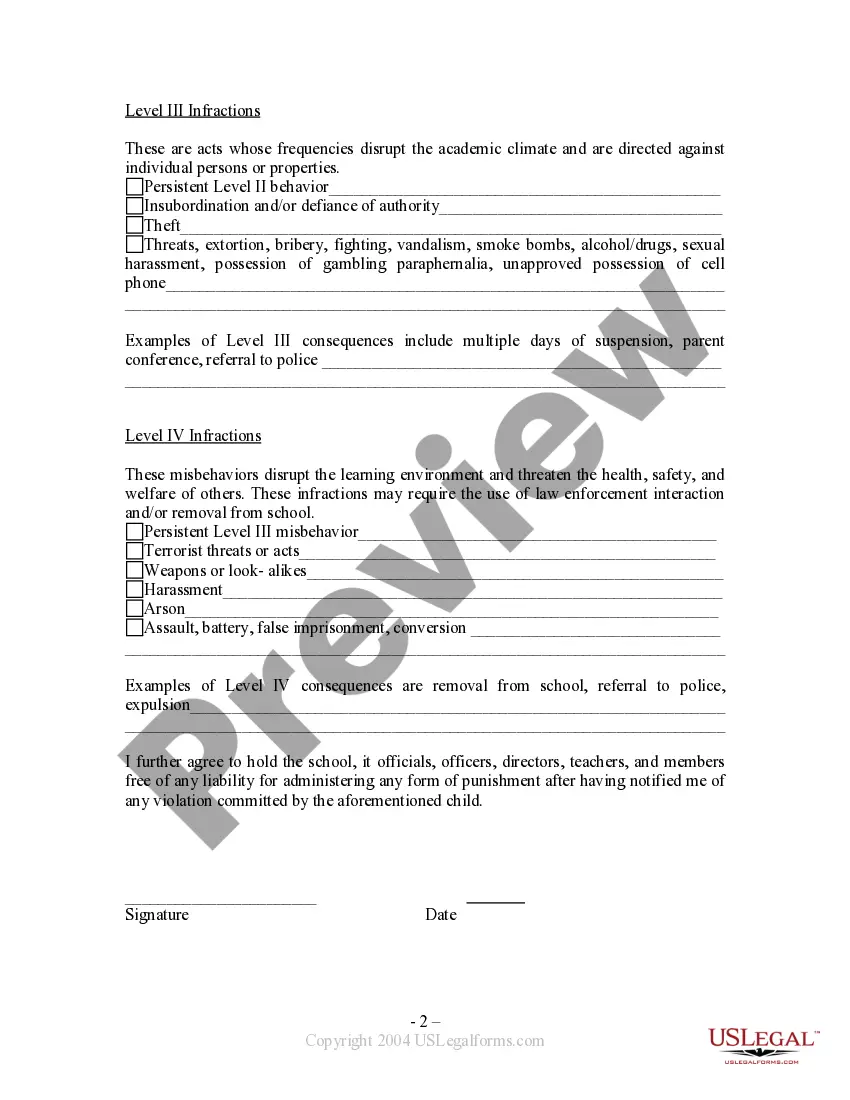
The Permission To Discipline form is a legal document that allows parents to grant specific school officials the authority to administer disciplinary actions to their child for inappropriate behavior. This form differs from general consent forms by outlining various levels of infractions and corresponding consequences, creating a clear framework for behavior management in schools.
Main sections of this form
- Identification of allowed behaviors and infractions.
- Consequences associated with Level I, II, III, and IV infractions.
- Parent's agreement to hold the school harmless for disciplinary actions taken.
- Space for additional behaviors that may warrant discipline.
- Fields for school officials' names and signature lines.
When to use this document
This form should be used when parents wish to formally permit school staff to discipline their child for specific behaviors. It is particularly useful at the beginning of a school year or when administering new discipline policies. Scenarios include addressing ongoing behavioral issues, clarifying expectations, and when a child is participating in school activities that may trigger disciplinary actions.
Intended users of this form
- Parents or guardians of children enrolled in school.
- School administrators in charge of student behavior management.
- Teachers and staff responsible for enforcing school discipline policies.
- School boards looking to implement structured behavior policies.
Steps to complete this form
- Enter the child's name and details at the top of the form.
- List the specific behaviors that may require discipline in the designated area.
- Outline the consequences associated with each level of behavior infractions.
- Sign and date the form to indicate consent.
- Provide a contact method for school officials to reach out in case of infractions.
Does this document require notarization?
This form does not typically require notarization to be legally valid. However, some jurisdictions or document types may still require it. US Legal Forms provides secure online notarization powered by Notarize, available 24/7 for added convenience.
Get your form ready online
Our built-in tools help you complete, sign, share, and store your documents in one place.
Make edits, fill in missing information, and update formatting in US Legal Forms—just like you would in MS Word.
Download a copy, print it, send it by email, or mail it via USPS—whatever works best for your next step.
Sign and collect signatures with our SignNow integration. Send to multiple recipients, set reminders, and more. Go Premium to unlock E-Sign.
If this form requires notarization, complete it online through a secure video call—no need to meet a notary in person or wait for an appointment.
We protect your documents and personal data by following strict security and privacy standards.

Make edits, fill in missing information, and update formatting in US Legal Forms—just like you would in MS Word.

Download a copy, print it, send it by email, or mail it via USPS—whatever works best for your next step.

Sign and collect signatures with our SignNow integration. Send to multiple recipients, set reminders, and more. Go Premium to unlock E-Sign.

If this form requires notarization, complete it online through a secure video call—no need to meet a notary in person or wait for an appointment.

We protect your documents and personal data by following strict security and privacy standards.
Mistakes to watch out for
- Failing to list specific behaviors might lead to misunderstandings about expectations.
- Not thoroughly discussing consequences with the child before signing.
- Overlooking the need for updates if the child's behaviors change.
Why complete this form online
- Convenience of downloading and printing from home.
- Editable fields allow for customization according to specific school policies.
- Access to professionally drafted templates ensures reliability and accuracy.
Legal use & context
This form is legally binding once signed by a parent or guardian, granting schools the necessary authority to enforce disciplinary measures. It helps protect both students and schools by establishing a mutual understanding of acceptable behavior and consequences.
Looking for another form?

Form popularity
FAQ
1 Check for bias. Take a look at your own disciplinary data. 2 Make school discipline consistent. 3 Keep students' dignity intact. 4 Anticipate feelings and address them. 5 Maintain privacy. 6 Reenter in relationship.
Preventative Discipline. Supportive Discipline. Corrective Discipline.
Greet students at the door. Get students focused before you begin any lesson. Use positive presence. Model the behavioryou want students to produce. Use low-profile intervention.
A referral is the process or steps taken by a teacher in order to get extra assistance for a student with whom they directly work.All referral situations are dictated by the behavior and/or actions of a student, however extreme those may be.
DISCIPLINE REFERRAL TO ADMINISTRATIONReferrals are legal documents. To complete a referral, write only the exact behavior or situation. Be specific and include interventions that you have taken. Do not write opinions or the action that should be taken on the referral.
Power School. Log Entries. From the Start page, choose a student. From the Quick Lookup page for the chosen student, choose Log Entries, located under Administrative Functions. Student Name. Name. The New Log Entry Page appears below. Choose Discipline from the Dropdown. Student Name. Enter Incident Notes Here.
A single discipline approach is efficient in that material can be taught in a logical sequence, with skills building on skills. This supports students in progressing, practicing, mastering, and pushing further within the subject matter.
Well, a school discipline referral is simply a way for a teacher to refer a student to an administrator to be disciplined. It's usually a physical form that a teacher will fill out and turn into the office with information about the incident and what steps the teacher has taken to correct the problem.
Show and tell. Teach children right from wrong with calm words and actions. Set limits. Have clear and consistent rules your children can follow. Give consequences. Hear them out. Give them your attention. Catch them being good. Know when not to respond. Be prepared for trouble.