Motion for Leave to Amend Complaint - Personal Injury
Understanding this form
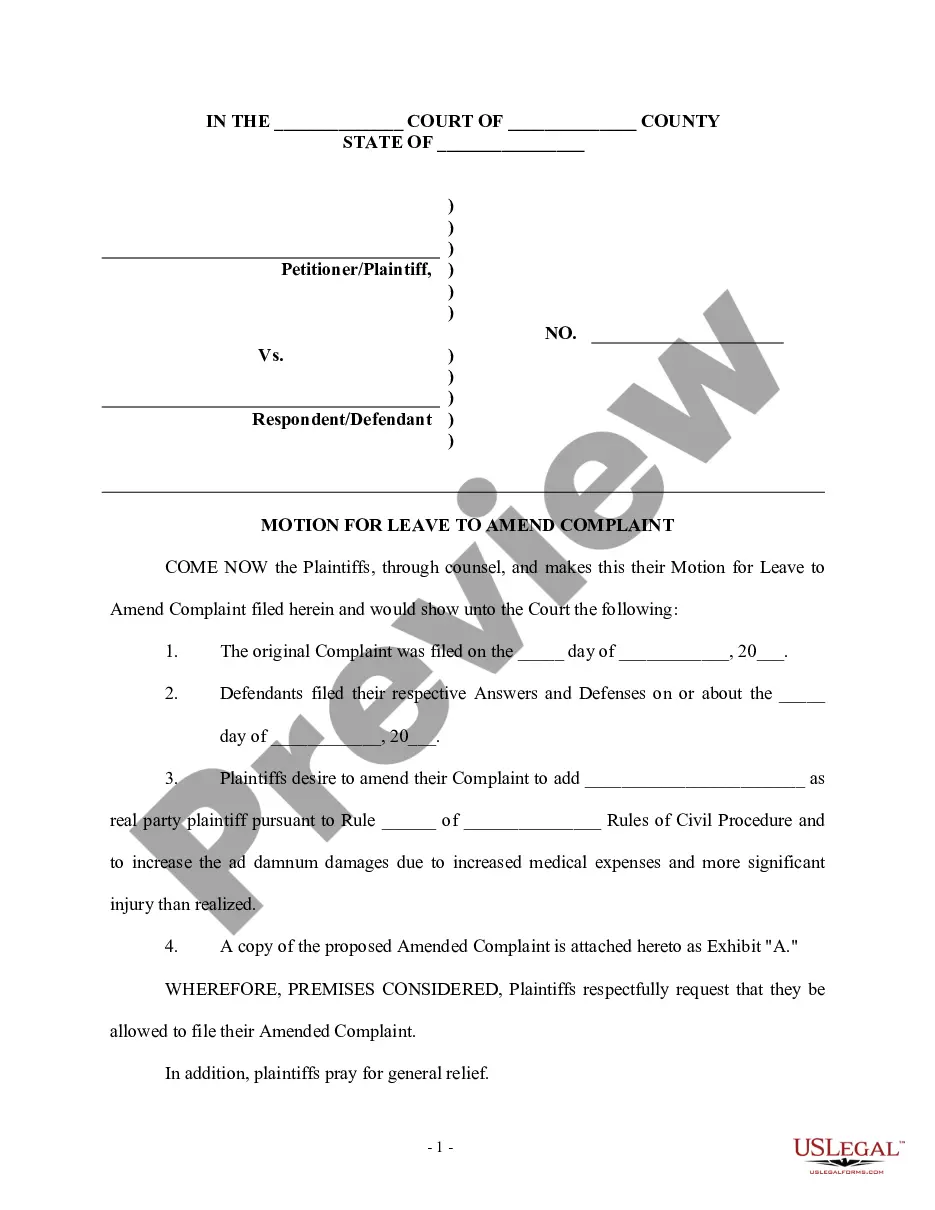
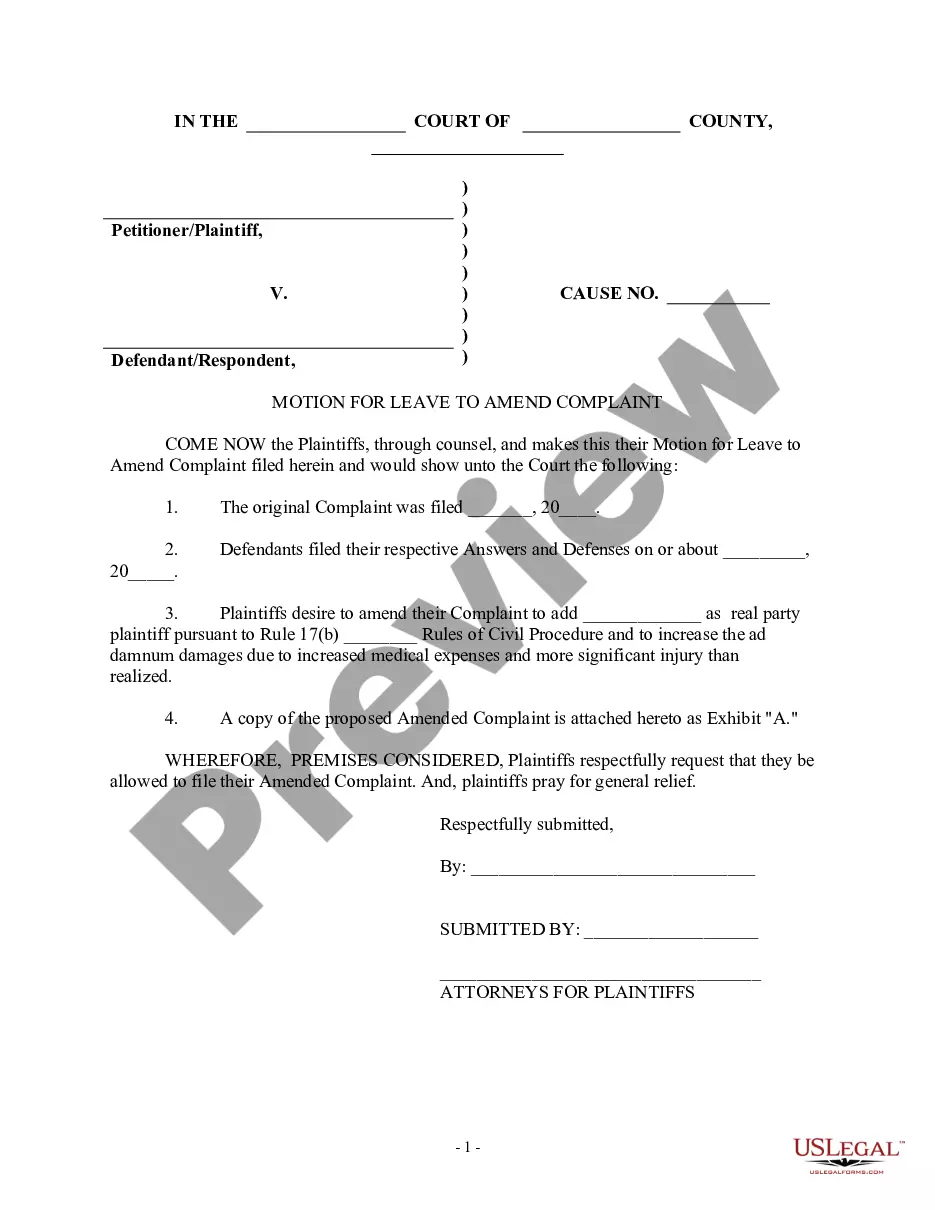
The Motion for Leave to Amend Complaint - Personal Injury is a legal document that allows plaintiffs in personal injury cases to request the court's permission to modify their initial complaint. This form is distinct in that it specifically focuses on adding additional parties or increasing the amount of damages sought, usually due to unforeseen medical expenses or injuries that have worsened over time.
Main sections of this form
- The date of the original complaint filing.
- The dates when defendants filed their answers and defenses.
- Details about the additional parties being added to the case.
- Justification for the amendment, including updated damages claims.
- A section for the proposed Amended Complaint attached as Exhibit A.
- A request for general relief in the last paragraph.

Situations where this form applies
This form is used when a plaintiff realizes that they need to include new parties in their personal injury case or when the extent of their damages has increased after the original complaint was filed. Typical scenarios include discovering additional liable parties or experiencing worsening injuries necessitating a higher compensation claim.
Intended users of this form
- Plaintiffs in personal injury cases who have filed an initial complaint.
- Individuals seeking to add additional defendants or parties to their case.
- Claimants who need to increase the damages requested due to new information regarding medical expenses or injury severity.
Completing this form step by step
- Fill in the date of the original complaint filing and the defendants' answers.
- Specify the new parties being added to the lawsuit.
- Clearly state the reasons for seeking to amend the complaint.
- Attach the proposed Amended Complaint as Exhibit A.
- Include the date of submission and your signature at the bottom of the form.
Is notarization required?
This form does not typically require notarization unless specified by local law. Always check your state's regulations to ensure compliance.
Get your form ready online
Our built-in tools help you complete, sign, share, and store your documents in one place.
Make edits, fill in missing information, and update formatting in US Legal Forms—just like you would in MS Word.
Download a copy, print it, send it by email, or mail it via USPS—whatever works best for your next step.
Sign and collect signatures with our SignNow integration. Send to multiple recipients, set reminders, and more. Go Premium to unlock E-Sign.
If this form requires notarization, complete it online through a secure video call—no need to meet a notary in person or wait for an appointment.
We protect your documents and personal data by following strict security and privacy standards.

Make edits, fill in missing information, and update formatting in US Legal Forms—just like you would in MS Word.

Download a copy, print it, send it by email, or mail it via USPS—whatever works best for your next step.

Sign and collect signatures with our SignNow integration. Send to multiple recipients, set reminders, and more. Go Premium to unlock E-Sign.

If this form requires notarization, complete it online through a secure video call—no need to meet a notary in person or wait for an appointment.

We protect your documents and personal data by following strict security and privacy standards.
Common mistakes
- Forgetting to attach the proposed Amended Complaint as Exhibit A.
- Failing to provide a clear justification for the amendments sought.
- Not adhering to state-specific rules regarding the amendment process.
- Submitting the motion after important deadlines have passed.
Why complete this form online
- Convenience of completing the form at your own pace.
- Editability allows you to revise details as necessary before final submission.
- Access to legal templates drafted by licensed attorneys, ensuring reliability.
- Immediate download provides quick access to essential forms.
Looking for another form?





Form popularity
FAQ
The motion for leave to file an answer to a complaint means that the defendant did not answer within the requisite time period, and is essentially asking for more time to answer the complaint.
A defendant may respond in an answer that admits or denies each of the plaintiff's allegations in the complaint. The answer will list defenses and counter-claims or cross-claims against the plaintiff or other defendants. The answer will state whether the defendant wants a jury trial. The case will then continue.
Unless the court orders otherwise, any required response to an amended pleading must be made within the time remaining to respond to the original pleading or within 14 days after service of the amended pleading, whichever is later.
Amended complaint. n. what results when the party suing (plaintiff or petitioner) changes the complaint he/she has filed. It must be in writing, and can be done before the complaint is served on any defendant, by agreement between the parties (usually their lawyers), or upon order of the court.
Bill of complaint (plural bills of complaint) (law, historical) In the English Court of Chancery, prior to the Judicature Act of 1873, the formal statement of the facts and prayer for relief submitted by a plaintiff to the court.
Once a defendant has answered, a first amended complaint can only be filed and served with leave of court. If the plaintiff did not get the court's permission, it is not deemed a valid first amended complaint.
What it means to file a motion: A motion, in its simplest form is a list of requests that you are asking the Court grant on your behalf. You, or your attorney on your behalf, will file a Notice of Motion which includes a list of requests for the court to rule upon.
(a) A defendant may file an answer with the reviewing official and the Office of Hearings and Appeals within 30 days of service of the complaint. An answer will be considered a request for an oral hearing.