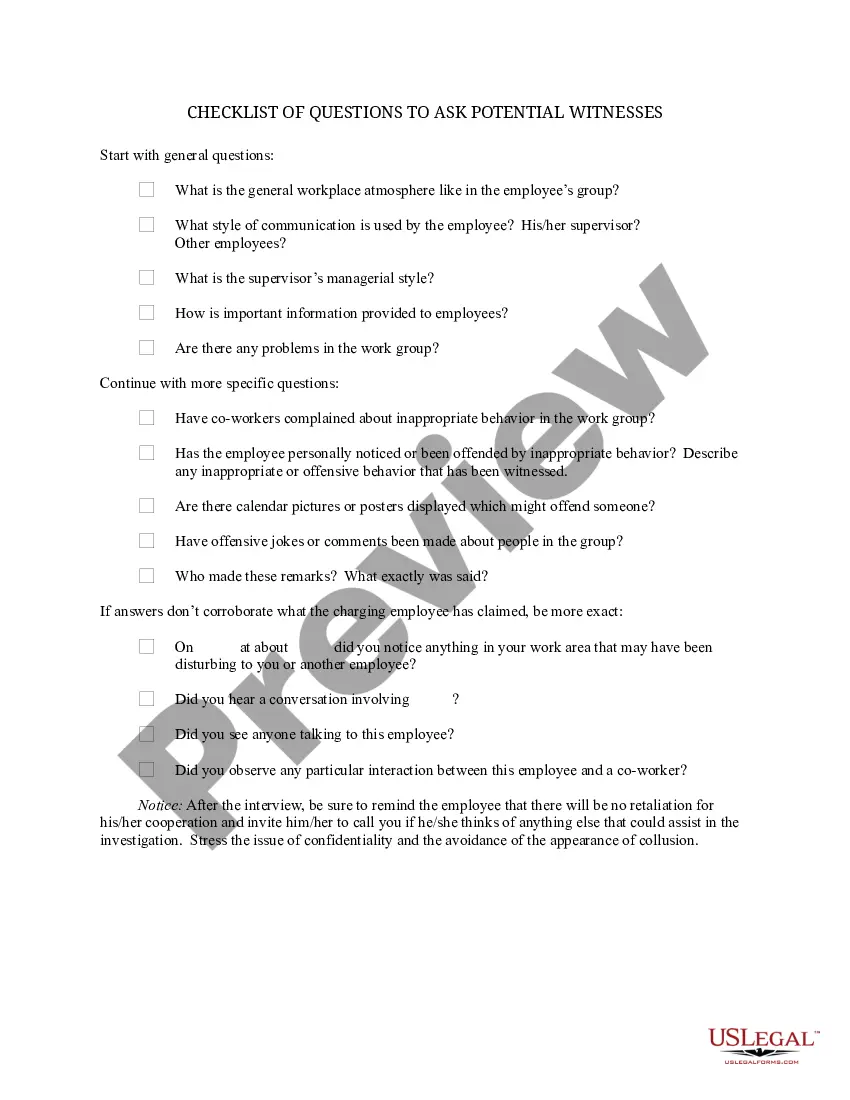
Checklist of Questions to Ask Sexual Harassment Witnesses - Workplace
Understanding this form
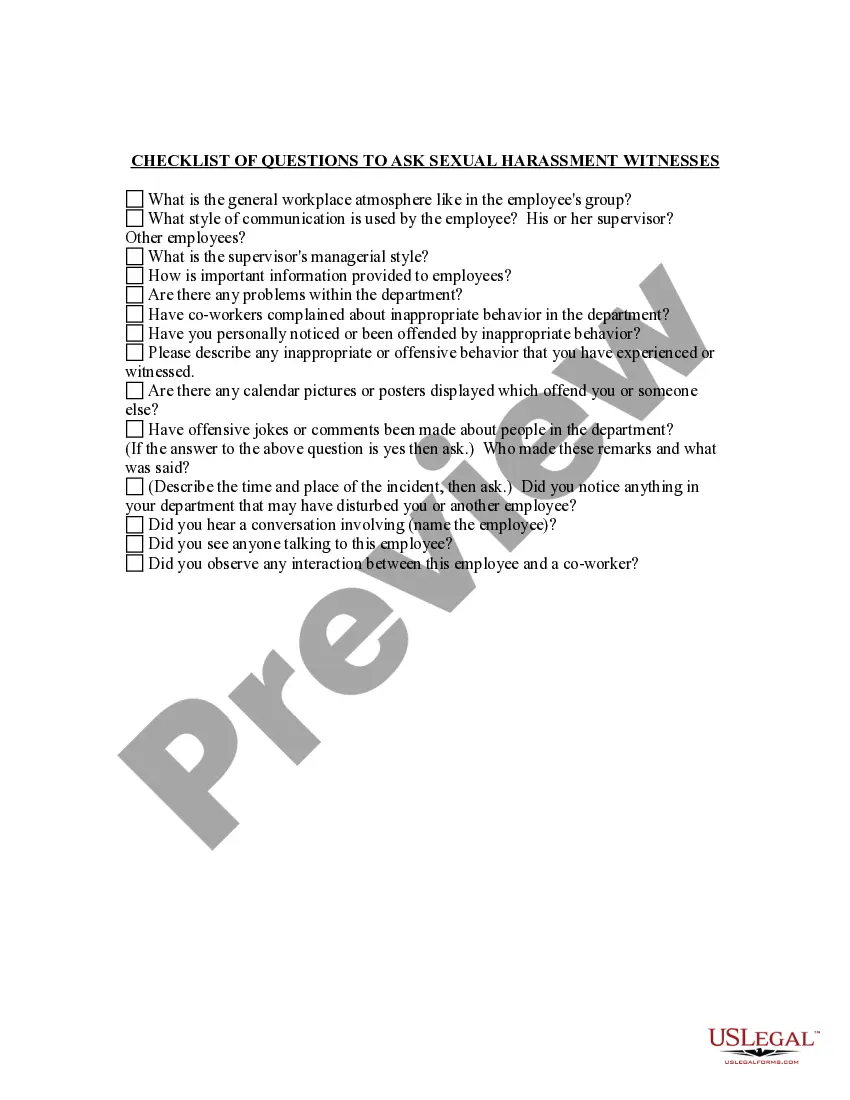
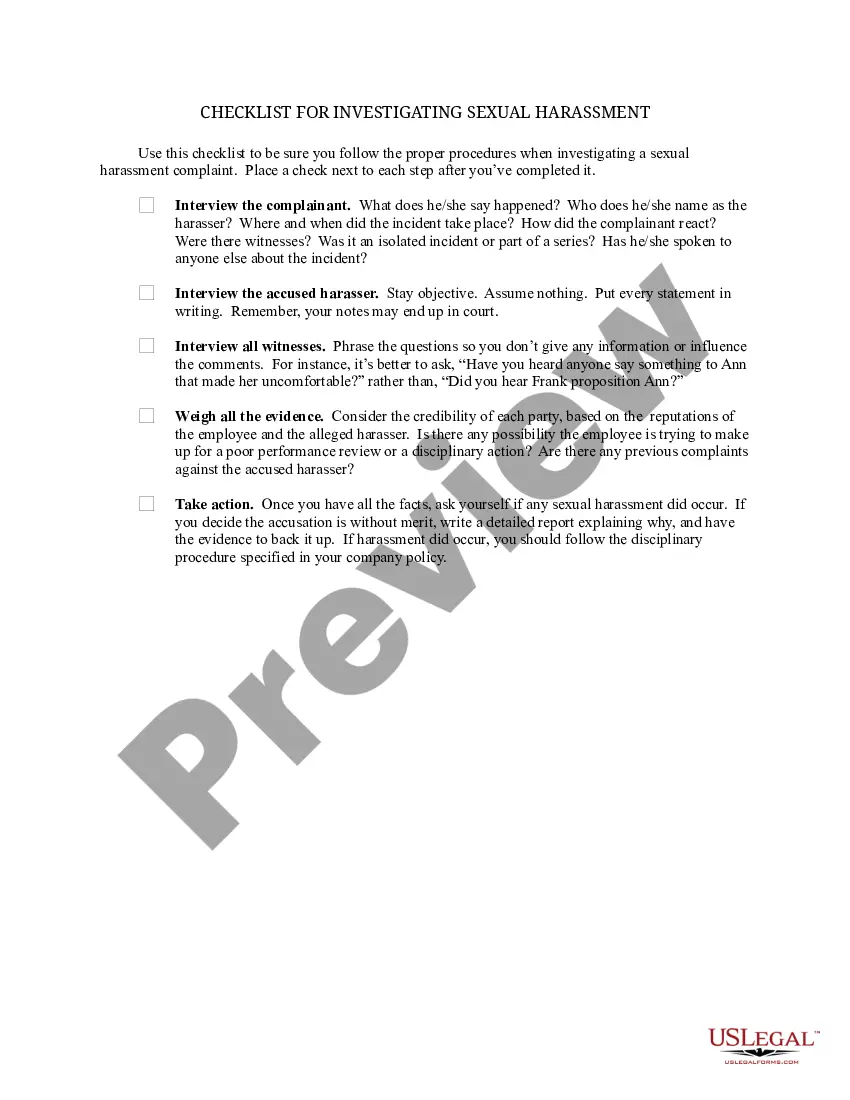
The Checklist of Questions to Ask Sexual Harassment Witnesses is a vital tool used by employers to gather information regarding workplace harassment incidents. This form serves to guide employers in creating a safe and respectful work environment by collecting detailed testimonies from witnesses. It differs from other employment forms by focusing specifically on the nuances of gathering witness statements in sexual harassment cases within the workplace, ensuring a thorough and structured approach to investigations.
What’s included in this form
- Overview of workplace atmosphere and communication styles.
- Assessment of managerial styles and departmental issues.
- First-hand accounts of inappropriate behavior and comments.
- Details of any offensive materials displayed in the workplace.
- Records of conversations or interactions involving specific employees.
Situations where this form applies
This form should be utilized when an employer is investigating allegations of sexual harassment. It is particularly useful in scenarios where a formal complaint has been lodged, or when there are indications of inappropriate behavior among employees. The checklist helps employers outline key questions to ask witnesses, ensuring a comprehensive understanding of the situation and facilitating a fair and just outcome.
Who should use this form
- Human resources professionals responsible for workplace investigations.
- Employers dealing with allegations of sexual harassment.
- Managers seeking to address workplace culture issues.
- Legal teams within organizations looking to document witness testimonies.
How to complete this form
- Identify the key witnesses who observed the incident.
- Ask about the general atmosphere and communication within the workplace.
- Inquire about any inappropriate behavior or comments witnessed by employees.
- Document specific incidents, including dates, times, and interactions involving relevant employees.
- Compile all responses for review and further action.
Notarization guidance
Notarization is not commonly needed for this form. However, certain documents or local rules may make it necessary. Our notarization service, powered by Notarize, allows you to finalize it securely online anytime, day or night.
Get your form ready online
Our built-in tools help you complete, sign, share, and store your documents in one place.
Make edits, fill in missing information, and update formatting in US Legal Forms—just like you would in MS Word.
Download a copy, print it, send it by email, or mail it via USPS—whatever works best for your next step.
Sign and collect signatures with our SignNow integration. Send to multiple recipients, set reminders, and more. Go Premium to unlock E-Sign.
If this form requires notarization, complete it online through a secure video call—no need to meet a notary in person or wait for an appointment.
We protect your documents and personal data by following strict security and privacy standards.

Make edits, fill in missing information, and update formatting in US Legal Forms—just like you would in MS Word.

Download a copy, print it, send it by email, or mail it via USPS—whatever works best for your next step.

Sign and collect signatures with our SignNow integration. Send to multiple recipients, set reminders, and more. Go Premium to unlock E-Sign.

If this form requires notarization, complete it online through a secure video call—no need to meet a notary in person or wait for an appointment.

We protect your documents and personal data by following strict security and privacy standards.
Avoid these common issues
- Failing to ask open-ended questions, limiting the information obtained.
- Not documenting witness responses accurately.
- Overlooking the importance of confidentiality during the process.
- Neglecting to follow up on unclear responses for further clarity.
Advantages of online completion
- Convenient access to the form anytime, allowing for quick responses.
- Editable format, providing flexibility in how information is recorded.
- Reliable and legally sound templates drafted by licensed attorneys.
- Easy storage and retrieval of information for future reference.
Legal use & context
- This form aids employers in documenting alleged sexual harassment to support compliance with legal obligations.
- Properly completed forms can be utilized as evidence in potential legal scenarios.
- Employers must ensure the information gathered respects confidentiality and non-retaliation policies.
What to keep in mind
- The Checklist of Questions to Ask Sexual Harassment Witnesses is essential for effective investigations.
- Its structured approach helps gather necessary information while ensuring a fair process.
- Employers should use this form to foster a supportive workplace environment.
Looking for another form?
Form popularity
FAQ
Who committed the alleged behavior?What happened?When did this occur?Where did this happen?Did you let the accused know that you were upset by this?Who else may have seen or heard this as a witness?Have you reported or discussed this with anyone?10 Employee Investigation Questions & Best Practices - HR Acuity\nwww.hracuity.com > blog > best-practices-questions-for-complainants-in-a-...
5. The first step of handling any workplace harassment is to confront your harasser directly. Is this a true statement? Yes, it's true because you must give the harasser a chance to apologize and change their behavior before filing an official complaint.
Assuming that an investigation is the answer to every workplace problem.Acting on complaints that lack substance:Failure to follow the process.The wrong person investigates.The scope of the investigation is unclear.Confidentiality is not respected.Preconceptions about the outcome.Allowing the time frame to blow out.How not to run a workplace investigation - Worklogic\nwww.worklogic.com.au > workplace-misconduct > how-not-to-run-a-work...
Take all complaints seriously. Launch a prompt investigation. Protect confidentiality to the extent possible. Create an investigation file. Take steps to prevent retaliation. Prepare to interview appropriate parties. Interview the complainant. Interview witnesses.
If you feel like you've been a victim of workplace harassment, you can file a claim with the Equal Employment Opportunity Commission (EEOC). Before you file the claim, educate yourself to ensure that the incident actually counts as harassment. For various reasons, people make many false claims of harassment.
1. Talk to the Person Directly. Once the first incident of sexual harassment occurs, be very clear in letting the person know the behavior is unwelcome and ask them to stop. If the behavior continues after that, tell them that you plan to file a report with Human Resources.
What happened? What was the date, time and duration of the incident or behavior? How many times did this happen? Where did it happen? How did it happen? Did anyone else see it happen? Who? Was there physical contact? What did you do in response to the incident or behavior?
Any employee who believes he or she has been the target of sexual harassment is encouraged to inform the offending person orally or in writing that such conduct is unwelcome and offensive and must stop.
Know your Rights. Knowing what Title VII states is important, but understanding your company's policy and procedures regarding sexual harassment is key. Tell the Harasser to Stop. Document, Document, Document. Follow company procedures. Involve Government Agencies. Advocate for stronger protections.