Annulment Questionnaire
What this document covers
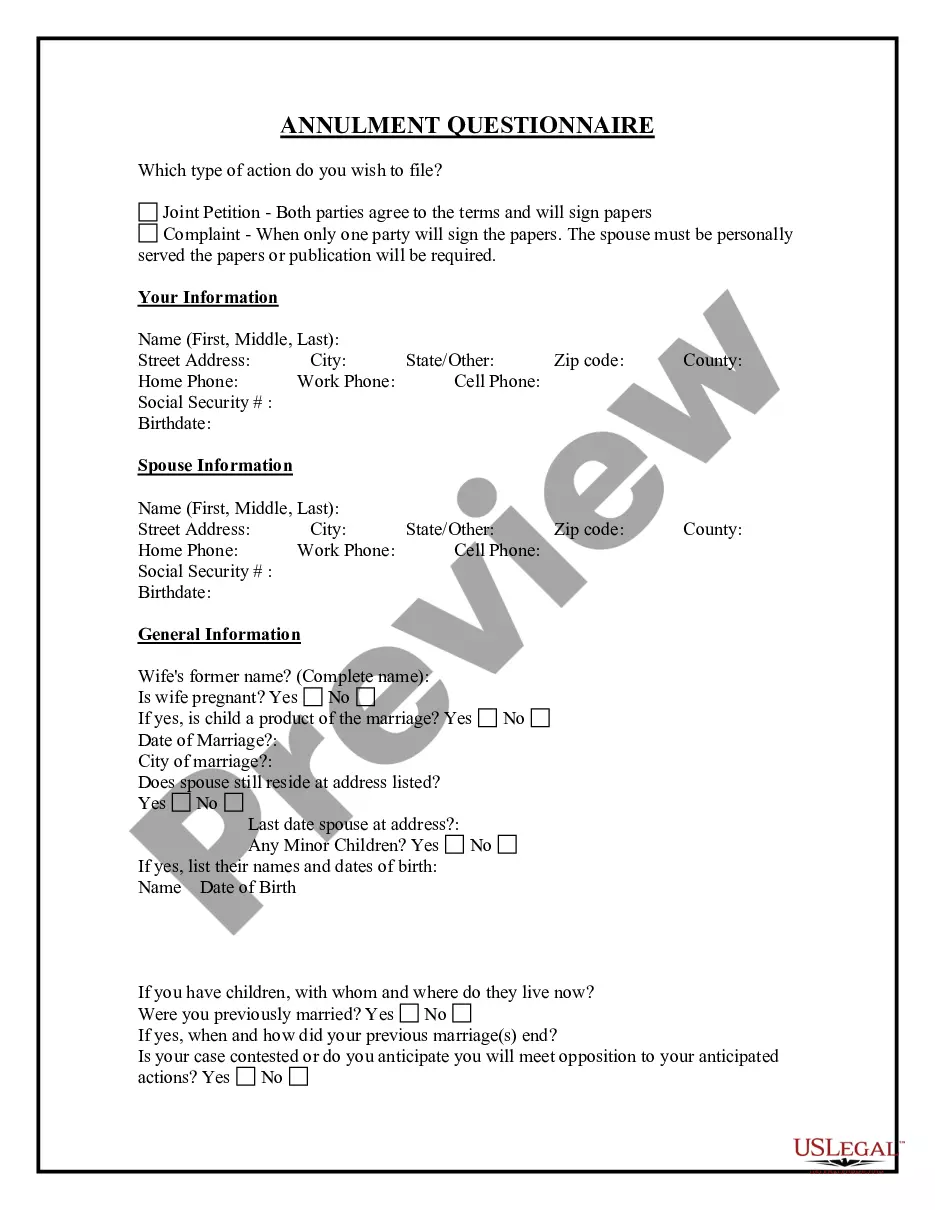
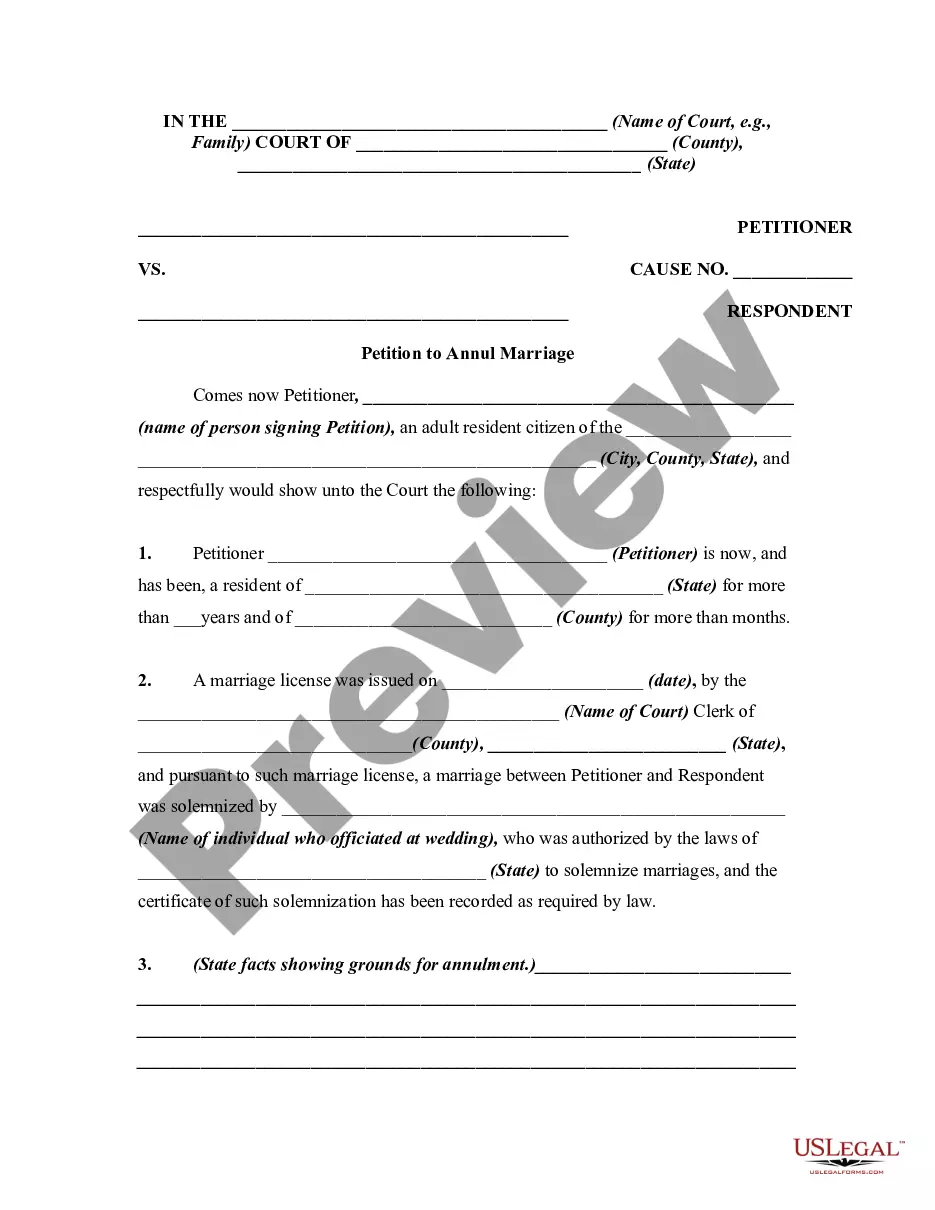
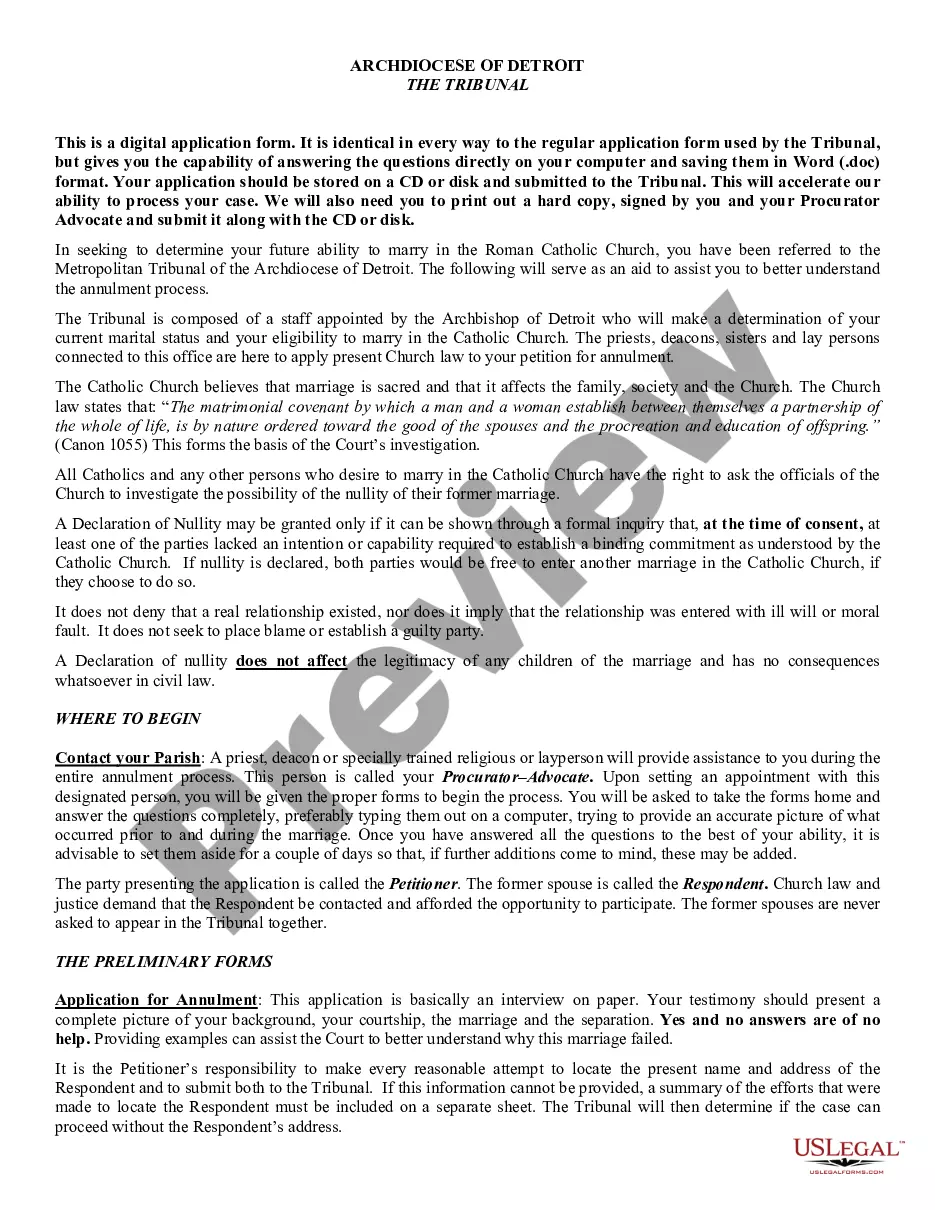
The annulment questionnaire is a legal document designed to gather important information for individuals seeking annulment of their marriage. This form helps identify key issues that may affect the legal rights and obligations of both parties involved. Unlike divorce documents, an annulment questionnaire focuses on the conditions that warrant declaring a marriage null and void under the law. By completing this form, users can effectively prepare their case with an attorney, making the process more efficient and potentially less costly.
Main sections of this form
- Options for action: joint petition or complaint.
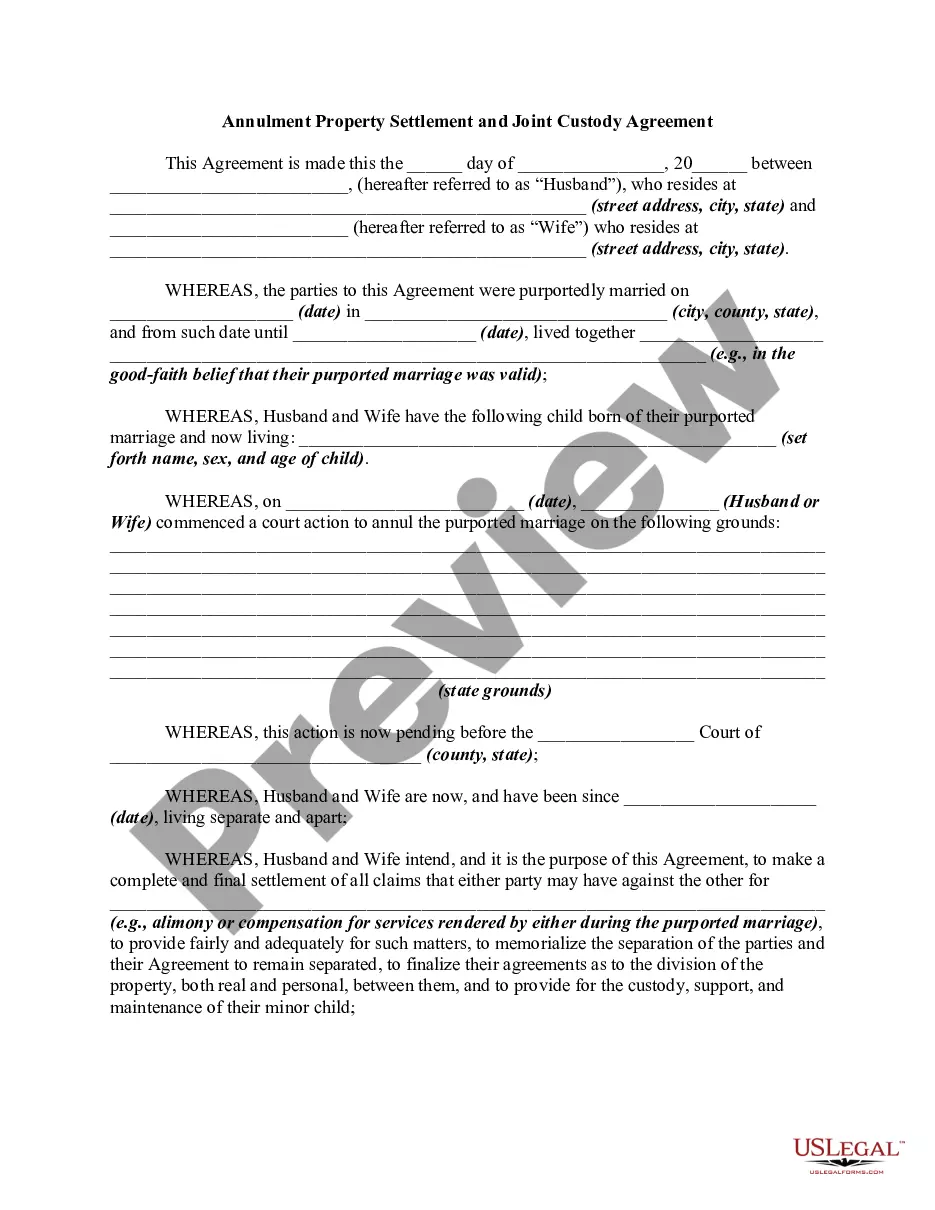
- Details regarding the parties' agreement on terms.
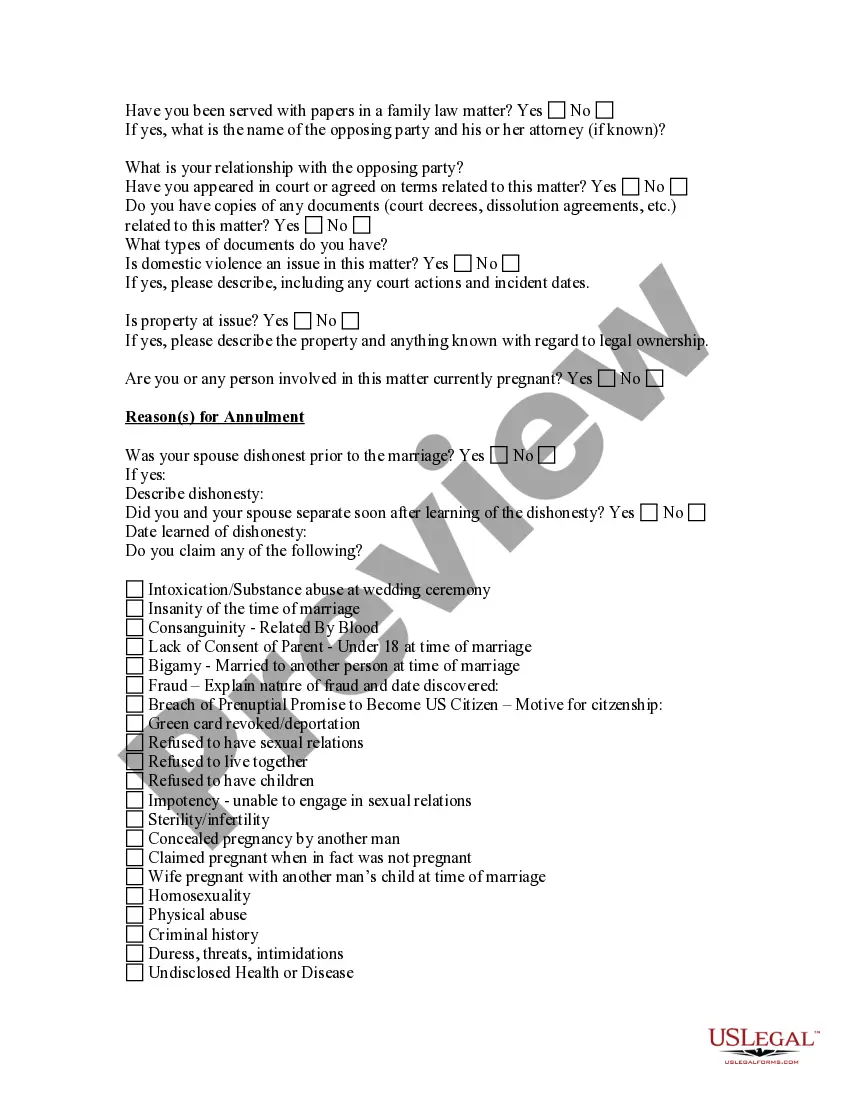
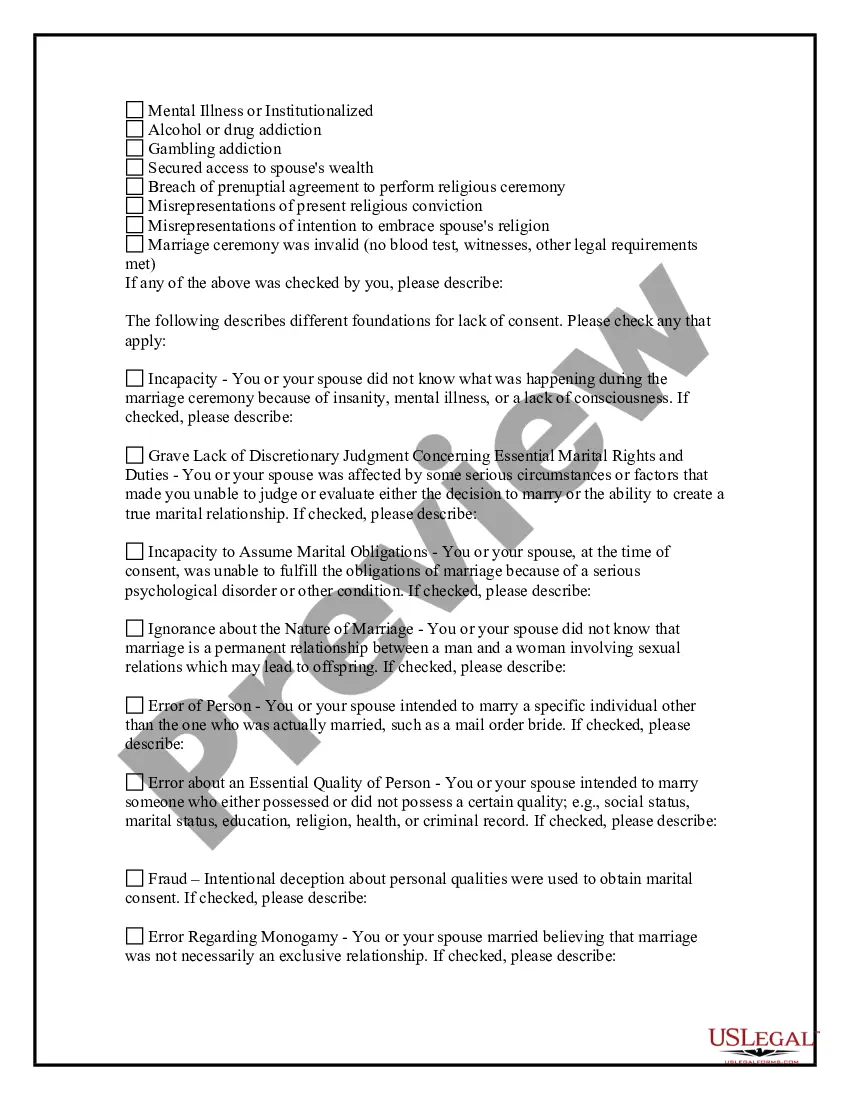
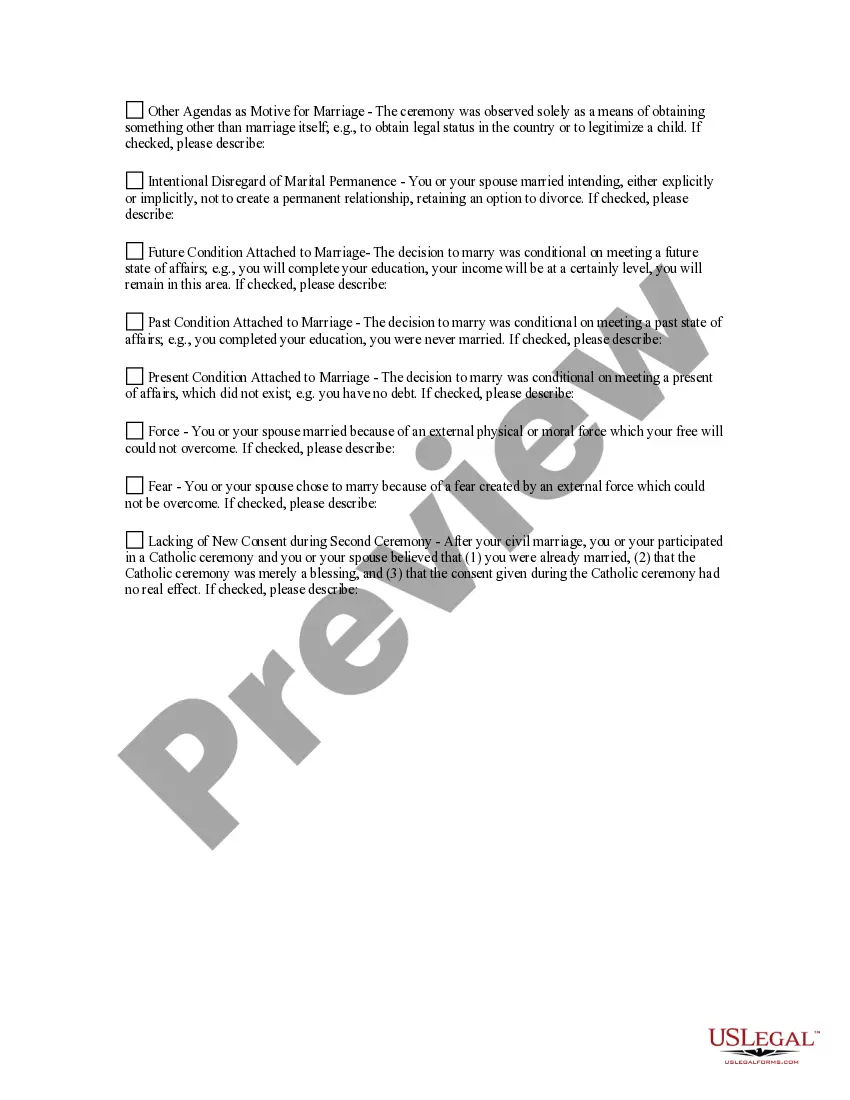
- Reasons for annulment including insanity, lack of consent, and bigamy.
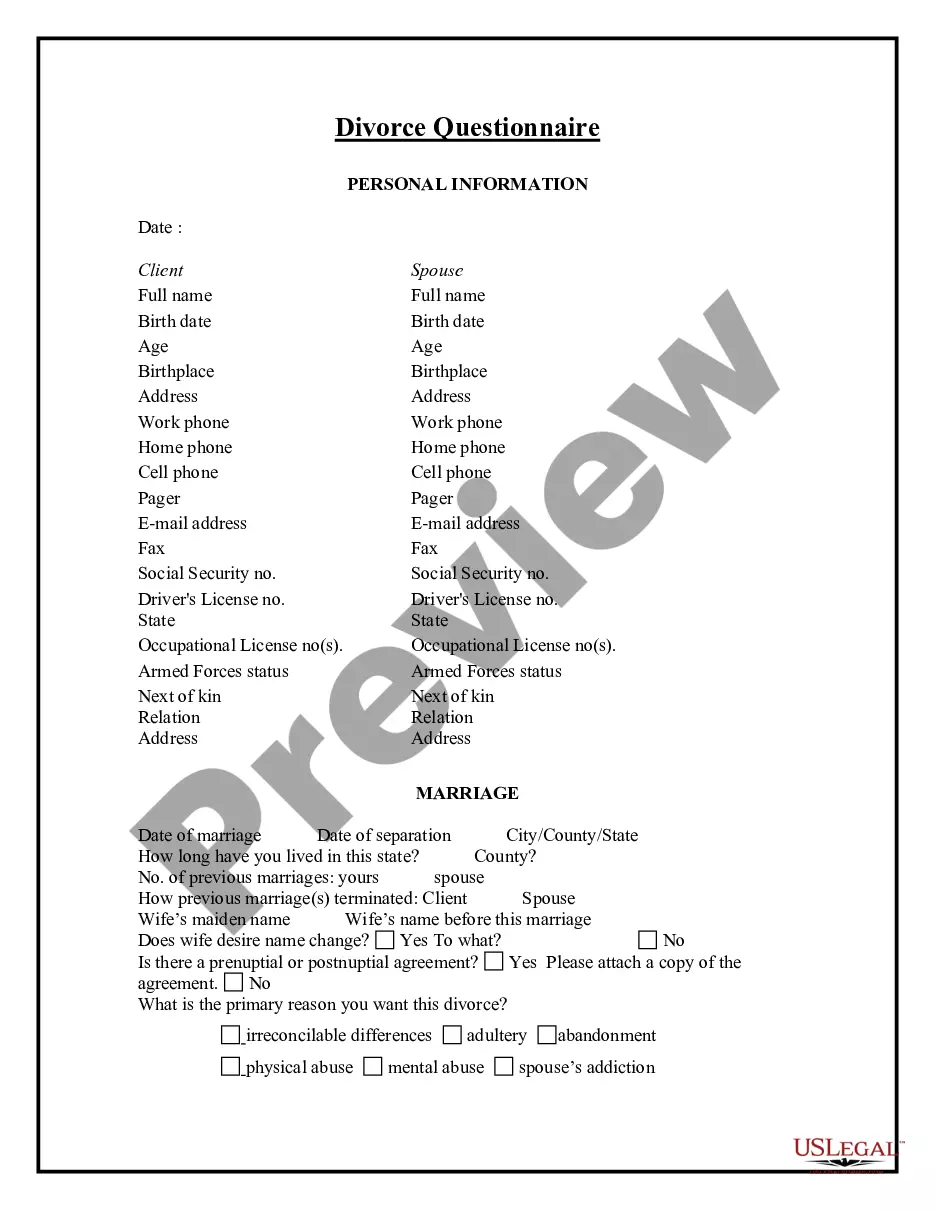
- Information about both partiesâ health, criminal history, and prior relationships.
- Considerations for financial matters, such as prenuptial agreements and wealth access.

Common use cases
This annulment questionnaire should be used when an individual or couple seeks to annul their marriage based on specific legal grounds. It is particularly beneficial when there is a mutual agreement between both parties or when one spouse needs to present their case. The form helps clarify the reasons for annulment, ensuring that those variables are addressed early in the legal process.
Who should use this form
- Individuals considering annulment of their marriage.
- Couples who agree on the terms of the annulment.
- Attorneys representing clients in annulment cases.
- Anyone needing to clarify their legal position before seeking legal representation.
Steps to complete this form
- Choose the type of action you wish to file: joint petition or complaint.
- Provide information concerning both parties and their agreement on annulment terms.
- Detail any grounds for annulment, including mental fitness, consent issues, or bigamy.
- Include pertinent health, criminal, and financial history relevant to the case.
- Review the completed form for accuracy before submission to ensure all necessary information is included.
Notarization requirements for this form
This form does not typically require notarization to be legally valid. However, some jurisdictions or document types may still require it. US Legal Forms provides secure online notarization powered by Notarize, available 24/7 for added convenience.
Get your form ready online
Our built-in tools help you complete, sign, share, and store your documents in one place.
Make edits, fill in missing information, and update formatting in US Legal Forms—just like you would in MS Word.
Download a copy, print it, send it by email, or mail it via USPS—whatever works best for your next step.
Sign and collect signatures with our SignNow integration. Send to multiple recipients, set reminders, and more. Go Premium to unlock E-Sign.
If this form requires notarization, complete it online through a secure video call—no need to meet a notary in person or wait for an appointment.
We protect your documents and personal data by following strict security and privacy standards.

Make edits, fill in missing information, and update formatting in US Legal Forms—just like you would in MS Word.

Download a copy, print it, send it by email, or mail it via USPS—whatever works best for your next step.

Sign and collect signatures with our SignNow integration. Send to multiple recipients, set reminders, and more. Go Premium to unlock E-Sign.

If this form requires notarization, complete it online through a secure video call—no need to meet a notary in person or wait for an appointment.

We protect your documents and personal data by following strict security and privacy standards.
Common mistakes
- Not clearly indicating whether the annulment is mutual or contested.
- Failing to provide sufficient details about grounds for annulment.
- Omitting crucial personal information of both parties involved.
- Not reviewing the requirements of the specific state before submission.
Benefits of completing this form online
- Convenient access to the form anytime and anywhere.
- Editable format allows for easy updates and corrections.
- Reliable templates drafted by licensed attorneys ensure legal compliance.
- Ability to store and retrieve documents securely online.
Key takeaways
- The annulment questionnaire aids in preparing for legal discussions regarding marriage annulment.
- It identifies crucial issues that affect the annulment process.
- Completing the form can lead to significant savings on attorney fees.
- This form is suitable for both individuals and legal representatives dealing with annulment cases.
Looking for another form?
Form popularity
FAQ
You are required to report and register the Decree of Annulment/Declaration of Nullity within thirty (30) days from from receipt. You must go to the civil registry where the marriage was registered, the civil registry where the Family Court is situated, and the Philippine Statistics Authority.
Type the name and title of the person in charge of the tribunal, followed by his title. Skip a line space. Begin the letter by identifying the petitioner and his spouse, and introduce yourself. Explain how you knew the couple and how long you knew them.
It was not consummated - you have not had sexual intercourse with the person you married since the wedding (does not apply for same sex couples) you did not properly consent to the marriage - for example you were forced into it.
There is no way to put a timeline on the process. However, it normally takes approximately 16 months. The period for a declaration of nullity depends on many factors. For instance, if the petitioner does not complete the necessary document gathering in a timely fashion, the annulment is delayed.
Reasons for Annulment Denial In some cases, grounds may include aspects like bigamy, the fact that your partner was already married, coercion, forced marriage, and fraud if you were tricked into marriage.If you can't meet these requirements, then your marriage is valid and you will have to receive a divorce.
To get an annulment, you'll have to prove your marriage is "voidable," meaning it was valid, but should be nullified (voided or canceled) based on one of the following grounds: unsound mind--one spouse lacked the ability to give consent due to a mental impairment or the influence of drugs or alcohol.