Application for a Declaration of Nullity
About this form
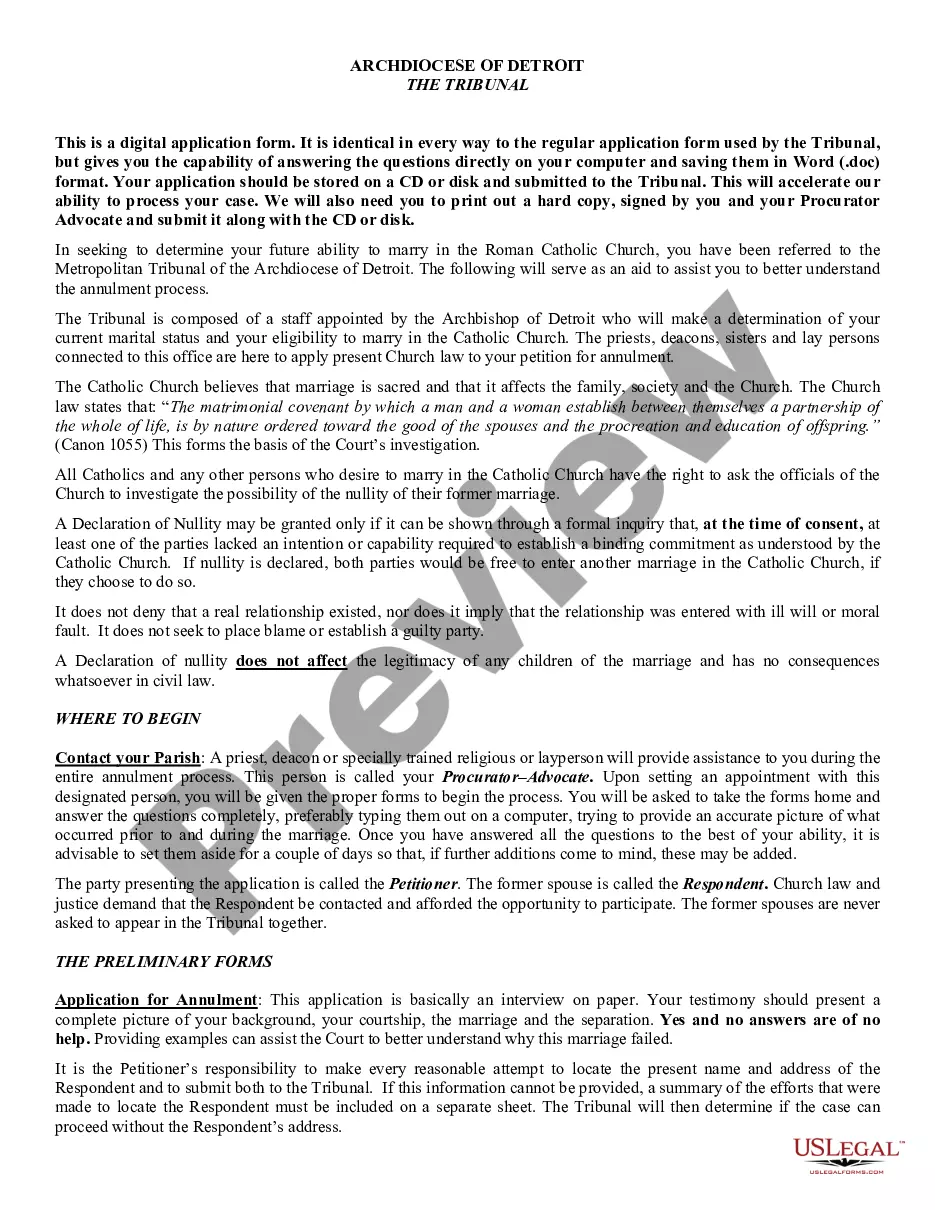
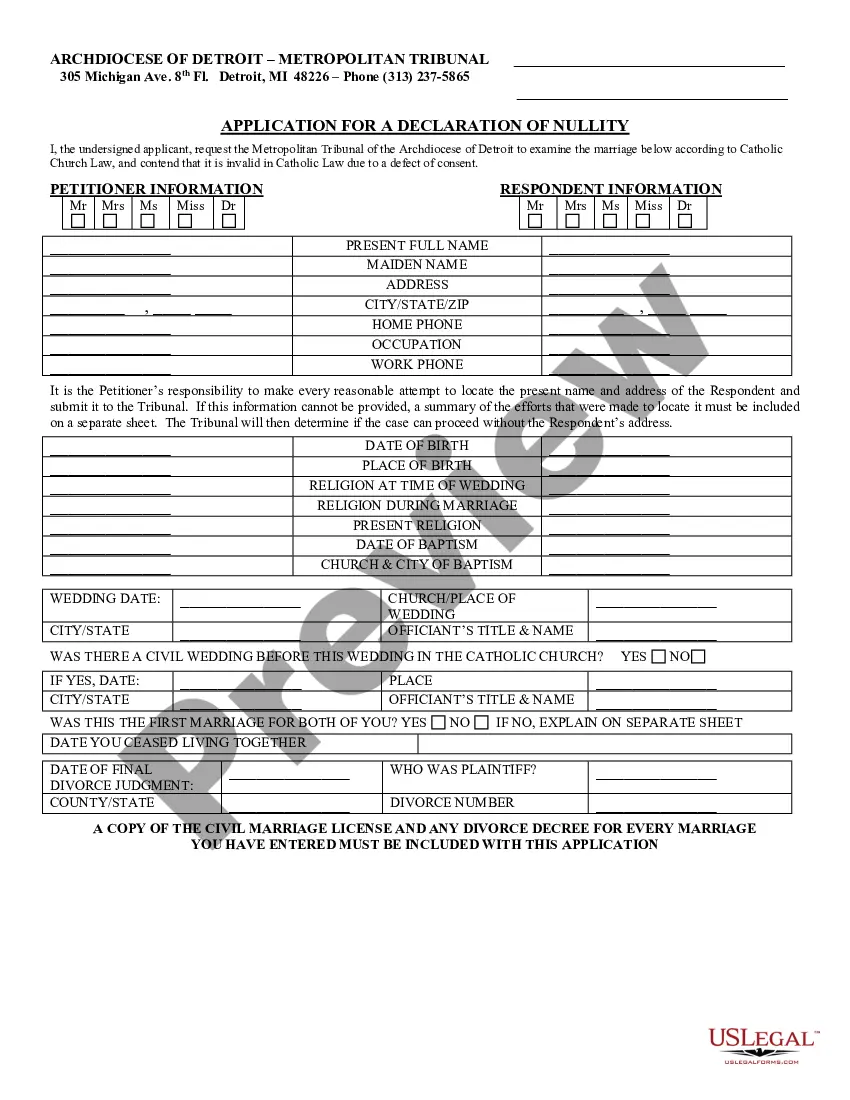
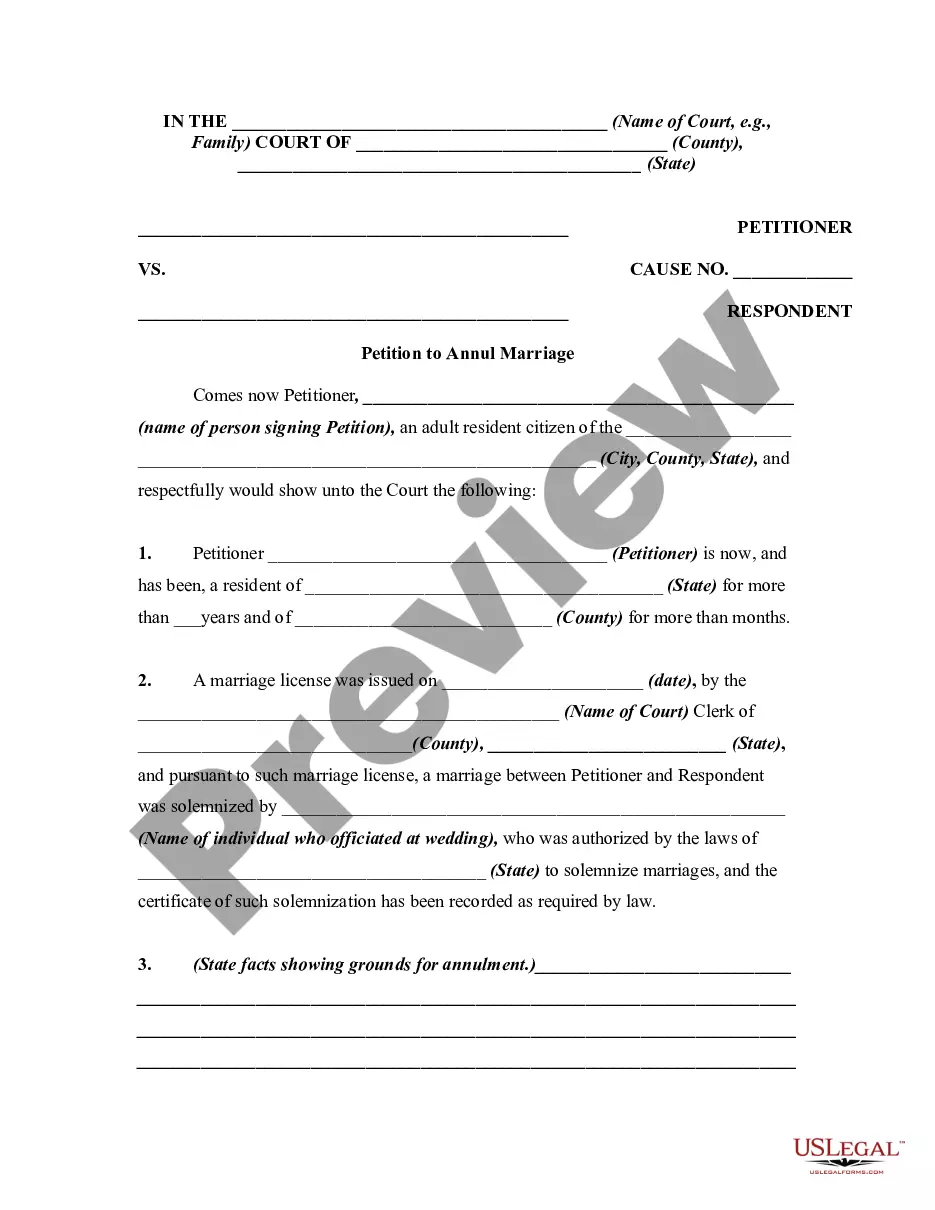
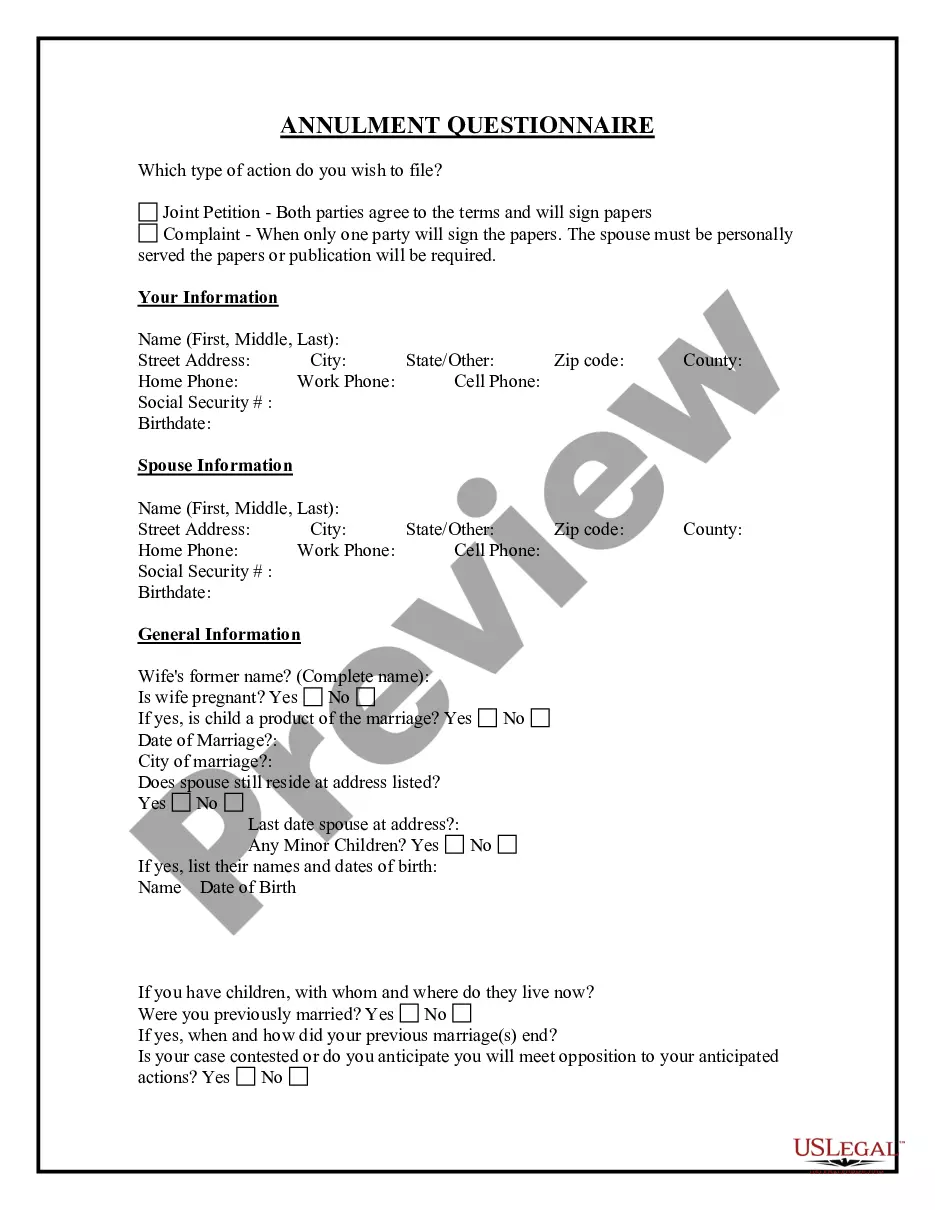
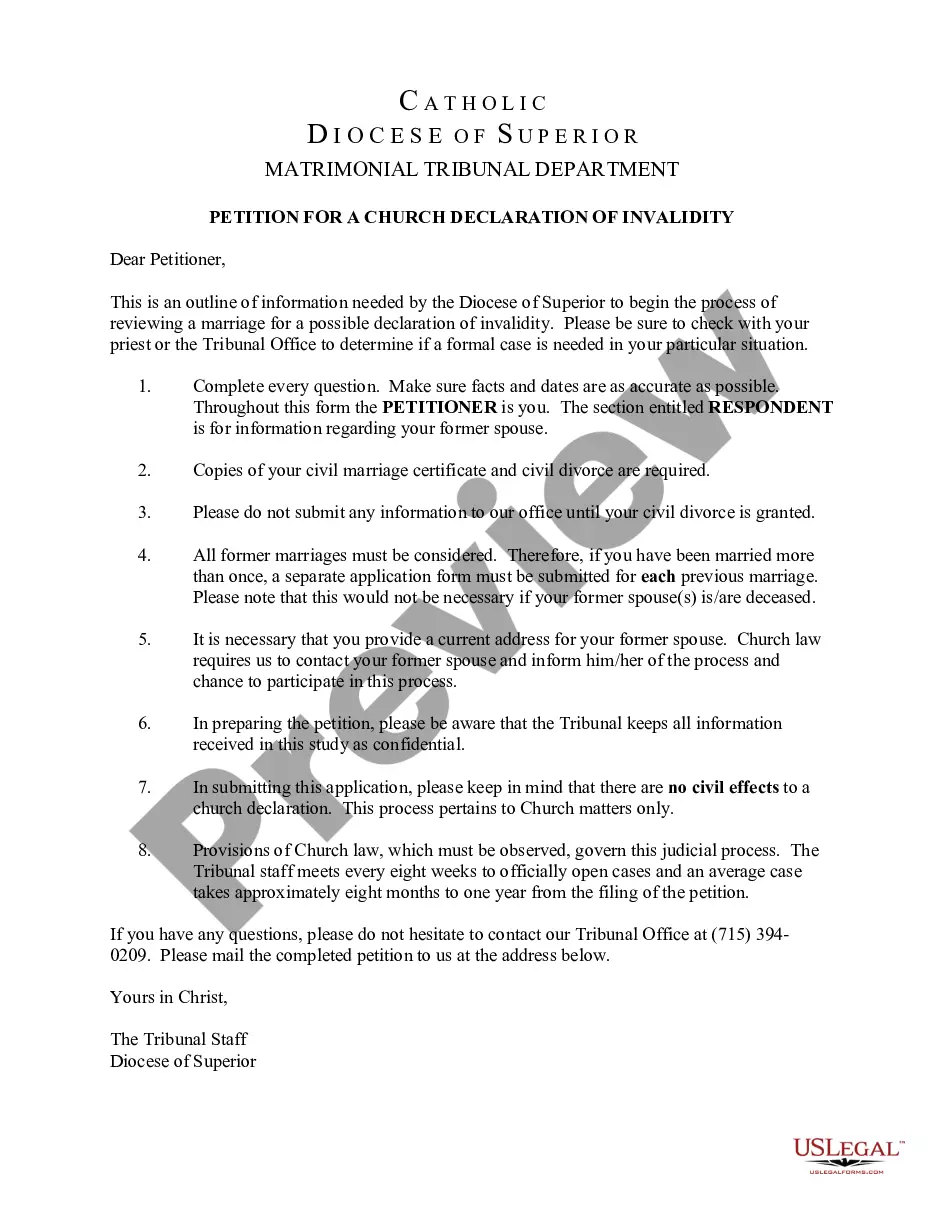
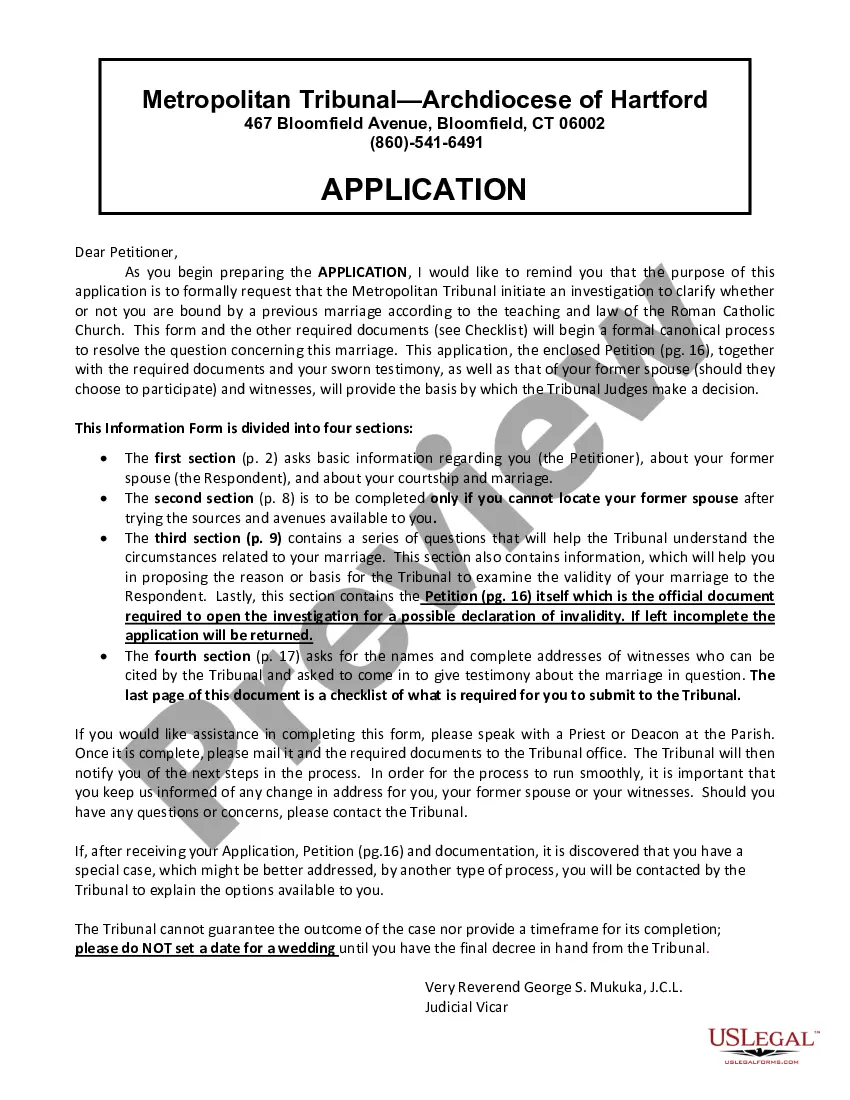
The Application for a Declaration of Nullity, commonly known as an annulment application, is a legal document used within the Catholic Church to request the examination of a previous marriage's validity. This form serves to determine if the marriage, under Catholic law, was never validly contracted due to factors affecting consent at the time of marriage. It differs from divorce as it seeks to establish that a true matrimonial bond never existed, rather than ending a valid marriage.
Form components explained
- Petitioner and Respondent information sections to detail both parties.
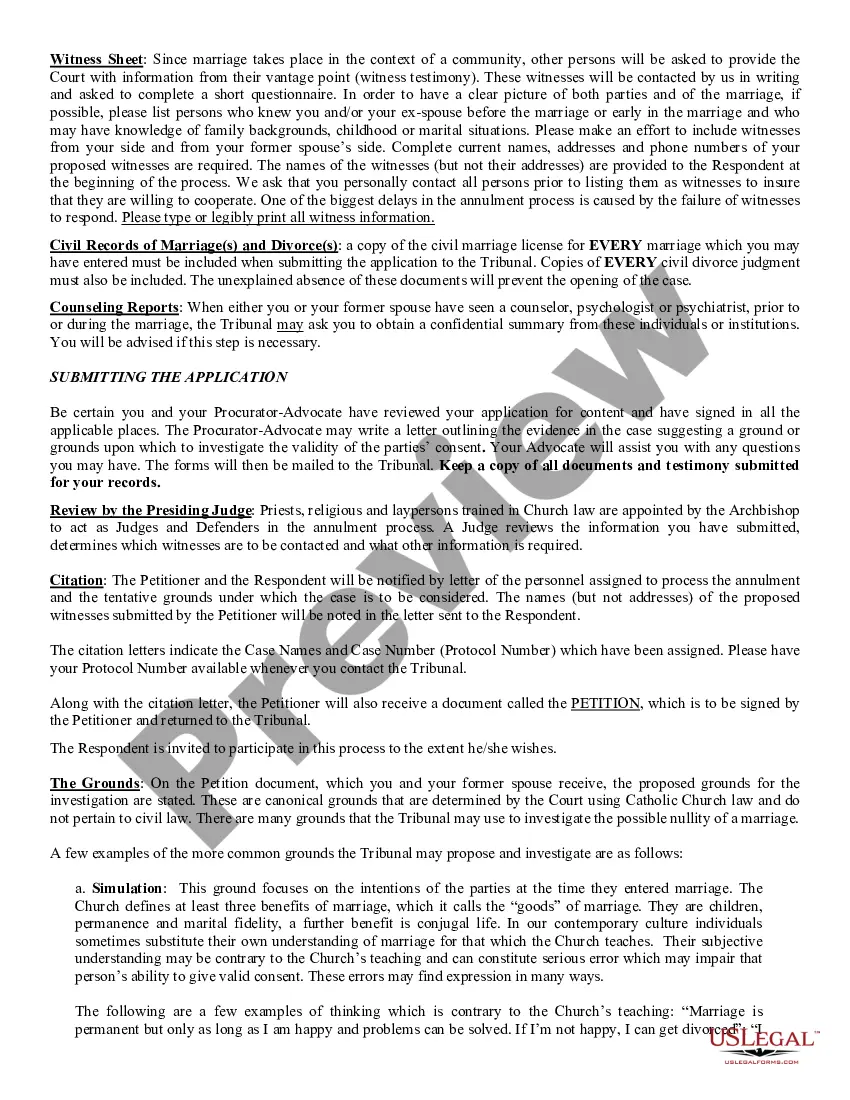
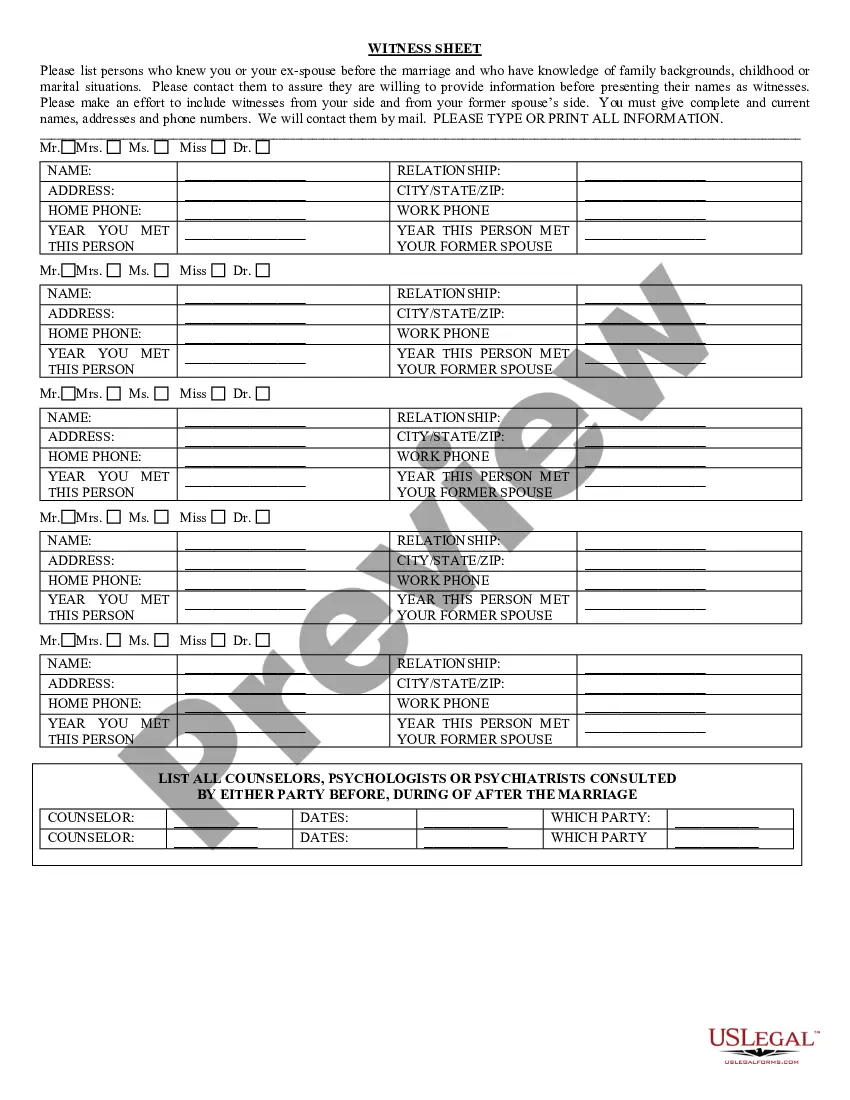
- Witness sheet to list individuals who can provide testimony regarding the marriage.
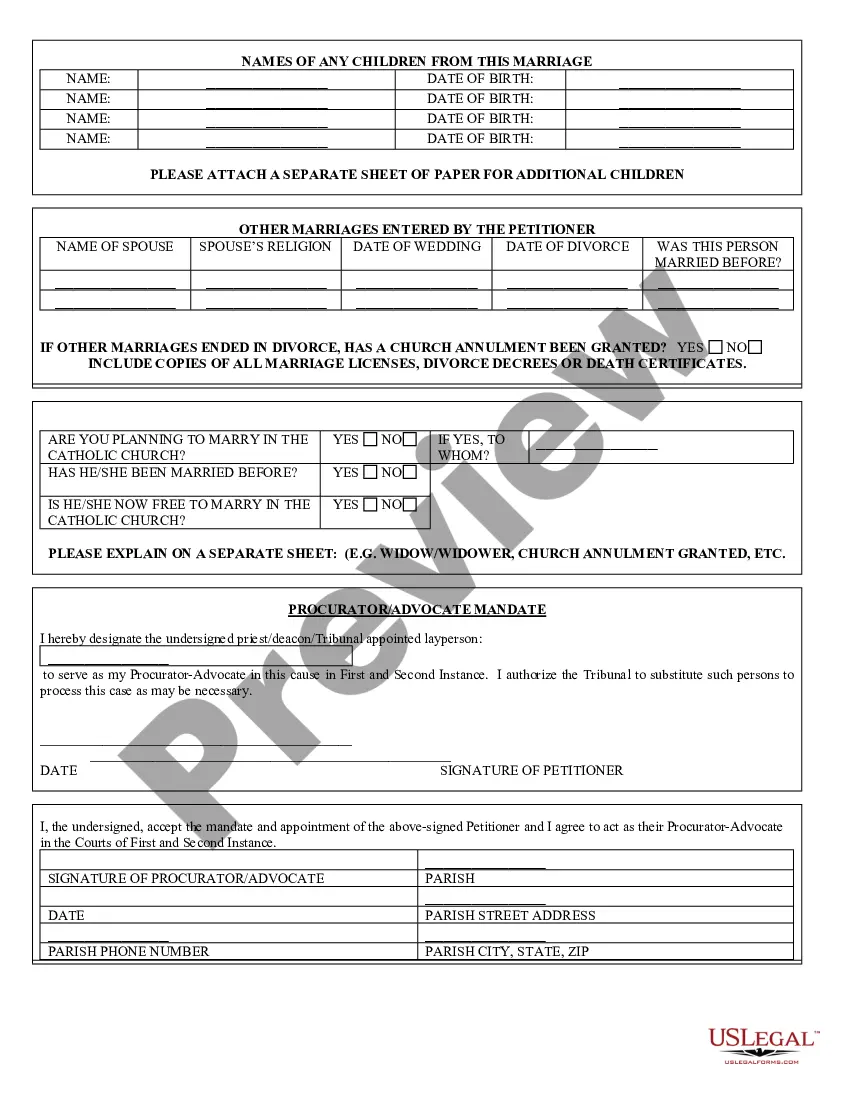
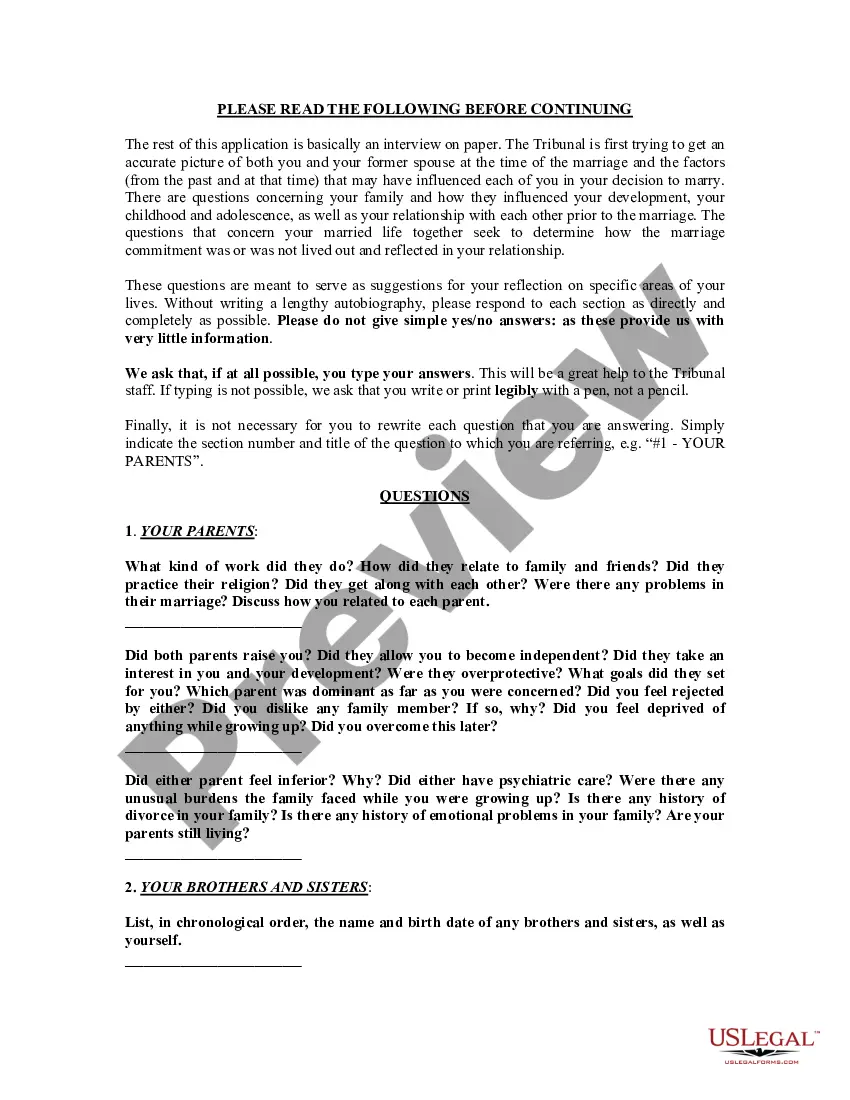
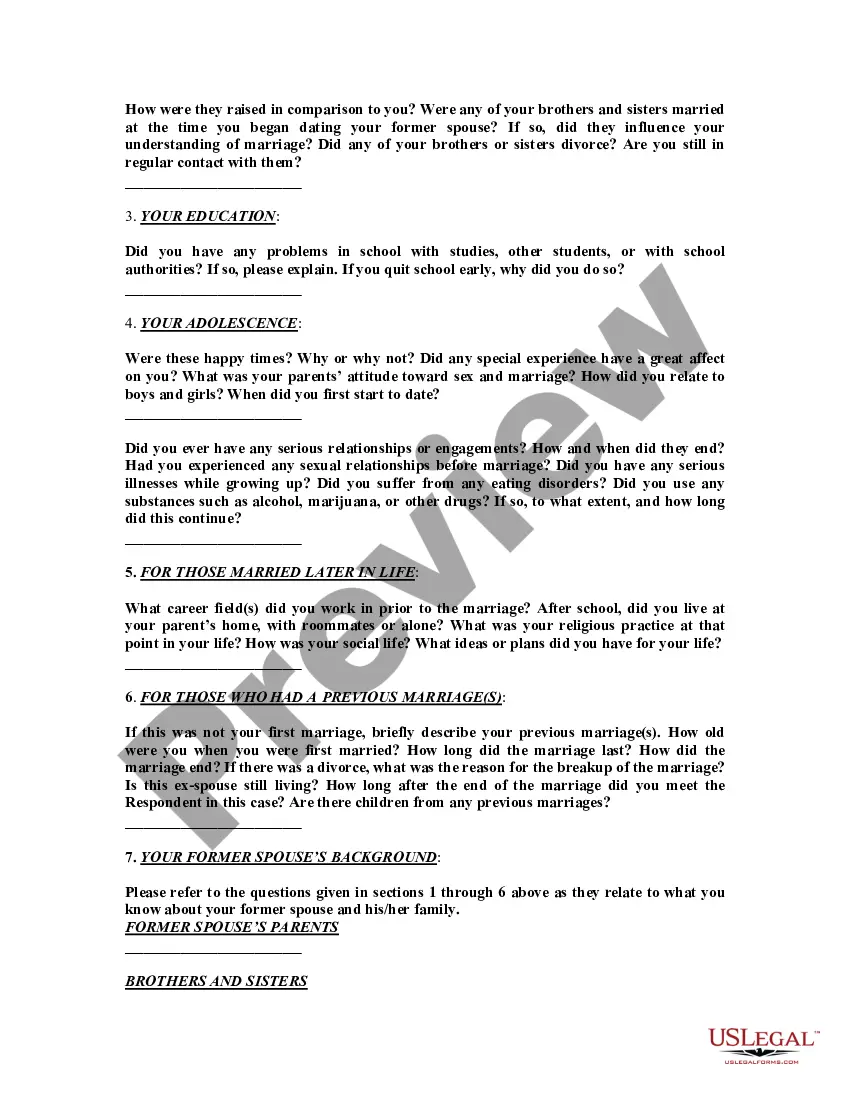
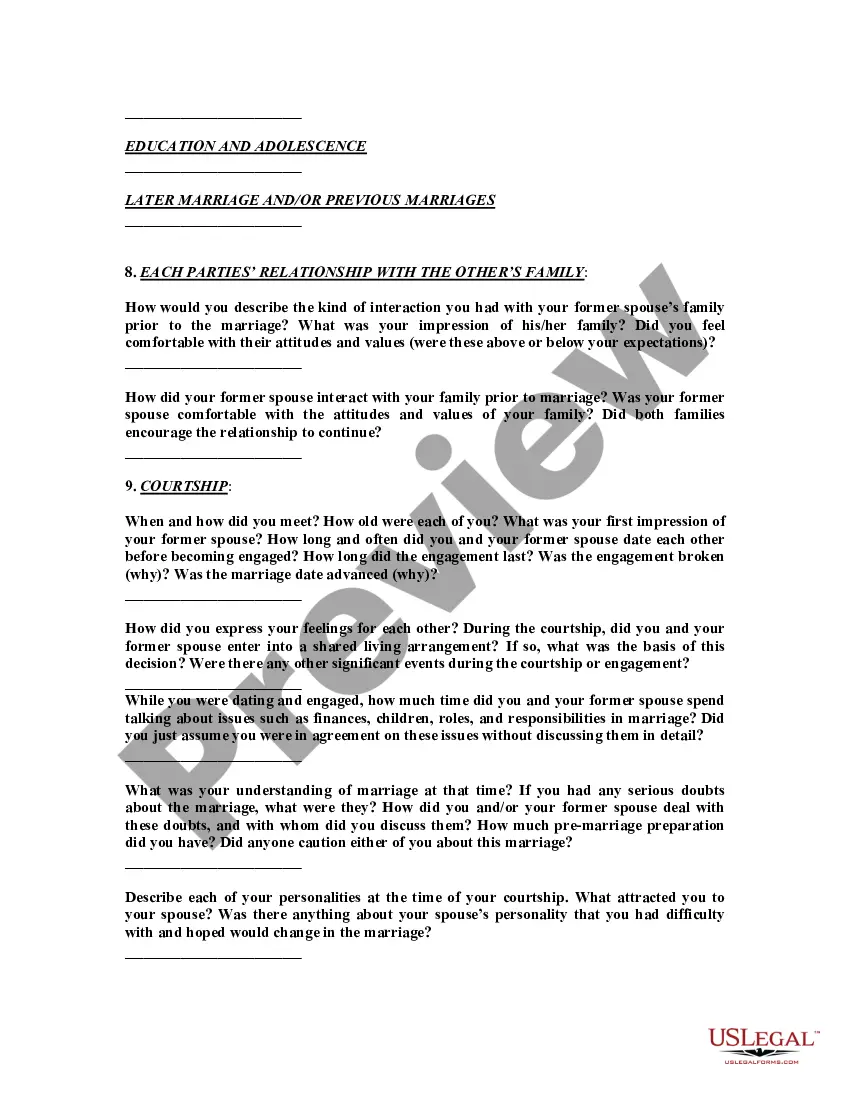
- Detailed questions about the marriage, courtship, and individual backgrounds.
- Mandate for Procurator-Advocate to assist the Petitioner throughout the process.
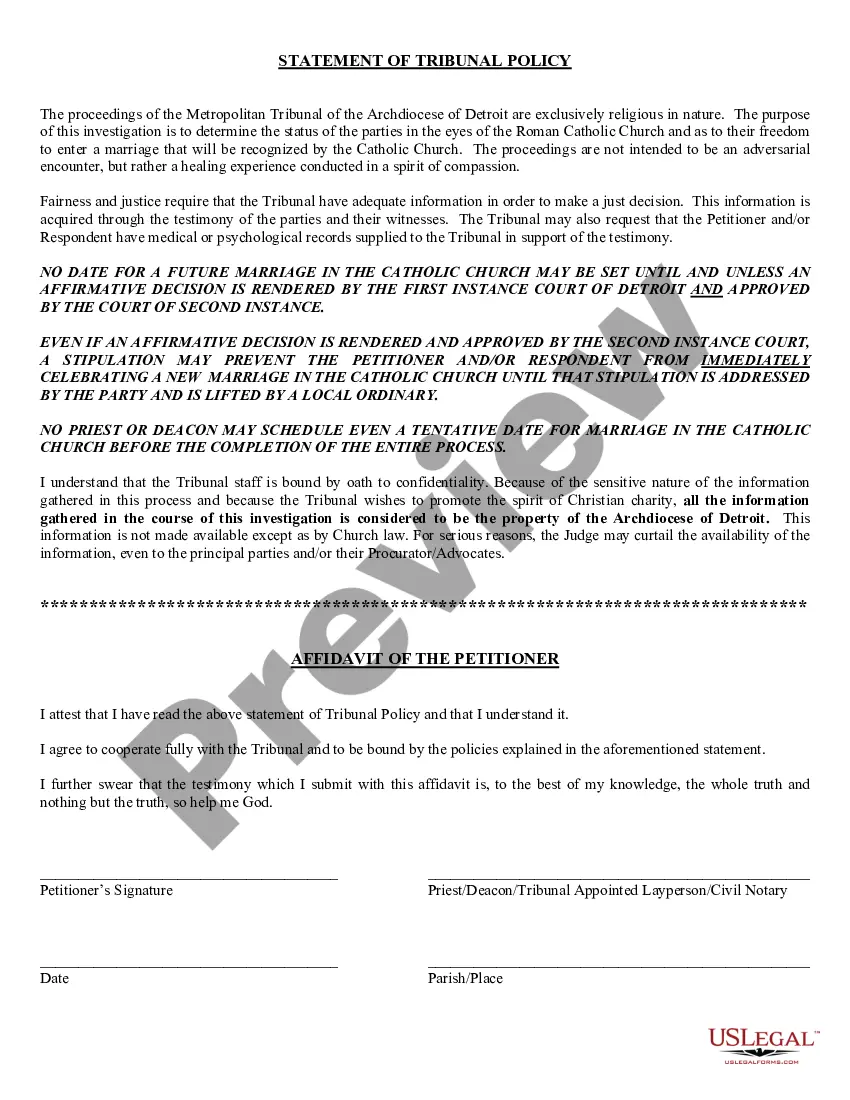
- Affidavit affirming the truth and completeness of provided information.

Common use cases
This form should be used when an individual wishes to petition the Catholic Church for an annulment of a previous marriage. It is relevant for those who plan to remarry within the Church and need to establish their freedom to enter a new marital union. It is often needed after experiences of separation or divorce where the validity of the first marriage is questioned.
Who can use this document
- Individuals previously married who are seeking a declaration that their marriage was invalid in the eyes of the Catholic Church.
- Those who wish to remarry within the Catholic Church and require an annulment to do so.
- Any Catholic or individual wishing to understand their marital status under Church law.
Completing this form step by step
- Identify the parties involved by filling out the Petitioner and Respondent sections with accurate information.
- Provide a comprehensive account of the marriage, including important dates and backgrounds.
- List potential witnesses who can testify regarding the marriage and ensure their willingness to cooperate.
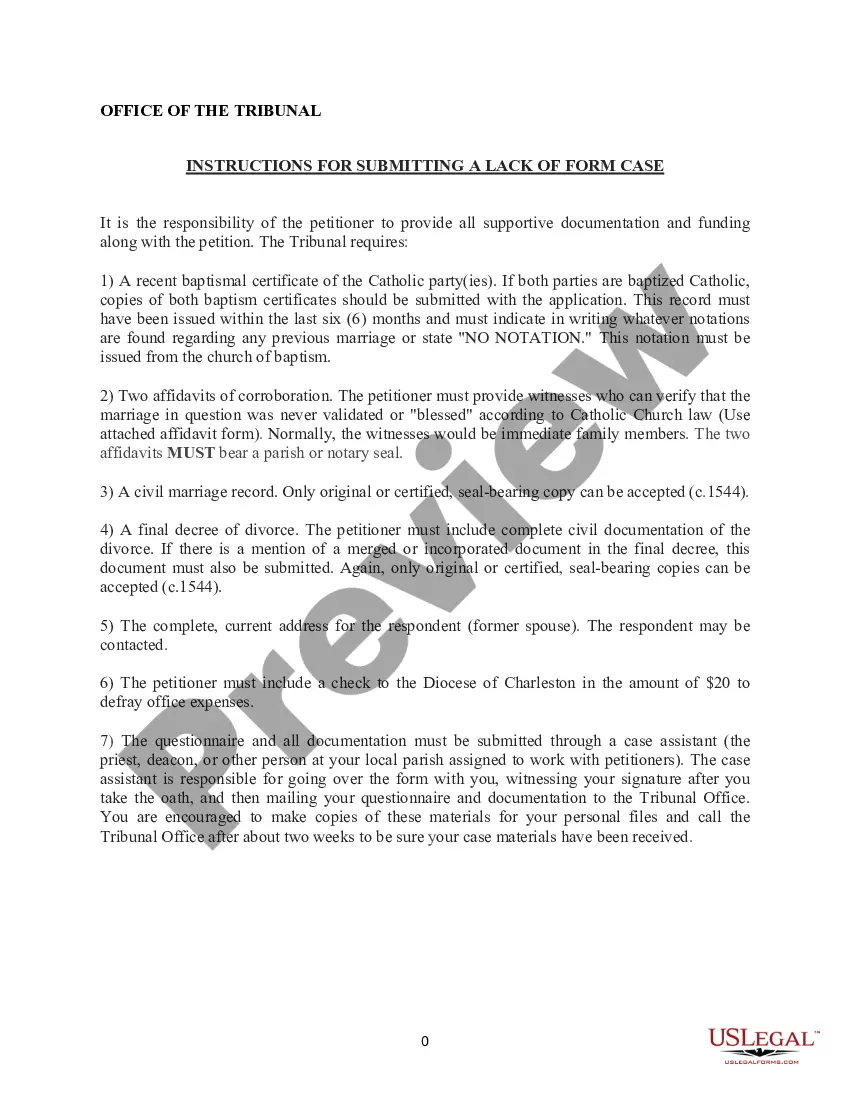
- Attach all necessary civil documents, including marriage licenses and divorce decrees, as required.
- Finalise the application with signatures from both the Petitioner and the Procurator-Advocate before submitting it to the Tribunal.
Is notarization required?
In most cases, this form does not require notarization. However, some jurisdictions or signing circumstances might. US Legal Forms offers online notarization powered by Notarize, accessible 24/7 for a quick, remote process.
Get your form ready online
Our built-in tools help you complete, sign, share, and store your documents in one place.
Make edits, fill in missing information, and update formatting in US Legal Forms—just like you would in MS Word.
Download a copy, print it, send it by email, or mail it via USPS—whatever works best for your next step.
Sign and collect signatures with our SignNow integration. Send to multiple recipients, set reminders, and more. Go Premium to unlock E-Sign.
If this form requires notarization, complete it online through a secure video call—no need to meet a notary in person or wait for an appointment.
We protect your documents and personal data by following strict security and privacy standards.

Make edits, fill in missing information, and update formatting in US Legal Forms—just like you would in MS Word.

Download a copy, print it, send it by email, or mail it via USPS—whatever works best for your next step.

Sign and collect signatures with our SignNow integration. Send to multiple recipients, set reminders, and more. Go Premium to unlock E-Sign.

If this form requires notarization, complete it online through a secure video call—no need to meet a notary in person or wait for an appointment.

We protect your documents and personal data by following strict security and privacy standards.
Common mistakes
- Providing incomplete witness information or failing to contact witnesses beforehand.
- Neglecting to attach civil records of all marriages if applicable.
- Submitting the application without proper signatures or endorsements from the Procurator-Advocate.
- Offering yes/no answers instead of detailed descriptions where narrative is required.
Benefits of completing this form online
- Convenience of completing the form digitally, allowing for easy edits and clarity in responses.
- Accessibility to save and store documents securely on your device.
- Streamlined submission process to the Tribunal, helping to expedite case processing.
Looking for another form?

Form popularity
FAQ
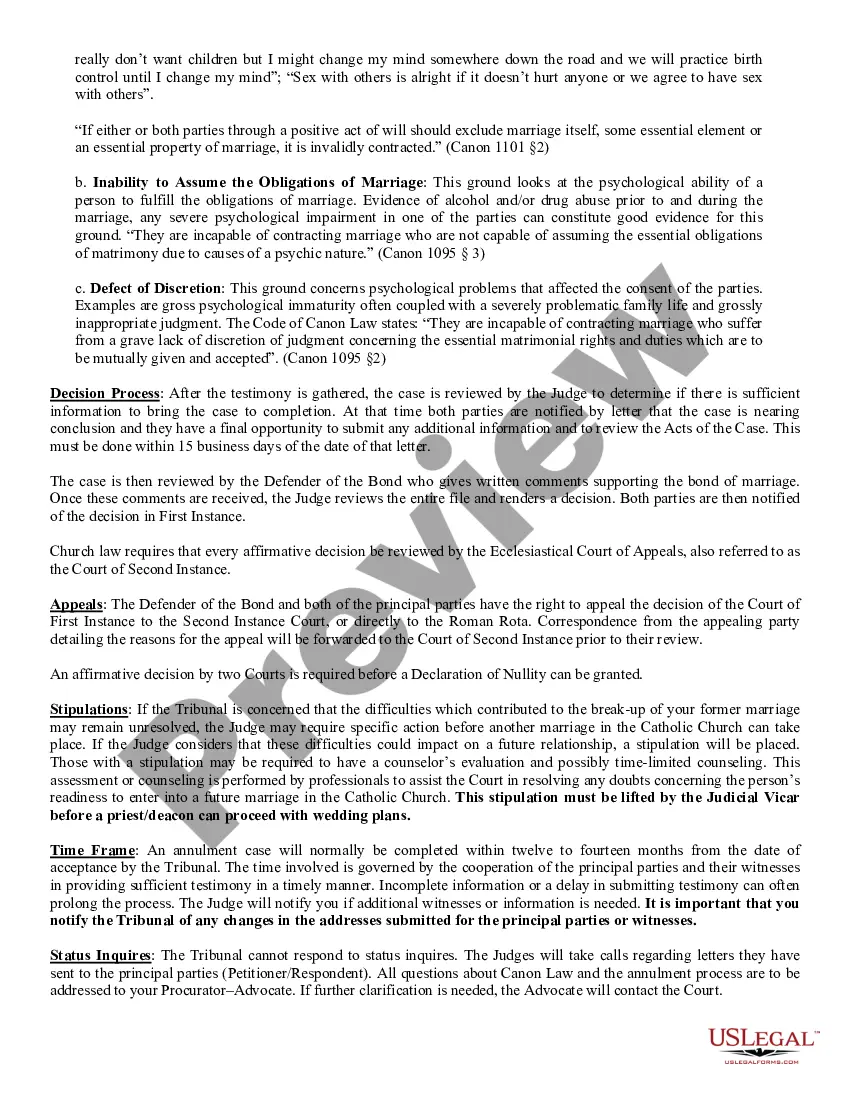
In order to obtain a declaration of nullity, the parties must approach a Catholic diocesan tribunal. Most applications for nullity that are heard by the tribunal are granted because one or both of the parties are judged to have given invalid consent. In order to give valid consent, the parties must give it freely.
A declaration of nullity is a decision that is made by the Church, which acknowledges that a couple never established the sacred bond of marriage. This "declaration" can only be made after one of the parties in a former marriage requests it, and only after a detailed study of the marriage has been carried out.
Grounds for nullity A marriage may be declared invalid because at least one of the two parties was not free to consent to the marriage or did not fully commit to the marriage.
A decree of nullity is a declaration of the court that the marriage is null and void, ie. that a legal marriage never actually took place. An individual can apply to court for a decree of nullity to annul the marriage on grounds that the marriage is either void or voidable.
A decree of nullity is a declaration by a court that your marriage never existed in the eyes of the law. It means that no valid marriage exists between you and your partner. Nullity (or annulment) is not the same as divorce. Divorce is a declaration ending a valid marriage.
In a Declaration of Nullity of Marriage, the marriage that is sought to be declared void ab initio or void from the beginning. Whereas in an Annulment, the marriage is considered voidable, or the marriage is valid but is susceptible of being voided pursuant to the grounds provided under the law.
An annulment (or nullity) is when a judge says in a court order that your marriage or domestic partnership is not legally valid. This means something was legally wrong with the marriage from the start. If you get an annulment, it's like your marriage never happened because it was never legal.
The Church requires a declaration of nullity in order to establish that an essential element was missing in that previous union that prevented it from being a valid marriage, and thus the intended spouse is free to marry. This is often a difficult and emotional issue.