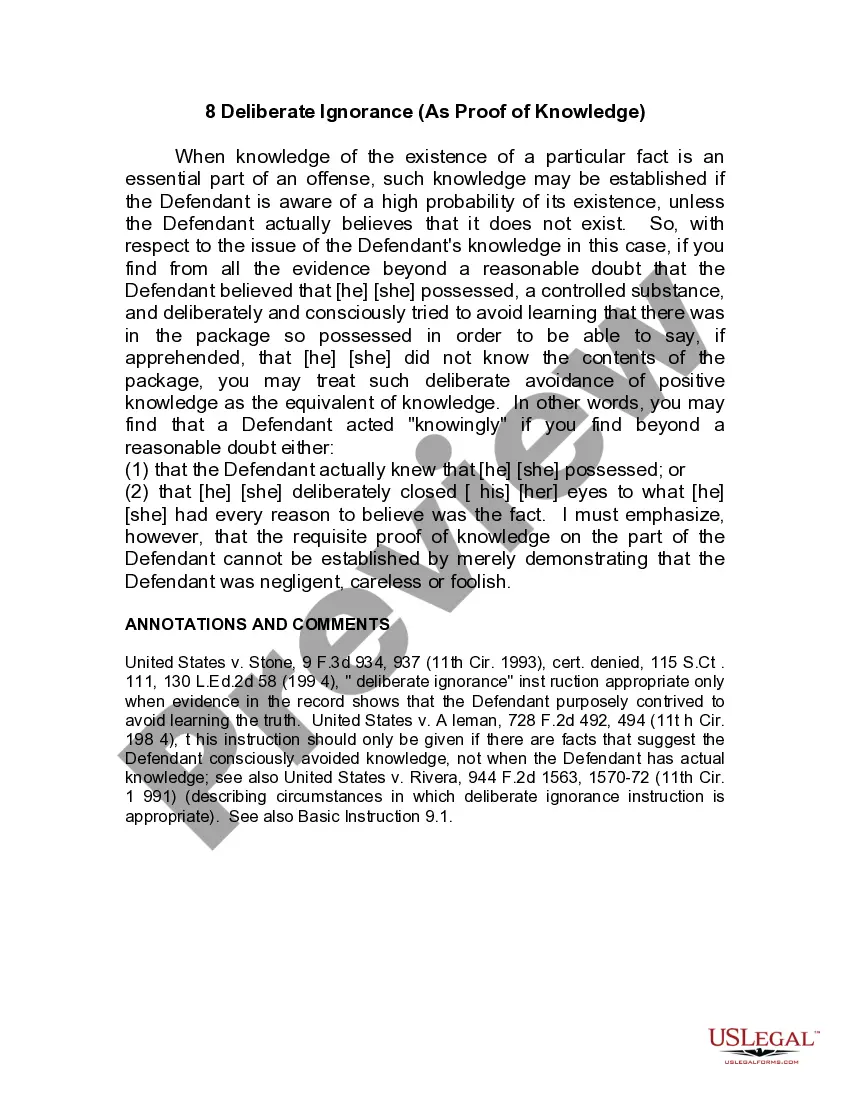
Jury Instruction - Deliberate Ignorance - As Proof Of Knowledge
What is this form?
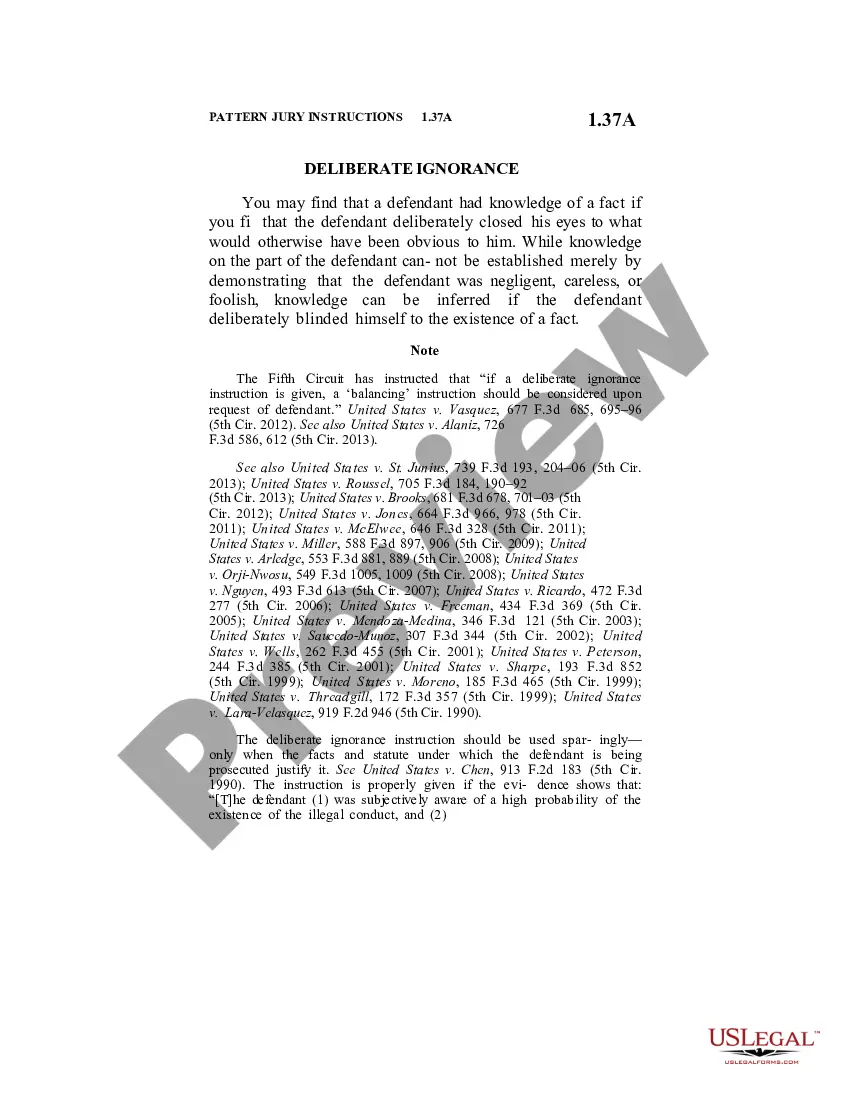
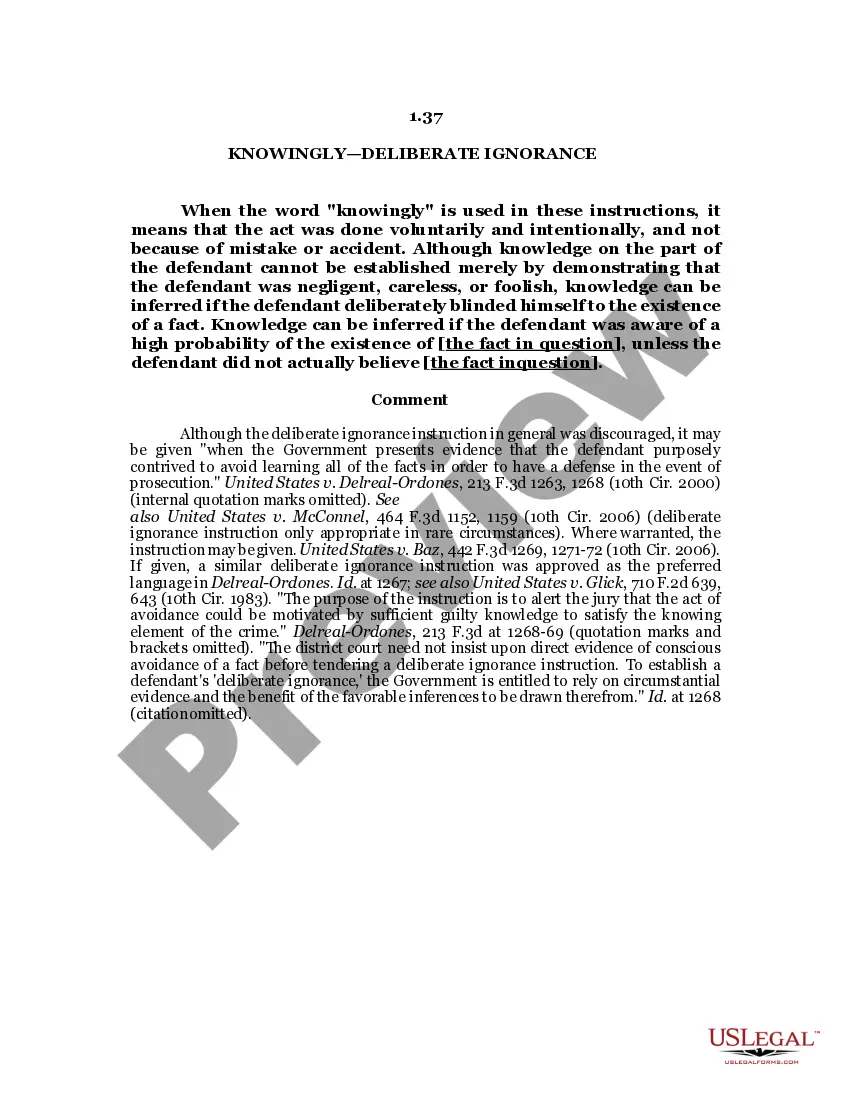
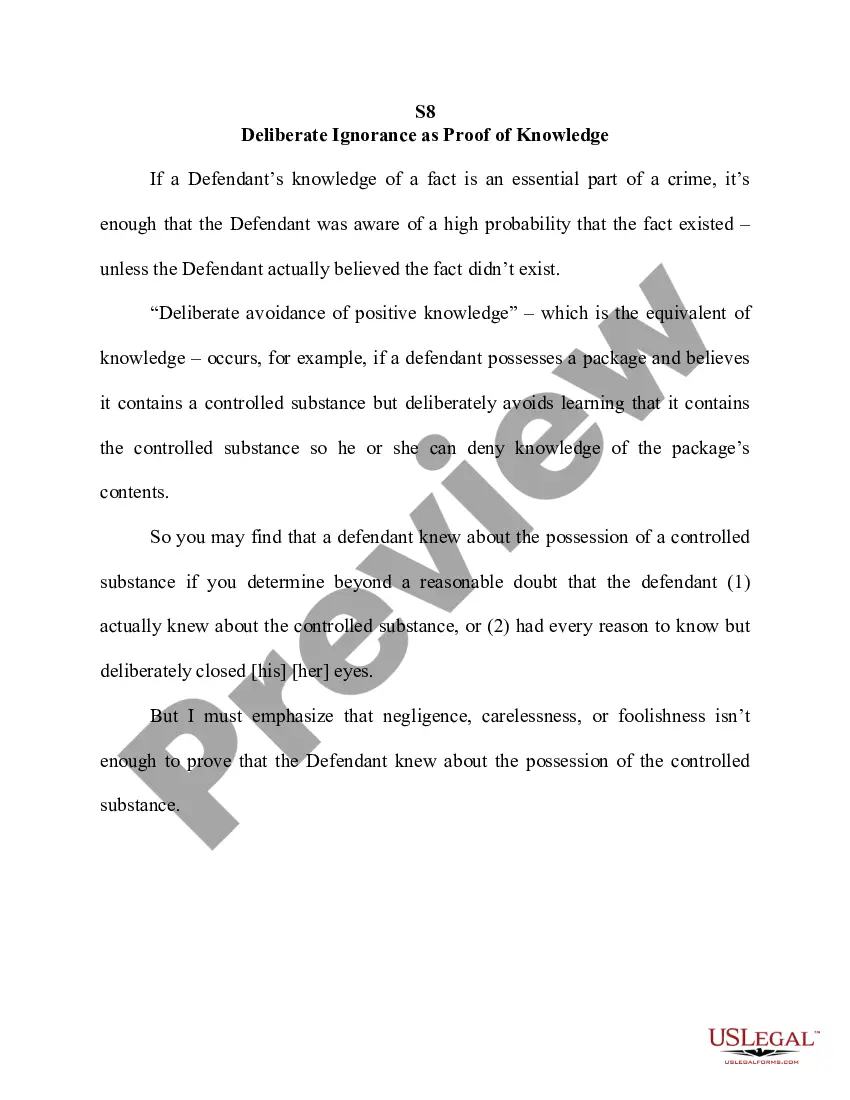
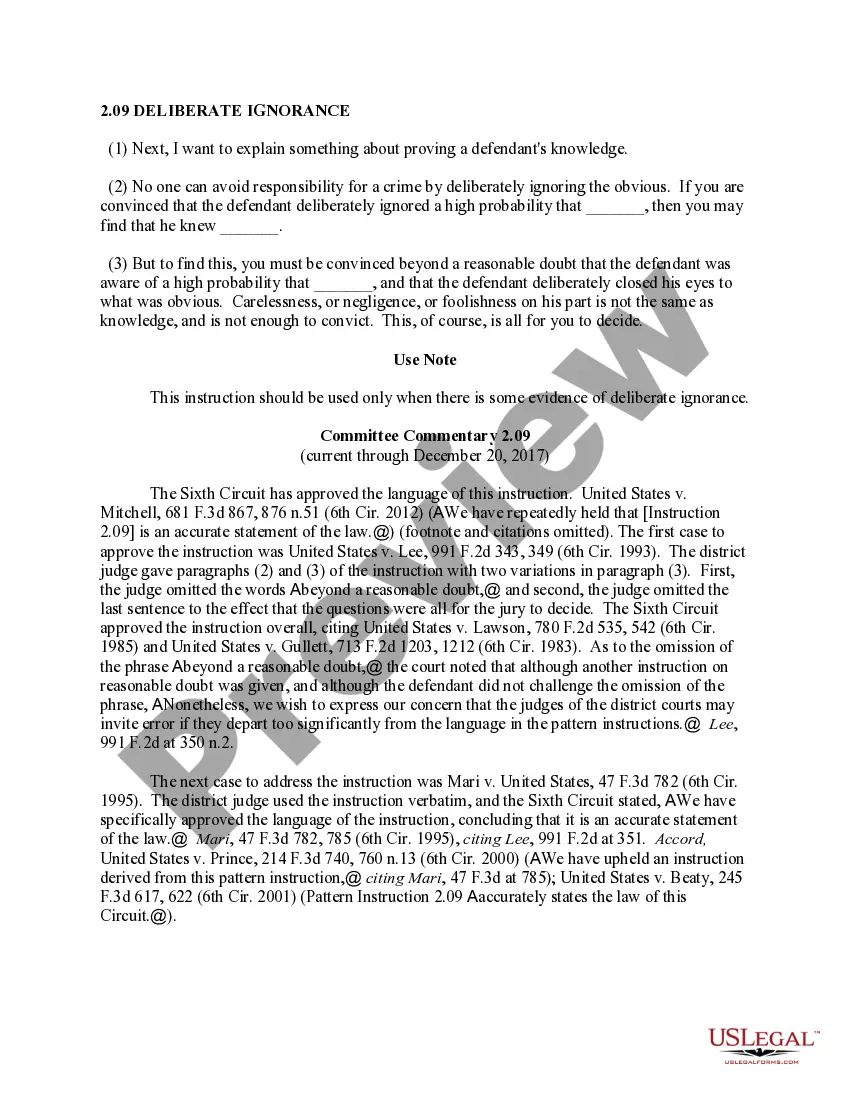
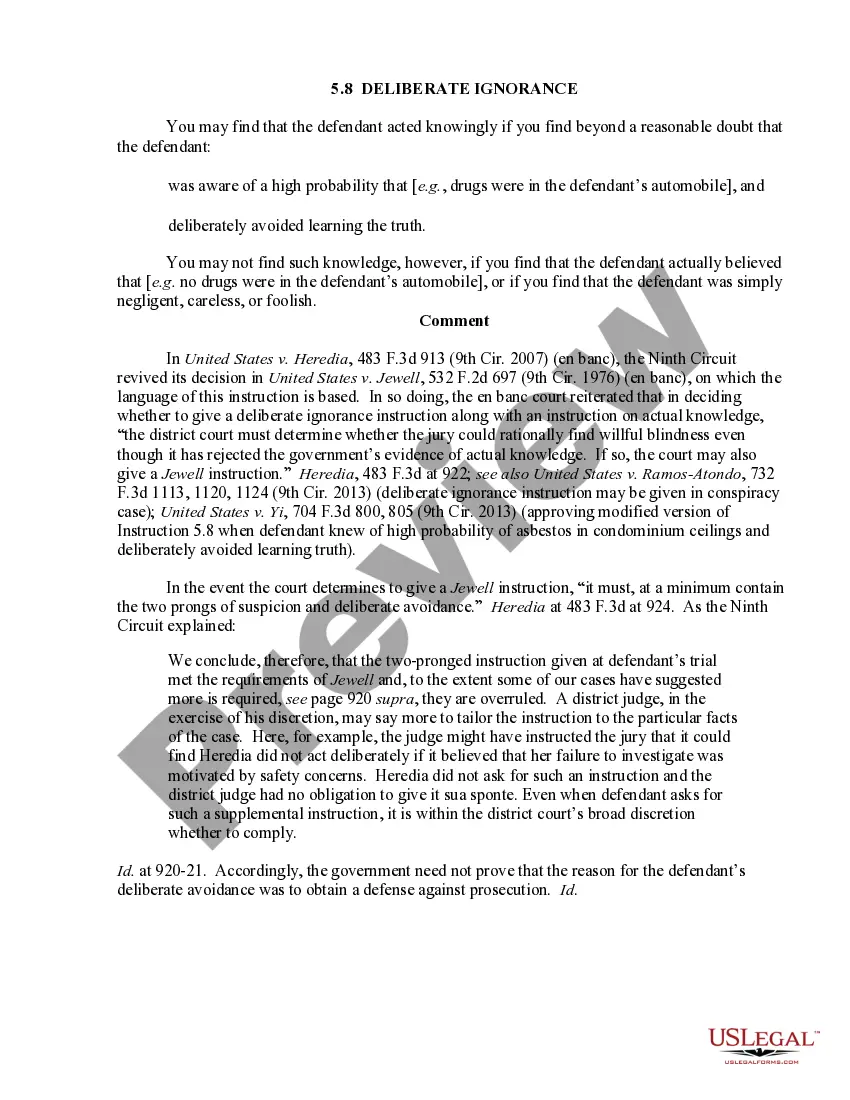
The Jury Instruction for Deliberate Ignorance serves as guidance for jurors regarding how to interpret knowledge in relation to criminal intent. This form is designed to clarify that a defendant's ignorance may not be a defense if they deliberately avoided acknowledging facts they had strong reasons to believe. It helps jurors understand that knowledge of possession can be inferred from deliberate avoidance of awareness, distinguishing it from cases where actual knowledge is present.
Key components of this form
- Definition of deliberate ignorance as it relates to knowledge of criminal offenses.
- Guidance on how to assess a defendant's state of mind regarding possession of controlled substances.
- Criteria to determine whether ignorance is a result of negligent behavior or deliberate evasion.
- Reference to legal precedents that support the instruction's application.
Situations where this form applies
This form is applicable in criminal cases where the prosecution must establish that the defendant had knowledge of the possession of illegal items, such as controlled substances. It is particularly relevant when the evidence suggests the defendant may have intentionally avoided learning the truth about their actions to claim ignorance later.
Who this form is for
- Judges requiring jury instructions for trials involving charges where knowledge is critical.
- Prosecutors aiming to clarify the implications of a defendant's deliberate ignorance in court.
- Defense attorneys preparing to challenge the understanding of knowledge and intent in their cases.
Steps to complete this form
- Draft the jury instruction based on the specific facts of the case.
- Incorporate relevant legal precedents as references to support the instruction.
- Ensure clarity by defining terms and concepts related to deliberate ignorance.
- Review the instruction for compliance with state-specific legal standards.
Does this form need to be notarized?
Notarization is not commonly needed for this form. However, certain documents or local rules may make it necessary. Our notarization service, powered by Notarize, allows you to finalize it securely online anytime, day or night.
Get your form ready online
Our built-in tools help you complete, sign, share, and store your documents in one place.
Make edits, fill in missing information, and update formatting in US Legal Forms—just like you would in MS Word.
Download a copy, print it, send it by email, or mail it via USPS—whatever works best for your next step.
Sign and collect signatures with our SignNow integration. Send to multiple recipients, set reminders, and more. Go Premium to unlock E-Sign.
If this form requires notarization, complete it online through a secure video call—no need to meet a notary in person or wait for an appointment.
We protect your documents and personal data by following strict security and privacy standards.

Make edits, fill in missing information, and update formatting in US Legal Forms—just like you would in MS Word.

Download a copy, print it, send it by email, or mail it via USPS—whatever works best for your next step.

Sign and collect signatures with our SignNow integration. Send to multiple recipients, set reminders, and more. Go Premium to unlock E-Sign.

If this form requires notarization, complete it online through a secure video call—no need to meet a notary in person or wait for an appointment.

We protect your documents and personal data by following strict security and privacy standards.
Common mistakes to avoid
- Failing to include necessary references to applicable case law.
- Using vague language that does not clearly define deliberate ignorance.
- Confusing negligence with deliberate ignorance in the instruction.
Why complete this form online
- Convenience of accessing expertly drafted jury instructions from anywhere.
- Ability to customize the instruction to meet specific case needs.
- Quick download for immediate use in court proceedings.
Looking for another form?









Form popularity
FAQ
Argumentum ad Ignorantiam: (appeal to ignorance) the fallacy that a proposition is true simply on the basis that it has not been proved false or that it is false simply because it has not been proved true. This error in reasoning is often expressed with influential rhetoric.
What are the two forms of the appeal to ignorance? One form says that a claim must be true because it hasn't been shown to be false, and another form says that a claim must be false because it hasn't been proved to be true.
You cannot prove that God does not exist; therefore God exists. If someone is guilty, they always try to deny their guilt. No one has ever proven that UFOs haven't visited earth yet, so I believe that they have. You can't prove that you are innocent, therefore you are guilty to me.
A fallacy is a mistake in belief based on an unsound argument; so, an ignorance fallacy, or Appeal to Ignorance occurs when a person mistakenly believes something to be true that is not, because he or she does not know enough about the subject, or ha not bee given enough evidence, to know otherwise.
An example of the fallacy-fallacy fallacy is the following: Alex: your argument contained a strawman, so you're wrong. Bob: it's wrong of you to assume that my argument is wrong just because it contains a fallacy, so that means that you're wrong, and my original argument was right.
Ad Ignorantiam (Appeal to Ignorance) Ad Ignorantiam (Appeal to Ignorance) Description: The argument offers lack of evidence as if it were evidence to the contrary. The argument says, "No one knows it is true; therefore it is false," or "No one knows it is false, therefore it is true."
A fallacy is a kind of error in reasoning.Sometimes the term fallacy is used even more broadly to indicate any false belief or cause of a false belief. The list below includes some fallacies of these sorts, but most are fallacies that involve kinds of errors made while arguing informally in natural language.