DELIBERATE IGNORANCE
What this document covers
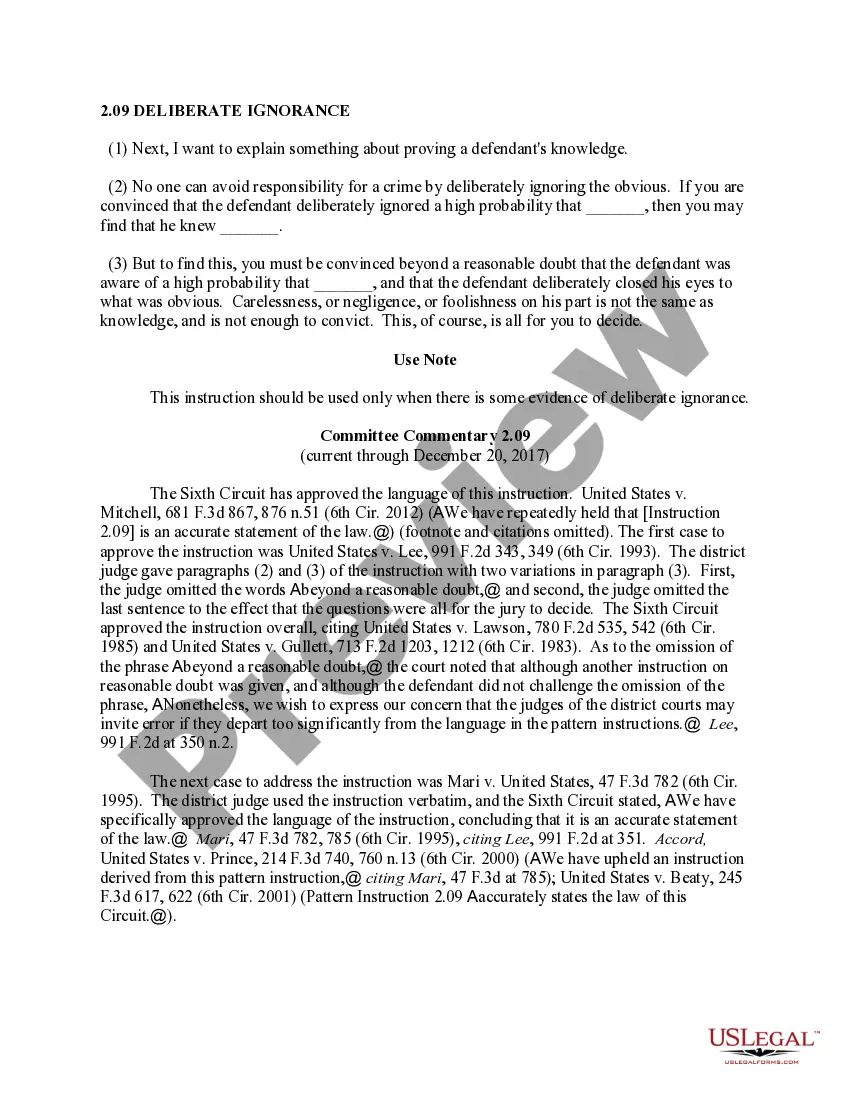
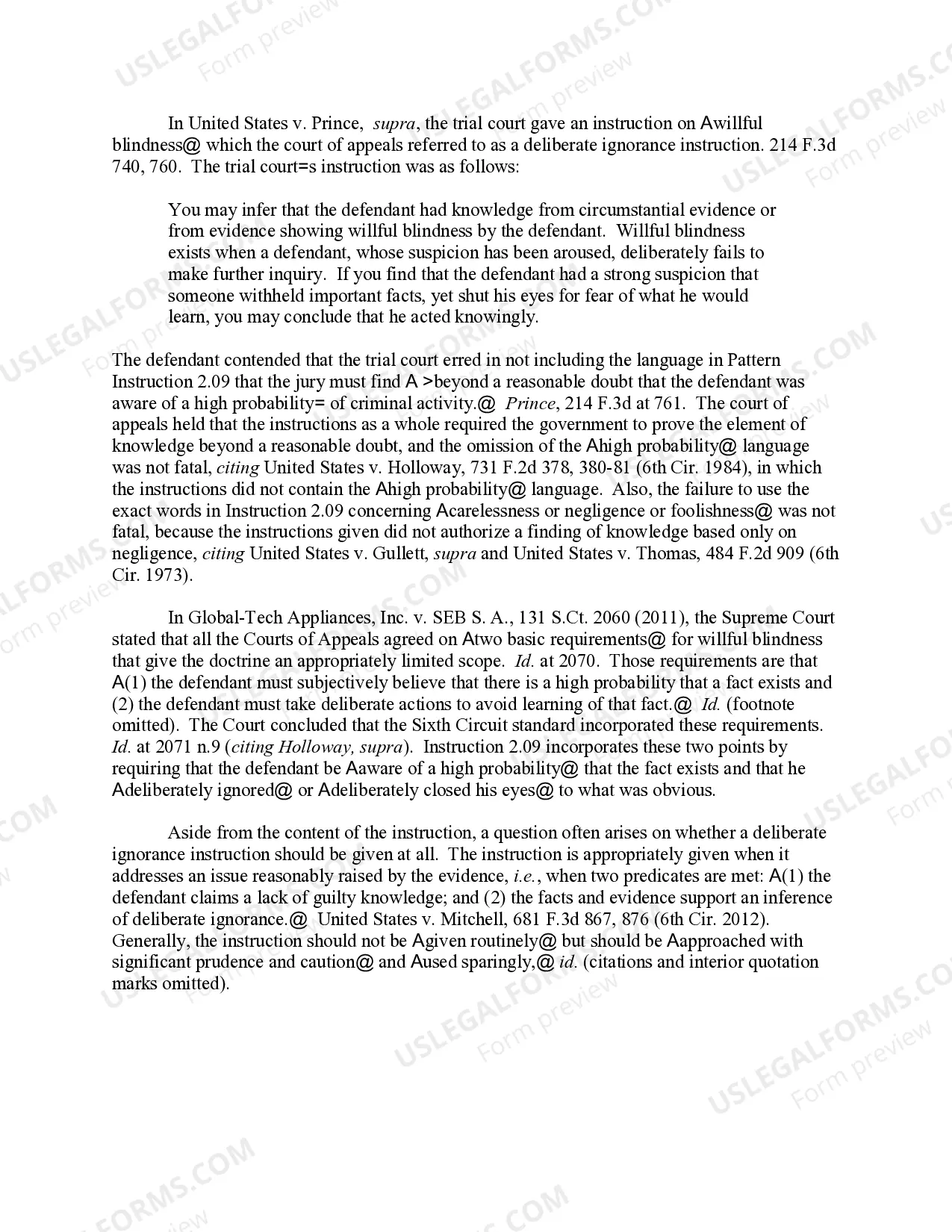
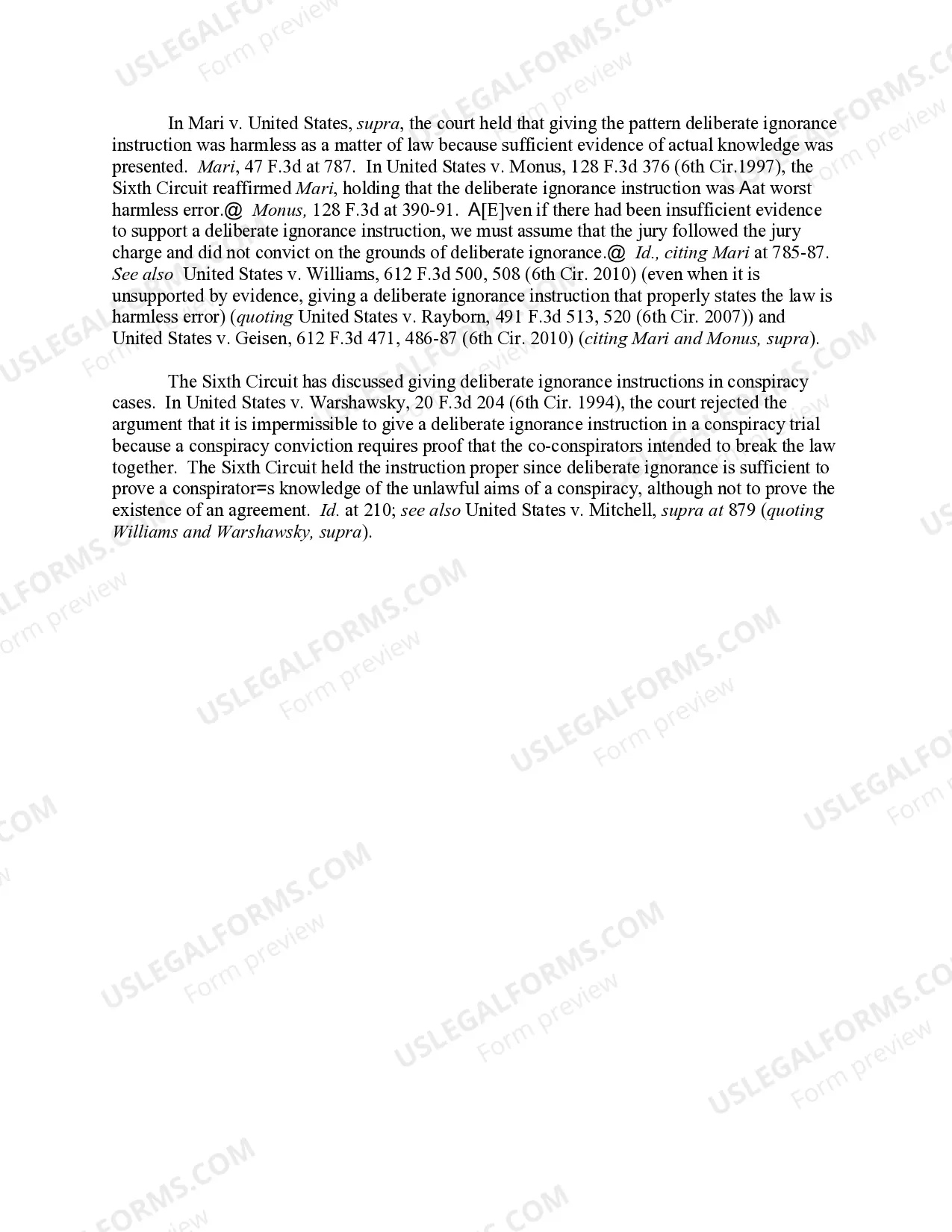
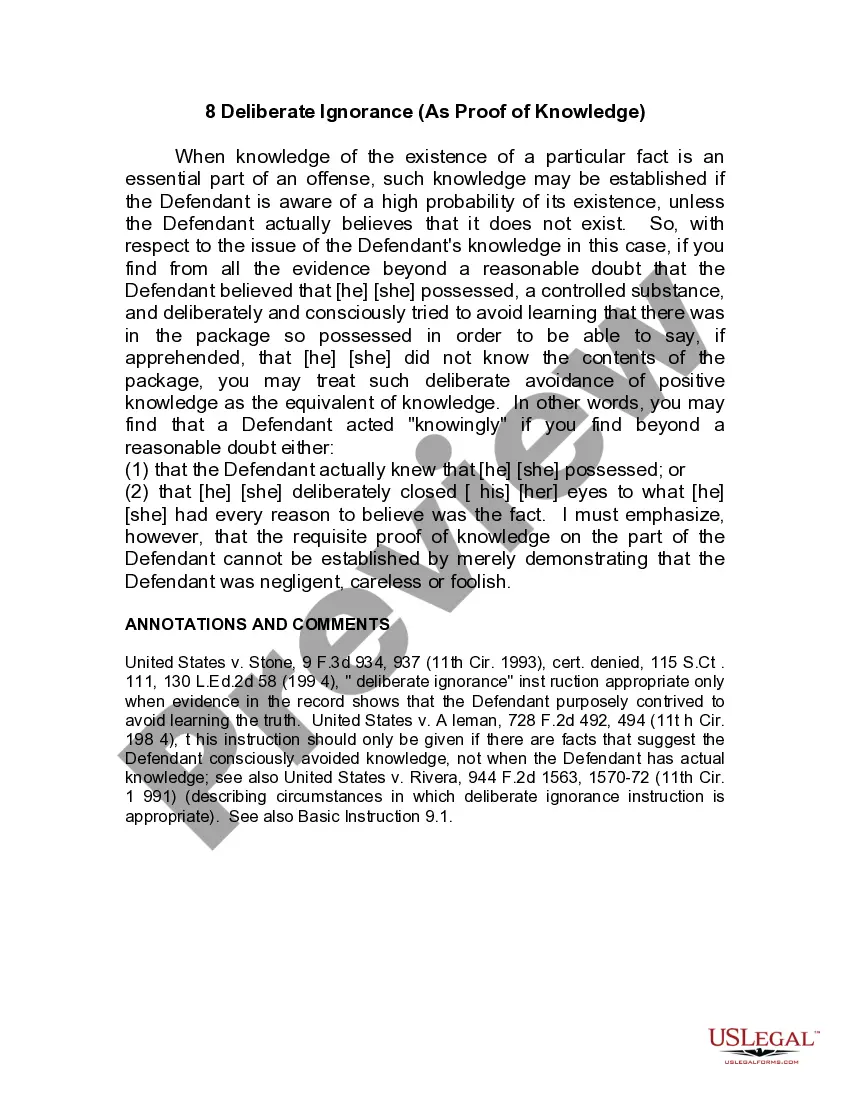
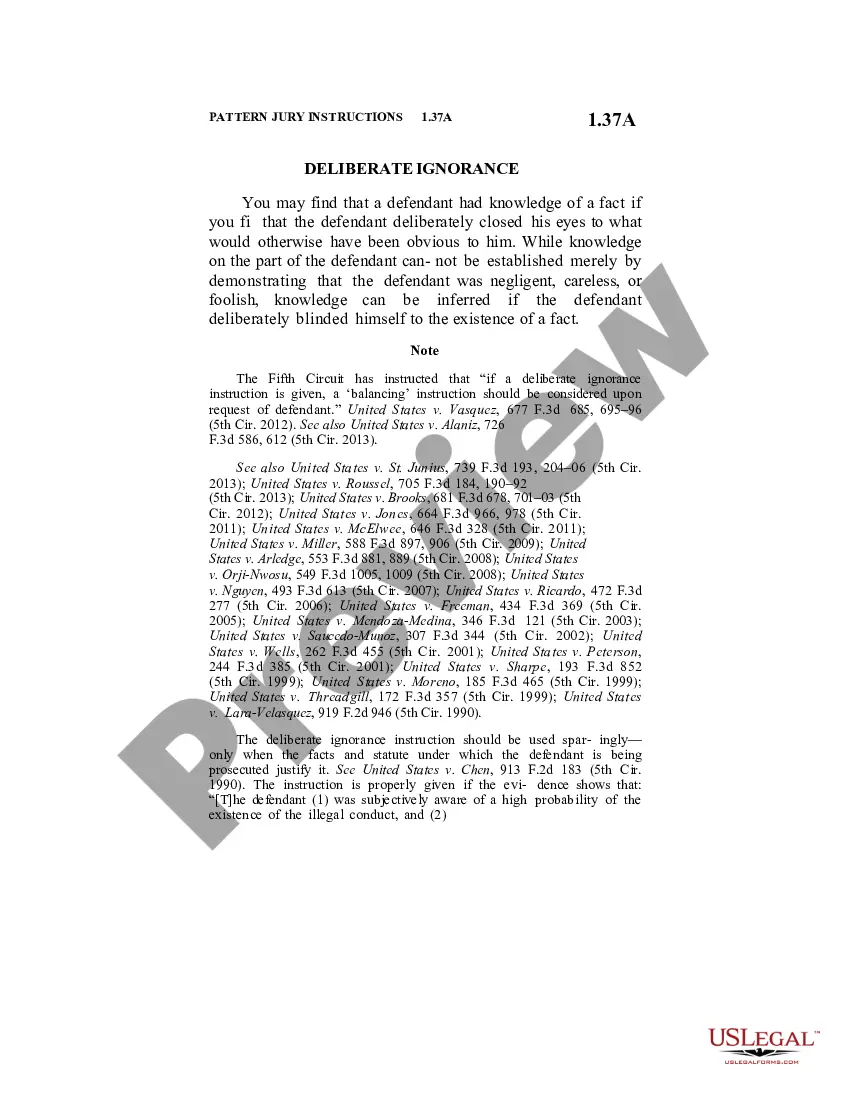
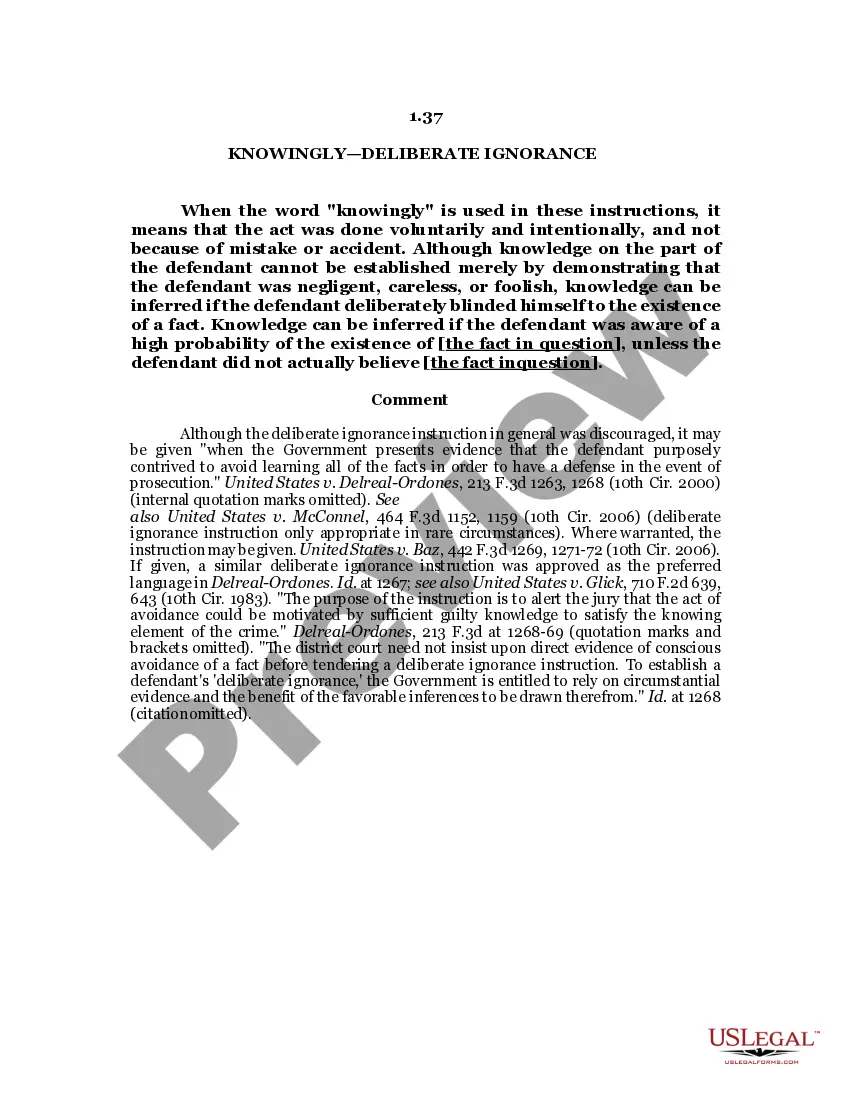
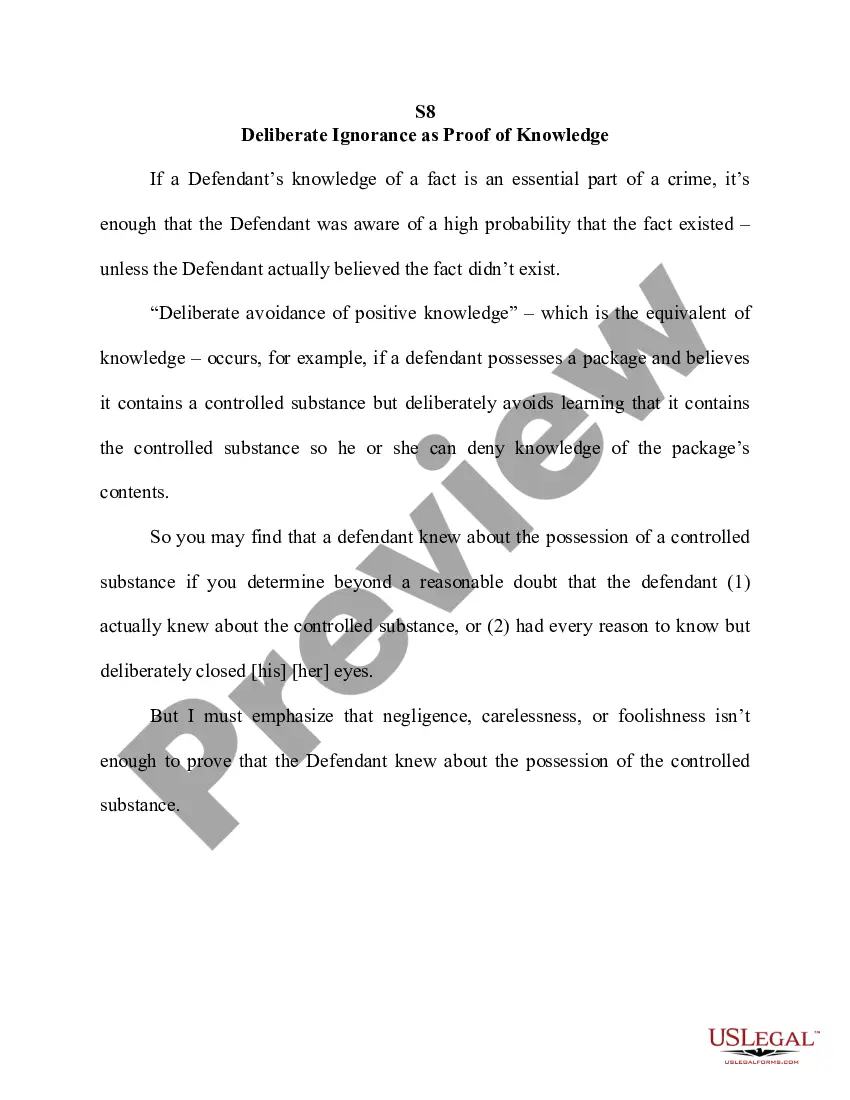
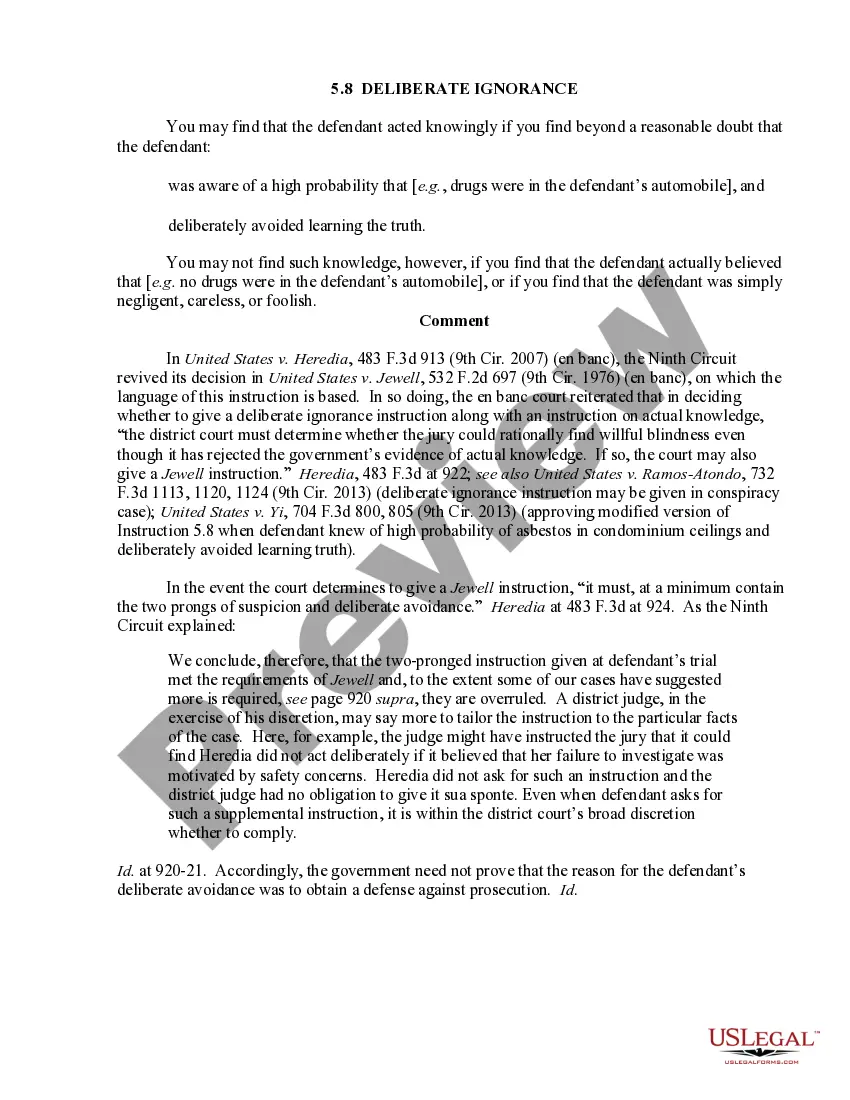
The Deliberate Ignorance form is used in criminal cases to help juries understand how to assess a defendant's knowledge of alleged criminal activity. It clarifies that a defendant cannot evade legal responsibility by simply ignoring obvious facts. The form outlines the criteria for finding that a defendant acted with knowledge based on their deliberate ignorance of certain probabilities, distinguishing it from mere negligence or carelessness.
Form components explained
- Definition of deliberate ignorance and its relevance to criminal liability.
- Criteria for establishing a defendant's knowledge beyond a reasonable doubt.
- Explanation of carelessness versus knowledge.
- Guidance on when to apply this instruction in court.
When this form is needed
This form should be used when there is a suspicion that a defendant may have deliberately ignored evidence of criminal activity. It is particularly relevant in cases where knowledge of the crime is a key element of the prosecution's case, and where the defendant claims a lack of knowledge or awareness.
Intended users of this form
- Judges in both criminal trials and jury instructions.
- Prosecutors seeking to establish knowledge in their case.
- Defense attorneys preparing to counter claims of deliberate ignorance.
- Juries needing guidance on legal interpretations of knowledge.
Steps to complete this form
- Determine if there is evidence suggesting deliberate ignorance of the defendant.
- Assess whether that evidence supports a high probability of knowledge regarding the crime.
- Evaluate the defendant's response to signs of unlawful activity.
- Instruct the jury on how to consider this evidence under the law.
Notarization guidance
This form does not typically require notarization to be legally valid. However, some jurisdictions or document types may still require it. US Legal Forms provides secure online notarization powered by Notarize, available 24/7 for added convenience.
Get your form ready online
Our built-in tools help you complete, sign, share, and store your documents in one place.
Make edits, fill in missing information, and update formatting in US Legal Forms—just like you would in MS Word.
Download a copy, print it, send it by email, or mail it via USPS—whatever works best for your next step.
Sign and collect signatures with our SignNow integration. Send to multiple recipients, set reminders, and more. Go Premium to unlock E-Sign.
If this form requires notarization, complete it online through a secure video call—no need to meet a notary in person or wait for an appointment.
We protect your documents and personal data by following strict security and privacy standards.

Make edits, fill in missing information, and update formatting in US Legal Forms—just like you would in MS Word.

Download a copy, print it, send it by email, or mail it via USPS—whatever works best for your next step.

Sign and collect signatures with our SignNow integration. Send to multiple recipients, set reminders, and more. Go Premium to unlock E-Sign.

If this form requires notarization, complete it online through a secure video call—no need to meet a notary in person or wait for an appointment.

We protect your documents and personal data by following strict security and privacy standards.
Common mistakes
- Assuming negligence constitutes knowledge.
- Failing to provide sufficient evidence of deliberate ignorance.
- Using the instruction when not supported by the facts of the case.
Benefits of using this form online
- Convenient access to standardized legal language.
- Editability to customize based on specific case needs.
- Reliability, as forms are drafted by licensed attorneys.
Legal use & context
- This instruction reflects established legal principles within the Sixth Circuit.
- It is important for juries to understand the difference between knowledge and mere avoidance of awareness.
- Proper application can influence the outcome of criminal cases significantly.
Looking for another form?
Form popularity
FAQ
Deliberate ignorance can be defined as the willful decision not to know the answer to a question of personal interest, even if the answer is free, that is, with no search costs.
Ralph Hertwig: To give an example, if somebody takes an HIV test and then decides that they do not want to know the result and has unprotected sex, most of us would consider this to be morally highly problematic. In this case, the person who is deliberately ignorant would accept that they might be harming others.
Ignorance Examples Saying that scientific facts are a hoax.Believing in conspiracy theories.Behaving negatively about culture and ethnicity.Taking the word of a guru as truth.Accepting rumor as truth.Being gullible to real hoaxes.Maintaining ancient beliefs that have no scientific backing.
Deliberate ignorance can be defined as the willful decision not to know the answer to a question of personal interest, even if the answer is free, that is, with no search costs.
Terminology. Willful blindness or wilful blindness is sometimes called ignorance of law, willful ignorance, contrived ignorance, conscious avoidance, intentional ignorance or Nelsonian knowledge.
Our findings reveal a diverse range of reasons for deliberate ignorance, including regulation of negative emotions, avoidance of personal conflict, scepticism about the information compiled, and rejection of the victorious political system's authority over the files.
Terminology. Willful blindness or wilful blindness is sometimes called ignorance of law, willful ignorance, contrived ignorance, conscious avoidance, intentional ignorance or Nelsonian knowledge.