Jury Instruction - Tax Evasion - General Charge
What is this form?
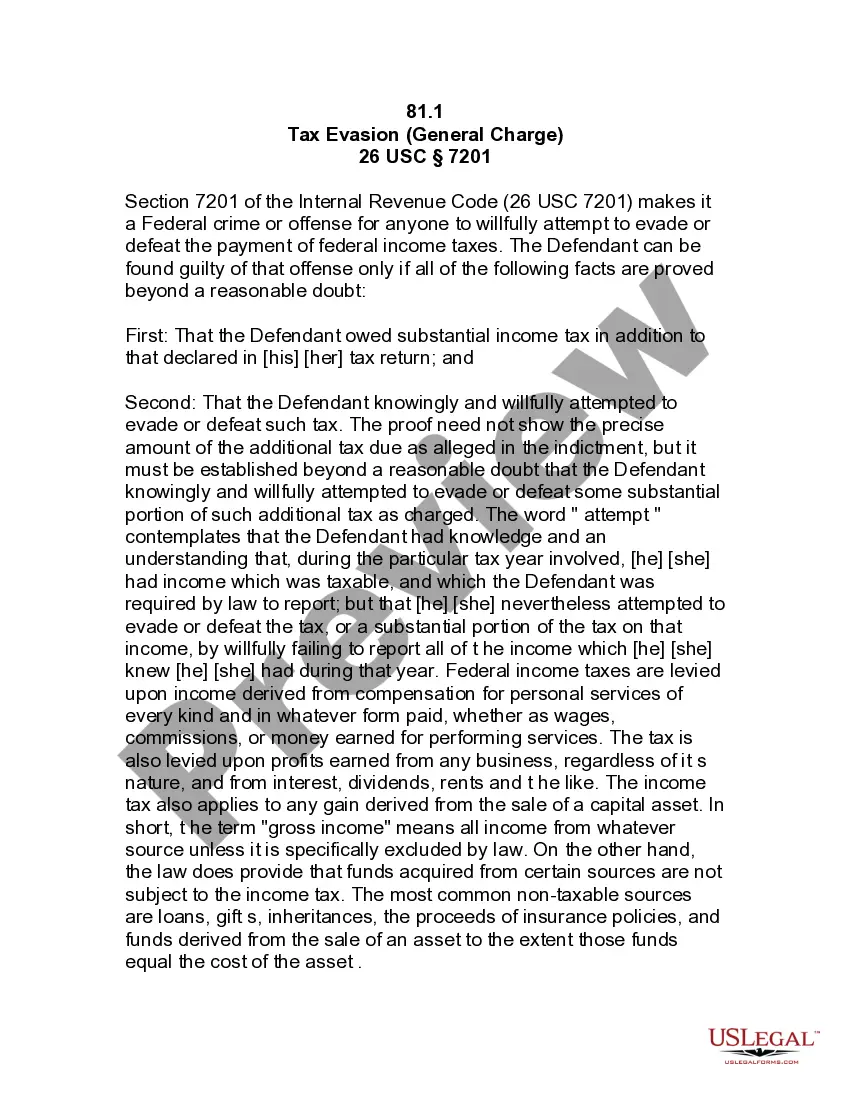
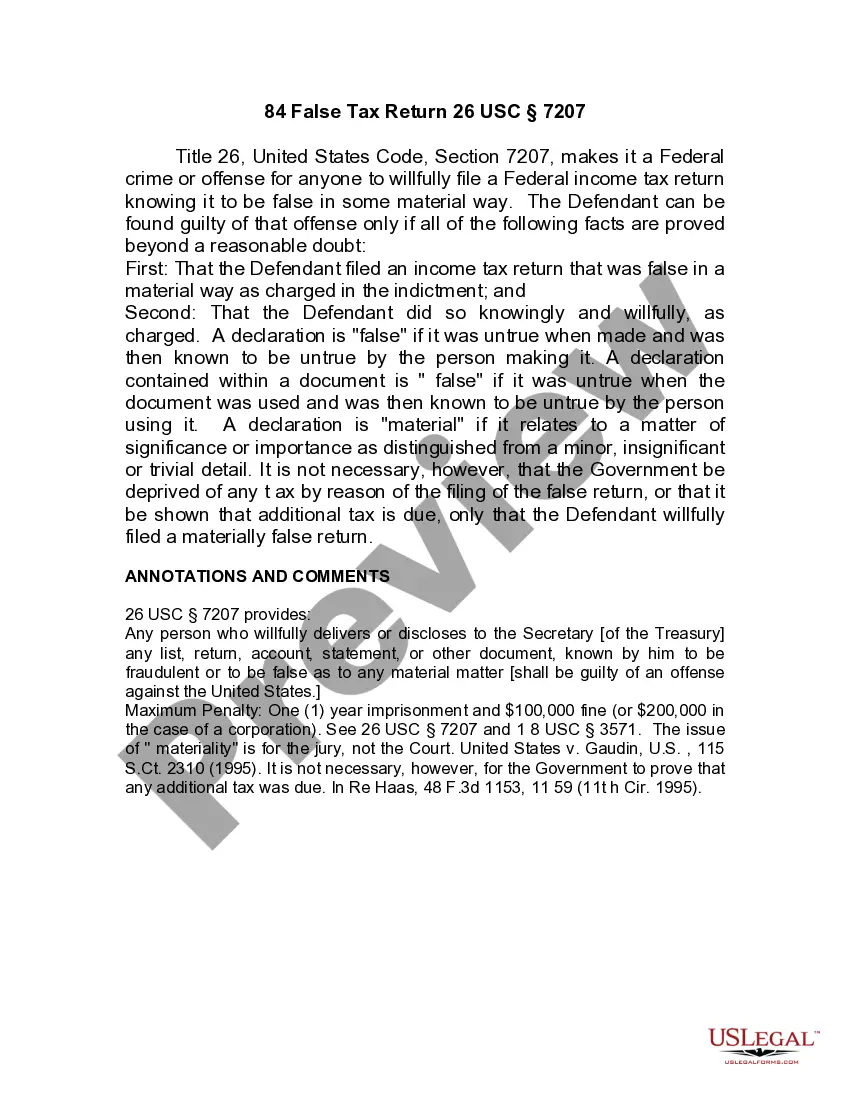
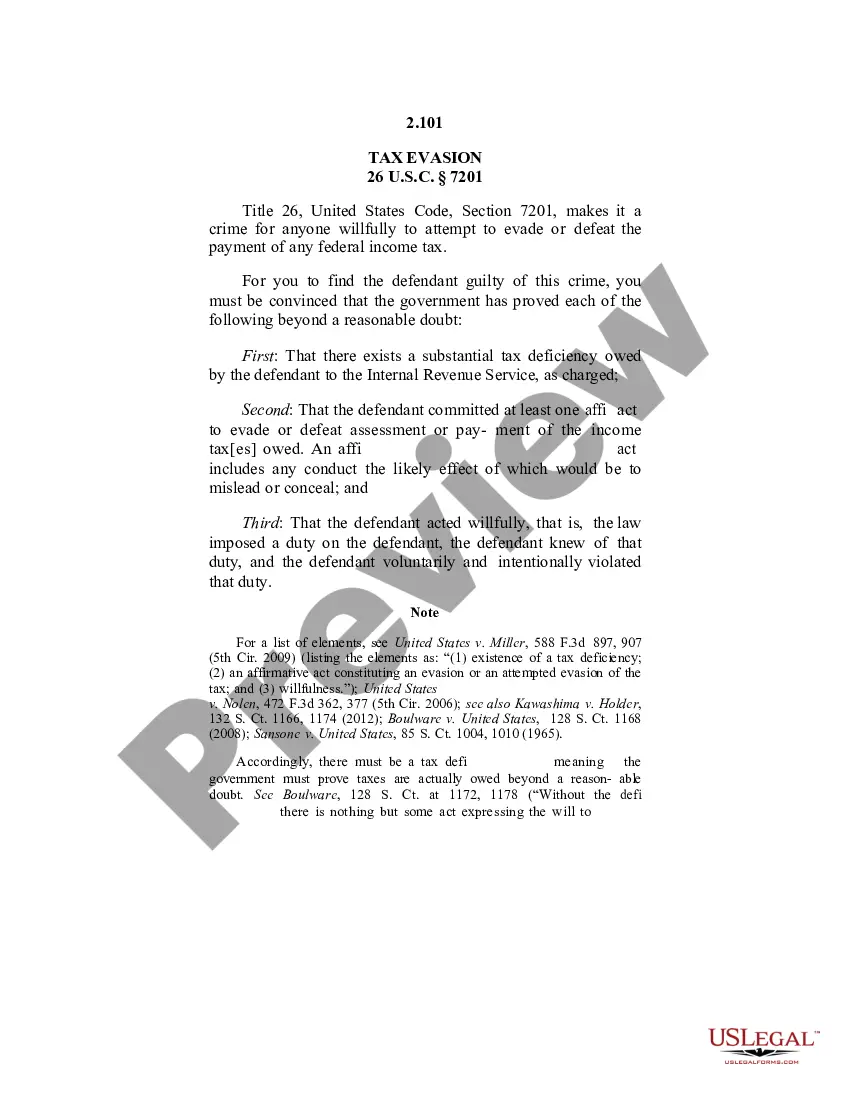
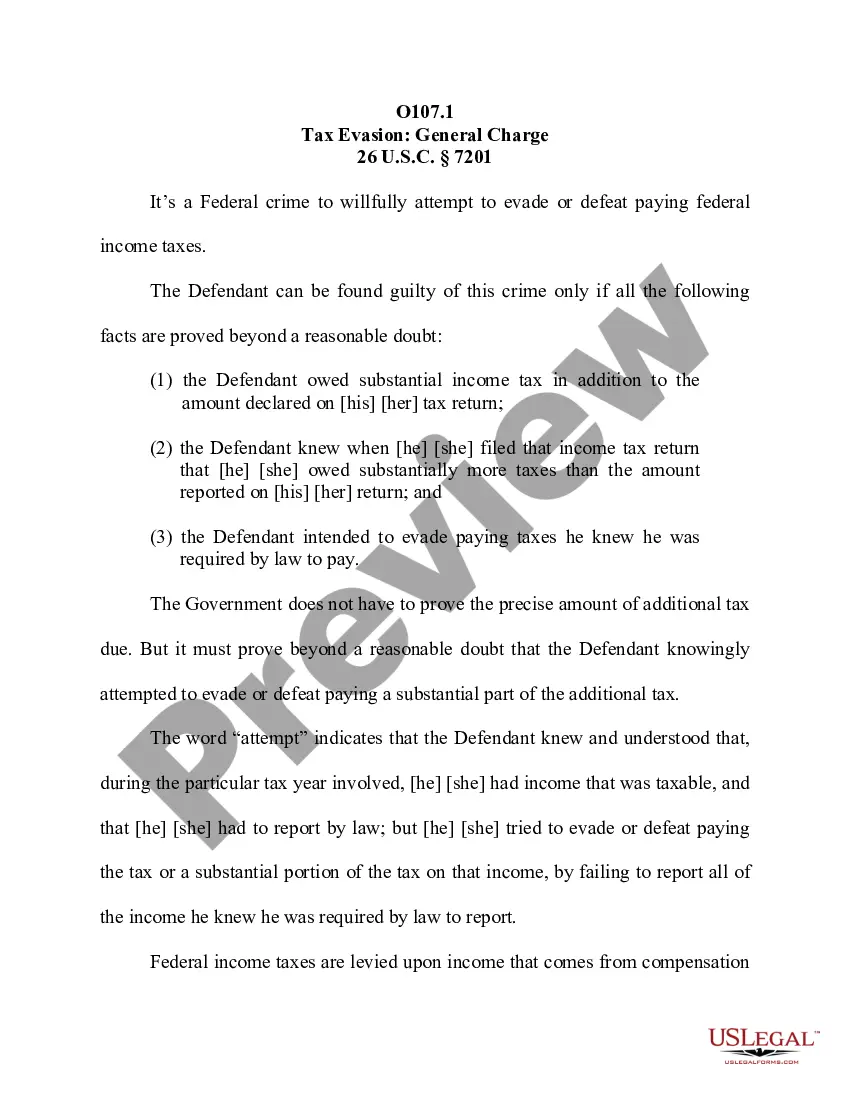
The Jury Instruction - Tax Evasion - General Charge form provides standardized jury instructions that can be used in cases of tax evasion under Section 7201 of the Internal Revenue Code. This form outlines the legal requirements necessary for establishing guilt in a tax evasion case, distinguishing it from other criminal instructions as it specifically caters to federal income tax evasion. It serves as a guide for judges and attorneys in framing the jury's understanding of the law regarding tax obligations and the implications of willfully attempting to evade these duties.
Form components explained
- Definition of tax evasion under 26 USC 7201.
- Elements required to prove guilt beyond a reasonable doubt.
- Explanation of what constitutes "knowingly" and "willfully" under the law.
- Specifications regarding taxable income and non-taxable sources.
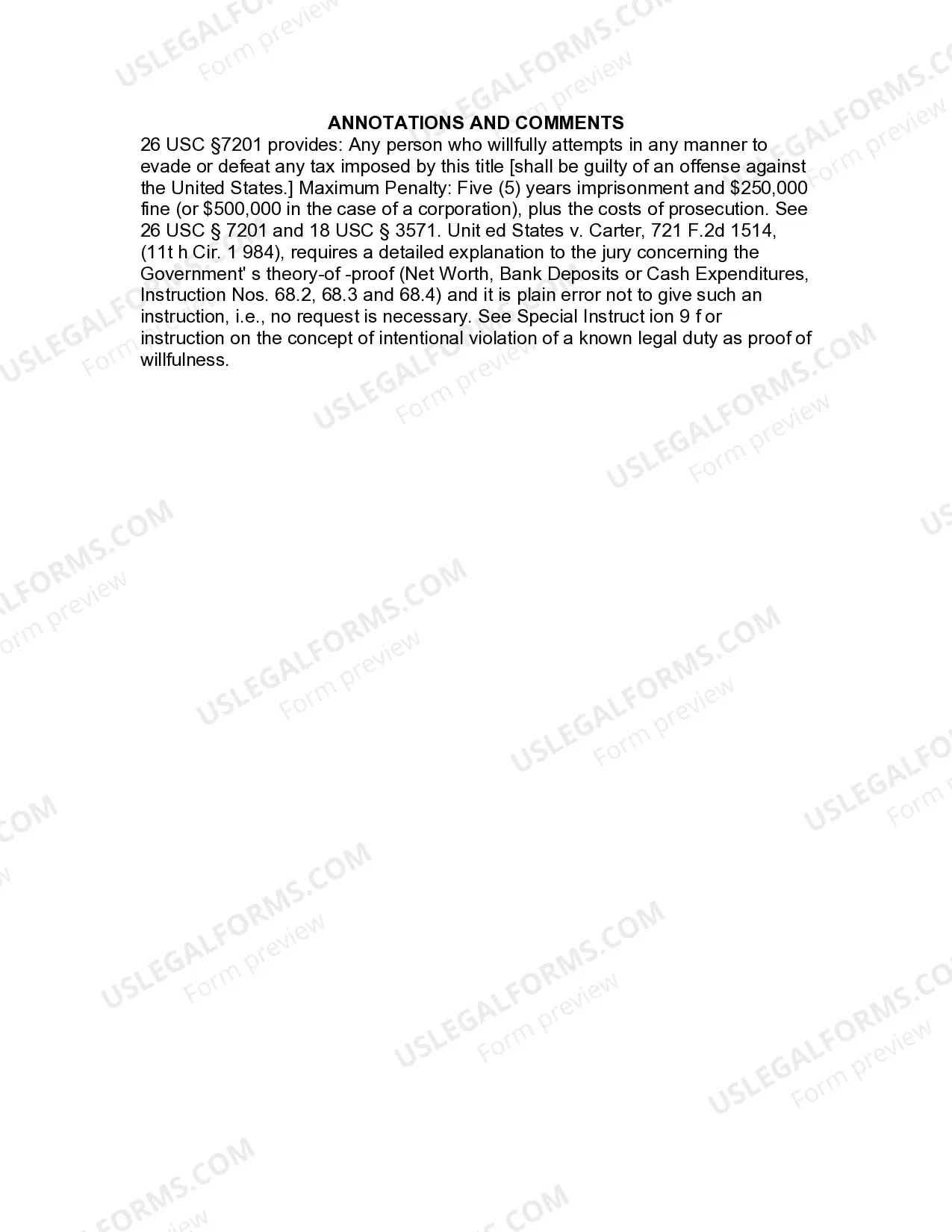
- Consequences associated with tax evasion, including potential penalties.
When to use this document
This form should be used during trials that involve tax evasion charges. It is particularly relevant when presenting jury instructions that clarify the charges against a defendant and outline the legal standards that must be met to prove tax evasion. The form is useful in ensuring that jurors understand their role in determining the defendant's guilt based on the specific legal criteria established by federal law.
Who this form is for
- Judges presiding over cases involving tax evasion charges.
- Prosecutors working to present their case to a jury.
- Defense attorneys aiming to ensure comprehensive jury instructions are provided to avoid misinterpretation of the law.
- Legal educators seeking a model for teaching about jury instructions in criminal cases.
How to prepare this document
- Review the relevant legal statutes regarding tax evasion, specifically 26 USC 7201.
- Customize the instruction to reflect the circumstances of your case, including specific facts about the defendant's alleged tax evasion.
- Ensure all elements of the crime as defined by law are clearly laid out for the jury.
- Include any necessary legal references or citations that support the jury instruction.
- Review the instructions for clarity and legal sufficiency before presenting them to the jury.
Does this document require notarization?
In most cases, this form does not require notarization. However, some jurisdictions or signing circumstances might. US Legal Forms offers online notarization powered by Notarize, accessible 24/7 for a quick, remote process.
Get your form ready online
Our built-in tools help you complete, sign, share, and store your documents in one place.
Make edits, fill in missing information, and update formatting in US Legal Forms—just like you would in MS Word.
Download a copy, print it, send it by email, or mail it via USPS—whatever works best for your next step.
Sign and collect signatures with our SignNow integration. Send to multiple recipients, set reminders, and more. Go Premium to unlock E-Sign.
If this form requires notarization, complete it online through a secure video call—no need to meet a notary in person or wait for an appointment.
We protect your documents and personal data by following strict security and privacy standards.

Make edits, fill in missing information, and update formatting in US Legal Forms—just like you would in MS Word.

Download a copy, print it, send it by email, or mail it via USPS—whatever works best for your next step.

Sign and collect signatures with our SignNow integration. Send to multiple recipients, set reminders, and more. Go Premium to unlock E-Sign.

If this form requires notarization, complete it online through a secure video call—no need to meet a notary in person or wait for an appointment.

We protect your documents and personal data by following strict security and privacy standards.
Typical mistakes to avoid
- Failing to clarify legal terms that may confuse jurors.
- Neglecting to adjust the instructions to accurately reflect the specifics of the case.
- Omitting critical elements required to prove willfulness in tax evasion.
- Assuming jurors understand complex tax law without adequate explanation.
Advantages of online completion
- Convenience of downloading immediately for immediate use in legal proceedings.
- Editability allows for customization to fit particular case needs.
- Reliability of a document drafted by licensed attorneys with expertise in tax law.
Legal use & context
- Jury instructions are critical for ensuring a fair trial in criminal cases.
- The instructions must clearly articulate the legal standards required for conviction.
- Failure to provide appropriate jury instructions can lead to appeals and retrials.
What to keep in mind
- This form provides essential jury instructions for tax evasion cases based on federal law.
- Understanding the elements of the crime is crucial for jurors to make informed decisions.
- Customization of instructions is necessary to convey the specifics of each case accurately.
Looking for another form?









Form popularity
FAQ
Tax evasion in California is punishable by up to one year in county jail or state prison, as well as fines of up to $20,000. The state can also require you to pay your back taxes, and it will place a lien on your property as a security until you pay. If you cannot pay what you owe, the state will seize your property.
In Australia, you can go to jail for lodging incorrect tax returns or incorrect business activity statements with the Australian Taxation Office (ATO). Tax fraud is a serious criminal offence that carries a maximum penalty of 10 years imprisonment.
What's the maximum penalty for tax evasion in the UK? The penalty for tax evasion can be anything up to 200% of the tax due and can even result in jail time. For example, evasion of income tax can result in 6 months in prison or a fine up to £5,000, with a maximum sentence of seven years or an unlimited fine.
Fines. Fines for violating federal tax laws are very steep. A conviction for tax evasion, as well as several other tax crimes, can result in a fine of up to $250,000 for individuals and $500,000 for corporations. Other tax fraud crimes have maximum penalties of $100,000 for individuals and $250,000 for corporations.
Any person who willfully attempts in any manner to evade or defeat any tax imposed by this title or the payment thereof shall, in addition to other penalties provided by law, be guilty of a felony and, upon conviction thereof, shall be fined not more than $100,000 ($500,000 in the case of a corporation), or imprisoned
If you commit tax evasion or tax fraud, the IRS can prosecute you and send you to jail. Generally, most tax crimes carry a maximum five-year prison term and a fine of $100,000. The same conduct which constitutes criminal tax fraud may also be considered civil tax fraud.
Attempt to evade or defeat paying taxes: Upon conviction, the taxpayer is guilty of a felony and is subject to other penalties allowed by law, in addition to (1) imprisonment for no more than 5 years, (2) a fine of not more than $250,000 for individuals or $500,000 for corporations, or (3) both penalties, plus the cost
You cannot go to jail for making a mistake or filing your tax return incorrectly. However, if your taxes are wrong by design and you intentionally leave off items that should be included, the IRS can look at that action as fraudulent, and a criminal suit can be instituted against you.