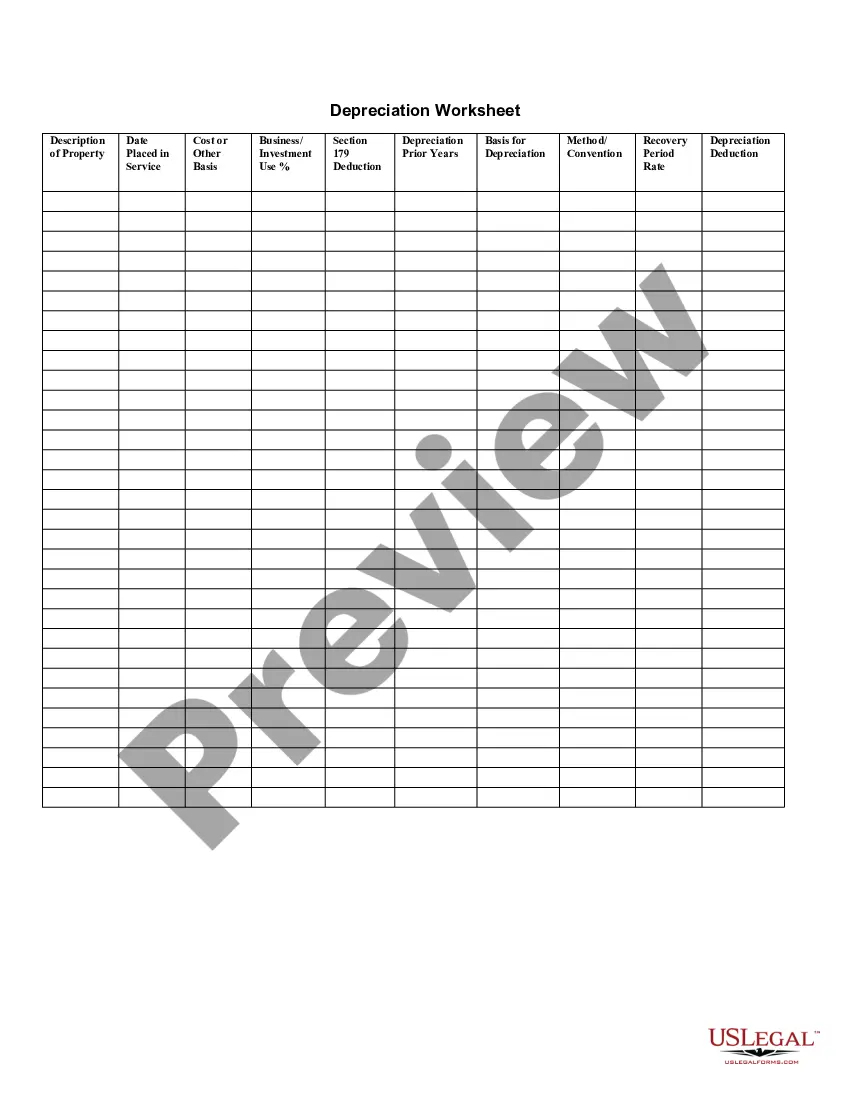
Depreciation Worksheet
Overview of this form
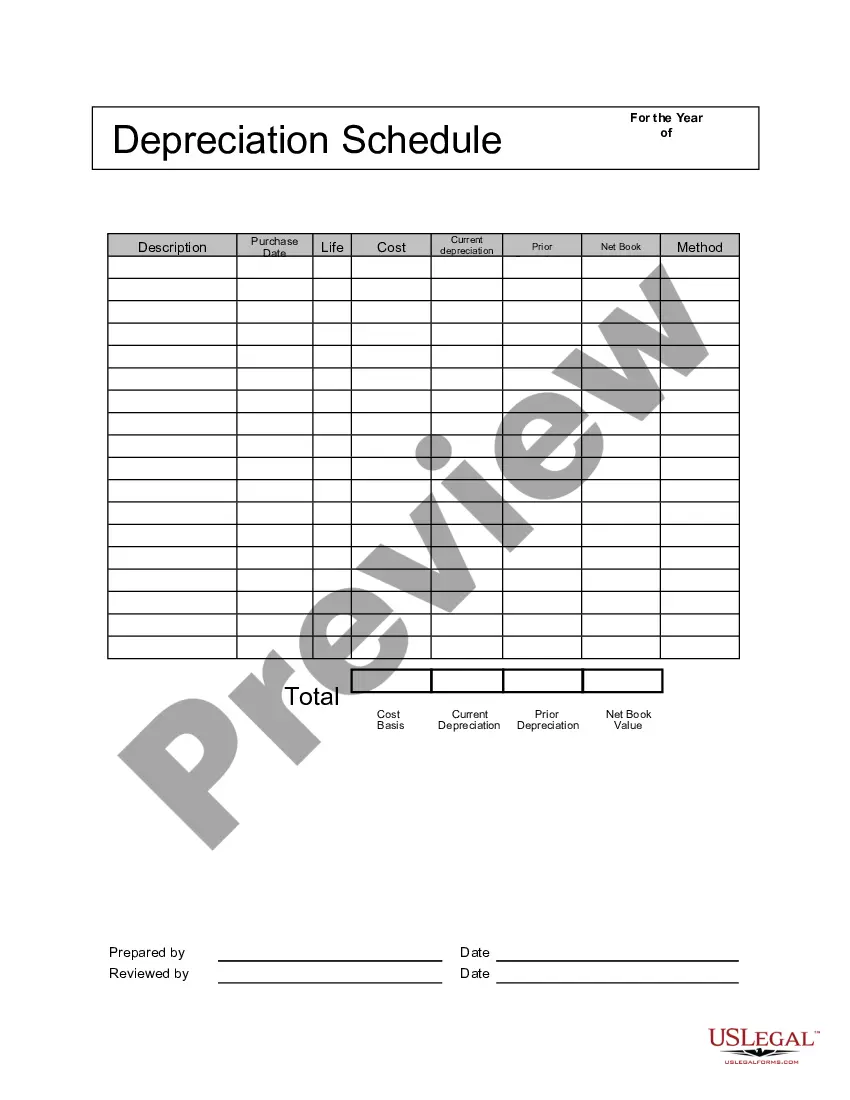
The Depreciation Worksheet is a vital tool for companies assessing their depreciation expenses. This form assists businesses in organizing and documenting their depreciation calculations effectively, allowing for customization to fit specific needs. By using this worksheet, companies can maintain accurate financial records and comply with financial reporting standards, which differs from simpler forms that may not provide the same level of detail.
Main sections of this form
- Description of Property
- Date Placed in Service
- Cost or Other Basis
- Business/Investment Use
- Section 179 Deduction
- Depreciation Prior Years
- Basis for Depreciation Method/Convention
- Recovery Period
- Rate
- Depreciation Deduction
Common use cases
This worksheet is essential when a business needs to track and calculate the depreciation of its assets accurately. It is particularly useful during tax preparation, financial audits, or when assessing asset performance over time. The form can also aid in making informed decisions regarding capital expenditures.
Who can use this document
- Small business owners managing multiple assets
- Accountants preparing financial reports
- Financial analysts reviewing asset values
- Anyone involved in tax preparation and compliance
How to complete this form
- Identify the property for which you are calculating depreciation.
- Enter the date the property was placed in service.
- Specify the cost or other basis for the property.
- Indicate the business or investment use percentage.
- Complete the section for any applicable Section 179 deduction.
- Fill in prior years' depreciation and the basis for your chosen depreciation method or convention.
Is notarization required?
In most cases, this form does not require notarization. However, some jurisdictions or signing circumstances might. US Legal Forms offers online notarization powered by Notarize, accessible 24/7 for a quick, remote process.
Get your form ready online
Our built-in tools help you complete, sign, share, and store your documents in one place.
Make edits, fill in missing information, and update formatting in US Legal Forms—just like you would in MS Word.
Download a copy, print it, send it by email, or mail it via USPS—whatever works best for your next step.
Sign and collect signatures with our SignNow integration. Send to multiple recipients, set reminders, and more. Go Premium to unlock E-Sign.
If this form requires notarization, complete it online through a secure video call—no need to meet a notary in person or wait for an appointment.
We protect your documents and personal data by following strict security and privacy standards.

Make edits, fill in missing information, and update formatting in US Legal Forms—just like you would in MS Word.

Download a copy, print it, send it by email, or mail it via USPS—whatever works best for your next step.

Sign and collect signatures with our SignNow integration. Send to multiple recipients, set reminders, and more. Go Premium to unlock E-Sign.

If this form requires notarization, complete it online through a secure video call—no need to meet a notary in person or wait for an appointment.

We protect your documents and personal data by following strict security and privacy standards.
Avoid these common issues
- Not updating the worksheet each year with current depreciation amounts.
- Failing to enter the correct date placed in service.
- Choosing the wrong depreciation method without fully understanding the implications.
- Overlooking a Section 179 deduction when eligible.
Benefits of using this form online
- Convenient access to the form from anywhere at any time.
- Editable fields allow for quick updates and calculations.
- Reliable templates drafted by licensed attorneys ensure compliance with legal standards.
- Instant download and printing capabilities streamline the process.
Legal use & context
The Depreciation Worksheet is legally recognized as an effective tool for tracking asset depreciation in financial reporting and tax compliance. However, users must ensure that the chosen depreciation methods adhere to IRS guidelines and corresponding state laws, where applicable.
Summary of main points
- The Depreciation Worksheet is essential for tracking depreciation expenses.
- Understanding when and how to use this form ensures accurate financial reporting.
- Completing this worksheet effectively can lead to tax benefits and compliance.
Looking for another form?
Form popularity
FAQ
5-year property automobiles, computers. 7-year property office furniture, agricultural machinery. 10-year property boats, fruit trees. 15-year property restaurants, gas stations.
Subtract the asset's salvage value from its cost to determine the amount that can be depreciated. Divide this amount by the number of years in the asset's useful lifespan. Divide by 12 to tell you the monthly depreciation for the asset.
Depreciation is an accounting method of allocating the cost of a tangible or physical asset over its useful life or life expectancy. Depreciation represents how much of an asset's value has been used up.
Straight-Line Depreciation. Declining Balance Depreciation. Sum-of-the-Years' Digits Depreciation. Units of Production Depreciation.
In this way, you can see at a glance exactly how much depreciation you've claimed for that asset over the years, and you'll know when the asset is fully depreciated so that no more deductions can be claimed.
The straight-line method is the simplest and most commonly used way to calculate depreciation under generally accepted accounting principles. Subtract the salvage value from the asset's purchase price, then divide that figure by the projected useful life of the asset.
Straight Line Depreciation Method. Diminishing Balance Method. Sum of Years' Digits Method. Double Declining Balance Method. Sinking Fund Method. Annuity Method. Insurance Policy Method. Discounted Cash Flow Method.
Straight Line Method: This method assumes that depreciation is a function of time rather than use. Diminishing Balance Method: Under this method, a fixed percentage is applied to book value of the assets (cost of assets). Unit of Production Method: Annuity Method: Sinking Fund Method:
Straight-Line Depreciation. Declining Balance Depreciation. Sum-of-the-Years' Digits Depreciation. Units of Production Depreciation.