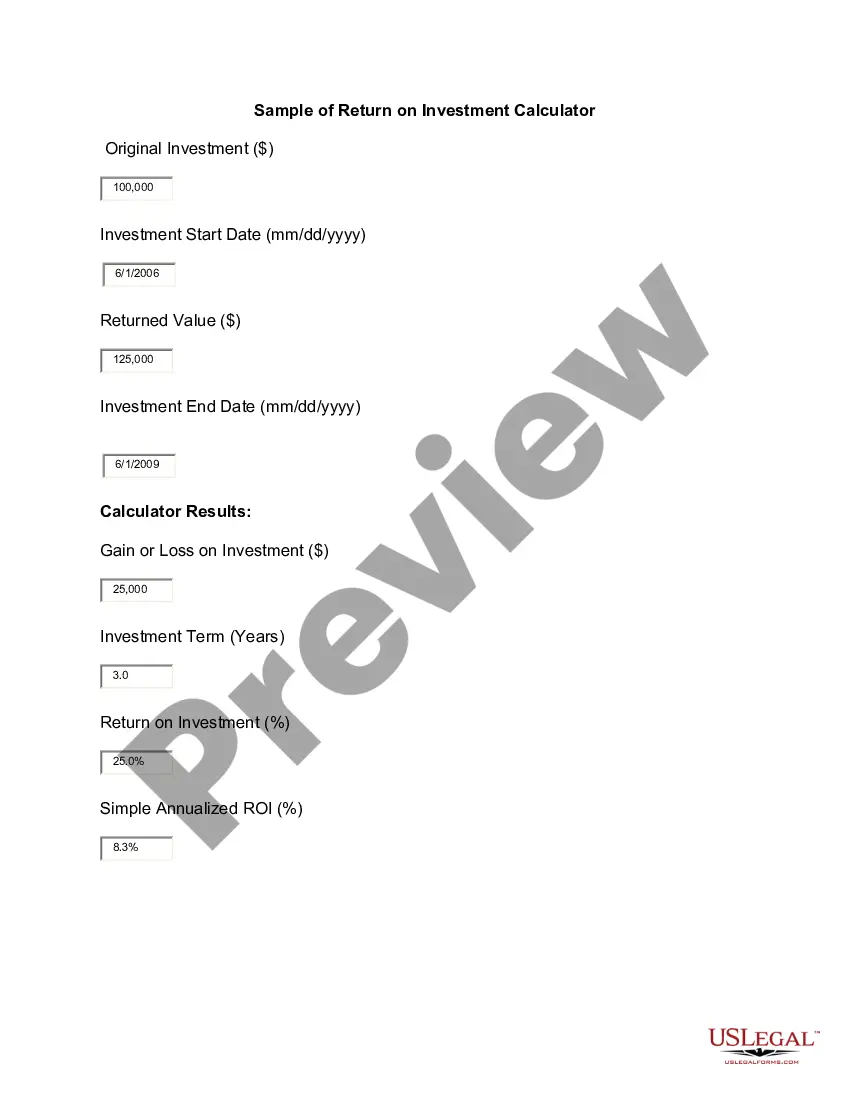
Sample of Return on Investment Calculator - ROI
Overview of this form
A return on investment (ROI) calculator is a tool used to determine the gain or loss on an investment. It calculates both the overall ROI and the annualized ROI, providing insights into the profitability of investments over time. This calculator is distinct from other financial calculators by focusing specifically on returns from investments, simplifying complex financial assessments into clear results.
What’s included in this form
- Original investment amount: The initial amount of money invested.
- Investment start date: The date when the investment was made.
- Returned value: The current or projected value of the investment at the end of the term.
- Investment end date: The date when the investment is expected to mature or be evaluated.
- Gain or loss on investment: The net profit or loss calculated from the investment.
- Investment term (years): The total duration of the investment in years.
- Return on investment percentage: The overall percentage gain or loss calculated.
- Simple annualized ROI: The annualized return expressed as a percentage.
When this form is needed
This calculator is useful when you want to assess the performance of an investment, whether it's stocks, bonds, real estate, or other assets. It's particularly beneficial when making investment decisions, such as determining if you should hold, sell, or reinvest your funds. Investors can also use it to compare multiple investment opportunities to find the most profitable option.
Who this form is for
- Individual investors looking to assess their portfolio performance.
- Financial analysts conducting investment feasibility studies.
- Business owners evaluating the return on capital investments.
- Students or professionals studying finance or investment strategies.
- Anyone interested in understanding the profitability of various investment options.
How to complete this form
- Input the original investment amount in the designated field.
- Enter the investment start date in the format mm/dd/yyyy.
- Provide the returned value of the investment, indicating its current or projected worth.
- Specify the investment end date in the format mm/dd/yyyy.
- Calculate the results to see the gain or loss on the investment and the total ROI.
- Review the calculated annualized ROI for a clearer annual profit perspective.
Does this form need to be notarized?
Notarization is not commonly needed for this form. However, certain documents or local rules may make it necessary. Our notarization service, powered by Notarize, allows you to finalize it securely online anytime, day or night.
Get your form ready online
Our built-in tools help you complete, sign, share, and store your documents in one place.
Make edits, fill in missing information, and update formatting in US Legal Forms—just like you would in MS Word.
Download a copy, print it, send it by email, or mail it via USPS—whatever works best for your next step.
Sign and collect signatures with our SignNow integration. Send to multiple recipients, set reminders, and more. Go Premium to unlock E-Sign.
If this form requires notarization, complete it online through a secure video call—no need to meet a notary in person or wait for an appointment.
We protect your documents and personal data by following strict security and privacy standards.

Make edits, fill in missing information, and update formatting in US Legal Forms—just like you would in MS Word.

Download a copy, print it, send it by email, or mail it via USPS—whatever works best for your next step.

Sign and collect signatures with our SignNow integration. Send to multiple recipients, set reminders, and more. Go Premium to unlock E-Sign.

If this form requires notarization, complete it online through a secure video call—no need to meet a notary in person or wait for an appointment.

We protect your documents and personal data by following strict security and privacy standards.
Common mistakes to avoid
- Entering incorrect dates, which can affect the overall calculations.
- Forgetting to include any additional costs related to the investment, such as fees.
- Misunderstanding the difference between overall ROI and annualized ROI.
- Failing to update the returned value, especially if the investment has appreciated significantly.
Benefits of using this form online
- Convenience of calculating ROI from anywhere without the need for complex software.
- Editability allows for adjustments as your investment situation changes.
- Reliable results derived from standardized calculations, ensuring accuracy.
- Instant access to calculations provides quick feedback for your investment decisions.
Quick recap
- The ROI Calculator helps assess financial performance and investment viability.
- Accurate input of dates and amounts is crucial for reliable results.
- This tool can benefit a wide range of users, from individual investors to business professionals.
Looking for another form?







Form popularity
FAQ
ROI is calculated by subtracting the initial value of the investment from the final value of the investment (which equals the net return), then dividing this new number (the net return) by the cost of the investment, and, finally, multiplying it by 100.
Most people would agree that, over time, an average annual return of 5 to 12 percent on your passive investment dollars is good, and anything higher than 12 percent is excellent.
Return on investment (ROI) is a profitability ratio that measures how well your investments perform.For example, if you had a net revenue of $30,000 and your investment cost you $20,000, your ROI is 0.5 (or 50%). ROI = (gain from investment cost of investment) / cost of investment. You write ROI as a percentage.
The basic formula for ROI is: ROI = Net Profit / Total Investment 100. Keep in mind that if you have a net loss on your investment, the ROI will be negative. Shareholders can evaluate the ROI of their stock holding by using this formula: ROI = (Net Income + (Current Value - Original Value)) / Original Value 100.
The most commonly used ROI formula is net profits divided by the total cost of the investment.Because ROI is most often expressed as a percentage, the quotient should be converted to a percentage by multiplying it by 100. So this particular investment's ROI is 2 multiplied by 100, or 200%.
Return on investment (ROI) is a calculation that shows how an investment or asset has performed over a certain period. It expresses gain or loss in percentage terms. The formula for calculating ROI is simple: (Current Value - Beginning Value) / Beginning Value = ROI.
A ROI figure of 30% from one store looks better than one of 20% from another for example. The 30% though may be over three years as opposed to the 20% from just the one, thus the one year investment obviously is the better option.
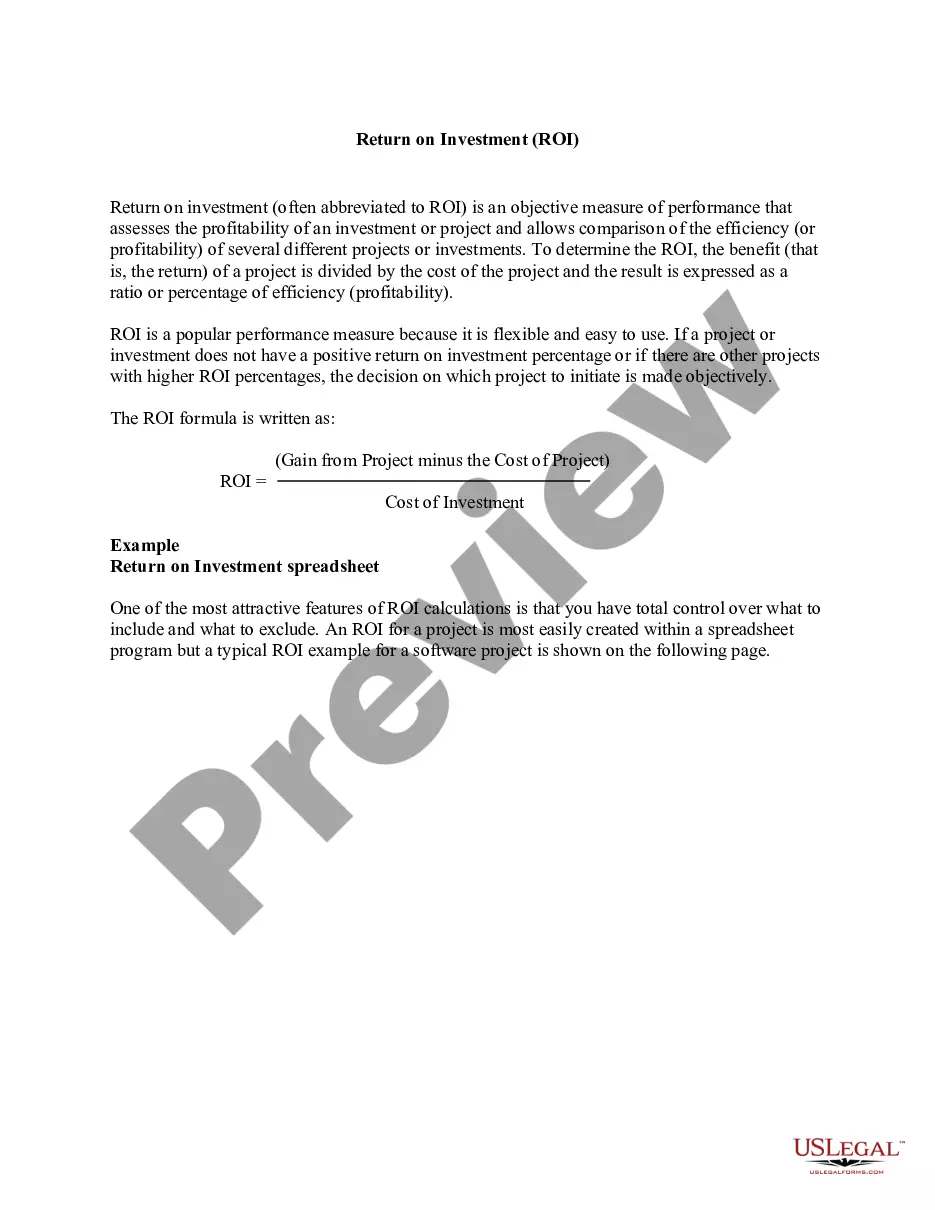
Let's break this down very simply beginning with ROI. The formula for ROI is gain from investment minus cost of investment then divided by the cost of investment and multiplied by 100. This calculation is incredibly simple and gives a good idea of the gain made on the investment in terms of a percentage.