Solar Easement
What this document covers
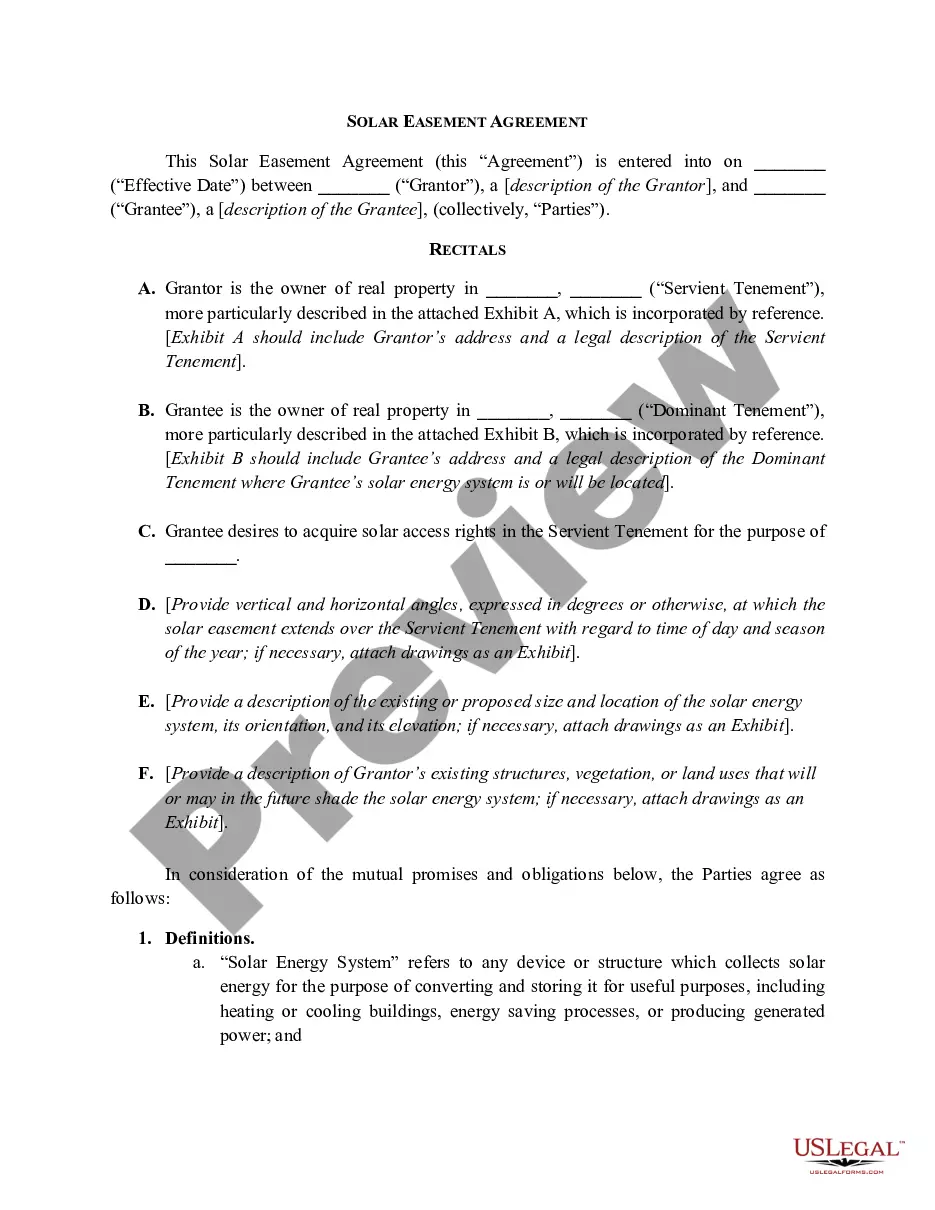
The Solar Easement Agreement is a legal document that allows one property owner to grant another the right to access sunlight over their property for the purpose of maintaining a solar energy system. This form distinguishes itself by specifically addressing the rights to light necessary for solar applications without transferring ownership or possession of the land itself. It is essential for property owners engaged in solar energy projects who need to ensure unobstructed solar access for their systems.
What’s included in this form
- Identification of the Parties: Details of the Grantor and Grantee involved in the agreement.
- Recitals: Descriptions of the properties involved and the purpose of the easement.
- Definitions: Clarification of terms such as "Solar Energy System" and "Solar Property."
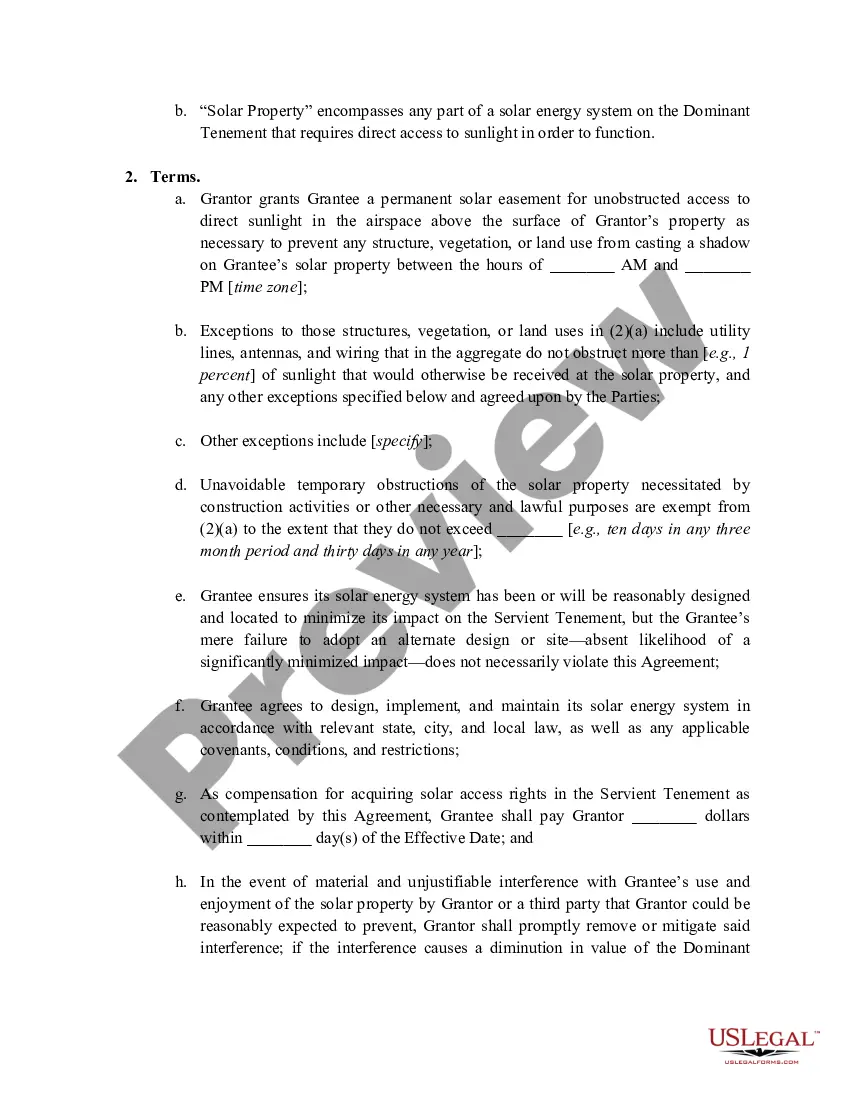
- Terms of the Easement: Specifications on the solar access rights granted and limitations.
- Compensation: Payment terms for the rights conveyed.
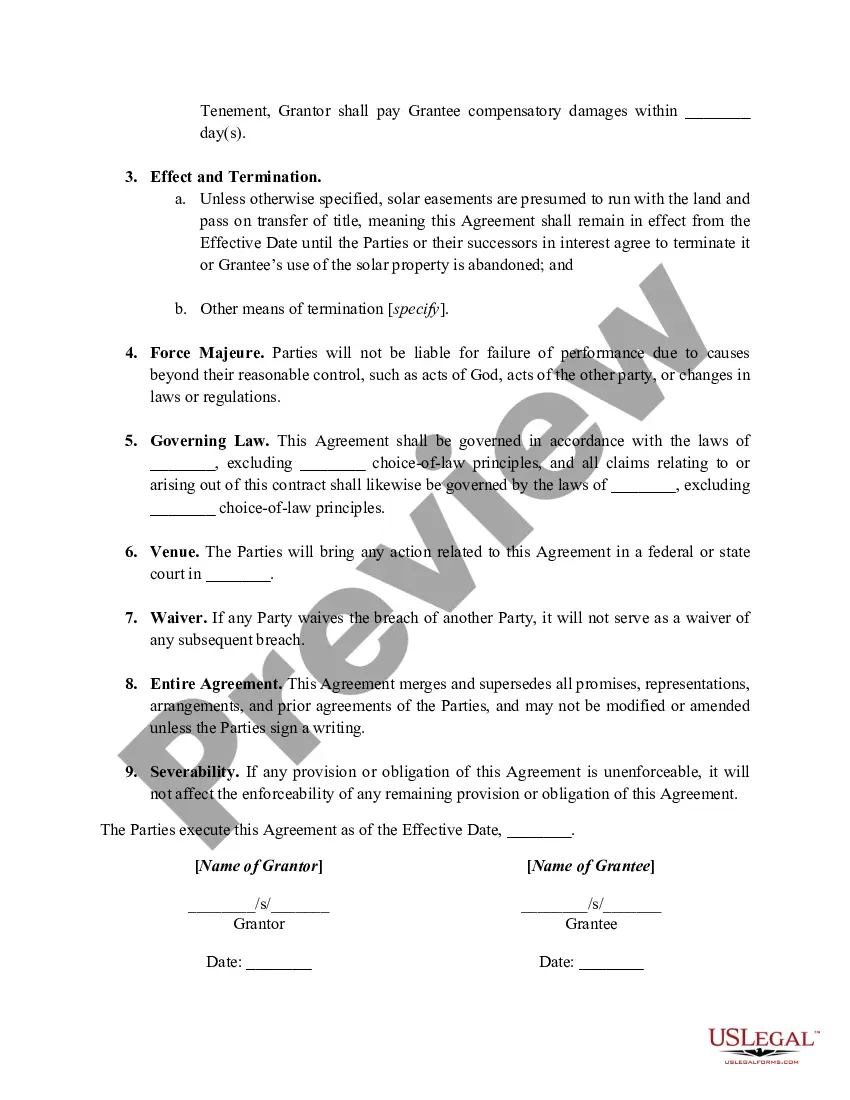
- Termination Conditions: Provisions about how and when the easement can be terminated.
When to use this document
This Solar Easement Agreement should be used when an individual or entity wishes to secure the right to access sunlight for a solar energy system situated on their property. It is particularly valuable in scenarios where existing structures, vegetation, or future developments may obstruct solar access. If you are planning to install or are currently using solar panels and need to ensure your access to sunlight is protected, this agreement is vital.
Who can use this document
- Property owners who are planning to install solar energy systems.
- Individuals or organizations seeking to protect their solar access rights.
- Landowners wanting to facilitate the installation of renewable energy on adjacent properties.
- Developers involved in solar projects needing to formalize easement agreements.
Completing this form step by step
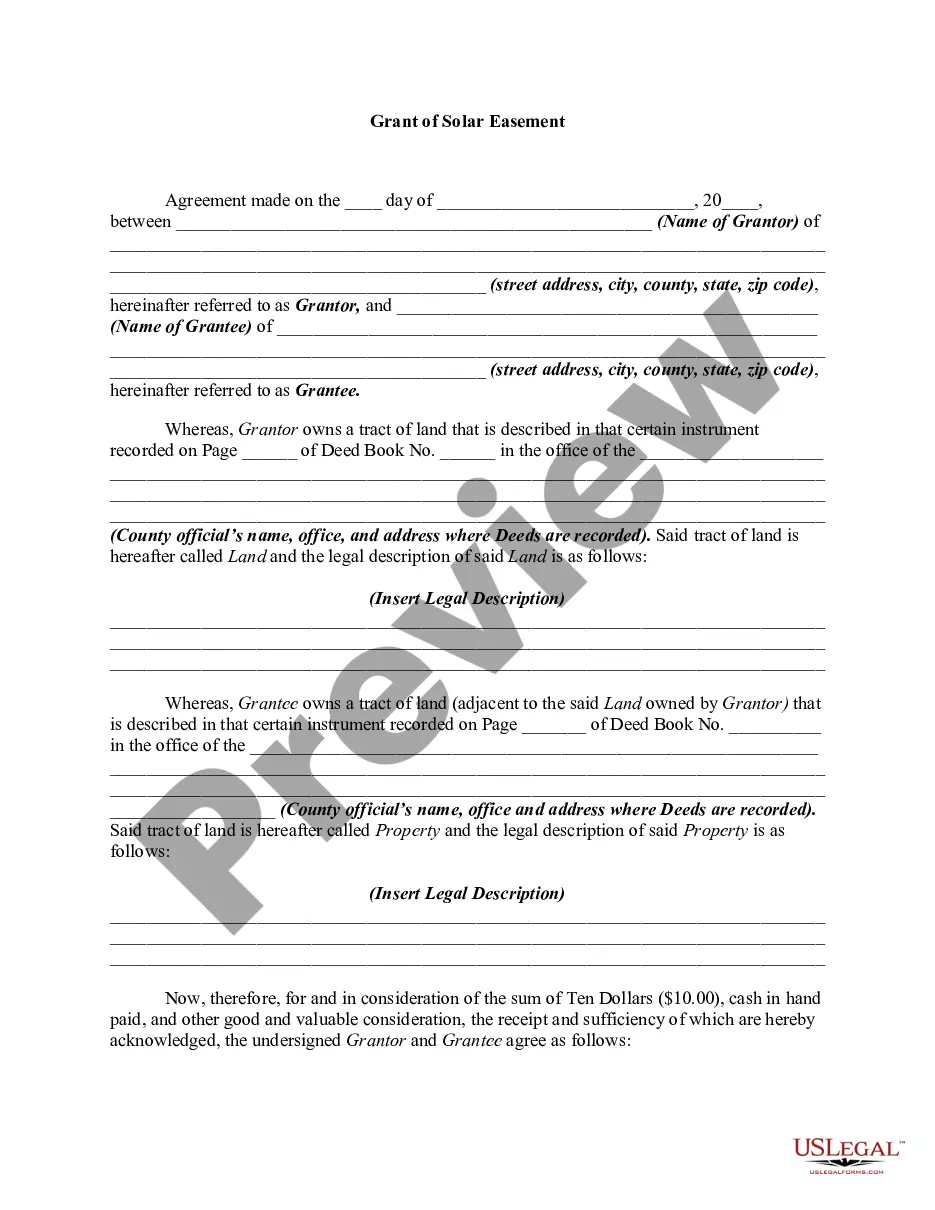
- Identify the parties: Fill in the names of the Grantor and Grantee along with their addresses.
- Specify the properties: Provide the legal descriptions of both the Servient Tenement and Dominant Tenement.
- Detail the solar access provisions: Outline the angles of sunlight access and any exceptions for shading.
- Provide compensation information: Enter the agreed payment amount and terms.
- Review and sign: Ensure both parties sign the agreement, noting the dates.
Notarization guidance
This form does not typically require notarization unless specified by local law. Always verify with your local regulations to ensure compliance with any notarization requirements.
Get your form ready online
Our built-in tools help you complete, sign, share, and store your documents in one place.
Make edits, fill in missing information, and update formatting in US Legal Forms—just like you would in MS Word.
Download a copy, print it, send it by email, or mail it via USPS—whatever works best for your next step.
Sign and collect signatures with our SignNow integration. Send to multiple recipients, set reminders, and more. Go Premium to unlock E-Sign.
If this form requires notarization, complete it online through a secure video call—no need to meet a notary in person or wait for an appointment.
We protect your documents and personal data by following strict security and privacy standards.

Make edits, fill in missing information, and update formatting in US Legal Forms—just like you would in MS Word.

Download a copy, print it, send it by email, or mail it via USPS—whatever works best for your next step.

Sign and collect signatures with our SignNow integration. Send to multiple recipients, set reminders, and more. Go Premium to unlock E-Sign.

If this form requires notarization, complete it online through a secure video call—no need to meet a notary in person or wait for an appointment.

We protect your documents and personal data by following strict security and privacy standards.
Common mistakes
- Failing to include precise property descriptions, which can lead to confusion.
- Not specifying the times of day and angles for solar access.
- Overlooking the need for both parties to sign and date the agreement.
- Neglecting to review local regulations that might affect the easement.
Why complete this form online
- Convenience of downloading the form instantly from anywhere, at any time.
- Ability to fill out and customize the document to meet specific needs easily.
- Access to professionally drafted templates created by licensed attorneys, ensuring legal compliance.
- Secure storage and backup of your forms for future reference.
Looking for another form?
Form popularity
FAQ
use easement is a right or interest in land held by a local government that restricts use of the land to photovoltaic solar energy facilities and other incidental or subordinate agricultural uses, openspace uses, or other alternative renewable energy facilities.
You can even benefit from rooftop solar energy in NJ if you own a townhouse complex, convertible home, or garden apartment. To help you get started, read on to learn how to get solar panels for condominiums or apartments in New Jersey.
The answer is no, an HOA can't restrict or deny solar panels in California. The state does permit HOAs to set parameters within reason on solar panel installations.
This update is called NEM 3.0, and it's set to replace NEM 2.0 on April 14, 2023. California's new NEM policy will see customers of major utility companies receive 75% less for the electricity they send back to the grid compared to the average amount of the current model.
The decision by the California Public Utilities Commission (CPUC) will make it much more expensive to get rooftop solar starting in mid-April 2023. The decision mostly affects those who do not yet have solar, but can affect existing solar users under certain circumstances as well.
OVERVIEW OF THE ACT The Act creates a legal framework for solar access. It includes limited protections to allow consumers access to sunlight and to limit the ability of HOAs and local governments from preventing the installation of solar energy systems.
New Jersey was one of the first states to pass a law (P.L. 2007, c. 153) that protects homeowners' right to go solar from HOA interference. The law is clear that your community association cannot completely deny your ability to a solar system.
Shall not exceed 12 feet in height and must maintain a minimum 3 foot setback from the property line.