Return on Investment
Overview of this form
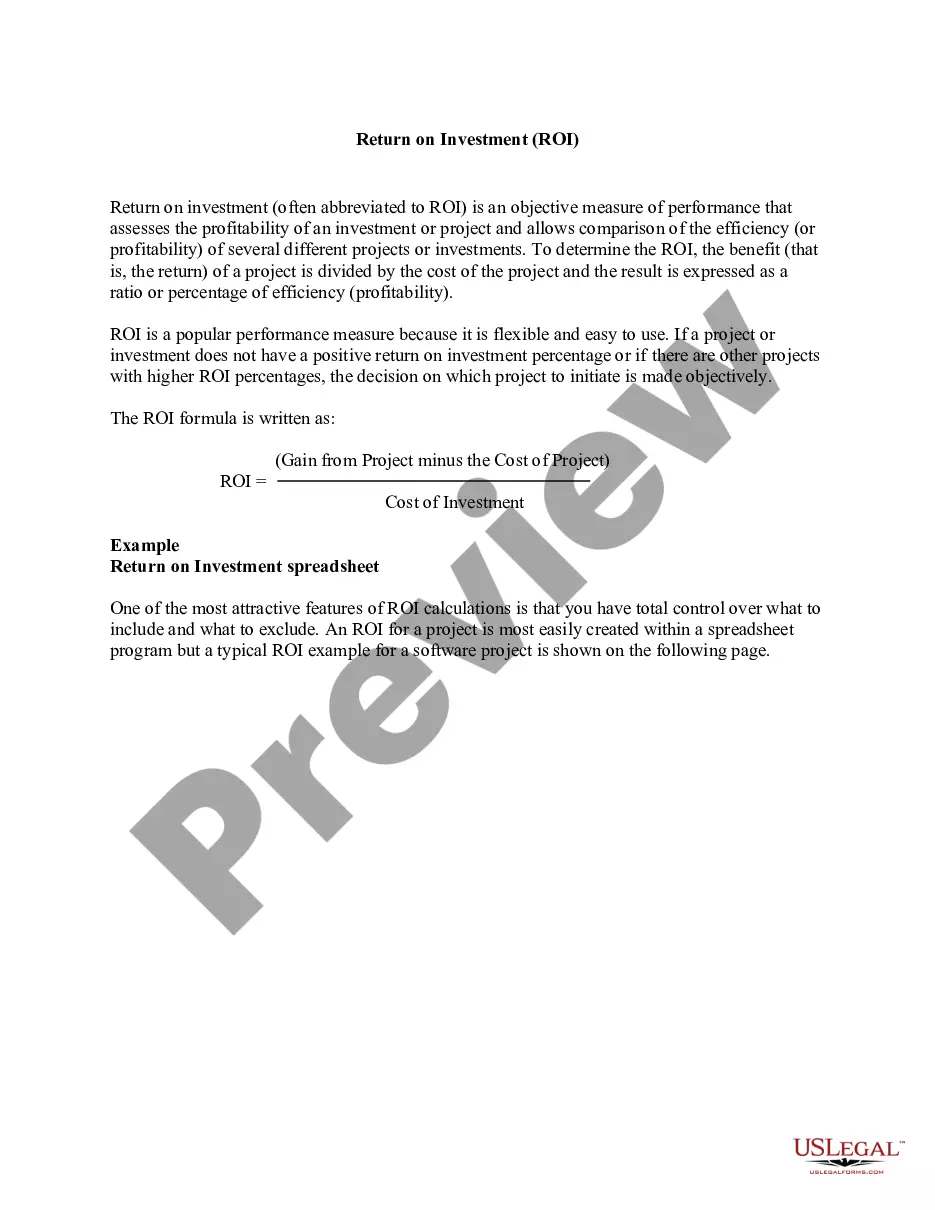
The Return on Investment (ROI) form is a financial tool used to evaluate the profitability and efficiency of various investments or projects. It provides a straightforward method to measure and compare the returns of different endeavors. Unlike other financial assessments, the ROI focuses on the ratio of return versus cost, allowing investors to make data-driven decisions about where to allocate resources.
What’s included in this form
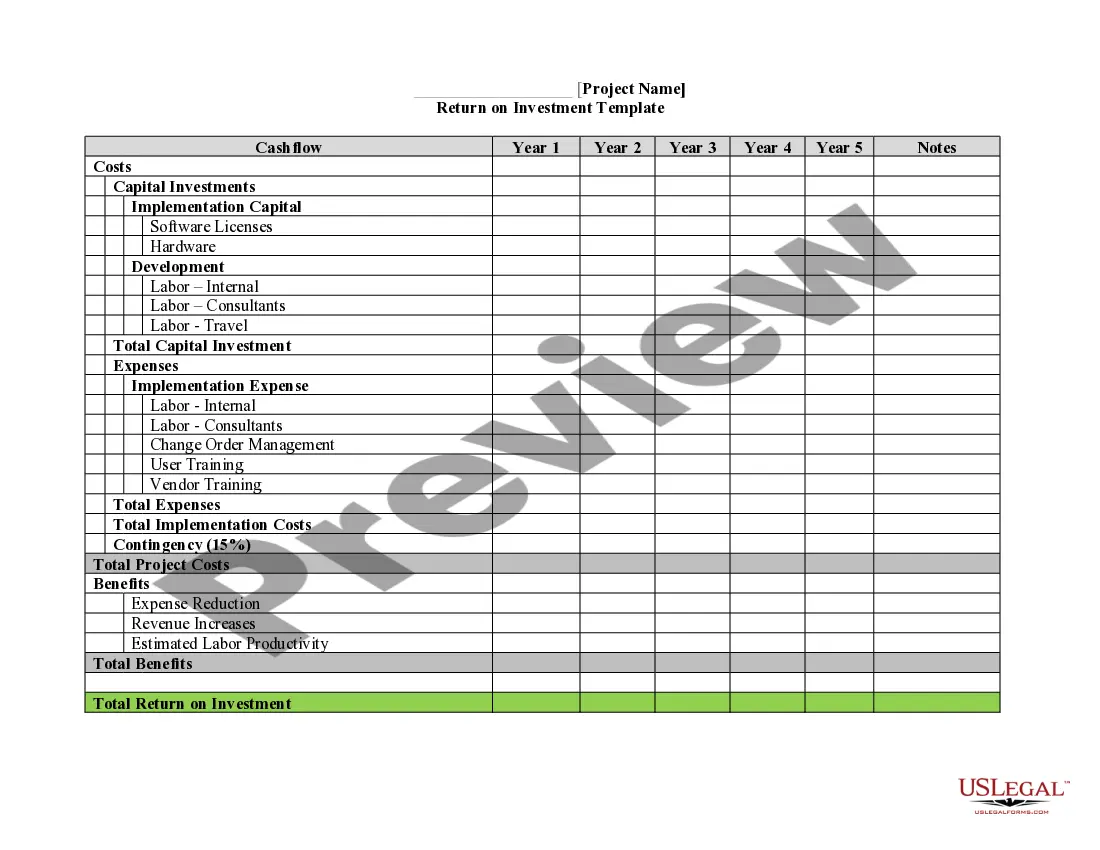
- Project name: Identifies the specific investment or project being analyzed.
- Cost analysis: Calculates all capital investments, including software, hardware, and labor costs.
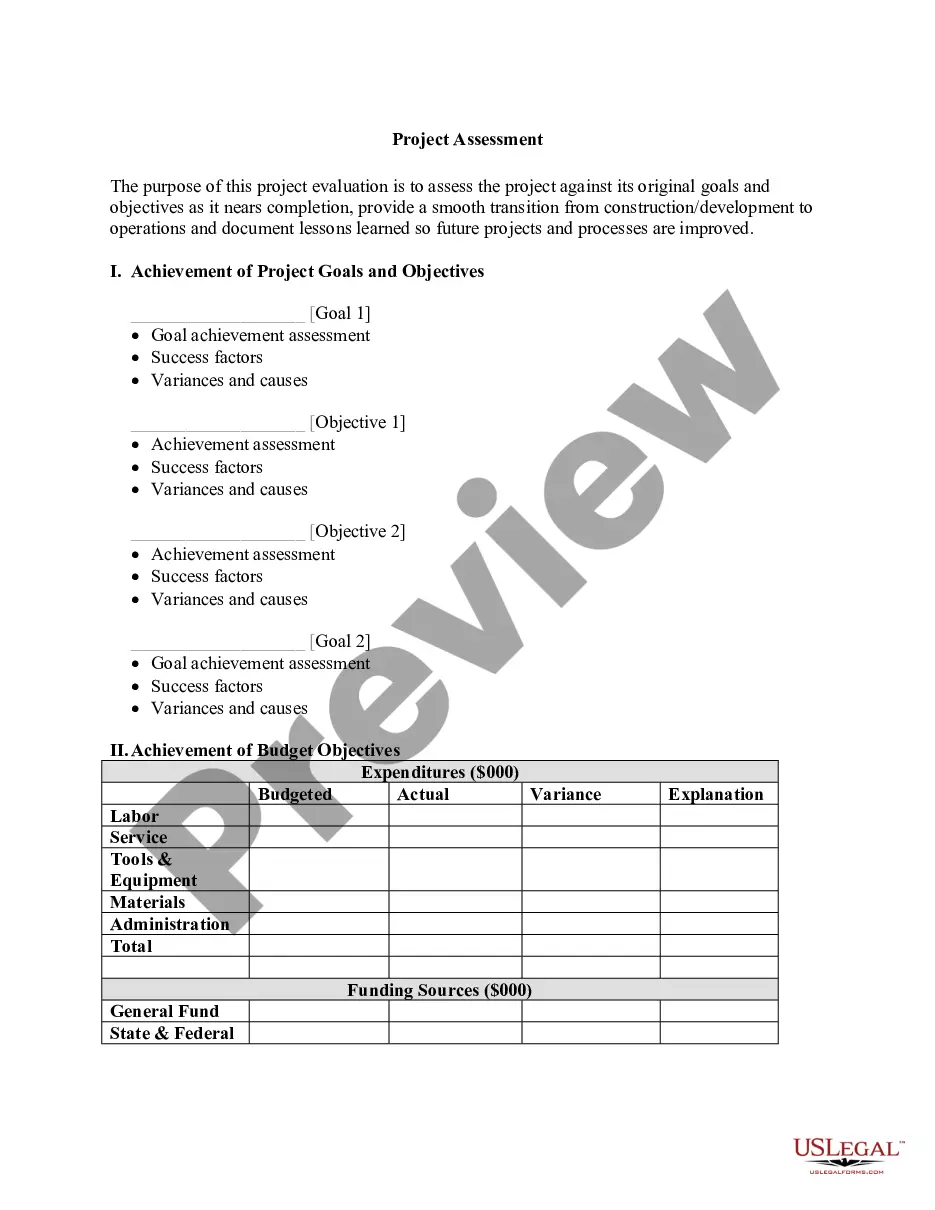
- Expense tracking: Records all expenses related to the project, such as implementation and training costs.
- Benefit estimation: Outlines expected benefits, including expense reductions and increased revenue.
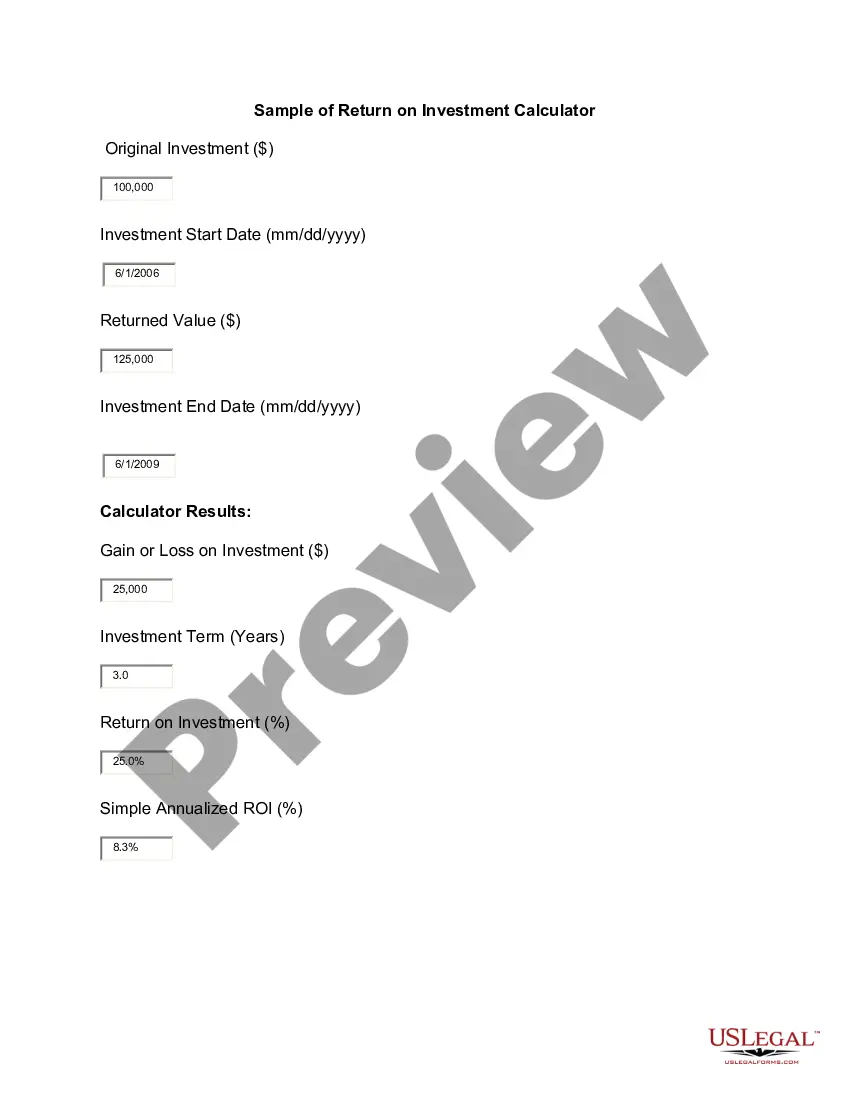
- ROI calculation: Uses the formula to determine the overall return on investment, expressed as a percentage.

Situations where this form applies
The ROI form is useful when assessing the potential success of a project or investment. It is commonly used in scenarios such as deciding whether to launch a new product, invest in technology, or undertake a marketing campaign. By calculating ROI, businesses can identify which projects will yield the most profitable returns and make informed decisions.
Who should use this form
- Investors looking to evaluate the potential return on different investments.
- Business owners assessing the feasibility of new projects.
- Financial analysts conducting performance evaluations on various initiatives.
- Project managers who need to present justifications for resource allocation.
Steps to complete this form
- Identify the project or investment title at the top of the form.
- List all costs associated with the project, including capital investments and expenses.
- Estimate the benefits expected from the project in terms of cost savings or revenue increases.
- Apply the ROI formula to calculate the return based on your inputs.
- Review the information for accuracy and completeness.
Is notarization required?
This form usually doesn’t need to be notarized. However, local laws or specific transactions may require it. Our online notarization service, powered by Notarize, lets you complete it remotely through a secure video session, available 24/7.
Get your form ready online
Our built-in tools help you complete, sign, share, and store your documents in one place.
Make edits, fill in missing information, and update formatting in US Legal Forms—just like you would in MS Word.
Download a copy, print it, send it by email, or mail it via USPS—whatever works best for your next step.
Sign and collect signatures with our SignNow integration. Send to multiple recipients, set reminders, and more. Go Premium to unlock E-Sign.
If this form requires notarization, complete it online through a secure video call—no need to meet a notary in person or wait for an appointment.
We protect your documents and personal data by following strict security and privacy standards.

Make edits, fill in missing information, and update formatting in US Legal Forms—just like you would in MS Word.

Download a copy, print it, send it by email, or mail it via USPS—whatever works best for your next step.

Sign and collect signatures with our SignNow integration. Send to multiple recipients, set reminders, and more. Go Premium to unlock E-Sign.

If this form requires notarization, complete it online through a secure video call—no need to meet a notary in person or wait for an appointment.

We protect your documents and personal data by following strict security and privacy standards.
Common mistakes to avoid
- Neglecting to account for all relevant costs.
- Overestimating benefits without realistic projections.
- Failing to update the form with accurate data throughout the project lifecycle.
Benefits of completing this form online
- Convenience of accessing and completing the form from anywhere.
- Editability allows users to easily adjust figures based on changing project specifics.
- Reliability from templates drafted by licensed attorneys, ensuring legal compliance.
Legal use & context
- ROI calculations help businesses comply with financial reporting standards.
- Effective ROI analysis supports decision-making in investment and project funding.
Main things to remember
- The ROI form is essential for evaluating the profitability of projects.
- Accurate financial input leads to more reliable results.
- This form aids in making informed business decisions based on performance data.
Definitions you should know
- Return: The gain or profit from an investment.
- Capital investment: Funds invested in a project or asset for future profit.
- Expense: Costs incurred to achieve the project's goals.
- Profitability: The degree to which an investment or project generates profit.
Looking for another form?




Form popularity
FAQ
You may calculate the return on investment using the formula: ROI = Net Profit / Cost of the investment 100 If you are an investor, the ROI shows you the profitability of your investments.
Return on investment (ROI) is calculated by dividing the profit earned on an investment by the cost of that investment. For instance, an investment with a profit of $100 and a cost of $100 would have an ROI of 1, or 100% when expressed as a percentage. Return on Investment (ROI): How to Calculate It and What It Means investopedia.com ? terms ? returnoninvestm... investopedia.com ? terms ? returnoninvestm...
Return on investment (ROI) is calculated by dividing the profit earned on an investment by the cost of that investment. For instance, an investment with a profit of $100 and a cost of $100 would have an ROI of 1, or 100% when expressed as a percentage.
ROI is calculated by subtracting the beginning value from the current value and then dividing the number by the beginning value.
Ing to many financial investors, 7% is an excellent return rate for most, while 5% is enough to be considered a 'good' return.
What Is a Good ROI? ing to conventional wisdom, an annual ROI of approximately 7% or greater is considered a good ROI for an investment in stocks. This is also about the average annual return of the S&P 500, accounting for inflation. What Is Return On Investment (ROI)? ? Forbes Advisor forbes.com ? advisor ? investing ? roi-retur... forbes.com ? advisor ? investing ? roi-retur...
The most common is net income divided by the total cost of the investment, or ROI = Net income / Cost of investment x 100.
There is no set percentage. Some agencies might be satisfied with a 5-percent ROI, while others might be on the lookout for a higher number like 20 percent for it to be considered good ROI.
An ROI of 30% can be good, but it can depend on how long your ROI has been at 30% in previous years.