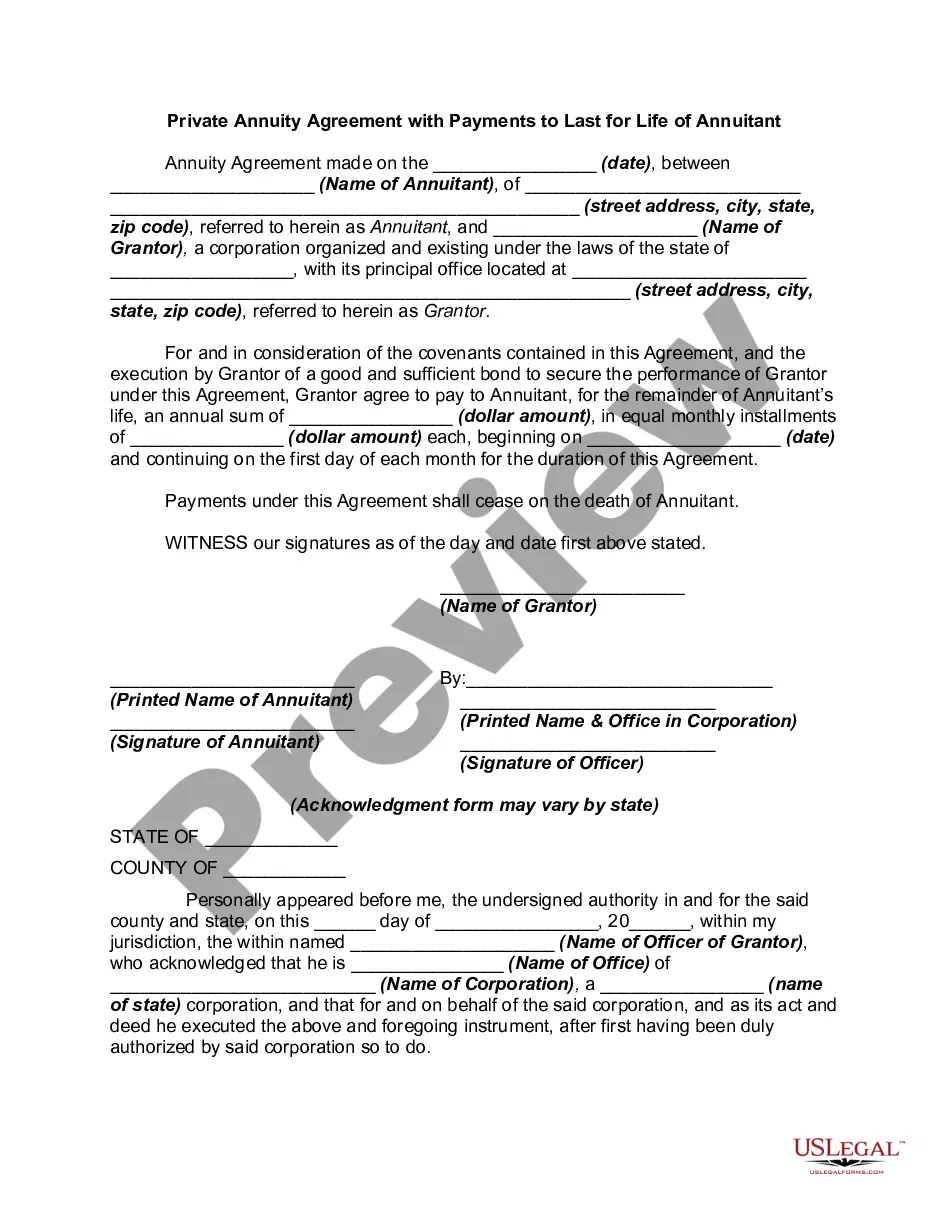
Private Annuity Agreement with Payments to Last for Life of Annuitant
About this form
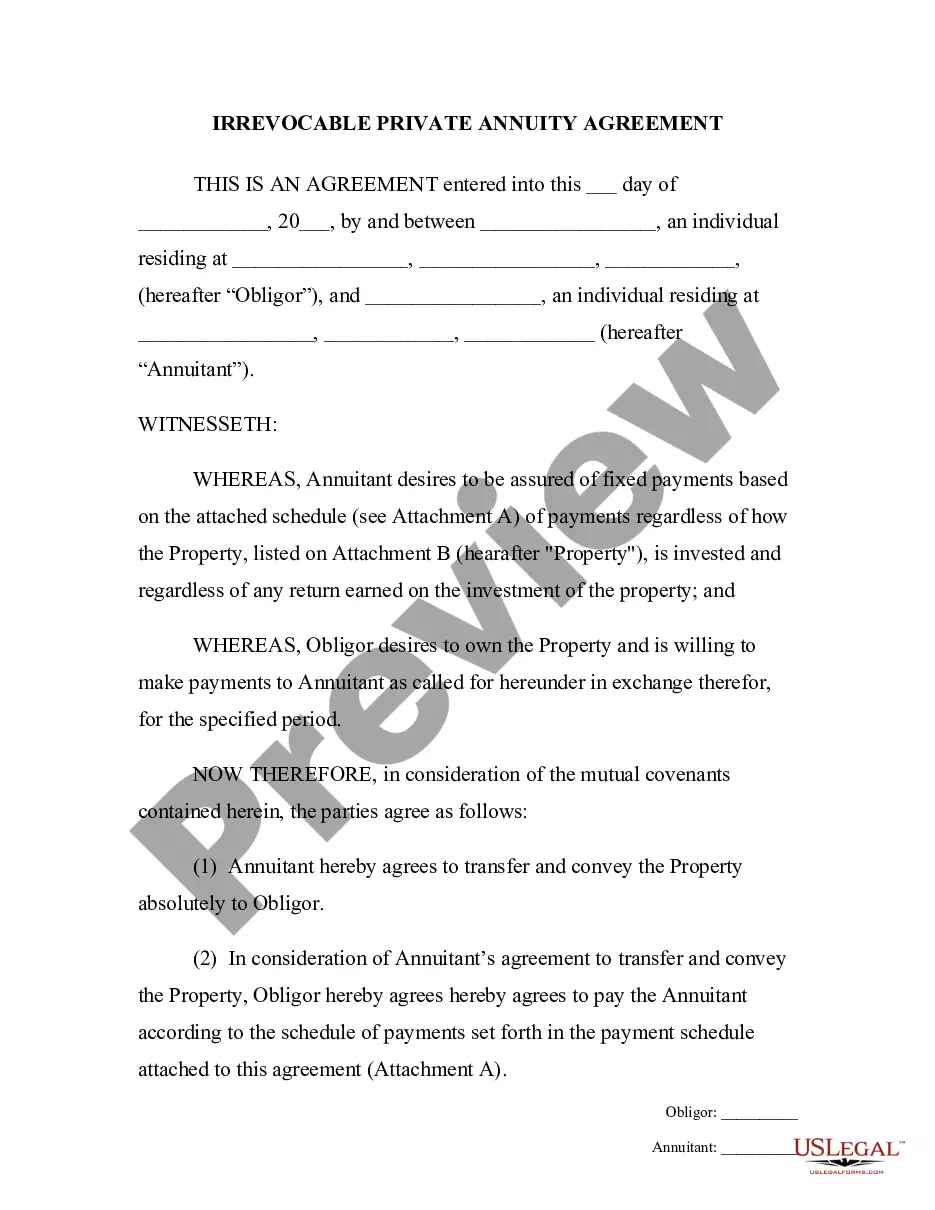
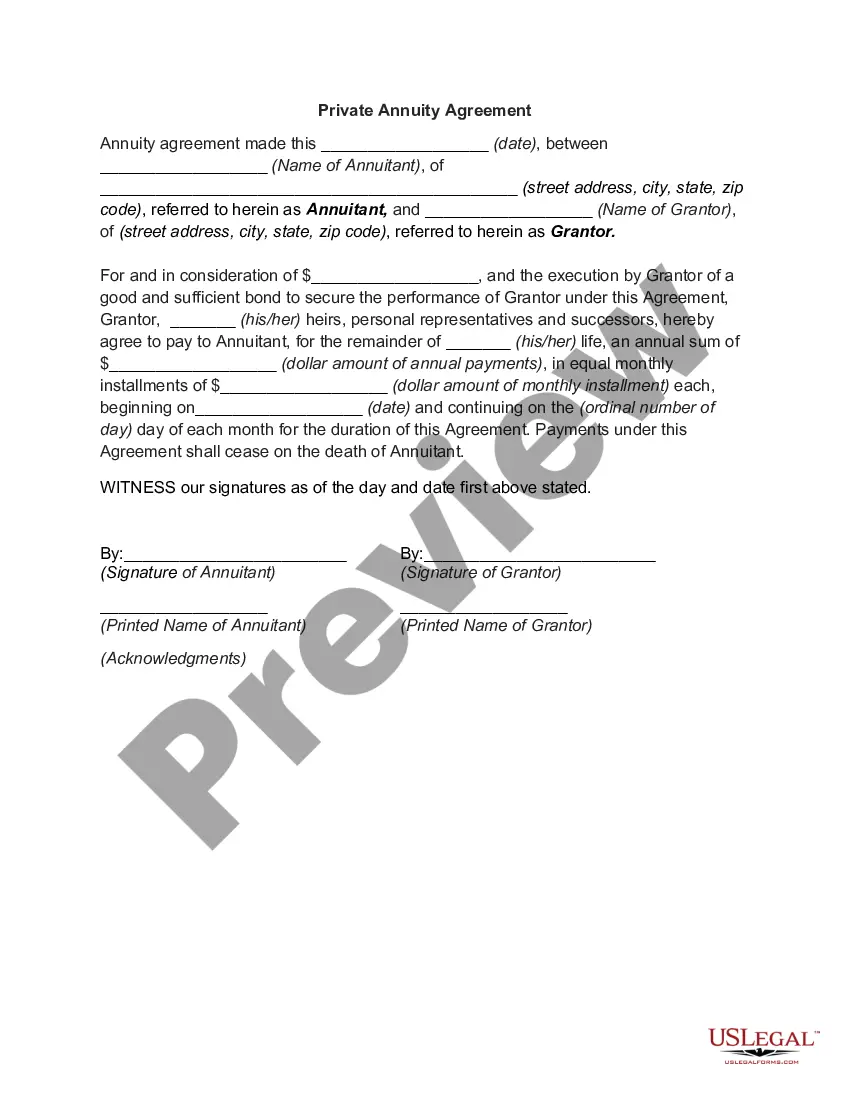
A private annuity agreement with payments to last for life of annuitant is a legal document that establishes a contractual arrangement between a grantor and an annuitant. In this agreement, the grantor agrees to make regular payments to the annuitant during their lifetime, with payments ceasing upon the annuitant's death. This form is distinct from other retirement income options, as it provides a guaranteed income stream based on the life of a specific individual.
Form components explained
- Date of the agreement
- Names and addresses of the annuitant and grantor
- Annual sum and monthly installment amounts
- Start date for payments
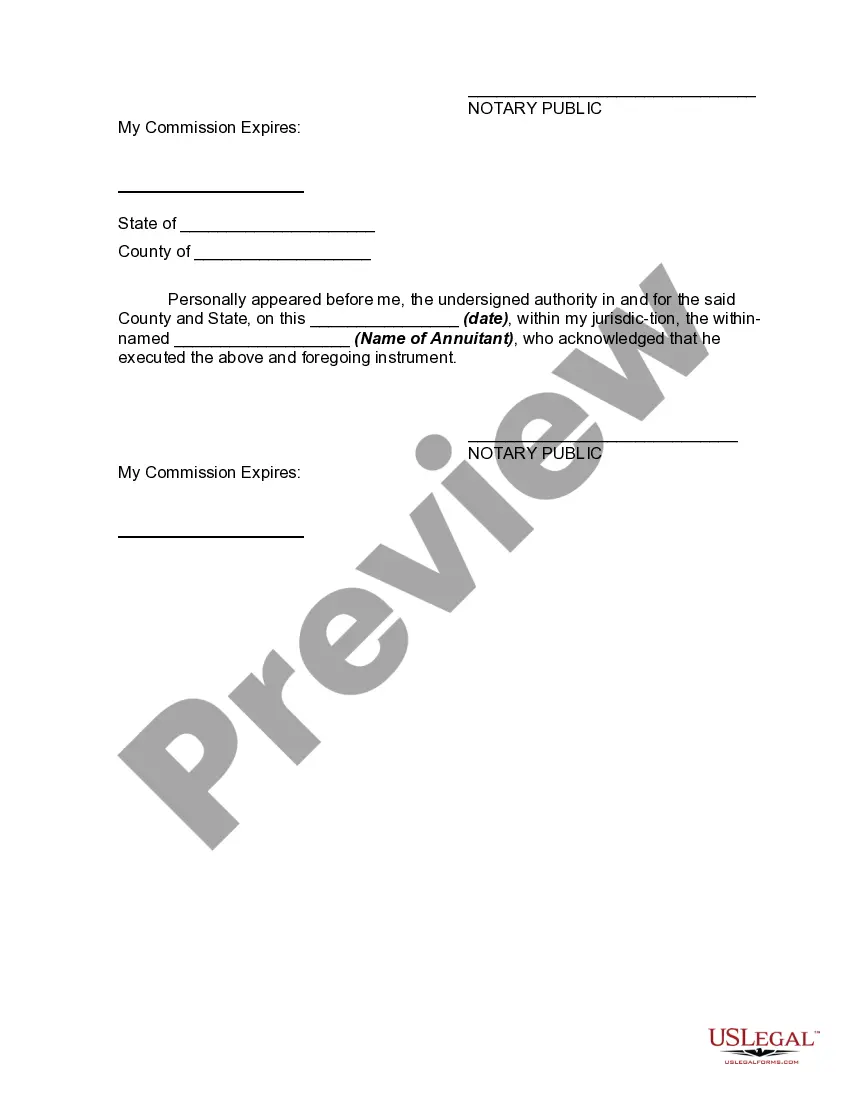
- Signatures of both parties and a notary's acknowledgment
When to use this document
This form is useful when an individual (the annuitant) wishes to receive a guaranteed income for life in exchange for transferring certain assets or investments to a grantor. It may be employed in estate planning to provide financial support during retirement while minimizing tax implications for the annuitant's estate.
Intended users of this form
- Individuals planning for retirement who want a steady income for life
- Grantors looking to provide a long-term financial arrangement
- Estate planners managing the financial interests of an annuitant
Completing this form step by step
- Identify and fill in the date of the agreement.
- Input the names and addresses of the annuitant and grantor.
- Specify the annual sum and the monthly payment amounts.
- Set the start date for the payments.
- Both parties should sign and date the agreement in the designated areas.
- Have the document notarized as required by your state.
Notarization requirements for this form
This document requires notarization to meet legal standards. US Legal Forms provides secure online notarization powered by Notarize, allowing you to complete the process through a verified video call, available 24/7.
Get your form ready online
Our built-in tools help you complete, sign, share, and store your documents in one place.
Make edits, fill in missing information, and update formatting in US Legal Forms—just like you would in MS Word.
Download a copy, print it, send it by email, or mail it via USPS—whatever works best for your next step.
Sign and collect signatures with our SignNow integration. Send to multiple recipients, set reminders, and more. Go Premium to unlock E-Sign.
If this form requires notarization, complete it online through a secure video call—no need to meet a notary in person or wait for an appointment.
We protect your documents and personal data by following strict security and privacy standards.

Make edits, fill in missing information, and update formatting in US Legal Forms—just like you would in MS Word.

Download a copy, print it, send it by email, or mail it via USPS—whatever works best for your next step.

Sign and collect signatures with our SignNow integration. Send to multiple recipients, set reminders, and more. Go Premium to unlock E-Sign.

If this form requires notarization, complete it online through a secure video call—no need to meet a notary in person or wait for an appointment.

We protect your documents and personal data by following strict security and privacy standards.
Common mistakes
- Failing to clearly state the payment amount and schedule.
- Not including the start date for payments.
- Neglecting to have the agreement notarized if required by state law.
- Omitting necessary signatures from both the annuitant and grantor.
Advantages of online completion
- Convenient access to legal documents from anywhere at any time.
- Editable templates allow for customization to fit your specific needs.
- Reliable forms drafted by licensed attorneys ensure legal validity.
What to keep in mind
- A private annuity agreement provides lifelong payments to the annuitant.
- It is essential for financial planning and may offer tax benefits.
- Complete all sections accurately to avoid legal complications.
- Consider notarization based on state-specific requirements.
Looking for another form?



Form popularity
FAQ
A private annuity is a special agreement in which an individual (annuitant) transfers property to an obligor. The obligor agrees to make payments to the annuitant according to an agreed upon schedule in exchange for the property transfer.Agreement contract provisions are created and agreed to by both parties.
Consequently, under no circumstances can a private annuity be secured with the asset transferred, or any other collateral.Insuring the life of the transferee is an available option; however, any connection of the life insurance policy to the private annuity will be deemed as a secured transaction.
Annual payments of $4,000 10 percent of your original investment is non-taxable. You live longer than 10 years. The money you receive beyond that 10-year-life expectation will be taxed as income.
All appreciation and/or earnings from the annuity property after the sale are outside of the Annuitant's estate and not subject to estate tax. 3. Upon the Annuitant's death, the annuity obligation terminates and nothing is included in the Annuitant's gross estate.
The taxable part of your pension or annuity payments is generally subject to federal income tax withholding. You may be able to choose not to have income tax withheld from your pension or annuity payments (unless they're eligible rollover distributions) or may want to specify how much tax is withheld.
When you receive payments from a qualified annuity, those payments are fully taxable as income. That's because no taxes have been paid on that money. But annuities purchased with a Roth IRA or Roth 401(k) are completely tax free if certain requirements are met.