Private Annuity Agreement
What is this form?
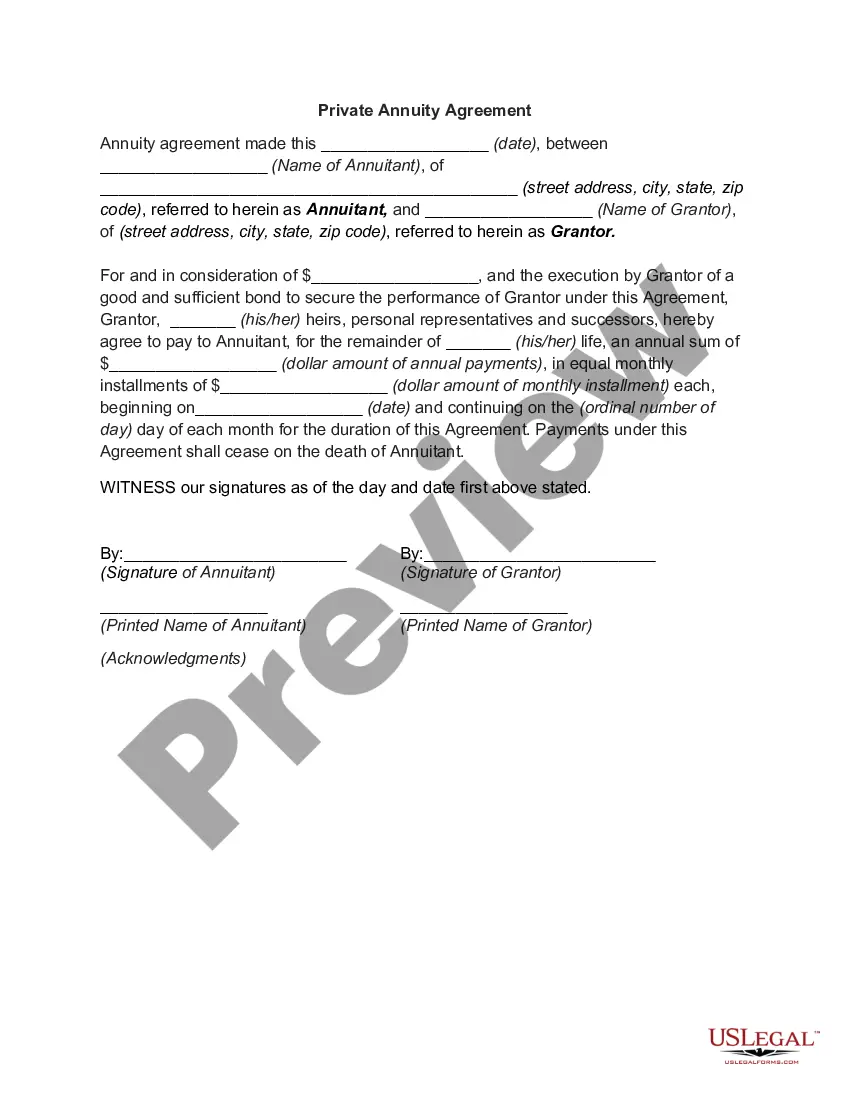
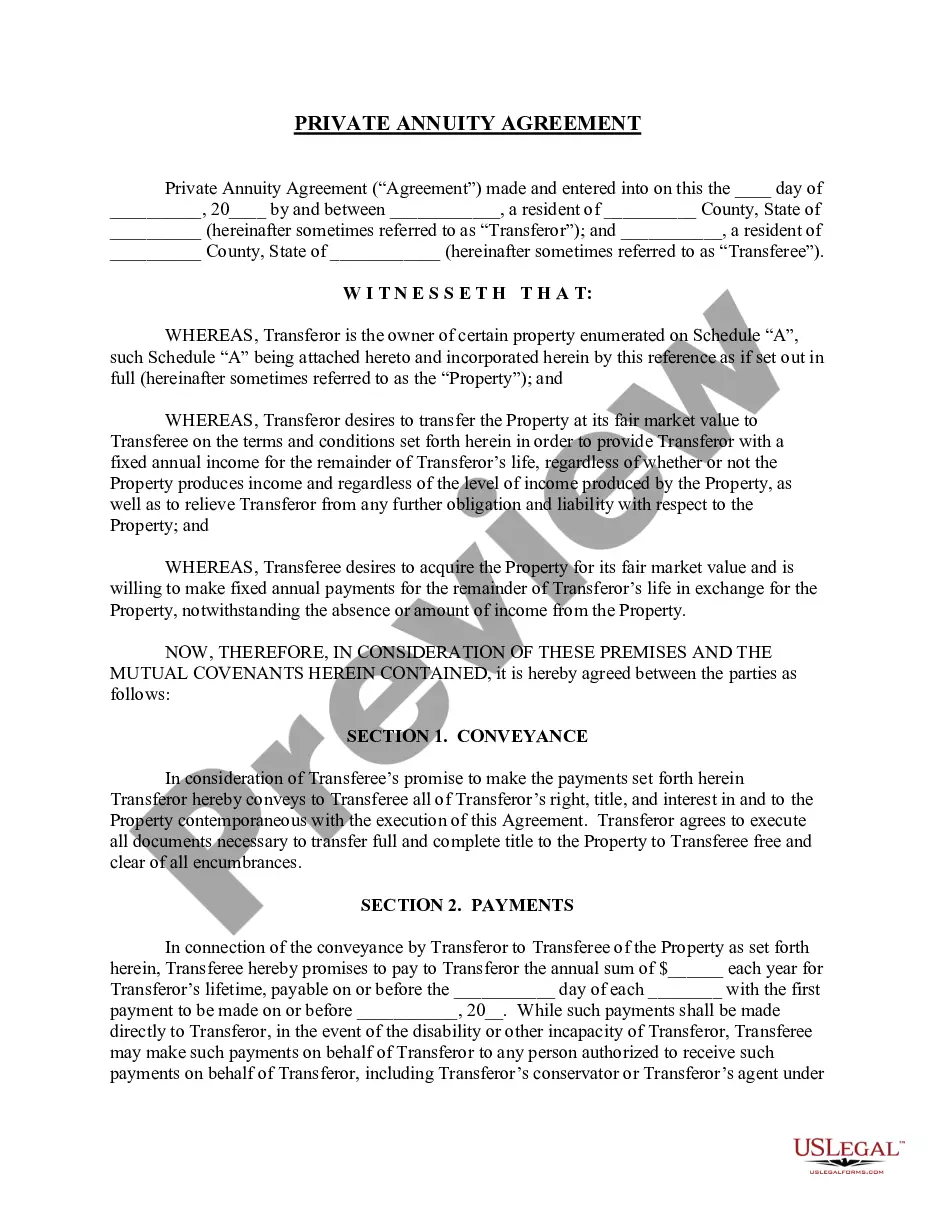
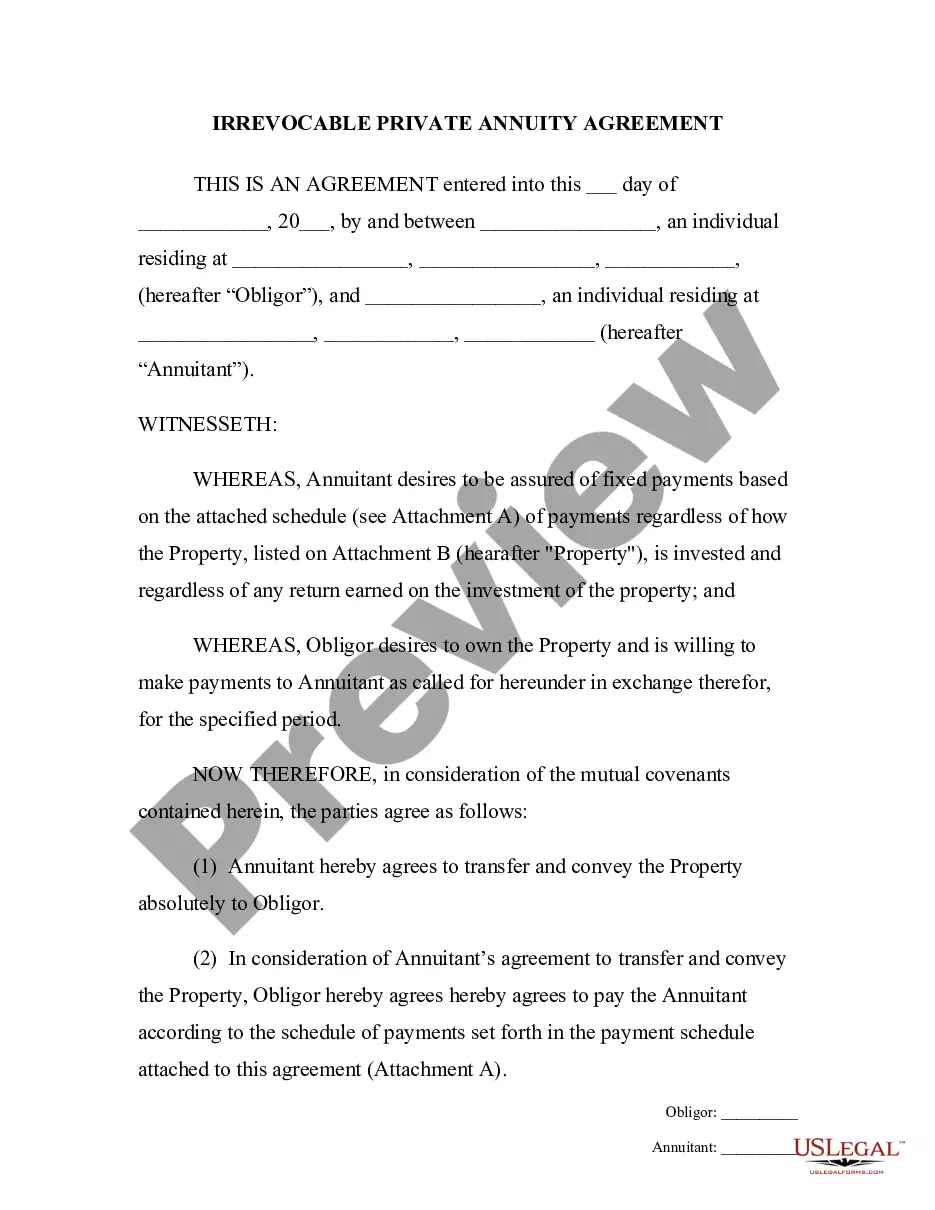
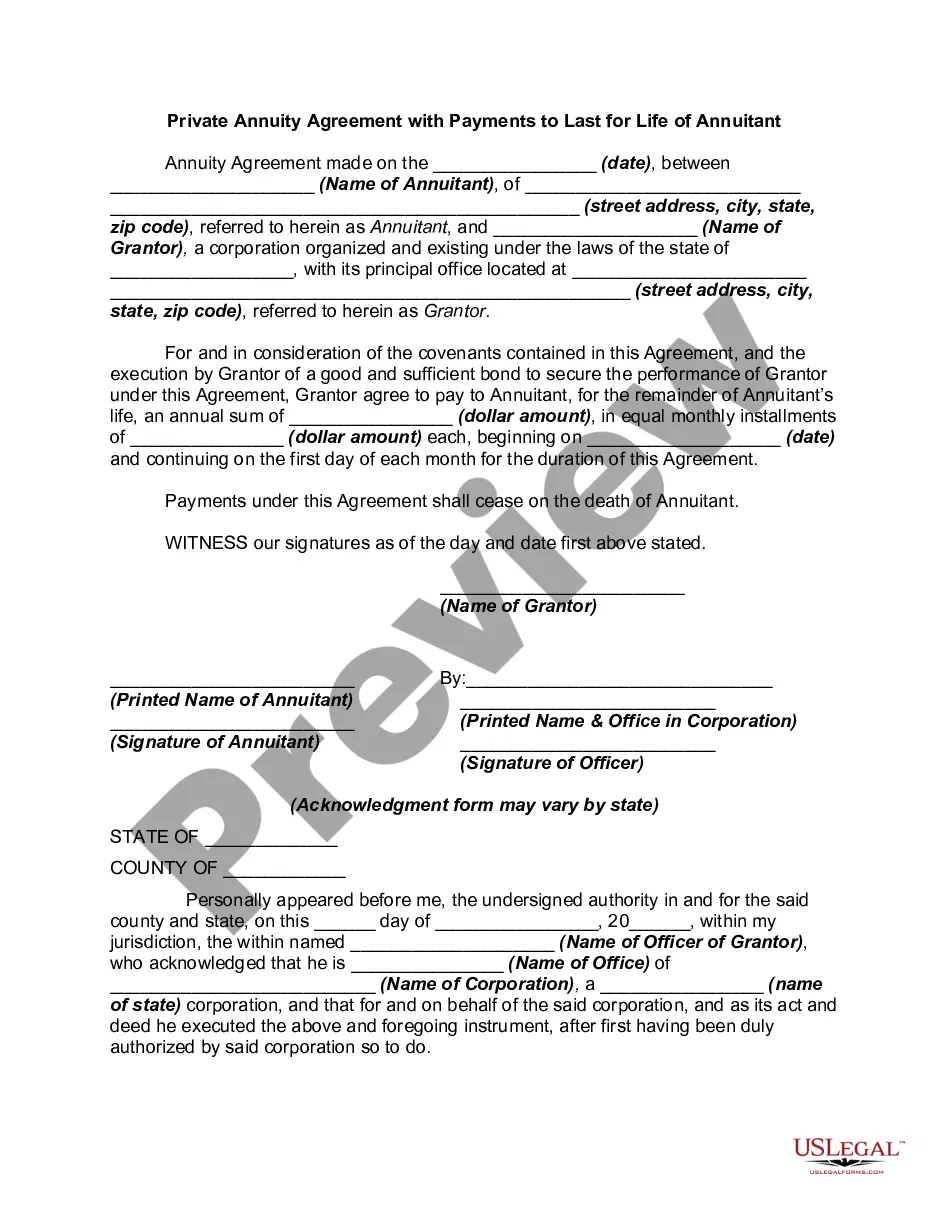
A Private Annuity Agreement is a legal document that outlines a special contractual agreement in which one party transfers property to another party. The receiving party, known as the obligor, commits to making periodic payments to the original property owner, referred to as the annuitant. This form is distinct from other annuity agreements as it specifically addresses private transactions rather than institutional arrangements. It ensures that the annuitant receives ongoing financial support while transferring property ownership.
Main sections of this form
- Date: Specifies when the agreement is made.
- Party Information: Includes names and addresses of both the annuitant and grantor.
- Consideration Amount: Details the monetary consideration given by the obligor for the annuity.
- Payment Terms: Outlines the amount and frequency of payments to the annuitant.
- Duration: Indicates that payments will continue for the life of the annuitant.
- Signatures: Requires both parties' signatures and printed names to validate the agreement.
Situations where this form applies
This form should be used when an individual wishes to transfer ownership of property to another individual while establishing a payment plan that provides income to the original owner for their lifetime. It is useful in estate planning, especially when the annuitant seeks to receive regular payments while ensuring the property passes to the grantor. Additionally, this form can be beneficial when the annuitant wants to minimize potential estate taxes or protect assets in case of future financial needs.
Who this form is for
- Individuals transferring property to a family member or friend.
- Retirees seeking a steady income stream from their assets.
- People involved in estate planning who want to maintain financial stability in retirement.
- Grantors wanting to ensure that the annuitant receives payments for life while securing property ownership.
How to prepare this document
- Identify the date of the agreement and fill it in at the top.
- Enter the full legal names and addresses of both the annuitant and grantor.
- Specify the consideration amount being paid by the grantor.
- Detail the annual payment amount and monthly installment amount.
- Indicate the start date for the payments and the ordinal number for the monthly frequency.
- Obtain signatures from both parties, ensuring printed names are also included.
Does this form need to be notarized?
This form does not typically require notarization unless specified by local law. It's advisable to check local regulations to confirm whether notarization is necessary for your specific situation.
Get your form ready online
Our built-in tools help you complete, sign, share, and store your documents in one place.
Make edits, fill in missing information, and update formatting in US Legal Forms—just like you would in MS Word.
Download a copy, print it, send it by email, or mail it via USPS—whatever works best for your next step.
Sign and collect signatures with our SignNow integration. Send to multiple recipients, set reminders, and more. Go Premium to unlock E-Sign.
If this form requires notarization, complete it online through a secure video call—no need to meet a notary in person or wait for an appointment.
We protect your documents and personal data by following strict security and privacy standards.

Make edits, fill in missing information, and update formatting in US Legal Forms—just like you would in MS Word.

Download a copy, print it, send it by email, or mail it via USPS—whatever works best for your next step.

Sign and collect signatures with our SignNow integration. Send to multiple recipients, set reminders, and more. Go Premium to unlock E-Sign.

If this form requires notarization, complete it online through a secure video call—no need to meet a notary in person or wait for an appointment.

We protect your documents and personal data by following strict security and privacy standards.
Avoid these common issues
- Failing to accurately identify both parties and their addresses.
- Not specifying the correct payment amounts or schedule.
- Omitting signatures or printed names of both parties.
- Not considering state-specific regulations that affect the agreement.
Why use this form online
- Convenience of downloading immediately and filling it out at your own pace.
- Editable format allows changes before finalizing the agreement.
- Access to legal templates drafted by attorneys ensures compliance.
Legal use & context
- This agreement establishes a legal obligation for the grantor to pay the annuitant for life.
- It is important to understand that the terms stated in the agreement must be followed to ensure enforceability.
- Consulting with a legal professional is recommended to ensure all local laws and regulations are adhered to.
Quick recap
- A Private Annuity Agreement provides a structured payment plan for property transfers.
- Correctly completing the form is essential to avoid legal complications.
- It's crucial to comply with state laws that may affect the agreement.
- This form supports financial planning for retirees and property owners.
Looking for another form?

Form popularity
FAQ
Payout options are often paid through ACH transfers. Methods for taking annuity payouts include the annuitization method, the systematic withdrawal schedule, and the lump-sum payment. Gender and age are the two most common factors used to determine payments.
A private annuity is a special agreement in which an individual (annuitant) transfers property to an obligor.For the agreement to be classified as a private annuity, neither party can be in the business of selling annuitiesthat is, neither party can be an insurance company.
For estate planning purposes, a GRAT is a type of gifting trust that allows individuals to transfer high-yielding and/or rapidly appreciating property or assets (again, typically shares of stock) to a beneficiary with minimal gift or estate tax.
Consequently, under no circumstances can a private annuity be secured with the asset transferred, or any other collateral.Insuring the life of the transferee is an available option; however, any connection of the life insurance policy to the private annuity will be deemed as a secured transaction.
If you die, normally your annuity payments will stop and the pension fund used to buy your annuity will be lost. However there are a number of options you can take to ensure a beneficiary can still benefit from your pension savings or annuity income.
A private annuity is a special agreement in which an individual (annuitant) transfers property to an obligor. The obligor agrees to make payments to the annuitant according to an agreed upon schedule in exchange for the property transfer.Agreement contract provisions are created and agreed to by both parties.
All appreciation and/or earnings from the annuity property after the sale are outside of the Annuitant's estate and not subject to estate tax. 3. Upon the Annuitant's death, the annuity obligation terminates and nothing is included in the Annuitant's gross estate.