3.18 JUROR NOTE-TAKING
What is this form?
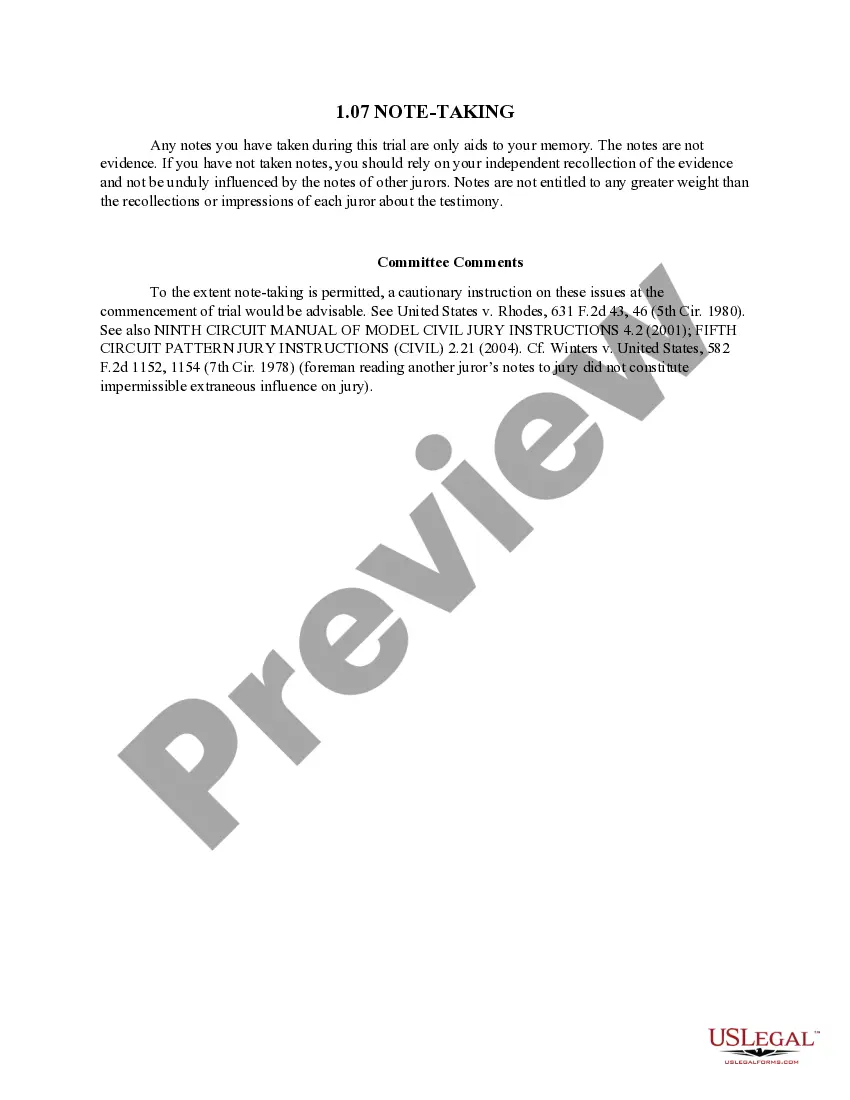
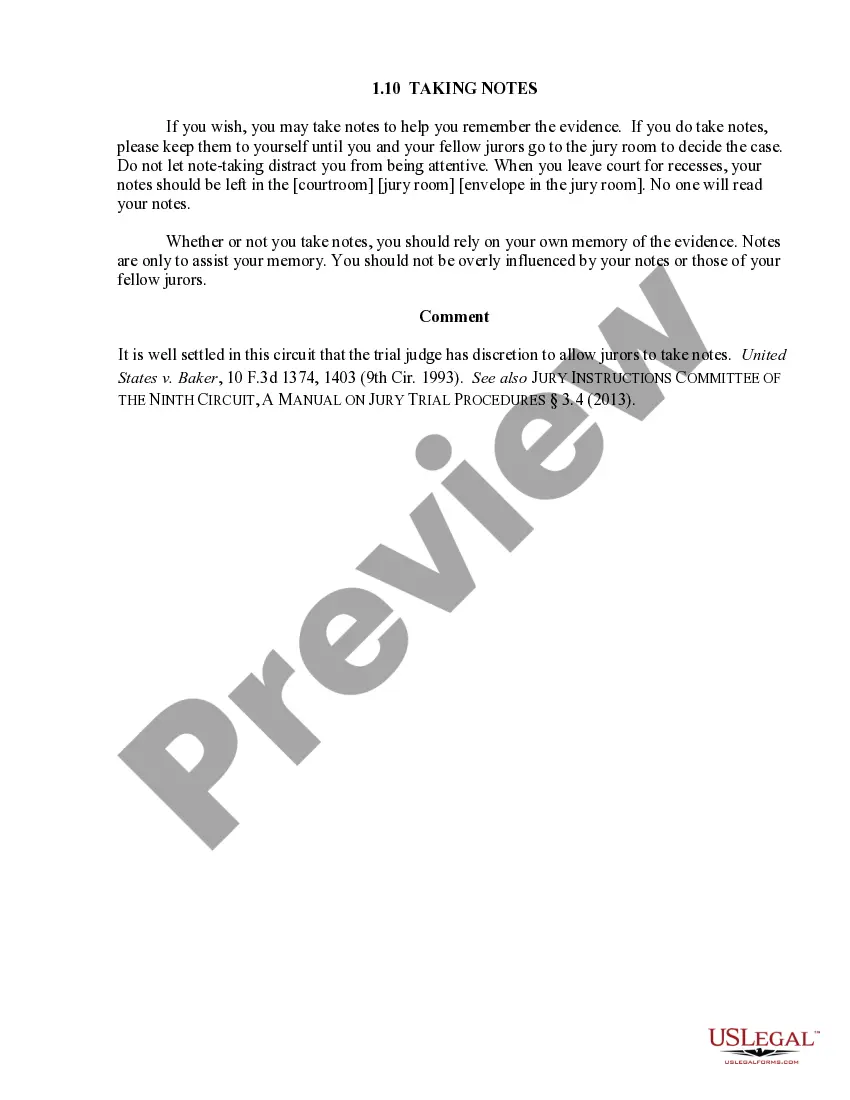
The 3.18 Juror Note-Taking form is an official instruction issued by the Federal 7th Circuit Court that outlines the guidelines for jurors regarding the use of notes during trial deliberations. Unlike many other legal forms, this document specifically addresses how jurors can utilize their personal notes as memory aids while ensuring they understand that these notes are not considered evidence. The uniqueness of this form lies in its clear emphasis on relying primarily on individual memory rather than comparing notes among jurors.
Main sections of this form
- Guidance on using notes during jury deliberations.
- Clarification that juror notes are not evidence.
- Emphasis on independent recollection of trial evidence.
- Instructions on avoiding undue influence from other jurors' notes.
- Committee comment referencing adaptation from existing jury instructions.


When to use this document
This form should be used during jury trials when jurors have taken notes throughout the proceedings. It serves as a guideline for effectively and properly utilizing these notes to aid memory during the deliberation process, ensuring that jurors understand the limitations and intended purpose of their notes.
Intended users of this form
This form is intended for jurors involved in a trial within the Federal 7th Circuit. It is relevant for all jurors who are permitted to take notes during trial proceedings, ensuring they adhere to proper protocols about the use of those notes during discussions and decision-making.
Instructions for completing this form
- Read the guidelines carefully to understand the role of notes in deliberations.
- During the trial, take comprehensive notes on key evidence and testimonies.
- Refer to these notes as needed during deliberations to assist in recalling important information.
- Discuss the evidence based on personal recollection rather than heavily relying on the notes of others.
- Follow the instructions provided in the form to ensure compliance with judicial guidelines.
Notarization guidance
Notarization is not commonly needed for this form. However, certain documents or local rules may make it necessary. Our notarization service, powered by Notarize, allows you to finalize it securely online anytime, day or night.
Get your form ready online
Our built-in tools help you complete, sign, share, and store your documents in one place.
Make edits, fill in missing information, and update formatting in US Legal Forms—just like you would in MS Word.
Download a copy, print it, send it by email, or mail it via USPS—whatever works best for your next step.
Sign and collect signatures with our SignNow integration. Send to multiple recipients, set reminders, and more. Go Premium to unlock E-Sign.
If this form requires notarization, complete it online through a secure video call—no need to meet a notary in person or wait for an appointment.
We protect your documents and personal data by following strict security and privacy standards.

Make edits, fill in missing information, and update formatting in US Legal Forms—just like you would in MS Word.

Download a copy, print it, send it by email, or mail it via USPS—whatever works best for your next step.

Sign and collect signatures with our SignNow integration. Send to multiple recipients, set reminders, and more. Go Premium to unlock E-Sign.

If this form requires notarization, complete it online through a secure video call—no need to meet a notary in person or wait for an appointment.

We protect your documents and personal data by following strict security and privacy standards.
Mistakes to watch out for
- Relying too heavily on notes instead of independent memory.
- Assuming that notes carry more weight than personal recollections.
- Discussing evidence based on others' notes rather than one's own understanding.
Benefits of completing this form online
- Immediate access to the legal guidelines governing note-taking during trial deliberations.
- Convenience of downloading and printing this form as needed.
- Editable format allows for personal annotations or highlights as necessary.
Legal use & context
- This form is legally recognized as a directive in jury trials within the Federal 7th Circuit.
- Ensures that jurors remain informed about the use of notes to avoid misunderstandings during deliberation.
Looking for another form?
Form popularity
FAQ
2023 California Rules of Court Jurors must be permitted to take written notes in all civil and criminal trials. At the beginning of a trial, a trial judge must inform jurors that they may take written notes during the trial. The court must provide materials suitable for this purpose.
The jurors were not allowed to take notes throughout the six-week trial. However, James said he and his fellow jurors wrote down questions they had on paper in the jury room during 15-minute breaks. Sometimes, those questions were answered during testimony in the trial.
Jurors must be permitted to take written notes in all civil and criminal trials. At the beginning of a trial, a trial judge must inform jurors that they may take written notes during the trial.
These states include Arizona, Arkansas, Connecticut, Missouri, New Jersey, New York, North Dakota, Ohio, Washington, Wisconsin, and Wyoming. Although only one state expressly prohibits this practice, in most jurisdictions whether members of a jury are allowed to take notes will depend upon the discretion of the judge.
The jurors may refer to their notes during the proceedings and deliberations. (e) Any notes taken are confidential and shall not be available for examination or review by any party or other person. After the jury has rendered its verdict, the court shall ensure that the notes are promptly collected and destroyed.