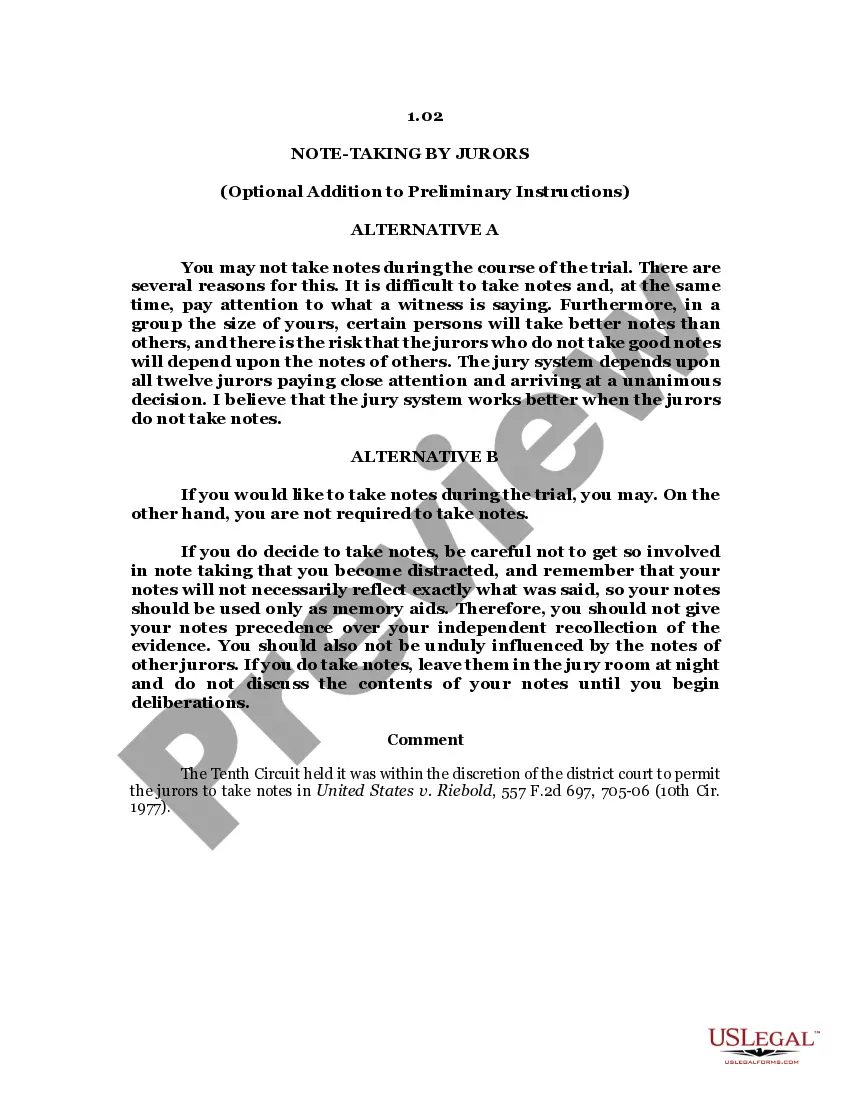
NOTE-TAKING BY JURORS
Understanding this form
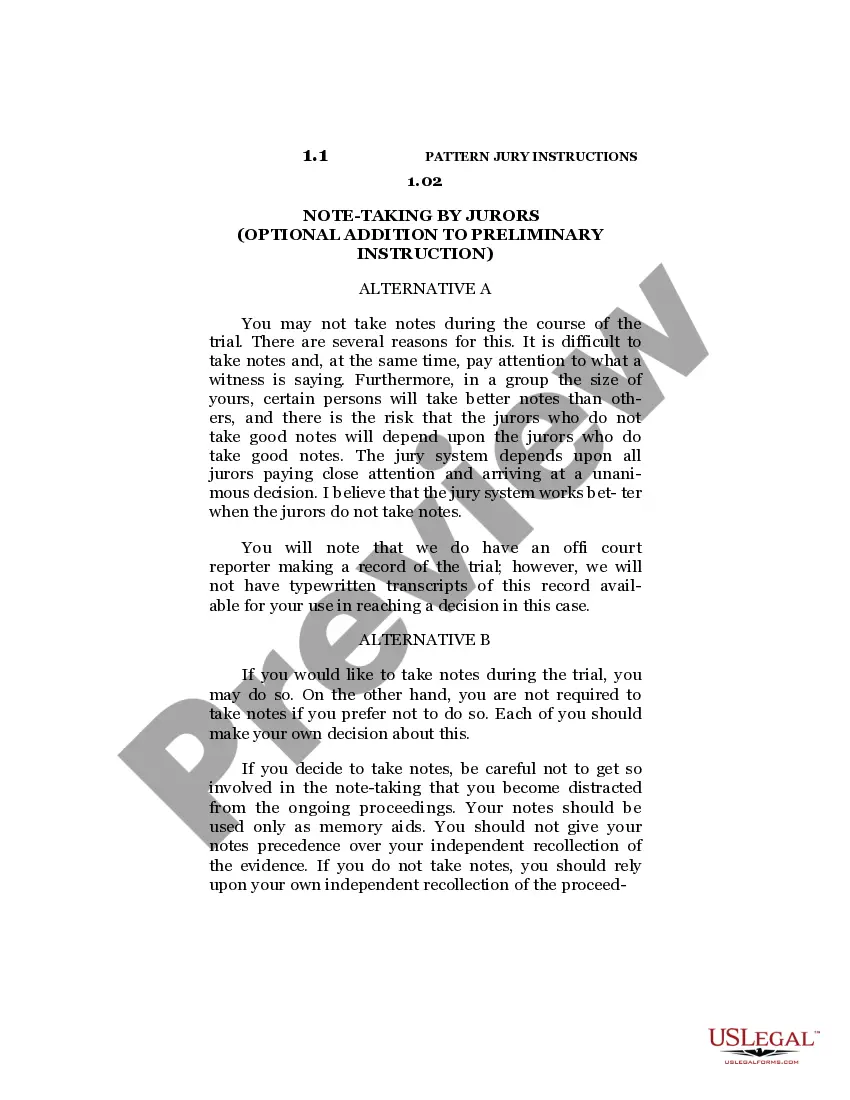
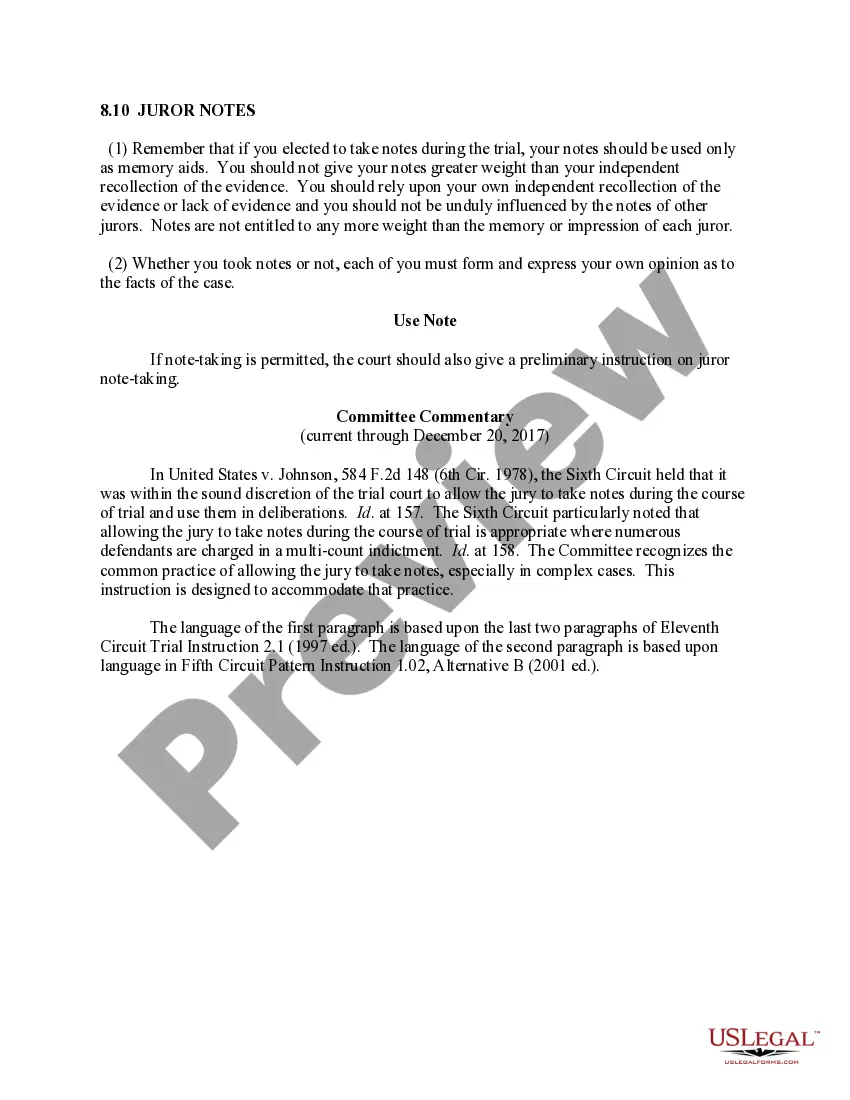
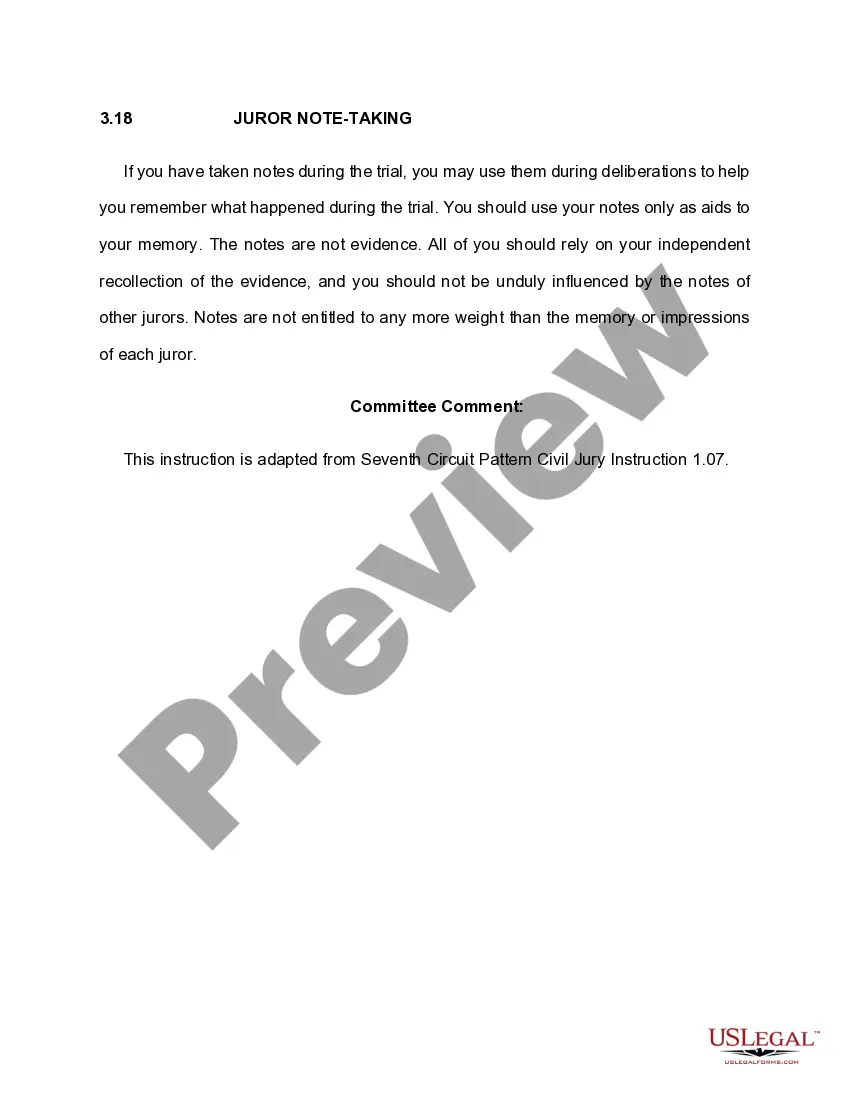
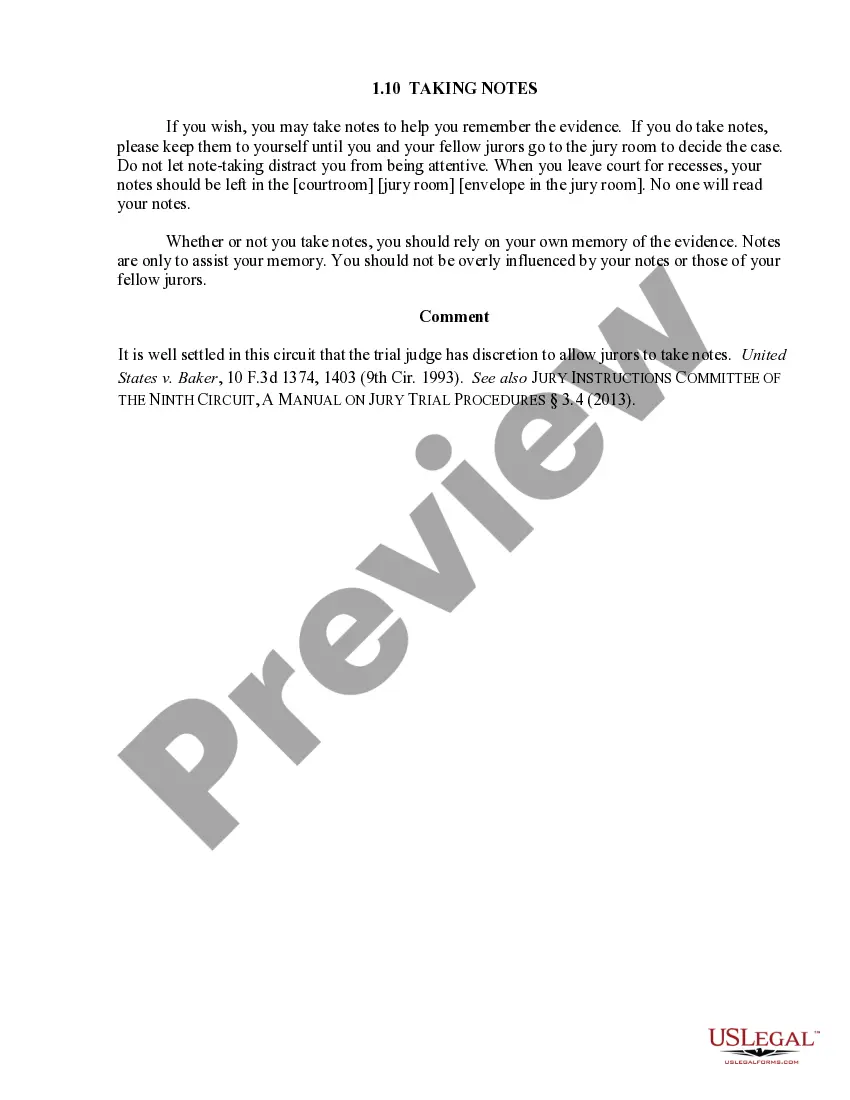
The Note-Taking by Jurors form provides guidelines related to juror note-taking during a trial. It consists of two alternatives: one that prohibits note-taking and another that permits it under specific conditions. This form helps to clarify the court's stance on note-taking and aims to ensure that jurors focus on the trial while considering the potential benefits and drawbacks of recording information.
Key parts of this document
- Alternative A: Guidelines prohibiting jurors from taking notes to encourage attentive listening.
- Alternative B: Conditions under which jurors may take notes and regulations surrounding their use.
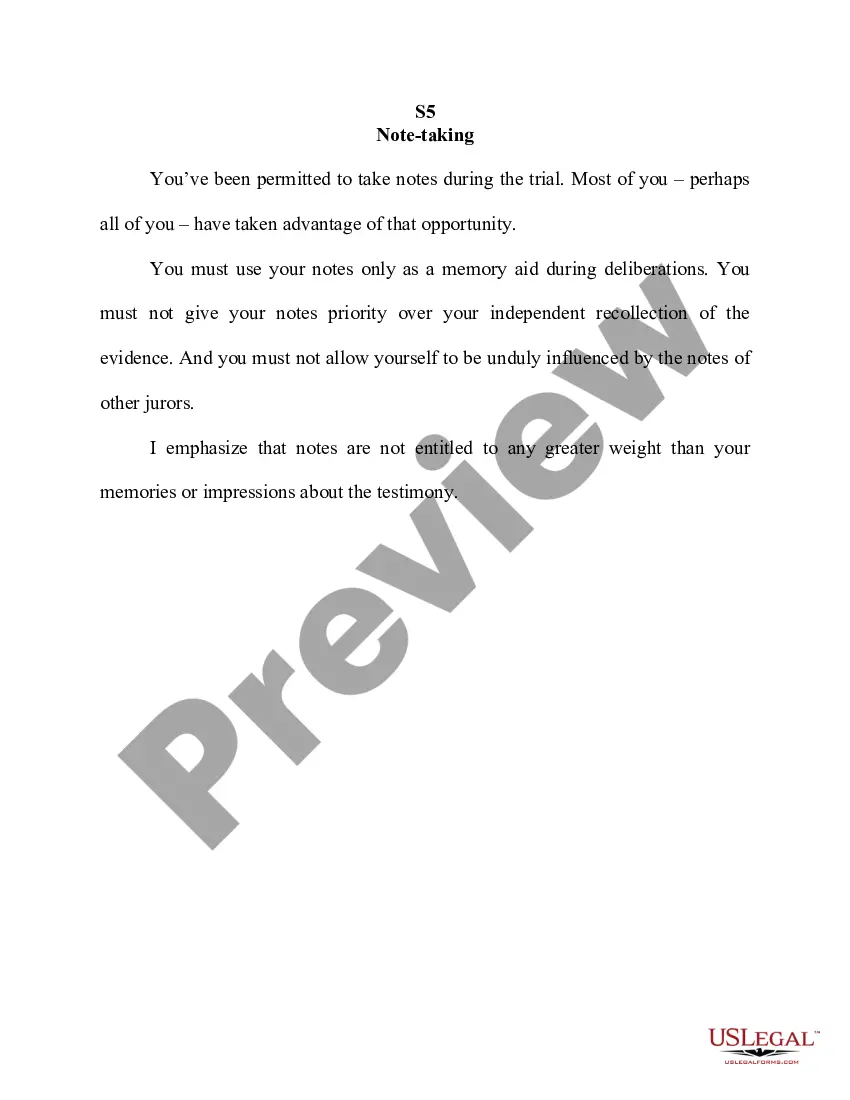
- Instructions emphasizing that notes should not override jurors' independent recollection of evidence.
- Advice on the proper handling of notes and discussions until deliberations are underway.
- Reference to relevant case law that supports the discretion of the court regarding this issue.
When this form is needed
This form is used in court settings where jurors are instructed on whether or not they may take notes during trial proceedings. It is particularly relevant at the start of a trial to inform jurors about their allowable conduct. The guidelines ensure jurors understand the importance of focusing on the trial while also acknowledging that note-taking can be beneficial for memory retention in some cases.
Who this form is for
- Court officials responsible for instructing jurors at the beginning of a trial.
- Judges looking to clarify policies regarding juror note-taking.
- Legal professionals involved in jury trials and interested in best practices for juror engagement.
Completing this form step by step
- Choose either Alternative A or Alternative B based on the court's policy towards note-taking.
- Ensure that jurors understand the implications of the chosen alternative thoroughly.
- Incorporate any specific language or requirements that may be dictated by local laws.
- Provide clear instructions regarding handling and discussing notes if Alternative B is selected.
- Reference relevant case law to support the instruction provided to jurors.
Is notarization required?
This form usually doesn’t need to be notarized. However, local laws or specific transactions may require it. Our online notarization service, powered by Notarize, lets you complete it remotely through a secure video session, available 24/7.
Get your form ready online
Our built-in tools help you complete, sign, share, and store your documents in one place.
Make edits, fill in missing information, and update formatting in US Legal Forms—just like you would in MS Word.
Download a copy, print it, send it by email, or mail it via USPS—whatever works best for your next step.
Sign and collect signatures with our SignNow integration. Send to multiple recipients, set reminders, and more. Go Premium to unlock E-Sign.
If this form requires notarization, complete it online through a secure video call—no need to meet a notary in person or wait for an appointment.
We protect your documents and personal data by following strict security and privacy standards.

Make edits, fill in missing information, and update formatting in US Legal Forms—just like you would in MS Word.

Download a copy, print it, send it by email, or mail it via USPS—whatever works best for your next step.

Sign and collect signatures with our SignNow integration. Send to multiple recipients, set reminders, and more. Go Premium to unlock E-Sign.

If this form requires notarization, complete it online through a secure video call—no need to meet a notary in person or wait for an appointment.

We protect your documents and personal data by following strict security and privacy standards.
Typical mistakes to avoid
- Failing to clarify the difference between the two alternatives regarding note-taking.
- Not addressing the importance of juror focus during trial proceedings when allowing note-taking.
- Neglecting to provide detailed instructions on the proper handling of notes.
Advantages of online completion
- Convenience of accessing legally vetted instructions for jurors at any time.
- Editability allows for customization based on specific court requirements.
- Reliability from obtaining templates drafted by licensed attorneys.
Legal use & context
- The ability to allow jurors to take notes is at the discretion of the presiding judge.
- Note-taking may affect juror deliberations if not properly managed.
- Relevant case law establishes the importance of maintaining juror focus on trial proceedings.
Quick recap
- Understand the implications of allowing juror note-taking during trials.
- Clearly communicate the guidelines and expectations for jurors.
- Ensure compliance with local legal requirements concerning note-taking policies.
Looking for another form?


Form popularity
FAQ
These states include Arizona, Arkansas, Connecticut, Missouri, New Jersey, New York, North Dakota, Ohio, Washington, Wisconsin, and Wyoming. Although only one state expressly prohibits this practice, in most jurisdictions whether members of a jury are allowed to take notes will depend upon the discretion of the judge.
These states include Arizona, Arkansas, Connecticut, Missouri, New Jersey, New York, North Dakota, Ohio, Washington, Wisconsin, and Wyoming. Although only one state expressly prohibits this practice, in most jurisdictions whether members of a jury are allowed to take notes will depend upon the discretion of the judge.
Jurors are more likely to hear and keep track of a detail that they understand is stated precisely. Treat truly important details as truly important, and jurors will make note of the details ? and write them down.
The jurors are the sole tryers of the facts in any case, criminal and civil, and the Constitution of South Carolina prohibits a judge from making any comment on the facts during the trial of a case, except when the jury is absent.
In general, it is not permitted. The judges feel it is important that jurors focus their attention on witnesses and information rather than on taking notes.
The jurors were not allowed to take notes throughout the six-week trial. However, James said he and his fellow jurors wrote down questions they had on paper in the jury room during 15-minute breaks. Sometimes, those questions were answered during testimony in the trial.
2023 California Rules of Court Jurors must be permitted to take written notes in all civil and criminal trials. At the beginning of a trial, a trial judge must inform jurors that they may take written notes during the trial. The court must provide materials suitable for this purpose.