California Request for Hearing and Application to Set Aside Voluntary Declaration of Paternity
What this document covers
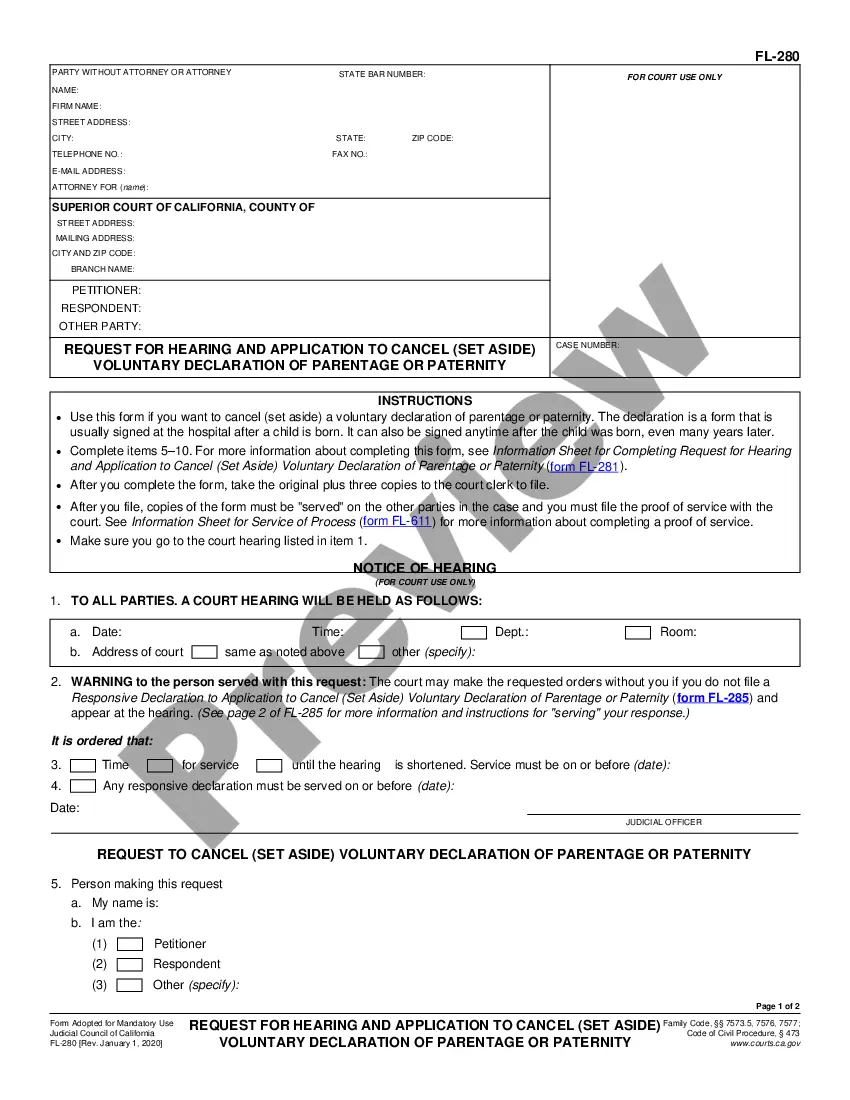
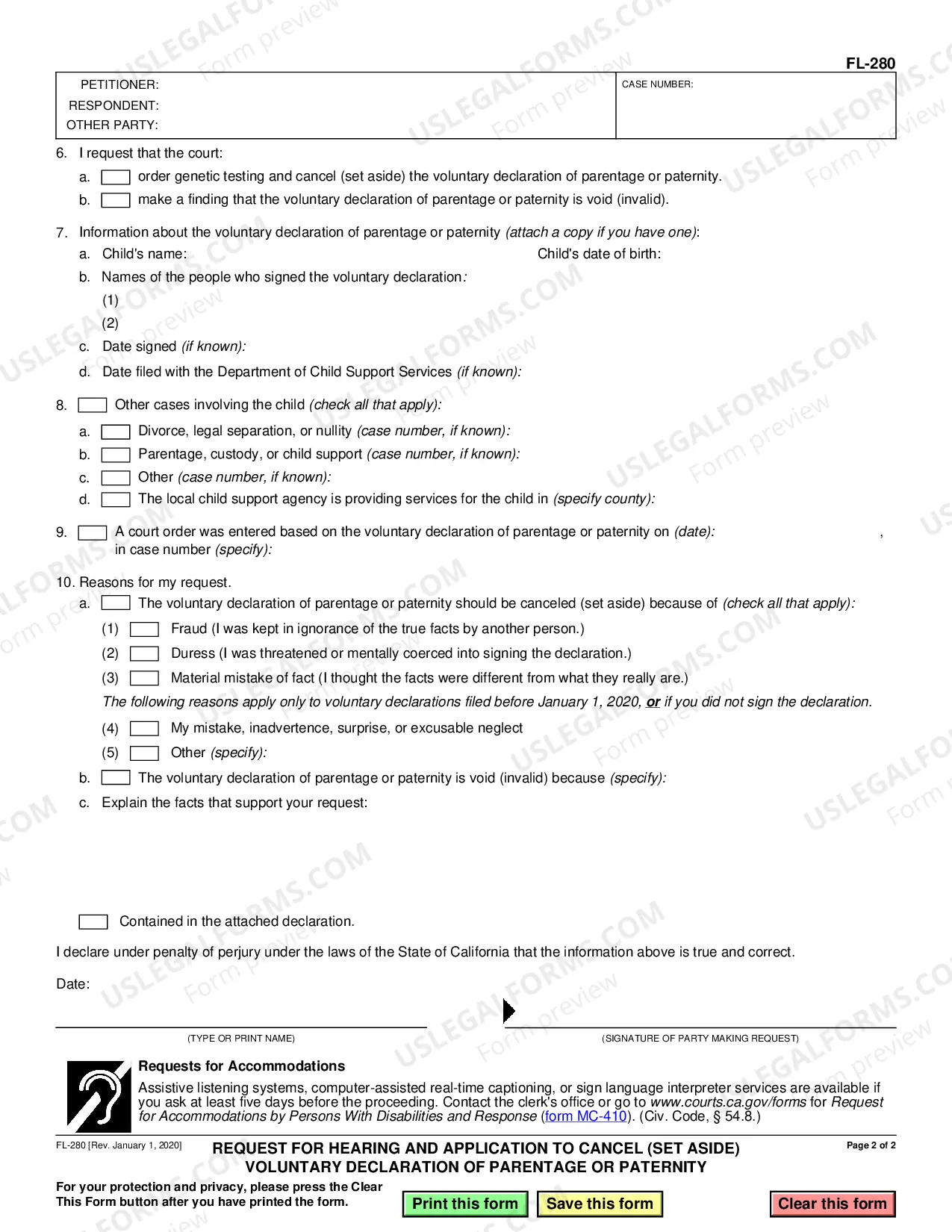
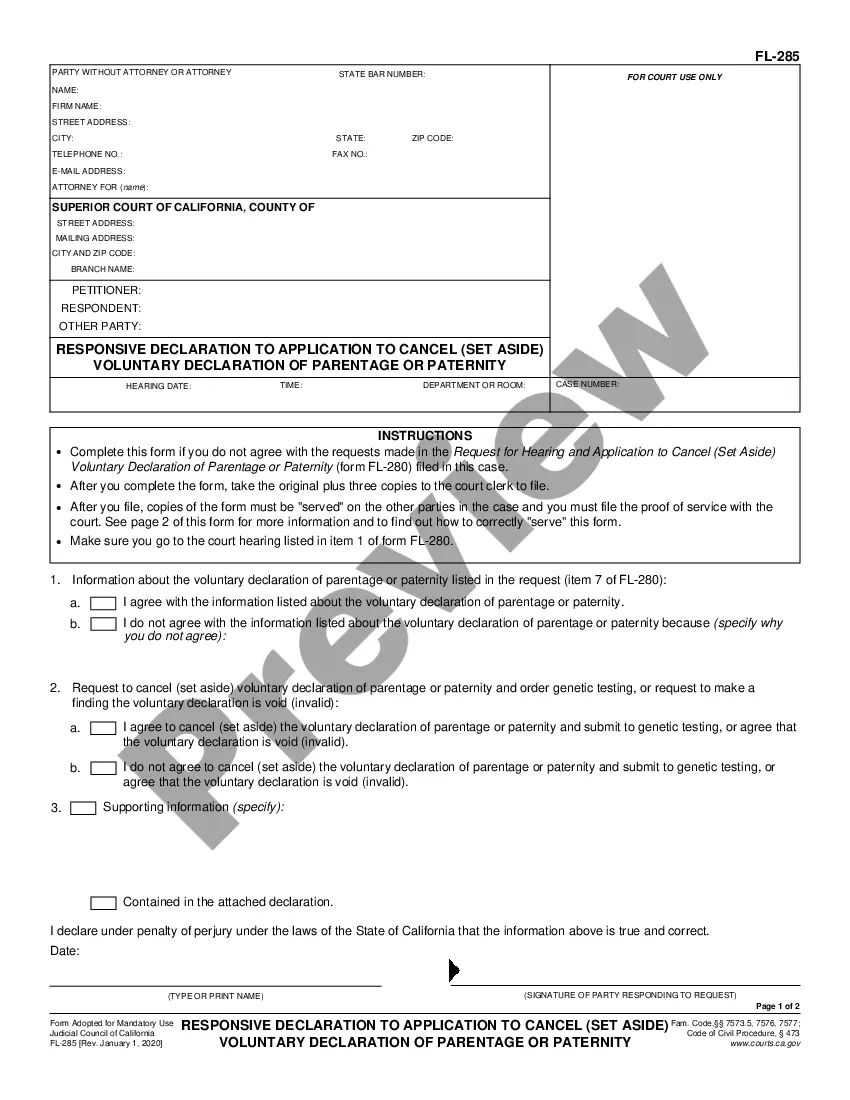
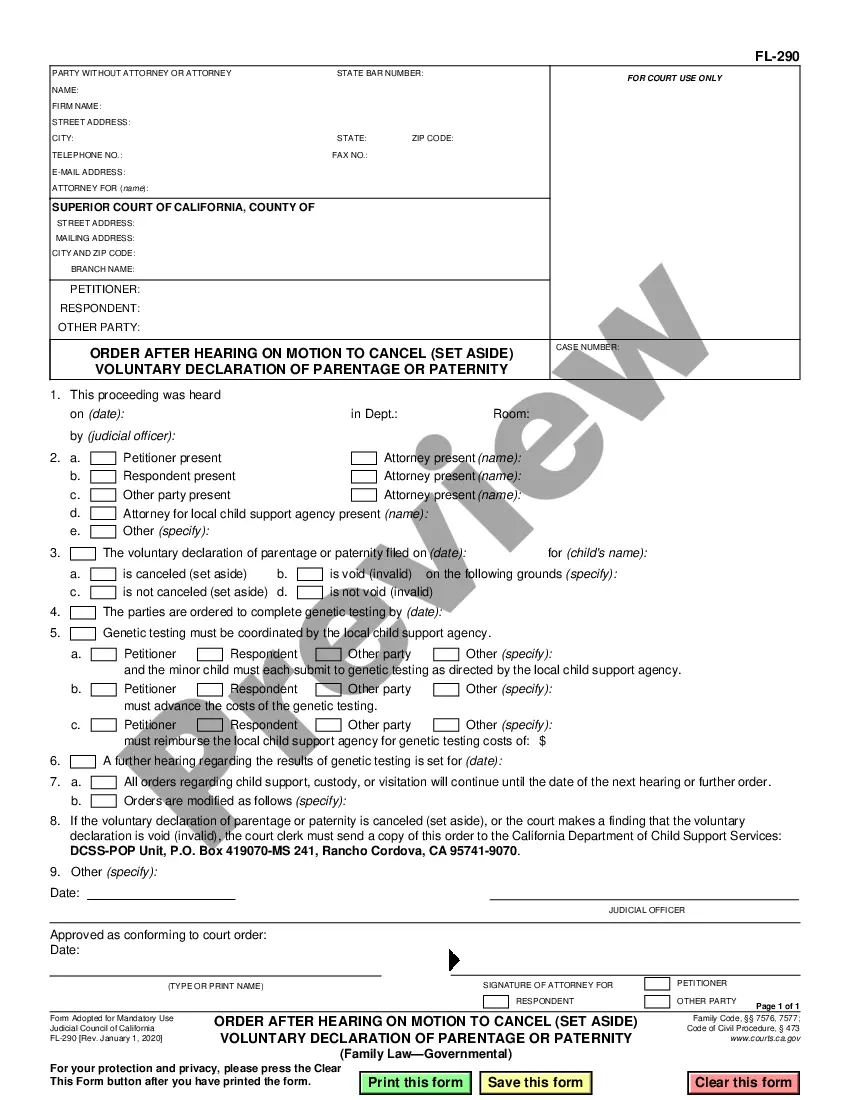
The Request for Hearing and Application to Set Aside Voluntary Declaration of Paternity is an official form used in California family law cases. This form allows parties to request a hearing to contest a voluntary declaration of paternity, which may have significant implications for child support and custody. It differs from similar forms by focusing specifically on the legal process of setting aside an existing declaration, ensuring parents can address any disputes regarding paternity.
Key parts of this document
- Petitioner and Respondent information: Details of the parties involved.
- Hearing details: Date, time, and location of the hearing.
- Grounds for request: Specific reasons for setting aside the voluntary declaration.
- Declaration of paternity: Information about the original declaration signed by parties.
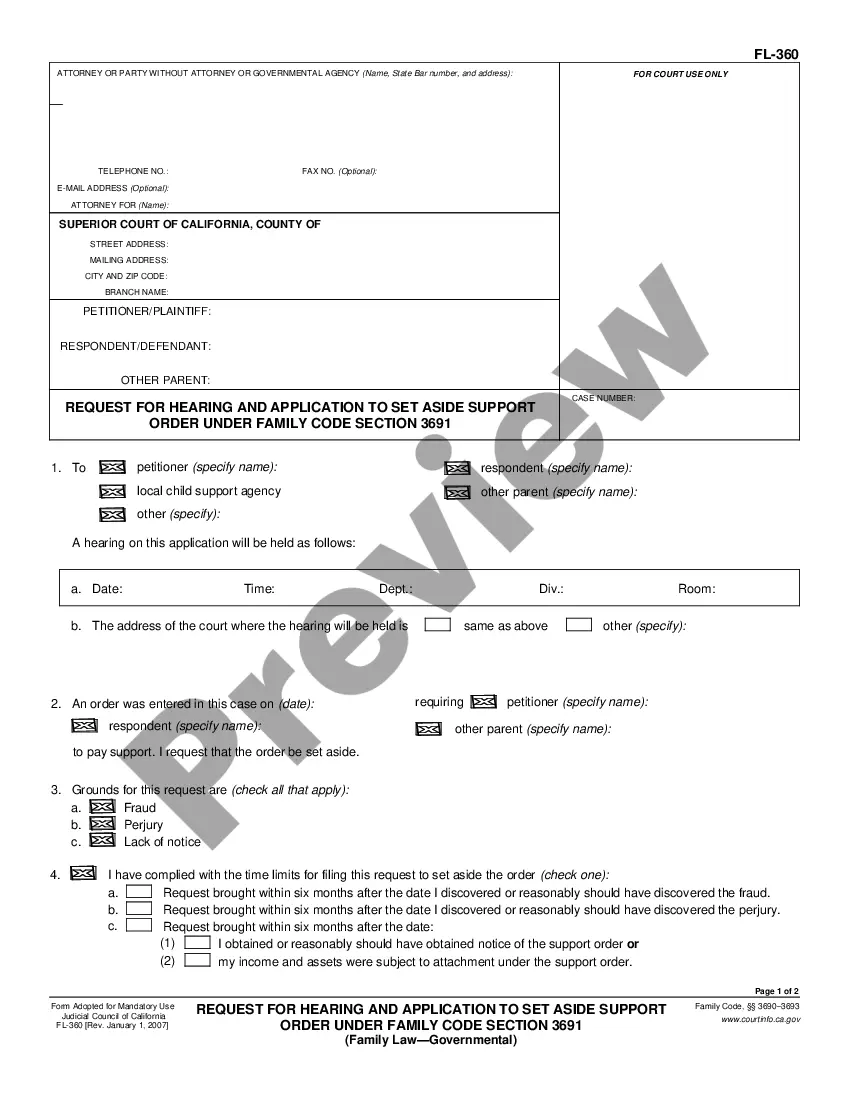
- Judgment reference: Details about any existing judgments or orders regarding paternity or support.
When this form is needed
This form should be used when a party wishes to challenge a previously signed voluntary declaration of paternity. Common scenarios include discovering new evidence that may prove the declaration was based on a mistake or fraud, or when there is a conflict with other paternity judgments. If there are concerns about the child's welfare or if new parentage issues arise, this form is relevant.
Who this form is for
- Individuals who have signed a voluntary declaration of paternity and wish to contest it.
- Respondents or petitioners involved in family law cases regarding child support, custody, or visitation.
- Local child support agencies acting on behalf of the child involved in the paternity case.
Completing this form step by step
- Identify and enter the names of all parties involved, including attorneys if applicable.
- Specify the date, time, and location of the requested hearing.
- Clearly state the grounds for requesting to set aside the voluntary declaration.
- Attach a copy of the original voluntary declaration of paternity, if applicable.
- Sign and date the form to authenticate the request.
Is notarization required?
This form does not typically require notarization unless specified by local law. However, it is recommended to check local court rules or consult with an attorney for specific requirements.
Get your form ready online
Our built-in tools help you complete, sign, share, and store your documents in one place.
Make edits, fill in missing information, and update formatting in US Legal Forms—just like you would in MS Word.
Download a copy, print it, send it by email, or mail it via USPS—whatever works best for your next step.
Sign and collect signatures with our SignNow integration. Send to multiple recipients, set reminders, and more. Go Premium to unlock E-Sign.
If this form requires notarization, complete it online through a secure video call—no need to meet a notary in person or wait for an appointment.
We protect your documents and personal data by following strict security and privacy standards.

Make edits, fill in missing information, and update formatting in US Legal Forms—just like you would in MS Word.

Download a copy, print it, send it by email, or mail it via USPS—whatever works best for your next step.

Sign and collect signatures with our SignNow integration. Send to multiple recipients, set reminders, and more. Go Premium to unlock E-Sign.

If this form requires notarization, complete it online through a secure video call—no need to meet a notary in person or wait for an appointment.

We protect your documents and personal data by following strict security and privacy standards.
Avoid these common issues
- Failing to file the request within the required time limits established by law.
- Not providing sufficient evidence or explanation for the request to set aside the declaration.
- Missing signatures or incomplete information on the form.
Benefits of using this form online
- Immediate access to the form simplifies the process of challenging paternity declarations.
- Editability allows users to tailor the content to their specific case needs.
- Reliable templates drafted by licensed attorneys ensure legal validity and compliance with state laws.
Looking for another form?
Form popularity
FAQ
A birth certificate is not considered a Voluntary Declaration of Paternity in California. While a birth certificate confirms a child's birth and parentage, a Voluntary Declaration of Paternity is a separate legal document that establishes paternity when both parents agree. If you need to challenge or set aside a Voluntary Declaration of Paternity, you may want to explore the California Request for Hearing and Application to Set Aside Voluntary Declaration of Paternity. This process ensures you understand your rights and obligations regarding parentage.
To file a motion to set aside a judgment in California, you will need to prepare the necessary documents, including a declaration that outlines your reasons for the request. It's essential to include the California Request for Hearing and Application to Set Aside Voluntary Declaration of Paternity as part of your submission. Once you have completed the paperwork, you must file it with the court that issued the original judgment. Consulting with a legal expert or using resources like US Legal Forms can help ensure that your filing complies with all state requirements.
A motion to set aside in California family court serves to nullify previous court decisions, including those regarding paternity. Specifically, this motion may arise from a California Request for Hearing and Application to Set Aside Voluntary Declaration of Paternity. The court reviews the motion based on supporting evidence and legal grounds. If you're unsure about the process, uslegalforms can provide guidance and helpful templates to ensure you submit a clear and effective motion.
To rescind a Voluntary Declaration of Paternity in California, you need to file a California Request for Hearing and Application to Set Aside Voluntary Declaration of Paternity. You have to act within the established timeframe, typically within 60 days of signing the declaration. It is crucial to provide valid reasons for the request, such as the absence of consent or mistaken identity. For assistance, consider using the user-friendly platform, uslegalforms, which offers resources and templates to simplify the process.
Setting aside a Voluntary Declaration of Paternity in California involves filing a legal motion in court. This process requires showing valid reasons, such as fraud or mistake, for wanting to revoke the declaration. Seeking help from uslegalforms can streamline your experience while navigating the California Request for Hearing and Application to Set Aside Voluntary Declaration of Paternity, ensuring you take the correct steps.
To obtain a copy of your paternity declaration in California, you can submit a request to the court where it was filed. You may also check with the California Department of Child Support Services, which keeps records of such documents. For further assistance, the uslegalforms platform can expedite your request while guiding you through the California Request for Hearing and Application to Set Aside Voluntary Declaration of Paternity process.
To request a declaration of paternity in California, you must complete the VDOP form and file it with the appropriate court. This process formalizes your status as the legal father and can enhance your parental rights. For straightforward instructions and form access, check uslegalforms, which simplifies the California Request for Hearing and Application to Set Aside Voluntary Declaration of Paternity.
In California, a father has until the child turns 18 years old to establish paternity. However, addressing this matter as early as possible is advisable to ensure that all legal rights are maintained. Utilizing the California Request for Hearing and Application to Set Aside Voluntary Declaration of Paternity can be crucial in clarifying paternity status effectively.
You can obtain a Voluntary Declaration of Paternity (VDOP) form from various sources in California, including local family law courts, hospitals, and the California Department of Child Support Services. Additionally, you can visit the uslegalforms platform for an online solution. This resource provides easy access to the necessary forms and guides you through the California Request for Hearing and Application to Set Aside Voluntary Declaration of Paternity.
A father can establish legal paternity in California by signing a voluntary acknowledgement of paternity or through a court order. If the father has not signed the acknowledgment, he may need to go through the court system to validate his relationship to the child. In such cases, the California Request for Hearing and Application to Set Aside Voluntary Declaration of Paternity is beneficial for those seeking to affirm their paternity status and gain legal recognition.