Homestead Declaration following Decree of Legal Separation or Divorce
What is this form?
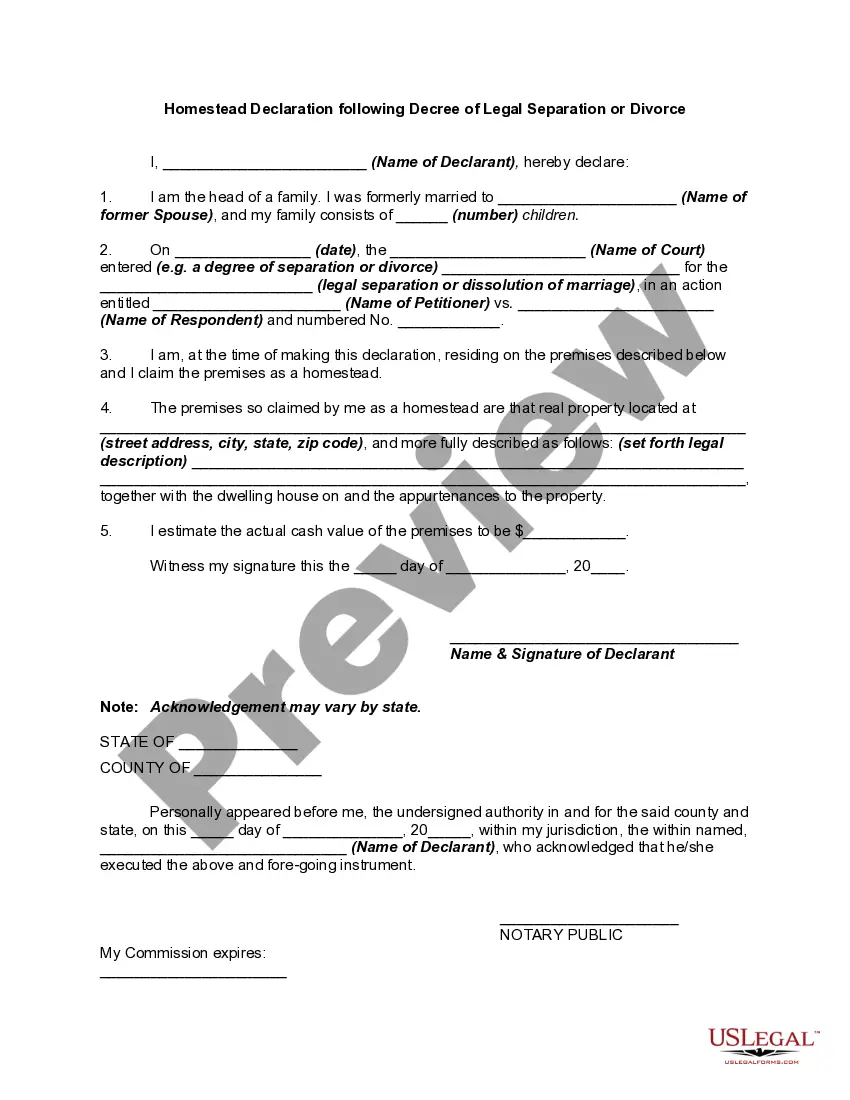
The Homestead Declaration following Decree of Legal Separation or Divorce is a legal document that allows an individual to declare their primary residence as a homestead. This declaration protects a home from forced sale due to debts following a legal separation or divorce. Unlike other property forms, this declaration specifically addresses the context of separation or divorce, establishing the claimant's right to claim homestead protection during these circumstances.
Main sections of this form
- Name of Declarant: The individual making the declaration.
- Former Spouse: The name of the individualâs ex-spouse.
- Date of Court Decree: The date when the court issued the decree of legal separation or divorce.
- Legal Description of Property: A detailed description of the property being claimed as a homestead.
- Estimated Cash Value: An estimate of the current market value of the declared property.
- Signature and Notary Section: The declaration requires a signature and may need notarization to be legally valid.


When to use this document
This form is necessary when an individual needs to formally declare their residence as homestead after a legal separation or divorce. It is often used to protect the home from being sold to pay off debts or claims which could arise after the dissolution of marriage. It is especially pertinent when the individual has dependents and wishes to secure their living situation.
Who should use this form
Individuals who should consider using this form include:
- Persons undergoing legal separation or divorce.
- Primary custodians of children from a previous marriage seeking protection for the family home.
- Homeowners who want to establish their residence as a homestead after separation or divorce.
How to prepare this document
To complete the Homestead Declaration following Decree of Legal Separation or Divorce, follow these steps:
- Identify the parties: Fill in the name of the declarant and the former spouse.
- Specify the relevant court details: Include the name of the court and the date the decree was issued.
- Enter the property information: Provide the street address and a detailed legal description of the homestead.
- Estimate the property's value: State the estimated cash value of the homestead.
- Sign and date the form: The declarant must sign and date the document, which may need to be notarized.
Notarization guidance
Yes, this form must be notarized to be legally valid. The presence of a notary public serves to verify the identity of the declarant and the authenticity of the signature. US Legal Forms offers integrated online notarization services that are available 24/7 through a secure video call.
Get your form ready online
Our built-in tools help you complete, sign, share, and store your documents in one place.
Make edits, fill in missing information, and update formatting in US Legal Forms—just like you would in MS Word.
Download a copy, print it, send it by email, or mail it via USPS—whatever works best for your next step.
Sign and collect signatures with our SignNow integration. Send to multiple recipients, set reminders, and more. Go Premium to unlock E-Sign.
If this form requires notarization, complete it online through a secure video call—no need to meet a notary in person or wait for an appointment.
We protect your documents and personal data by following strict security and privacy standards.

Make edits, fill in missing information, and update formatting in US Legal Forms—just like you would in MS Word.

Download a copy, print it, send it by email, or mail it via USPS—whatever works best for your next step.

Sign and collect signatures with our SignNow integration. Send to multiple recipients, set reminders, and more. Go Premium to unlock E-Sign.

If this form requires notarization, complete it online through a secure video call—no need to meet a notary in person or wait for an appointment.

We protect your documents and personal data by following strict security and privacy standards.
Mistakes to watch out for
- Failing to include the legal description of the property.
- Not accurately estimating the property's cash value.
- Skipping the notarization if required by local law.
- Leaving blank fields that are essential for the declarationâs validity.
Why use this form online
- Convenience: Downloadable and easy to access from US Legal Forms any time.
- Editability: Users can complete the form electronically for clarity and accuracy.
- Reliability: Forms drafted by licensed attorneys ensure legal compliance.
Quick recap
- The Homestead Declaration protects your primary residence in the event of debt after a separation or divorce.
- Ensure all necessary information is included to prevent issues with validity.
- Consult local laws for specific requirements to tailor the form to your jurisdiction.
Looking for another form?
Form popularity
FAQ
Greg, here in the state of Florida, when you have multiple owners of a piece of property and they own the property as joint tenants' rights of survivorship, they can get full homestead exemption, as long as at least one of them lives in the property.
Overview of Florida Homestead ProtectionFlorida homestead law protects a Florida resident's primary home from levy and execution by their judgment creditors. Article X, Section 4 of the Florida Constitution states that a judgment creditor cannot force the sale of your home to satisfy the creditor's money judgment.
A divorce and a property settlement are two different legal processes. A property settlement is the formal division of property following a couple separating. Discussions regarding the division of assets can occur as soon as a couple separates.You can formalise your property settlement without applying for a divorce.
Generally, a married couple is entitled to only one homestead exemption.If one of the spouses resides in another state and receives an ad valorem tax reduction with respect to his or her residence, generally, the spouse living in Florida is not entitled to a homestead exemption for his or her Florida residence.