Sample Sharps Injury Log
Understanding this form
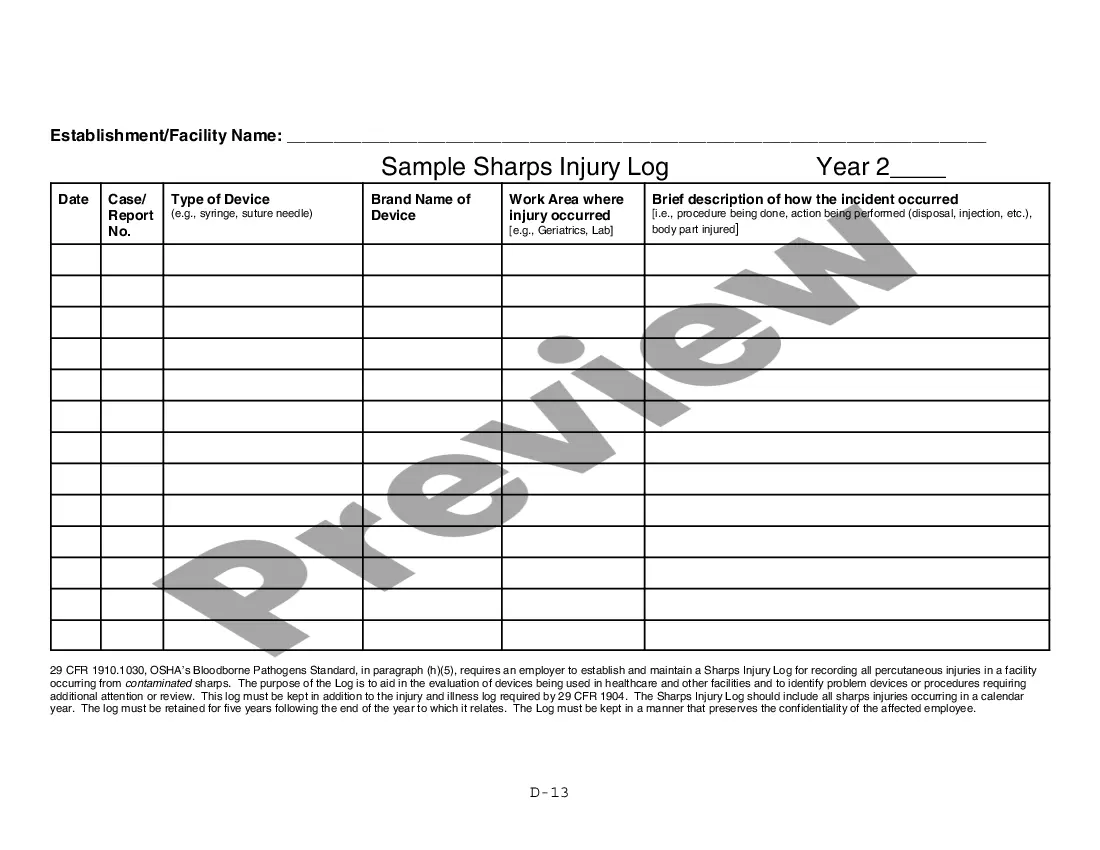
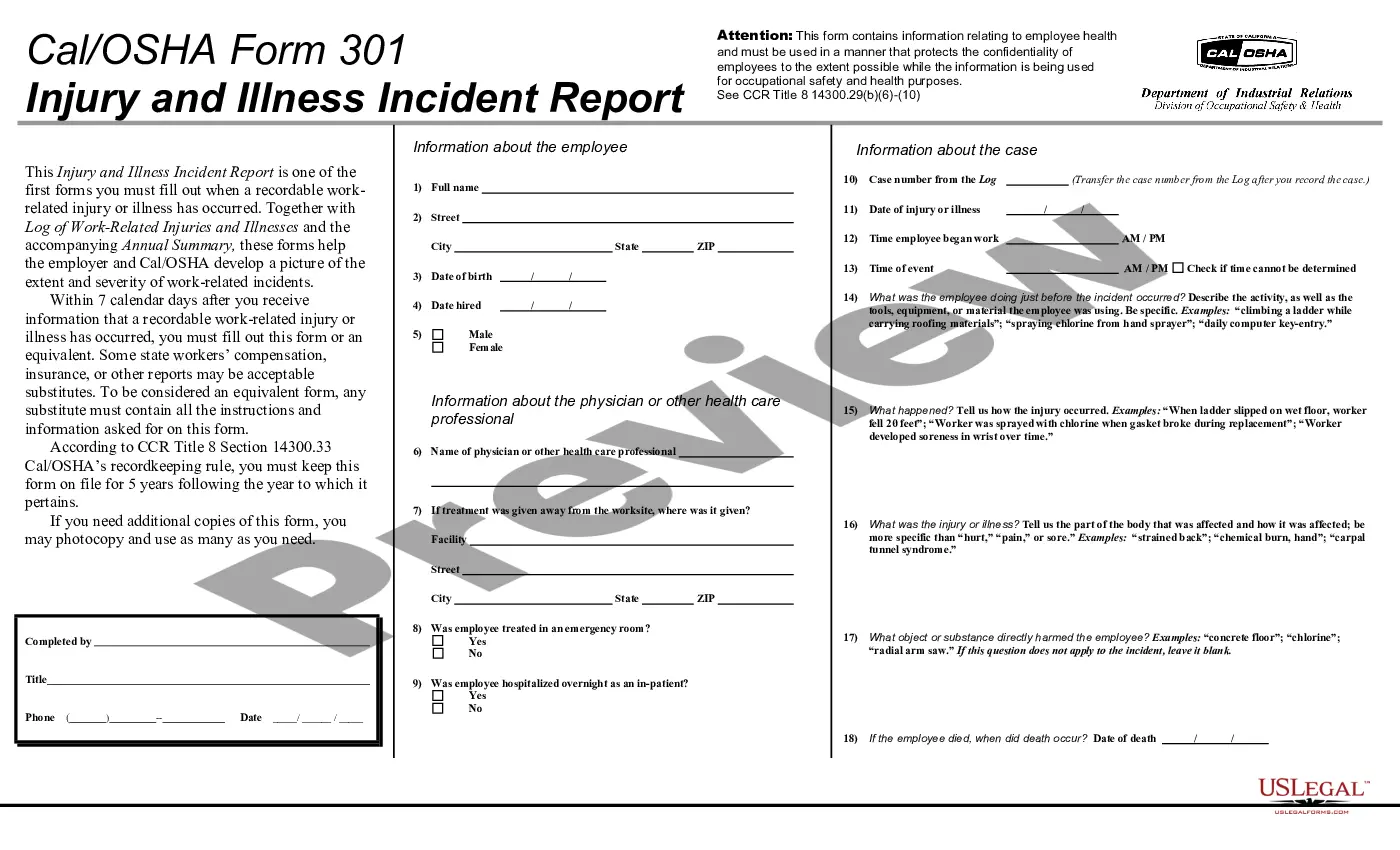
The Sample Sharps Injury Log is a crucial document used to record work-related injuries resulting from contaminated sharp objects, such as needle stick injuries and cuts. This log is specifically required by OSHA under the Bloodborne Pathogens Standard (29 CFR 1910.1030) to help employers monitor and evaluate incidents involving sharps. By maintaining this log, facilities ensure compliance with safety regulations and contribute to improving workplace safety protocols.
Main sections of this form
- Establishment/Facility Name: Enter the name of the healthcare facility or establishment.
- Date Case/Report No.: Document the date of the injury and assign a unique report number.
- Type of Device: Specify the type of sharp object involved in the injury, such as a syringe or suture needle.
- Brand Name of Device: Record the brand name of the specific device that caused the injury.
- Work Area: Indicate the location within the facility where the injury occurred.
- Incident Description: Provide a brief narrative of how the injury happened, including the procedure or action being performed.
When to use this form
This form should be used when any employee experiences a needle stick injury or cut from sharp objects at work. It is particularly important for healthcare settings, laboratories, and any environments where sharps are used, handled, or disposed of. The log should be updated for each incident within the calendar year to ensure accurate tracking and compliance with OSHA regulations.
Intended users of this form
- Healthcare employers responsible for worker safety.
- Occupational health and safety personnel.
- Workers in environments where sharp objects are used, such as hospitals, clinics, and laboratories.
- Facility managers overseeing compliance with safety regulations.
Steps to complete this form
- Enter the name of your establishment or facility at the top of the log.
- Fill in the date of the injury and document a report number for tracking.
- Specify the type of sharp device involved in the incident.
- Record the brand name of the device used during the incident.
- Indicate the specific work area where the injury occurred.
- Provide a detailed description of how the injury happened, including the actions performed at the moment of the incident.
Is notarization required?
Notarization is not commonly needed for this form. However, certain documents or local rules may make it necessary. Our notarization service, powered by Notarize, allows you to finalize it securely online anytime, day or night.
Get your form ready online
Our built-in tools help you complete, sign, share, and store your documents in one place.
Make edits, fill in missing information, and update formatting in US Legal Forms—just like you would in MS Word.
Download a copy, print it, send it by email, or mail it via USPS—whatever works best for your next step.
Sign and collect signatures with our SignNow integration. Send to multiple recipients, set reminders, and more. Go Premium to unlock E-Sign.
If this form requires notarization, complete it online through a secure video call—no need to meet a notary in person or wait for an appointment.
We protect your documents and personal data by following strict security and privacy standards.

Make edits, fill in missing information, and update formatting in US Legal Forms—just like you would in MS Word.

Download a copy, print it, send it by email, or mail it via USPS—whatever works best for your next step.

Sign and collect signatures with our SignNow integration. Send to multiple recipients, set reminders, and more. Go Premium to unlock E-Sign.

If this form requires notarization, complete it online through a secure video call—no need to meet a notary in person or wait for an appointment.

We protect your documents and personal data by following strict security and privacy standards.
Common mistakes
- Failing to document the incident promptly.
- Leaving out critical details in the incident description.
- Neglecting to keep the log updated for all incidents throughout the year.
- Not maintaining the confidentiality of affected employees.
Benefits of completing this form online
- Easy to download and print directly from your device.
- Editable fields for clear and consistent documentation.
- Maintain compliance with OSHA requirements efficiently.
- Secure storage options for keeping injury logs confidential.
Legal use & context
- This form is a legal requirement for employers under OSHA regulations.
- Maintaining a sharps injury log aids in compliance and protects against potential legal issues.
- Failure to document sharps injuries can lead to penalties and increased liability.
Looking for another form?
Form popularity
FAQ
The sharps injury log should include all sharps injuries occurring in a calendar year and must be kept for five years following the end of the year to which it relates. The log must be kept in a manner the preserves the confidentiality of the affected individual.
The Sharps Log must contain, at a minimum, information about the injury, the type and brand of device involved in the injury (if known), the department or work area where the exposure occurred, and an explanation of how the incident occurred.
Encourage the wound to gently bleed, ideally holding it under running water. Wash the wound using running water and plenty of soap. Don't scrub the wound while you are washing it. Don't suck the wound. Dry the wound and cover it with a waterproof plaster or dressing.
Don't scrub the wound while you are washing it. Don't suck the wound. Dry the wound and cover it with a waterproof plaster or dressing. Seek urgent medical advice (for example from your occupational health service) as effective prophylaxis (medicines to help fight infection) are available.
The Sharps Log must contain, at a minimum, information about the injury, the type and brand of device involved in the injury (if known), the department or work area where the exposure occurred, and an explanation of how the incident occurred.
Both the OSHA Recordkeeping Rule and the Bloodborne Pathogens Standard (29 CFR 1910.1030) require that employers record all work-related needlestick injuries and cuts from sharp objects that are contaminated with another person's blood or other potentially infectious material.
Response: The sharps injury log is used to track devices that are causing injuries and may need to be replaced; it is not intended to track employees having injuries. The log is a valuable surveillance tool for healthcare facilities to identify departments, devices, and/or procedures where injuries are occurring.
The Sharps Log must contain, at a minimum, information about the injury, the type and brand of device involved in the injury (if known), the department or work area where the exposure occurred, and an explanation of how the incident occurred.