Letter Rejecting Tender of Check
Overview of this form
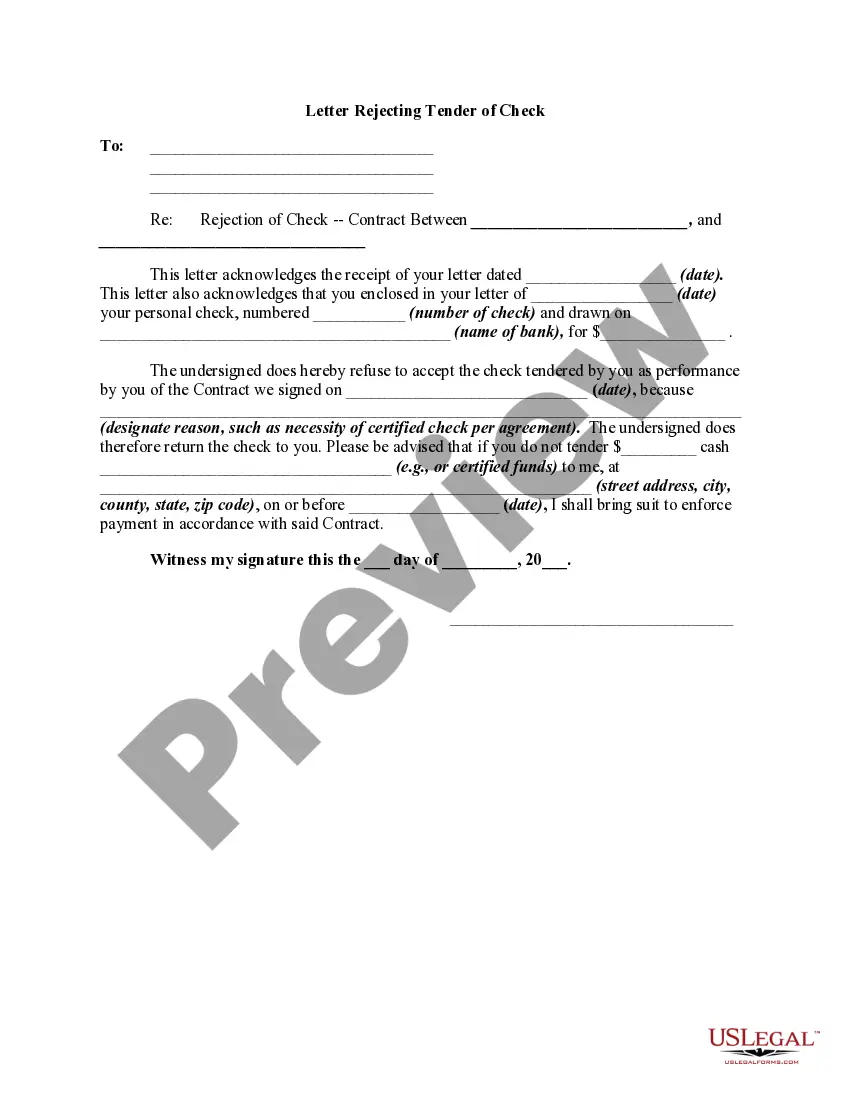
The Letter Rejecting Tender of Check is a legal form used to formally decline a check offered as payment for a debt or obligation. This form serves to document the refusal of a tender, providing a clear basis for any necessary legal follow-up. It differs from other payment-related forms as it specifically focuses on rejecting a tendered check, signaling that the payment does not satisfy the requirements of a contract.
Key components of this form
- Recipient's name and address: Identify the party to whom the letter is directed.
- Subject line: Clearly state the purpose of the letter, including reference to the contract involved.
- Details of the check: Record the check number, date, bank name, and amount.
- Reason for rejection: Specify why the check is not accepted, such as a requirement for certified funds.
- Notice for further action: Indicate what is required from the check issuer moving forward, including timelines.
- Signature line: Provide space for the sender's signature and date.
When to use this document
This form is necessary when a party receives a check as tender for a financial obligation but must refuse it due to specific reasons. Common situations might include instances where the terms of the original contract specify that only certified funds are acceptable, or when the amount on the check is insufficient. Utilizing this form helps formalize the rejection and outlines the next steps required to rectify the payment issue.
Who this form is for
- Individuals or businesses entering into contracts requiring specific types of payment.
- Creditors who have received checks that do not meet the contractual terms.
- Anyone involved in financial transactions who needs to document a rejection of a check.
Instructions for completing this form
- Identify the parties involved: Enter the name and address of both parties.
- Input details of the check: Include the check number, issuing bank, and check amount.
- State the reason for rejection: Clearly articulate why the check is not being accepted.
- Specify the required payment method: Indicate what payment form is acceptable and set any deadlines.
- Sign and date the letter: Ensure that you sign the document to validate it.
Is notarization required?
Notarization is not commonly needed for this form. However, certain documents or local rules may make it necessary. Our notarization service, powered by Notarize, allows you to finalize it securely online anytime, day or night.
Get your form ready online
Our built-in tools help you complete, sign, share, and store your documents in one place.
Make edits, fill in missing information, and update formatting in US Legal Forms—just like you would in MS Word.
Download a copy, print it, send it by email, or mail it via USPS—whatever works best for your next step.
Sign and collect signatures with our SignNow integration. Send to multiple recipients, set reminders, and more. Go Premium to unlock E-Sign.
If this form requires notarization, complete it online through a secure video call—no need to meet a notary in person or wait for an appointment.
We protect your documents and personal data by following strict security and privacy standards.

Make edits, fill in missing information, and update formatting in US Legal Forms—just like you would in MS Word.

Download a copy, print it, send it by email, or mail it via USPS—whatever works best for your next step.

Sign and collect signatures with our SignNow integration. Send to multiple recipients, set reminders, and more. Go Premium to unlock E-Sign.

If this form requires notarization, complete it online through a secure video call—no need to meet a notary in person or wait for an appointment.

We protect your documents and personal data by following strict security and privacy standards.
Common mistakes to avoid
- Not providing a clear reason for the rejection, which may lead to confusion.
- Failing to specify the required payment method, making it unclear how to proceed.
- Neglecting to keep a copy of the letter for personal records.
Why complete this form online
- Convenient access: Download and complete the form quickly from anywhere.
- Editability: Easily customize the form to fit specific needs.
- Reliable templates: Use professionally drafted forms that comply with legal standards.
Legal use & context
- This letter serves as a formal notice of rejection, creating a record of the transaction.
- Rejecting a payment method can safeguard creditors from accepting invalid funds.
- Failure to follow proper rejection procedures could complicate future legal action for debt recovery.
Quick recap
- The Letter Rejecting Tender of Check is crucial for formalizing the rejection of a check that fails to meet contract terms.
- Precise communication in the letter helps prevent misunderstandings and potential disputes.
- Using this form effectively protects creditors' rights and ensures proper compliance with payment requirements.
Looking for another form?
Form popularity
FAQ
Genuinely hear their request. Focus on what you CAN do. Be gentle and provide next steps. Don't waste time, but don't burn bridges either. Decline with gratitude. Offer alternatives. Position yourself as the expert. Be clear, transparent and upfront.
Format the letter with a professional tone and structure. Thank the company for their bid. Complement the contractor on their proposal, past work or reputation. Reject the bid.
Offer a clear and valid reason for rejecting the proposal. The recipient requires some explanation as to why their proposal didn't sail through. Use a polite tone. Be professional. Express wiliness to work with the client in the future should they meet your requirements.
Get straight to the point. Give them feedback. Let the candidate know that there may still be a chance. Wish them good luck. Send it as soon as possible. Write different rejection letters for each stage in the hiring process. Keep it personal. Thank the candidate.
Keep it timely. Send the rejection letter within a reasonable amount of time after you have determined the candidate will not be hired. Be direct, but gracious. Remain neutral. Personalize it. Leave the door open. Wish them well.
Thank the Person. Deliver the News Directly. Explain Your Reasoning. Suggest Other Ways of Partnership (If Appropriate) Keep the Professional Tone of Voice. Don't Explain Rejection with Price. End Your Email Appropriately. Rejection with a Willingness to Receive Other Service Offers.
Get straight to the point. Give them feedback. Let the candidate know that there may still be a chance. Wish them good luck. Send it as soon as possible. Write different rejection letters for each stage in the hiring process. Keep it personal. Thank the candidate.
Respond by first restating the original request to prevent confusion. Be specific about the reason the request has been denied and offer an alternative if applicable, such as a different date when an absence would be feasible. Use polite and professional language. Being blunt could cause undue offence.