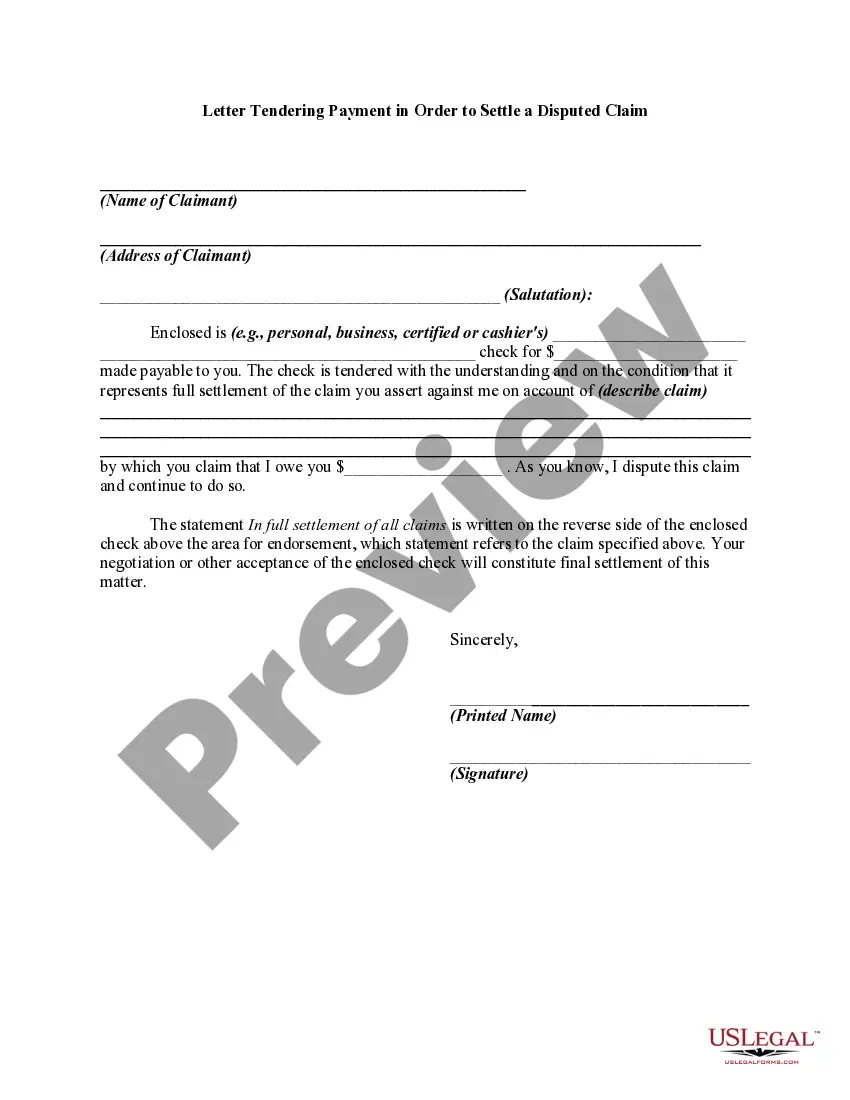
Letter Tendering Payment in Order to Settle a Disputed Claim
Overview of this form
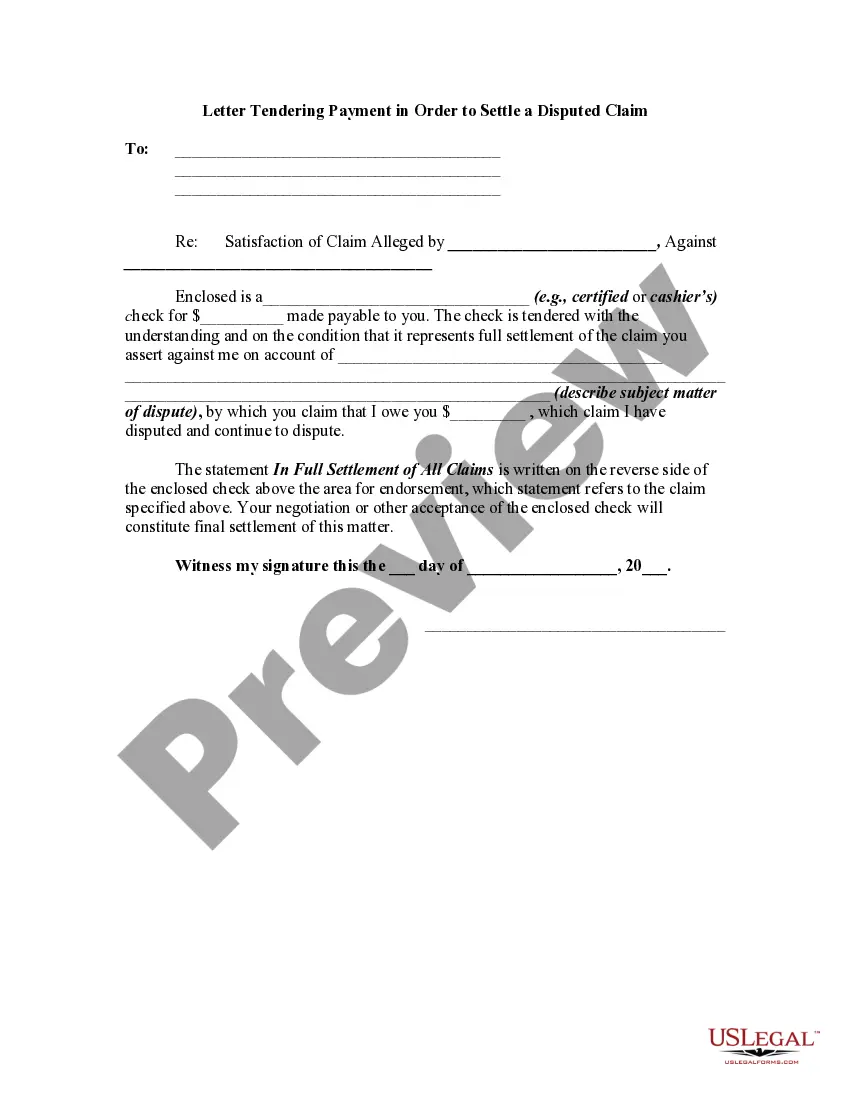
The Letter Tendering Payment in Order to Settle a Disputed Claim is a legal document used when a debtor disputes a claim made by a creditor. This form allows the debtor to send a check to the creditor, clearly indicating that the payment is intended as full settlement of the disputed claim. Unlike other settlement agreements, this letter ensures that the creditor's acceptance of the check equates to resolution of the claim, emphasizing the debtorâs ongoing dispute over the validity of the amount owed.
Key components of this form
- Name and address of the claimant
- Salutation to the creditor
- Amount and type of payment enclosed
- Description of the disputed claim
- Statement indicating the check is in full settlement
- Printed name and signature of the debtor
When to use this form
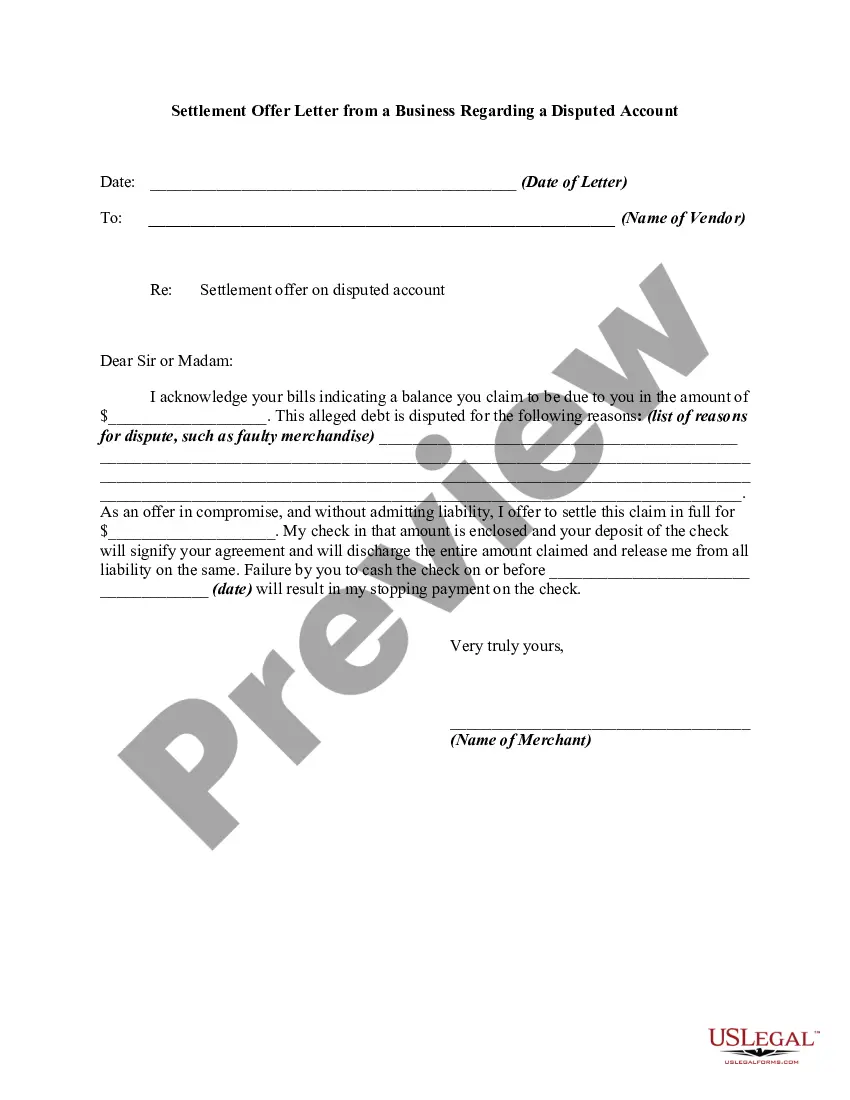
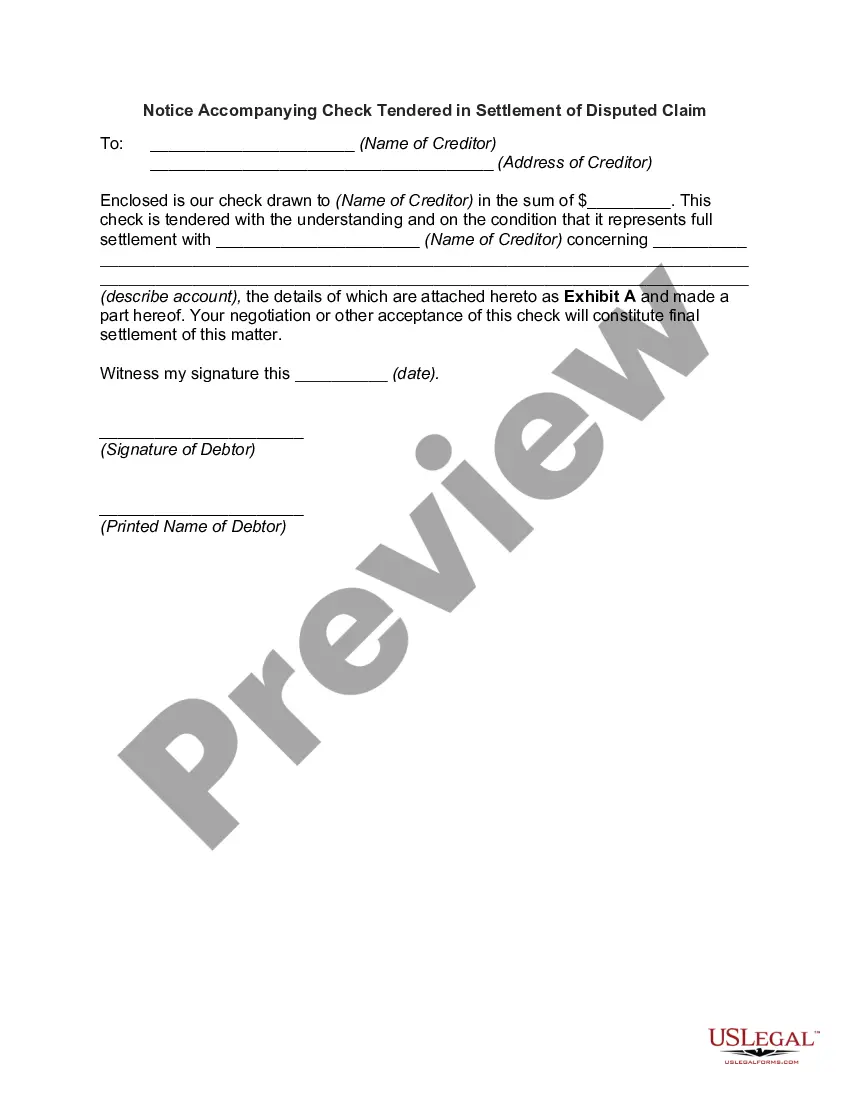
This form is used when a debtor wants to formally offer a payment to a creditor while disputing the validity of the claim. It serves to document that the debtor is tendering payment with the condition that it is accepted as full settlement. Scenarios include instances where the amount claimed is believed to be incorrect, excessively high, or when the debtor contests the underlying obligation altogether.
Who can use this document
- Debtors who are facing a claim from a creditor
- Individuals or businesses looking to dispute a specific claim
- Those seeking to settle a claim while formally documenting their dispute
How to complete this form
- Identify the parties by entering the name and address of the claimant.
- Begin the letter with an appropriate salutation to the creditor.
- Write the type and amount of payment being enclosed.
- Describe the nature of the claim that is being disputed.
- Clearly state that the check is intended as full settlement of the claim.
- Sign the form and include your printed name beneath the signature.
Is notarization required?
This form does not typically require notarization unless specified by local law. It is advisable to check your stateâs regulations to confirm.
Get your form ready online
Our built-in tools help you complete, sign, share, and store your documents in one place.
Make edits, fill in missing information, and update formatting in US Legal Forms—just like you would in MS Word.
Download a copy, print it, send it by email, or mail it via USPS—whatever works best for your next step.
Sign and collect signatures with our SignNow integration. Send to multiple recipients, set reminders, and more. Go Premium to unlock E-Sign.
If this form requires notarization, complete it online through a secure video call—no need to meet a notary in person or wait for an appointment.
We protect your documents and personal data by following strict security and privacy standards.

Make edits, fill in missing information, and update formatting in US Legal Forms—just like you would in MS Word.

Download a copy, print it, send it by email, or mail it via USPS—whatever works best for your next step.

Sign and collect signatures with our SignNow integration. Send to multiple recipients, set reminders, and more. Go Premium to unlock E-Sign.

If this form requires notarization, complete it online through a secure video call—no need to meet a notary in person or wait for an appointment.

We protect your documents and personal data by following strict security and privacy standards.
Avoid these common issues
- Failing to specify that the payment is in full settlement of the claim.
- Not clearly describing the disputed claim.
- Forgetting to include a signature or printed name.
- Sending the letter without including the check.
- Using vague language that could lead to misinterpretation.
Why complete this form online
- Convenience of completing the form from anywhere at any time.
- Editability allows for tailored and specific entries.
- Reliability of forms drafted by licensed attorneys to ensure legal validity.
Looking for another form?
Form popularity
FAQ
Some people wonder if they can save even more by money by writing their own settlement agreement and not seeking the help of a divorce attorney at all. While there is no legal requirement that you have a lawyer draft your settlement agreement, it is certainly a good idea to do so.
It depends on what you can afford, but you should offer equal amounts to each creditor as a full and final settlement. For example, if the lump sum you have is 75% of your total debt, you should offer each creditor 75% of the amount you owe them.
Type your letter. Concisely review the main facts. Be polite. Write with your goal in mind. Ask for exactly what you want. Set a deadline. End the letter by stating you will promptly pursue legal remedies if the other party does not meet your demand. Make and keep copies.
Writing the Agreement First, give the document a title that describes the settlement. Next, write a paragraph that identifies all parties involved in the lawsuit and indicates their roles. This should also include their addresses and note that they have the authority and capacity to sign the agreement.
Beware checks with "Payment in Full," "Full and Final Settlement" or similar language is written in the memo field or endorsement area. When these checks are cashed, they are very often binding and can eliminate your rights to recover under contract or the mechanics lien laws.