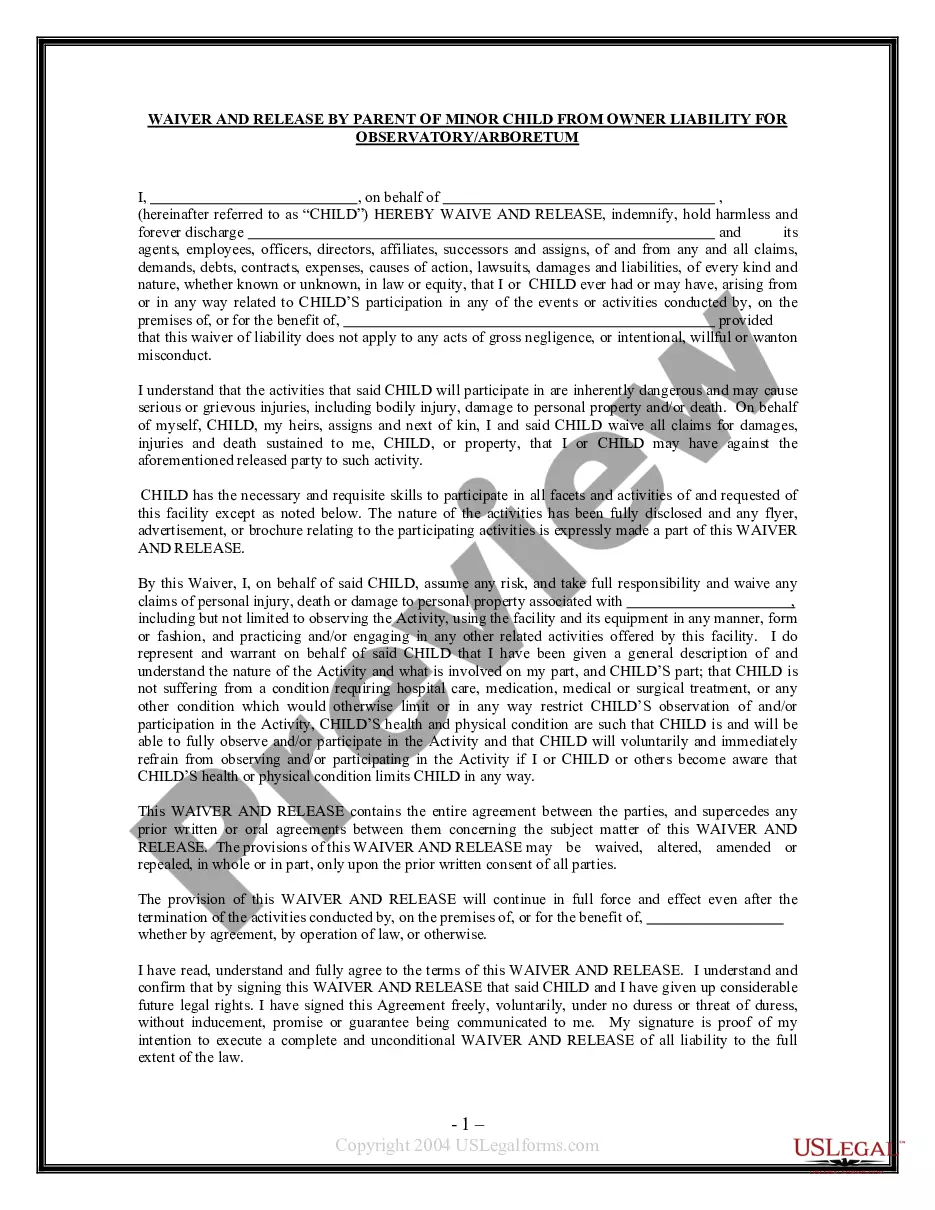
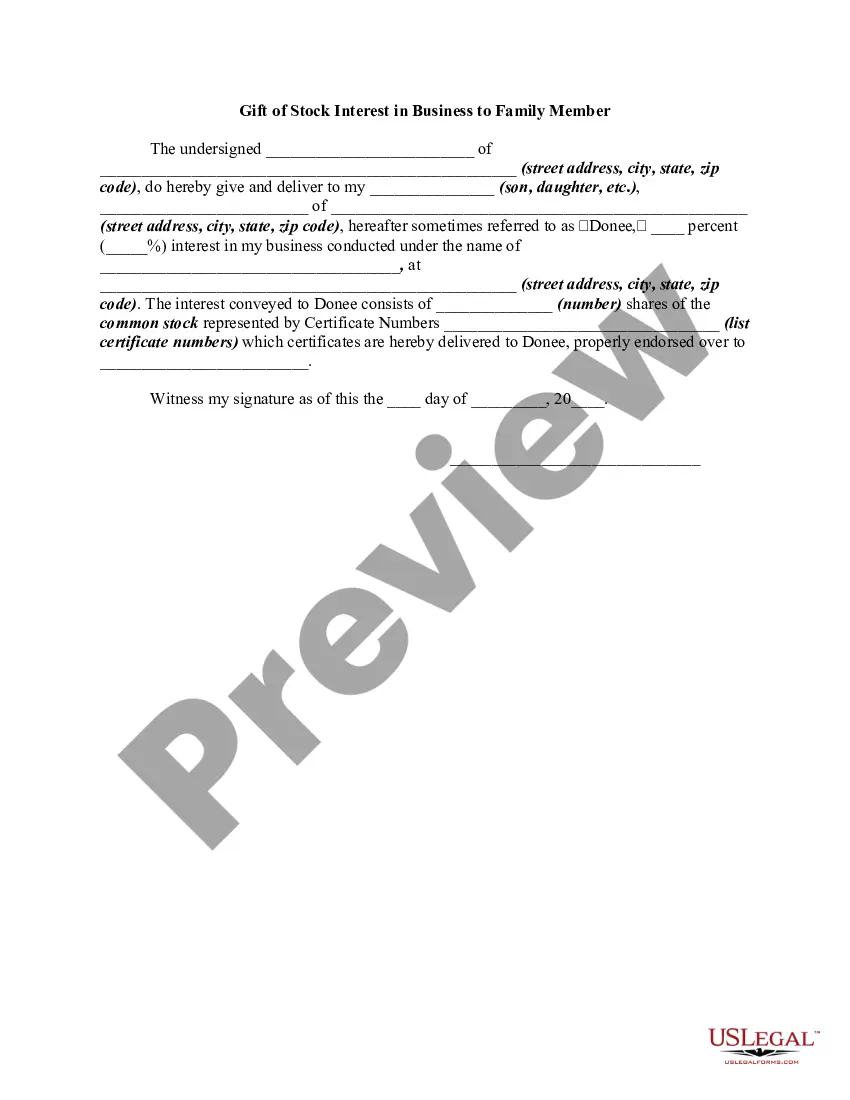
Gift of Stock Interest in Business to Family Member
Overview of this form
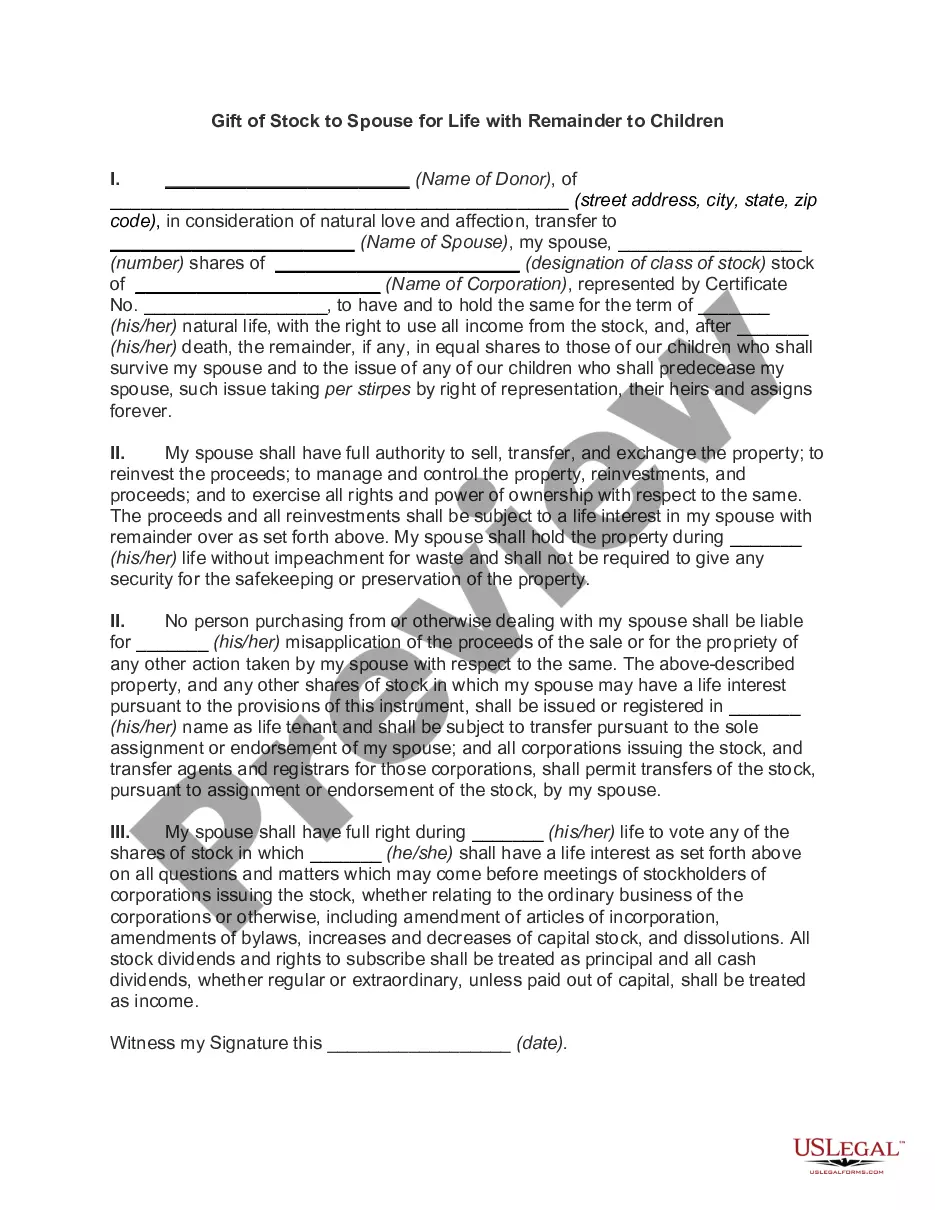
The Gift of Stock Interest in Business to Family Member is a legal document allowing you to transfer ownership of business stock to a family member without receiving anything in return. This form ensures that the title of the stock is passed with the intent of making a gift, distinguishing it from other transactions that involve compensation or consideration. By using this form, you can clearly document the gift, providing security for both the giver and the recipient.
Main sections of this form
- Name and address of the donor.
- Name and address of the family member receiving the gift (donee).
- Description of the business and the specific stock interest being transferred.
- Number of shares and any associated certificate numbers.

When to use this document
Use this form when you wish to formally gift shares of your business to a family member, such as a child, spouse, or parent. This situation typically arises during estate planning, to reduce tax liabilities, or simply to support family members in business endeavors. It is essential to have a documented record of the transaction to ensure legal clarity and to protect both parties' interests.
Intended users of this form
This form is intended for individuals who own shares in a business and wish to gift a portion of those shares to a family member. It is suitable for:
- Parents gifting stock to their children.
- Spouses transferring business interest to one another.
- Grandparents wishing to pass down family business interests.
How to prepare this document
- Identify the donor's full name and address at the top of the form.
- Fill in the name and relationship of the donee (recipient of the gift).
- Specify the business name and address associated with the stock interest.
- Indicate the number of shares being gifted and note the corresponding certificate numbers.
- Sign and date the form to validate the gesture of gifting.
Does this document require notarization?
This form does not typically require notarization unless specified by local law. However, notarizing the document can add an extra layer of legitimacy and may be advisable in certain situations. If you have questions about the notarization process, consider consulting with a legal professional.
Get your form ready online
Our built-in tools help you complete, sign, share, and store your documents in one place.
Make edits, fill in missing information, and update formatting in US Legal Forms—just like you would in MS Word.
Download a copy, print it, send it by email, or mail it via USPS—whatever works best for your next step.
Sign and collect signatures with our SignNow integration. Send to multiple recipients, set reminders, and more. Go Premium to unlock E-Sign.
If this form requires notarization, complete it online through a secure video call—no need to meet a notary in person or wait for an appointment.
We protect your documents and personal data by following strict security and privacy standards.

Make edits, fill in missing information, and update formatting in US Legal Forms—just like you would in MS Word.

Download a copy, print it, send it by email, or mail it via USPS—whatever works best for your next step.

Sign and collect signatures with our SignNow integration. Send to multiple recipients, set reminders, and more. Go Premium to unlock E-Sign.

If this form requires notarization, complete it online through a secure video call—no need to meet a notary in person or wait for an appointment.

We protect your documents and personal data by following strict security and privacy standards.
Typical mistakes to avoid
- Forgetting to include the donee's address.
- Not providing the correct certificate numbers for the shares being gifted.
- Failing to sign and date the document, making it unenforceable.
Benefits of using this form online
- Convenience of downloading and printing the form at your convenience.
- Editability allows you to customize the document to fit your specific needs.
- Reliable templates drafted by licensed attorneys ensure legal compliance.
Key takeaways
- The Gift of Stock Interest in Business to Family Member form facilitates gifting ownership of business stock without financial exchange.
- It is essential for individuals considering stock transfer as part of estate planning or family financial support.
- Completing the form accurately ensures a legally recognized gift and helps avoid potential disputes.
Looking for another form?

Form popularity
FAQ
The Various Ways of Transferring Ownership. It is possible to transfer the ownership of a business in multiple ways or through a business succession plan. The Sale. Adding a Business Partner. The Family Member Transfer. Sale of Assets in a Sole Proprietorship. Legal Support through the Transfer of Ownership.
The three main ways in which a business can be transferred to a family member is as a gift, through a sale, or through a partial sale. You might think that a sale would always be the obvious choice because you can make money that way.
Consider transferring the business as a gift, and drawing an income from the new owners. The lifetime federal gift tax exemption for 2021 is $11.7 million for individuals and $23.4 million for married couples. That gives business owners considerable latitude to transfer a part or all of the company as a gift.
Review your Operating Agreement and Articles of Organization. Establish What Your Buyer Wants to Buy. Draw Up a Buy-Sell Agreement with the New Buyer. Record the Sale with the State Business Registration Agency.
The recipient of a gift doesn't pay a gift tax, but when he or she decides to sell the stock, they have to calculate a value for income tax purposes.
Adding a Partner. The operating agreement describes how new partners can be taken on and how much the new partners will have to pay for their ownership interests. Sale of Business. There are two major methods to sell a private business: Lease-Purchase. Family Member Transfer.
Contact the firm that holds your stock for transfer paperwork. Complete the stock transfer form. Verify whether you are required to get a Medallion Signature Guarantee. Check for further documentation requirements. Submit your stock certificate to your financial services firm along with your completed paperwork.
When gifting stock to a relative, there is no tax impact for the donor or the relative receiving the shares. If the value of the gift is within the annual gifting limits, there is nothing for the donor to file.
The good news is that there is no Capital Gains Tax on gifts of assets (including shares) you give to your spouse or civil partner.However, in the case of a gift of shares, the market value of the shares at the time of disposal is taken into account for capital gains tax and inheritance tax purposes.