Defendant Initial Document Request
What this document covers
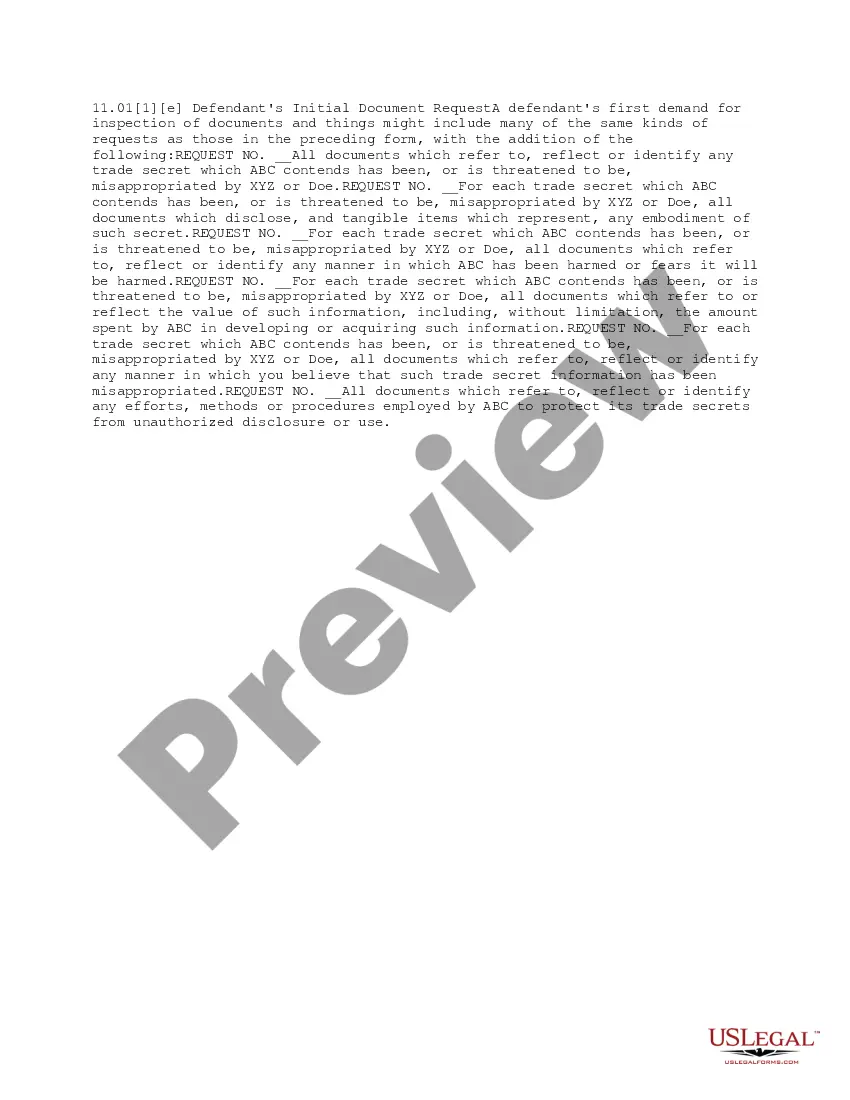
The Defendant Initial Document Request is a legal form used by defendants in litigation involving claims related to licensing, patents, or commercial trade secrets. This form allows a defendant to formally request evidence and documentation relevant to the case, thus differing from other forms that may not focus specifically on initial document demands in trade secret disputes.
What’s included in this form
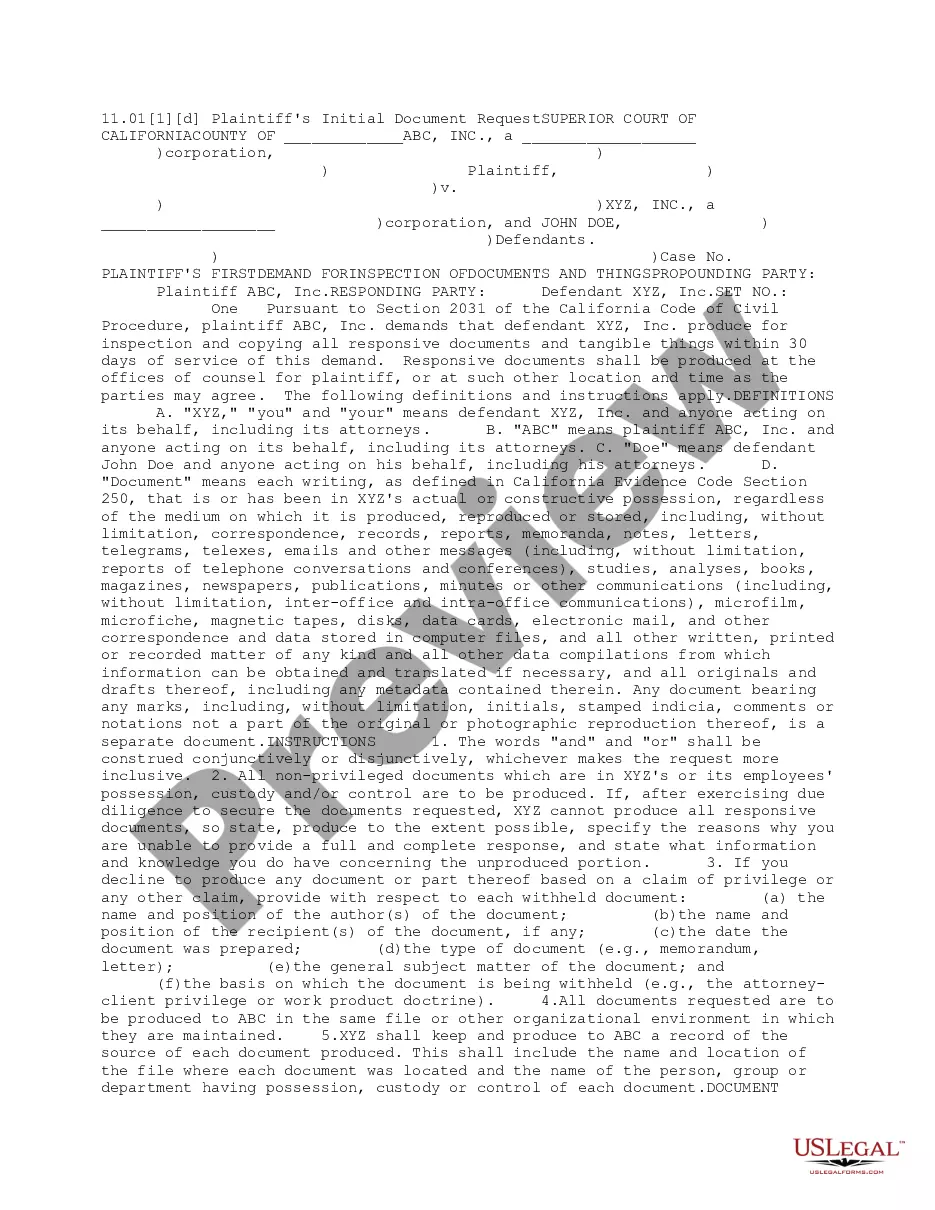
- REQUEST NO. for documents that refer to, reflect, or identify any claimed trade secrets.
- REQUEST NO. for all documents disclosing and tangible items representing each contested trade secret.
- REQUEST NO. for documents showing how the claimant believes they have been harmed or may be harmed.
- REQUEST NO. for documents indicating the value of the contested trade secret information.
- REQUEST NO. for documents reflecting the methods employed to protect trade secrets from unauthorized disclosure.
Common use cases
This form is commonly used at the outset of a legal case when a defendant needs to gather information that could support their defense against claims of trade secret misappropriation. It is particularly relevant in situations where the defendant needs to inspect documents or items that the plaintiff claims are confidential or proprietary.
Who can use this document
- Defendants involved in litigation over licensing, patents, or commercial trade secrets.
- Parties seeking to collect evidence to prepare for defense in a legal claim.
- Legal representatives acting on behalf of defendants in trade secret disputes.
Instructions for completing this form
- Identify the parties involved in the dispute.
- Detail each request by specifying the documents or items needed for inspection.
- Ensure that all requests are clear and pertain only to the contested trade secrets.
- Review the document for completeness and accuracy before submitting.
- Sign and date the form to validate the requests made.
Is notarization required?
Notarization is generally not required for this form. However, certain states or situations might demand it. You can complete notarization online through US Legal Forms, powered by Notarize, using a verified video call available anytime.
Get your form ready online
Our built-in tools help you complete, sign, share, and store your documents in one place.
Make edits, fill in missing information, and update formatting in US Legal Forms—just like you would in MS Word.
Download a copy, print it, send it by email, or mail it via USPS—whatever works best for your next step.
Sign and collect signatures with our SignNow integration. Send to multiple recipients, set reminders, and more. Go Premium to unlock E-Sign.
If this form requires notarization, complete it online through a secure video call—no need to meet a notary in person or wait for an appointment.
We protect your documents and personal data by following strict security and privacy standards.

Make edits, fill in missing information, and update formatting in US Legal Forms—just like you would in MS Word.

Download a copy, print it, send it by email, or mail it via USPS—whatever works best for your next step.

Sign and collect signatures with our SignNow integration. Send to multiple recipients, set reminders, and more. Go Premium to unlock E-Sign.

If this form requires notarization, complete it online through a secure video call—no need to meet a notary in person or wait for an appointment.

We protect your documents and personal data by following strict security and privacy standards.
Avoid these common issues
- Failing to specify each trade secret clearly in the request.
- Omitting necessary documents that could support the defense.
- Not reviewing local laws or court rules that may affect the request.
Why complete this form online
- Easy access to a professionally drafted form, ensuring legal compliance.
- Ability to edit the form to suit specific case needs.
- Immediate download for quick use in your legal proceedings.
Legal use & context
- This document serves as a legitimate method to request evidence in trade secret claims.
- Understanding how trade secrets are defined legally is crucial for effective use of this form.
- Using this form correctly can strengthen a defendant's position in litigation.
Looking for another form?

Form popularity
FAQ
Thank you for your inquiry regarding our product or service. Thank you for your interest in our product or service. We would like to thank you for your letter inquiring about our product. We truly appreciate your letter asking for information about our service.
A request for production is a discovery device used to gain access to documents, electronic data, and physical items held by an opposing party in a legal matter. The aim is to gain insight into any relevant evidence that the opposing party holds.
Requests for Admissions involves one party asking the opposing to admit, deny, or prove the validity of certain facts or documents. This portion of the discovery saves time during the trial and allows the party to trust the facts or documents in question.
A request for documents is a legal way the plaintiff can get information from you about the case.It will say Request for Documents at the top. This is part of the discovery process. If you do not respond in 30 days, the Plaintiff may be able to get a default judgment against you and win the case.
Have a strategy. Adjust the scope of your requests to the questions at issue. Send clear requests. Always consider how your client would be prepared to respond to similar requests. Make your objections clear and specific.
Your name and address. The Court's name. The title of the case. Case number. Fill your name in as the Requesting Party. On the following pages, choose which questions you wish to ask by checking boxes next to the questions you wish to ask.
When responding to Requests for Admissions, remember to answer as follows: Admit: If any portion of the Request for Admission is true then you must admit to that portion of the request. You are also allowed to have a hybrid response admit the part of the request that is true while denying another part.
If a request asks for a document, make a copy of the document; in your response, describe the document and say that a copy is attached; and attach a copy of the document to the responses you send back to the other side.