Legal Services Agreement - Contingent
Overview of this form
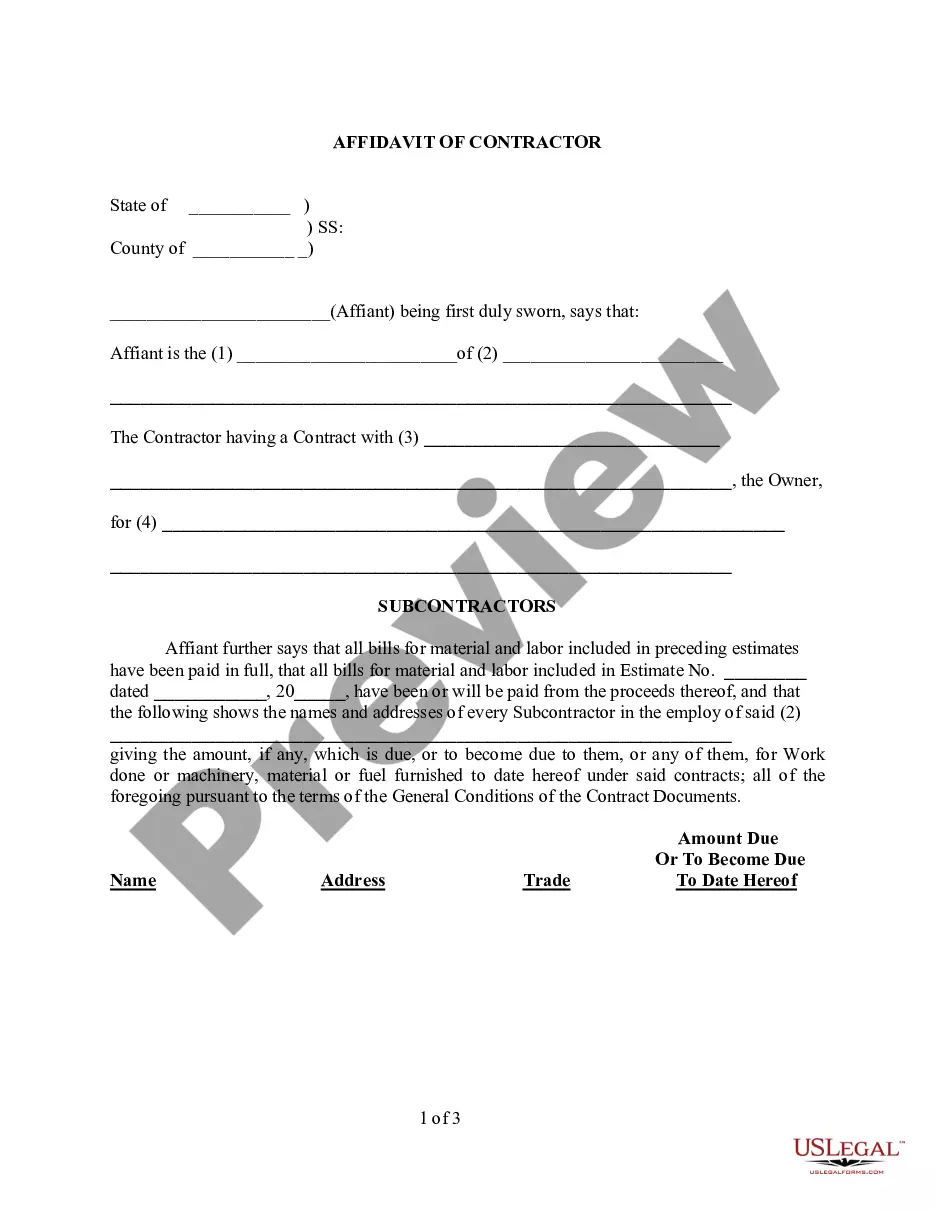
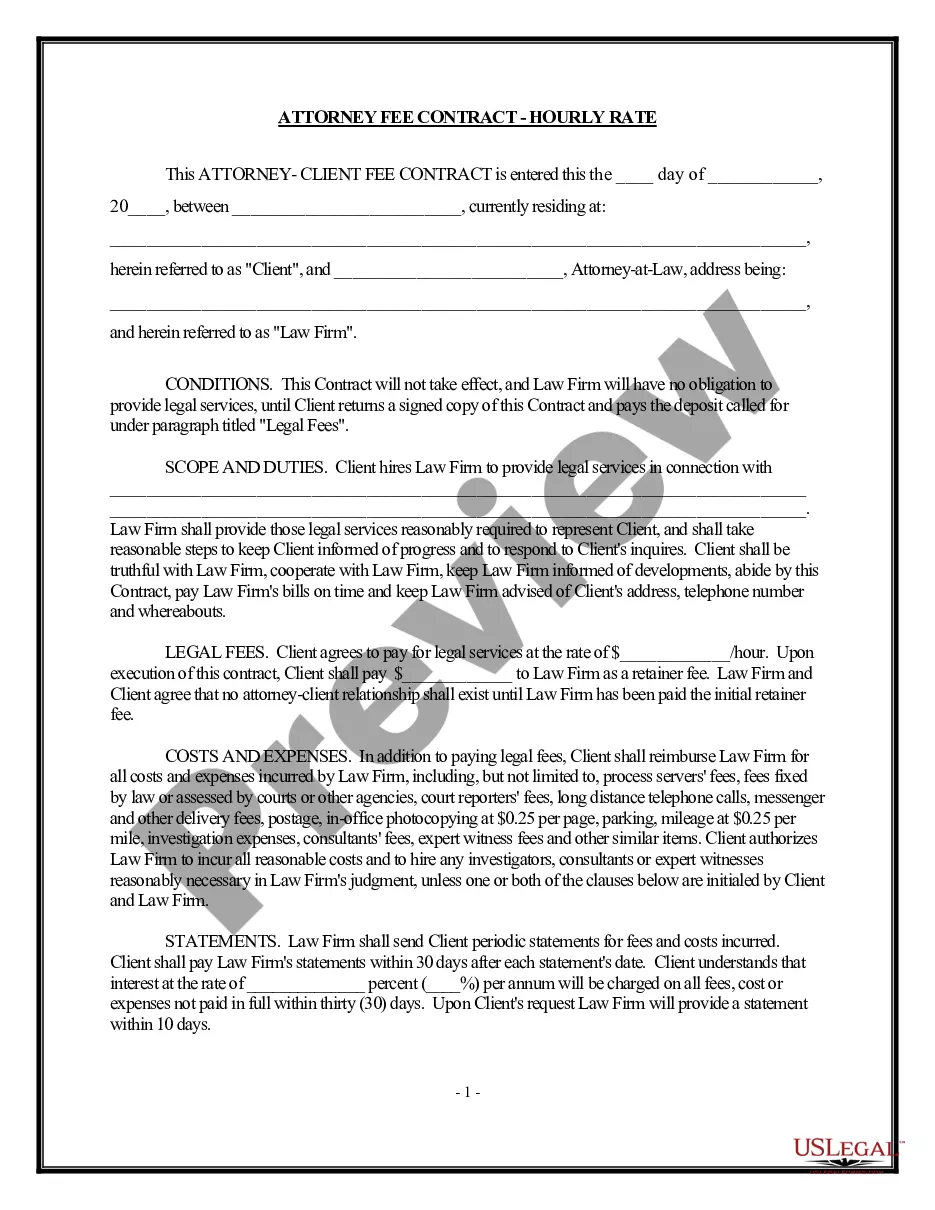
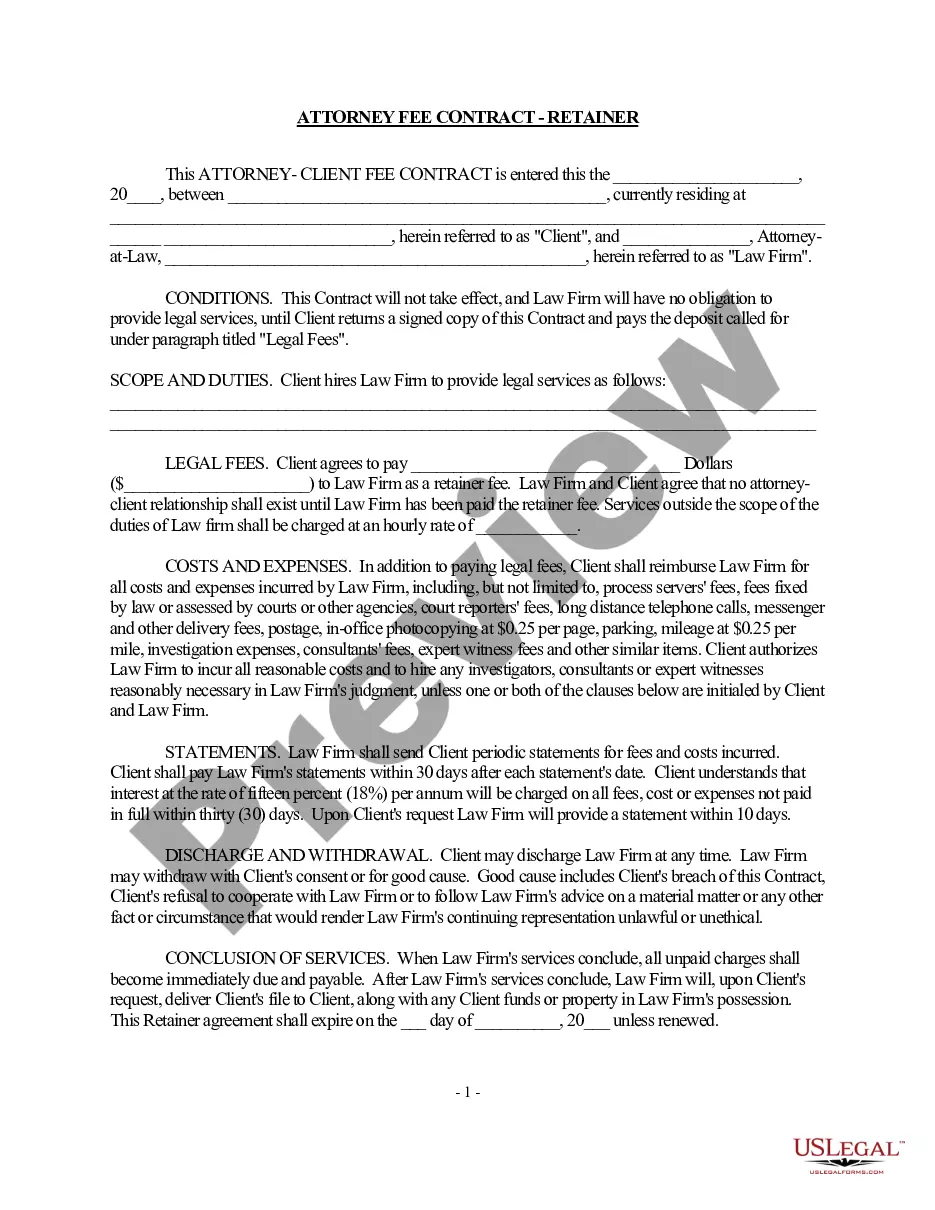
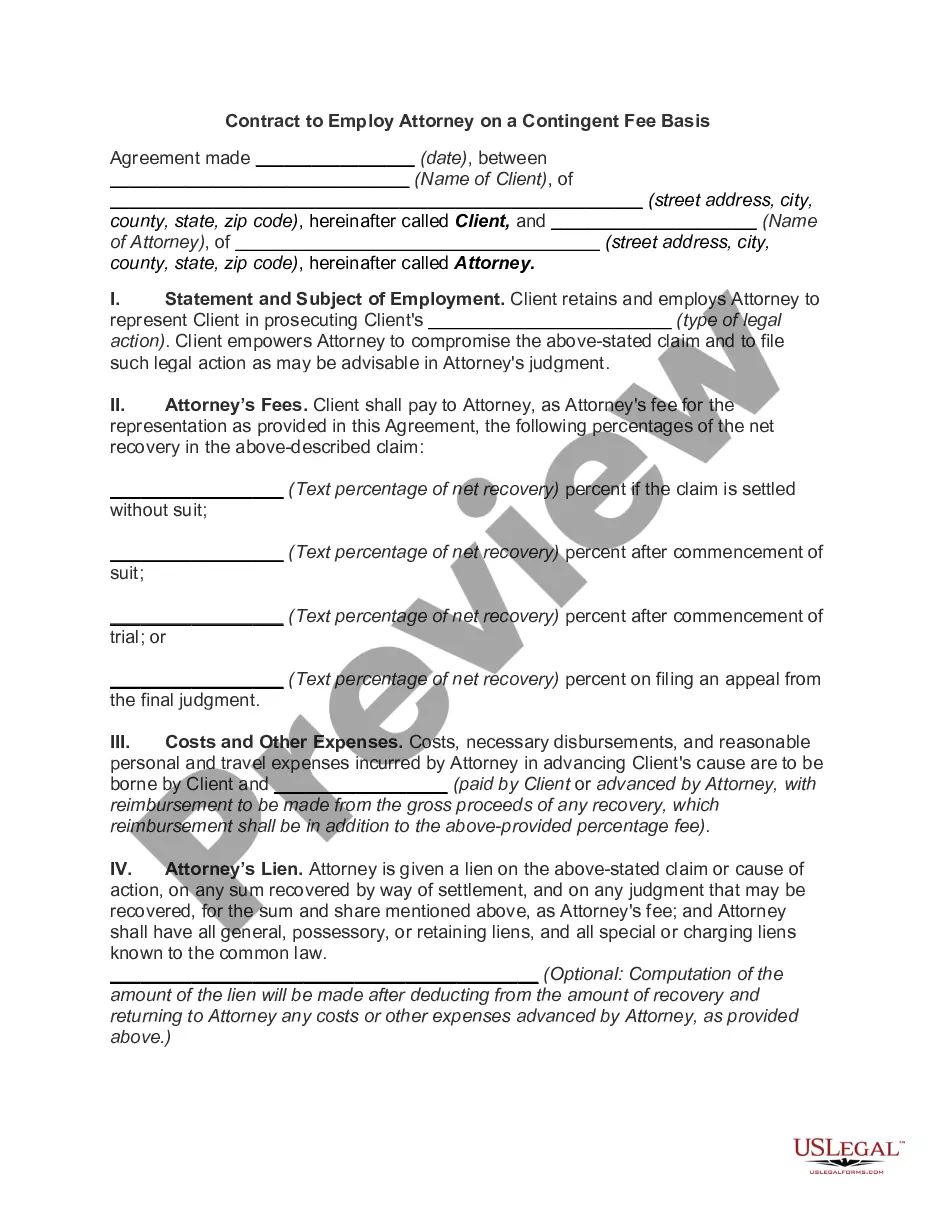
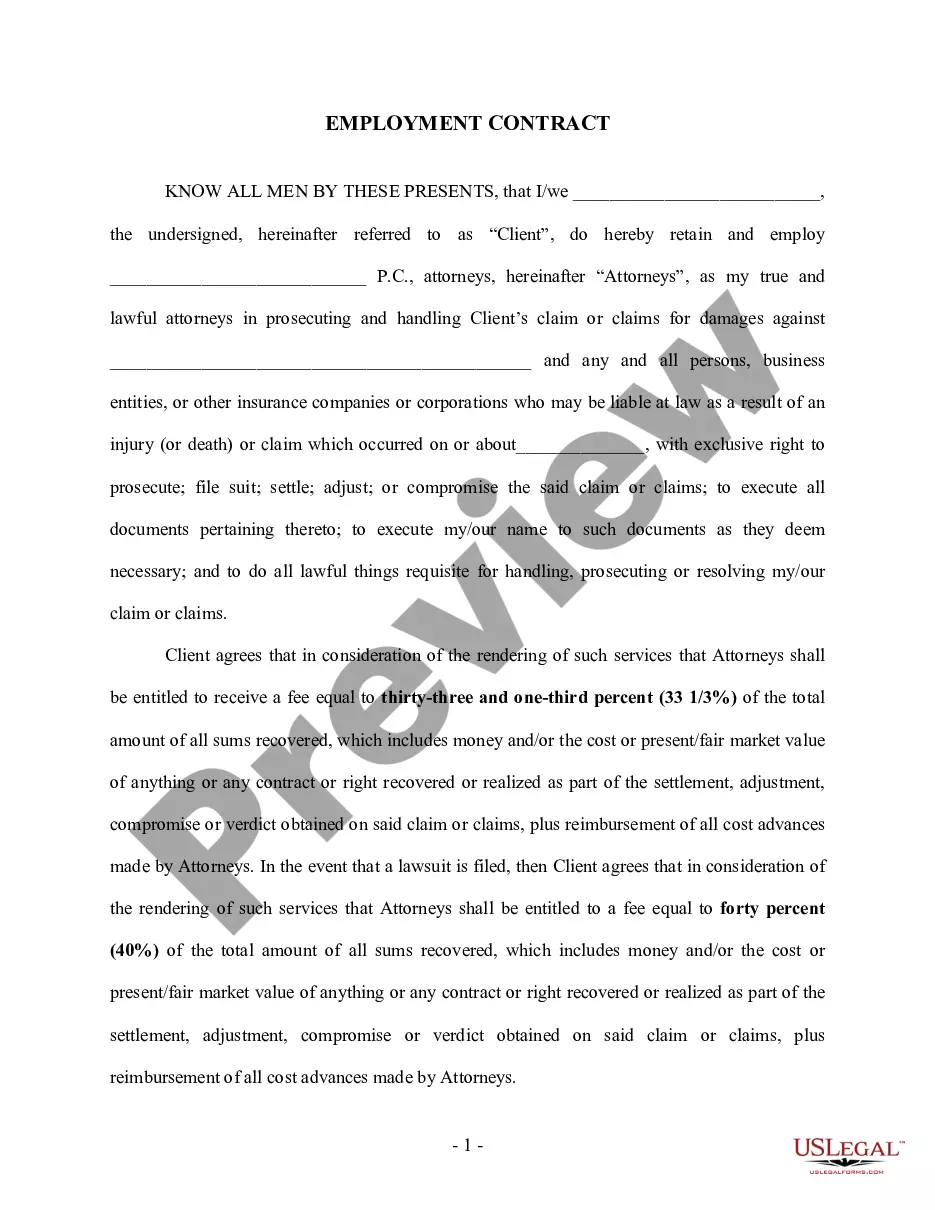
The Legal Services Agreement - Contingent is a formal contract between a client and a law firm outlining the terms of legal representation. This agreement stipulates that the law firm will receive a percentage of any amounts recovered on behalf of the client. Unlike other legal service agreements, this contingent fee arrangement means that the client typically does not pay upfront fees, making it accessible for clients seeking legal assistance without immediate financial burden.
What’s included in this form
- Identification of parties: Names and details of both the client and the law firm.
- Description of services: Outlines the legal services to be provided regarding a specific claim.
- Fee agreement: Specifies the percentage of recovery that the law firm will receive, based on different stages of the legal process.
- Initial retainer fee: Details the upfront payment required before the attorney-client relationship is established.
- Responsibilities of both parties: Lists the obligations of the client, including costs and cooperation requirements.
- Withdrawal conditions: Outlines the law firm's right to withdraw from the case under certain conditions.



Situations where this form applies
This form is ideal for individuals who seek legal representation for personal injury claims or other damages but prefer not to pay attorney fees upfront. It is commonly used in situations where clients anticipate a financial recovery and want to ensure that legal representation is accessible without immediate costs.
Intended users of this form
- Individuals seeking legal representation for personal injury or related claims.
- Clients who prefer a pay-on-success basis rather than upfront fees.
- Persons involved in disputes where they anticipate recovery but need legal assistance.
Completing this form step by step
- Identify the parties involved by entering the law firm's name and the client's name.
- Describe the claim in detail, including the circumstances and date of any incidents.
- Specify the percentage fees for recovery at various stages (settlement, pre-trial, trial).
- Enter the initial retainer fee amount in the designated field.
- Provide any necessary details regarding the costs and expenses that the client will be responsible for.
- Both parties should sign and date the agreement to make it effective.
Does this form need to be notarized?
This form does not typically require notarization unless specified by local law. It is important to check specific state requirements to ensure compliance.
Get your form ready online
Our built-in tools help you complete, sign, share, and store your documents in one place.
Make edits, fill in missing information, and update formatting in US Legal Forms—just like you would in MS Word.
Download a copy, print it, send it by email, or mail it via USPS—whatever works best for your next step.
Sign and collect signatures with our SignNow integration. Send to multiple recipients, set reminders, and more. Go Premium to unlock E-Sign.
If this form requires notarization, complete it online through a secure video call—no need to meet a notary in person or wait for an appointment.
We protect your documents and personal data by following strict security and privacy standards.

Make edits, fill in missing information, and update formatting in US Legal Forms—just like you would in MS Word.

Download a copy, print it, send it by email, or mail it via USPS—whatever works best for your next step.

Sign and collect signatures with our SignNow integration. Send to multiple recipients, set reminders, and more. Go Premium to unlock E-Sign.

If this form requires notarization, complete it online through a secure video call—no need to meet a notary in person or wait for an appointment.

We protect your documents and personal data by following strict security and privacy standards.
Common mistakes to avoid
- Failing to specify the correct percentages for fee recovery at different stages.
- Omitting the description of the claim, which may lead to misunderstandings.
- Not entering the initial retainer fee correctly or leaving it blank.
- Neglecting to ensure both parties sign and date the agreement.
Advantages of online completion
- Convenience of downloading the form instantly from any location.
- Editability allows customization to fit specific legal needs easily.
- Reliable and compliant with standard practices for legal agreements.
Legal use & context
- This agreement is enforceable in a court of law once signed by both parties.
- It provides a clear framework for the attorney-client relationship without upfront payment.
- Clients should be aware of their financial responsibilities regarding costs and expenses beyond attorney fees.
What to keep in mind
- The Legal Services Agreement - Contingent allows clients to seek legal help without upfront costs.
- A clear understanding of fees and client responsibilities is essential.
- This form must be tailored to comply with specific local laws where applicable.
Looking for another form?








Form popularity
FAQ
In a contingent fee arrangement, the lawyer agrees to accept a fixed percentage (often one third) of the recovery, which is the amount finally paid to the client. If you win the case, the lawyer's fee comes out of the money awarded to you.
A contingency fee is a form of payment to a lawyer for his/her legal services. In contrast to a fixed hourly fee, in a contingent fee arrangement lawyers receive a percentage of the monetary amount his/her client receives when they win or settle their case.
The standard contingency fee for an attorney is a percentage amount rather than a fixed amount. Most personal injury lawyers charge 33 1/3 percent if the case settles without filing a lawsuit and 40% if a lawsuit is filed. Most employment lawyers charge a 40% fee.
For example, a contingency fee agreement -- most common in personal injury lawsuits -- may state that the attorney's fee will be 30 percent of all funds recovered or, alternatively, 33 percent after all expenses of the case are paid.
Most personal injury lawyers work on a contingency basis meaning they do not bill you for any legal fees unless you obtain compensation.
Answer. In a contingency fee arrangement, the lawyer who represents you will get paid by taking a percentage of your award as a fee for services. If you lose, the attorney receives nothing. This situation works well when you have a winning lawsuit.
In the majority of cases, a personal injury lawyer will receive 33 percent (or one third) of any settlement or award. For example, if you receive a settlement offer of $30,000 from the at fault party's insurance company, you will receive $20,000 and your lawyer will receive $10,000.
No win, no fee personal injury lawyers are the ones most likely to take on a client on a contingent basis.Lawyers offer contingency fee arrangements to clients whose cases seem likely to succeed based on their risk assessment and how much work it would take to secure a win.
A contingency agreement is an arrangement between a plaintiff and a lawyer, stating that the lawyer will represent the plaintiff without money to pay up front. In these situations, the plaintiff pays the lawyer only if the lawyer wins the case.